How to Choose a Winter Oil Filter for Better Cold Starts
Choose a winter oil filter by fitment first, then check the bypass setting, anti-drainback valve material, and media type for your engine. In cold weather, the wrong filter can drain back overnight, delay oil pressure, and add wear at startup. The safest choice is the filter that matches the manual and your winter driving pattern.
Three-step summary: 1) confirm the owner’s manual for viscosity and filter requirements, 2) match the exact part number and bypass spec, and 3) favor a silicone anti-drainback valve with media that flows well when cold. If your trips are short, prioritize fast cold flow and drainback control over long-service claims.
Check the owner’s manual first
Your manual sets the starting point: the recommended viscosity grade, approved oil standards, and any manufacturer-specific approvals. Cold-weather selection begins there because the first number before the W indicates how the oil flows at low temperatures.
What to confirm before you shop
- The recommended viscosity grade for your climate.
- Approved oil standards and any brand-specific approvals.
- Whether your engine calls for 0W-20, 0W-30, 5W-30, or another grade.
- Whether the filter part number is listed for your exact engine family.
A 5W-30 flows thinner in winter than a 10W-30. Using 10W-40 instead of 5W-30 makes cold starts harder, so do not try to “fix” winter noise with a heavier grade unless the manual allows it.
Practical rule
If the manual allows a winter grade such as 0W-20 or 0W-30, use that before you compare filters. If it calls for 5W-30, stay with that grade rather than moving up to a thicker oil for winter commuting.
What oil filter features help with dry starts in cold weather?
The most useful winter features are the bypass valve, the anti-drainback valve, and the media design. Drainback control helps the filter stay full overnight. Bypass behavior protects the engine if the media restricts flow during a cold start or after a long service interval.
Bypass valve pressure and flow protection
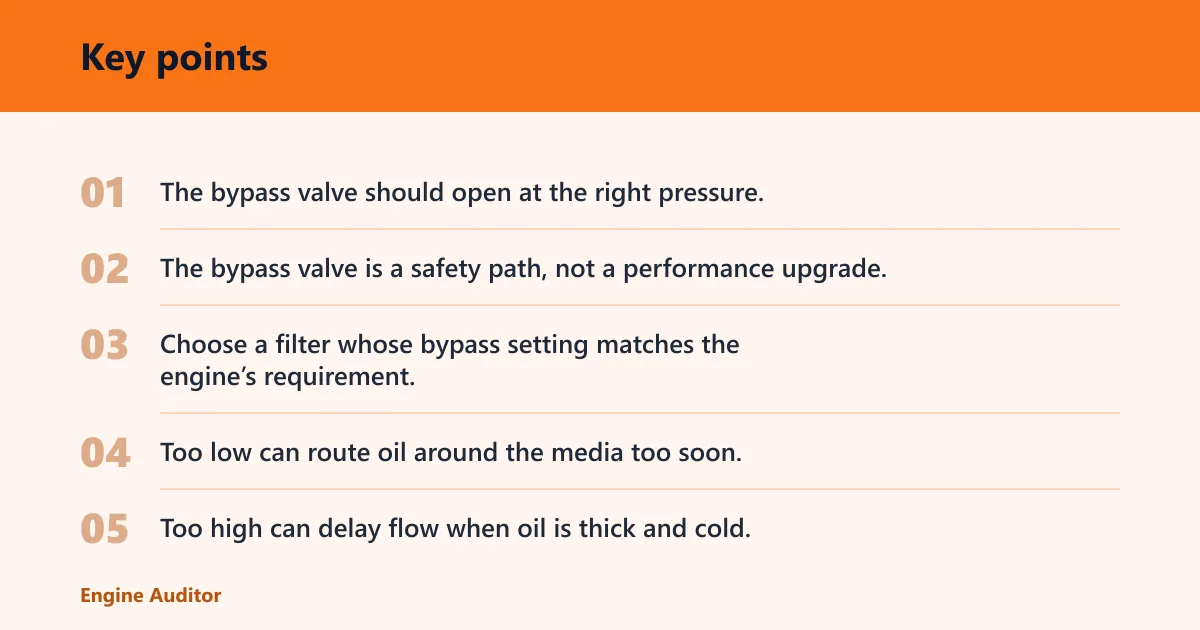
The bypass valve should open at the right pressure. That matters because thick oil, a clogged element, or a cold pressure spike can otherwise leave the engine short of oil. The bypass valve is a safety path, not a performance upgrade.
Choose a filter whose bypass setting matches the engine’s requirement. If an engine calls for a specific opening range, use a filter in that range rather than one that is much lower or higher. Too low can route oil around the media too soon. Too high can delay flow when oil is thick and cold.
Silicone anti-drainback valves
A silicone valve stays flexible in freezing weather better than standard rubber. That helps the anti-drainback valve seal more reliably, keeps oil from draining back overnight, and shortens dry-start time after a cold soak.
This feature matters most on engines where the filter mounts horizontally or lower than part of the oil circuit. In those layouts, overnight drainback can leave the filter empty by morning.
Media, micron rating, and flow rate
Synthetic-blend or synthetic media usually gives a better winter balance than basic cellulose, because it can keep flow steadier when oil is thick. Micron rating tells you what size particles the filter captures, while dirt-holding capacity tells you how much contamination it can load before restriction rises.
Do not treat finer filtration as automatically better for winter. A finer element can load faster and slow flow more than a more open design if the engine and oil grade need freer circulation. The right choice balances cold flow and dirt capture.
Winter oil filter decision table
Use this table as a cold-start decision matrix. Match the temperature band and your driving pattern before you compare brands.
| Temperature band | Driving pattern | Recommended filter traits | Avoid list |
|---|---|---|---|
| Above 20°F | Mixed use, longer highway trips | Correct bypass setting, silicone anti-drainback valve, synthetic-blend media | Wrong thread size, unknown housing fit, very cheap seals |
| 0°F to 20°F | Short-trip commuting | Fast-flowing media, reliable anti-drainback valve, exact vehicle part number | Extended-service claims without severe-duty support |
| Below 0°F | Repeated cold starts, short idle time | Silicone valve, bypass matched to engine spec, media with good cold-flow rating | Thick oil outside the manual, weak sealing, vague fitment |
| Below 0°F | Long highway runs after warm-up | OEM fitment or known-good aftermarket fit, synthetic media, strong dirt-holding capacity | Any filter with uncertain bypass calibration |
| Any winter band | Extended oil-change interval | Filter rated for the interval, high dirt-holding capacity, verified fitment | Filters sold only on price |
How to read the table
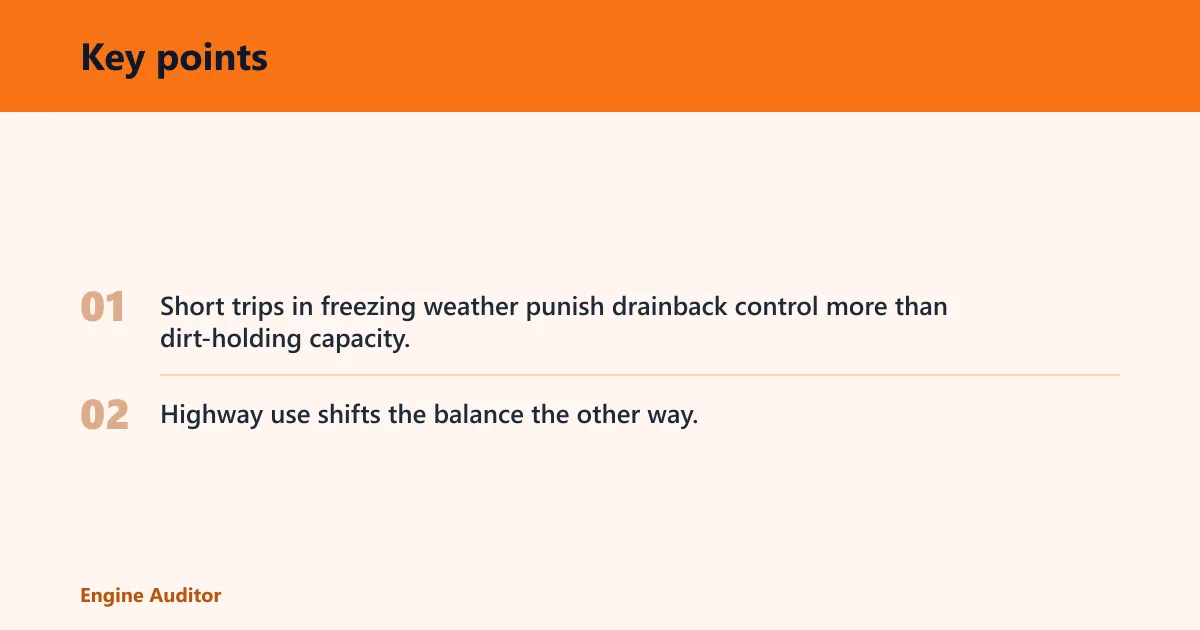
Short trips in freezing weather punish drainback control more than dirt-holding capacity. Highway use shifts the balance the other way. That is why the same filter can be a fine match for one vehicle and a poor match for another, even if both use the same oil grade.
Should I choose OEM or aftermarket oil filter for winter?
OEM filters are the safer choice when you want the closest match to the engine’s exact requirements. They reduce the chance of a bypass mismatch, seal issue, or housing fit problem in freezing weather. Aftermarket filter quality varies widely by brand.
When OEM is the safer pick
Choose OEM when the engine has a known fitment sensitivity, uses a vehicle-specific part number, or the manual is strict about the filter design. The key advantage is predictable fit and bypass behavior.
Where aftermarket quality varies
Aftermarket filters can be excellent or merely adequate. The gap usually shows up in media consistency, seal quality, and bypass calibration. In cold weather, a weak gasket or poor drainback valve matters more than a long marketing claim.
What to verify before you buy
- Match the part number. Confirm the filter number against your exact engine code, not just the vehicle model.
- Check the thread size. A correct-looking canister still fails if the threads do not match.
- Confirm housing compatibility. Some engines need a specific canister depth, gasket shape, or bypass spec.
- Inspect the valve material. Silicone is the winter-friendly choice for the anti-drainback valve.
Say your vehicle calls for a specific cartridge size and the aftermarket listing only says “fits most models.” That is not enough for winter work. A filter that threads on but seals poorly can leak, drain back, or bypass too early.
Do I need a special oil filter for cold weather?
You do not need a special winter-branded filter, but you do need one that matches winter use. The important features are a proper bypass valve, a silicone anti-drainback valve, and media that can flow quickly when oil is cold. Fitment still comes first.
What makes a winter-capable filter different
The best winter filters are built to keep oil pressure available during the first seconds after startup. That means the valve system and media design matter more than label language. A winter-capable filter is the one that keeps flow moving when the oil is thick.
What does not help much?
A high-mileage label alone does not solve cold-start drainback. A very long service claim also does not help if your winter use is mostly short trips with repeated overnight cold soak. In that pattern, the filter needs to perform early, not merely last a long time.
Do synthetic oil need a different oil filter in winter?
Synthetic oil for cold weather does not remove the need to choose the right winter filter. It can improve cold-flow behavior, but the filter still needs the correct bypass pressure, anti-drainback valve, and fitment. Oil and filter work together, and one cannot fully cover for a bad match in the other.
How synthetic oil changes the choice
With synthetic oil, a synthetic-blend or synthetic-media filter often makes sense because the whole system is aimed at better cold flow and stable filtration. That is especially true for engines that see repeated freezing starts.
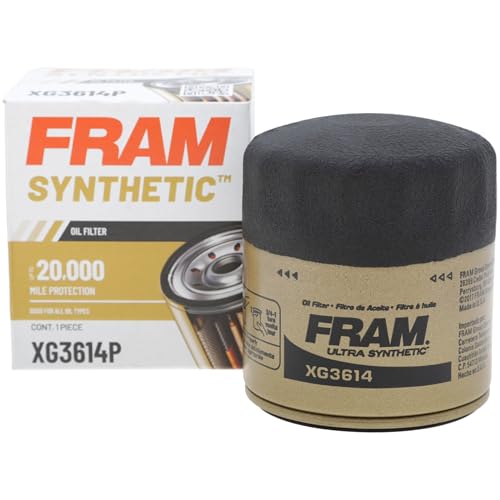
FRAM Ultra Synthetic claims a 20,000-mile lifespan and uses dual-layer synthetic media. Mobil 1 M1-212A is described as withstanding 9x normal pressure. Those claims may fit mild or moderate service, but they do not erase the need to check bypass and drainback behavior first.
When the oil type matters less
If your manual already specifies a winter grade such as 0W-20 or 0W-30, the filter decision shifts toward fitment and valve quality. The oil is already helping cold flow, so the filter should avoid adding restriction.
Our picks by need
Best overall winter fit: Mobil 1 M1-110A

- Over 99% contaminant removal efficiency
- Anti-drainback valve helps protect against dry starts
- Heavy-duty canister handles up to 9× normal pressure
Based on the published specs and buyer feedback, this is a strong fit when you want synthetic-blend construction, over 99% contaminant removal efficiency, and an anti-drainback valve for dry-start protection. The heavy-duty canister is also described as handling up to 9× normal pressure.
The drawback is that the high-mileage claim can make it feel like a universal answer. It still needs exact fitment, and its value drops if your engine needs a different bypass calibration or a more specific OEM-style part number.
Best for high-duty synthetic use: FRAM Ultra Synthetic XG10575

- Silicone anti-drainback valve helps reduce dry starts
- 99%+ filtration efficiency with pleated media
- Built for synthetic oil changes up to 20,000 miles
This is a fit for drivers who want dual-layer synthetic media, a silicone anti-drainback valve, and a filter built for synthetic oil changes lasting up to 20,000 miles. The published filtration figure is 99%+.
The tradeoff is the same one that comes with most extended-service filters: long-life claims suit moderate use better than repeated short winter trips. If your commute is short and cold, the interval claim matters less than drainback control and exact fit.
Best for dirt capacity: Purolator PBL24457 PurolatorBOSS

- Silicone anti-drainback valve protects against dry starts
- Over 99% dirt removal power
- Heavy-duty steel casing and metal center tube
Based on specs, this option stands out for over 99% dirt removal power, a silicone anti-drainback valve, and a heavy-duty steel casing with a metal center tube. PurolatorBOSS also carries a dirt-holding claim of 27 grams versus 15 grams for PurolatorONE.
The drawback is size and fitment sensitivity. A strong dirt-holding claim does not help if the thread size or housing match is wrong, and the larger-duty design may be more than you need for very short service intervals.
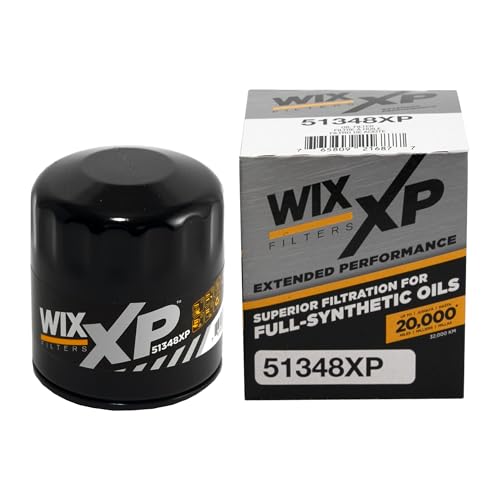
Best for severe winter and precise fit: WIX 51348XP
- Designed for synthetic oils in severe conditions
- 99% efficient filtration at 20 microns
- Engineered for a precise, hassle-free fit
This filter is positioned for synthetic oils in severe conditions and is described as 99% efficient at 20 microns. It also claims a precise, hassle-free fit, which is valuable when winter service leaves less room for install error.
The downside is that severe-condition positioning does not replace a manual check. If your engine needs a different bypass setting or a vehicle-specific part number, the label alone is not enough.
Do I need an extended-performance filter?
Extended-performance filters with 10,000 to 20,000 mile claims make sense when your winter driving is mostly mild, longer, and steady. They are a weaker match for severe short-trip winter use because repeated cold starts stress drainback control and early flow more than total dirt capacity.
When the claim fits the use
Choose an extended-performance filter when the oil-change interval is long, the engine sees regular highway time, and the winter pattern is not constant stop-and-go cold starts. In that case, dirt-holding capacity becomes a useful part of the decision.
When it is the wrong fit
If the car gets used for short winter errands, idles briefly, and cools down again, the filter’s startup behavior matters more than its maximum interval. A long-service filter can still work, but it is not the first choice if cold starts happen every day.
Picture a sedan that sits outside overnight at 5°F and does two short trips before noon. In that case, a filter with strong anti-drainback performance is a better match than one chosen only for a 20,000-mile claim.
Mistakes to avoid
The most common winter mistakes are predictable: wrong fit, wrong bypass setting, weak sealing, and choosing a filter by brand reputation alone. Each one can show up as slow pressure rise, oil seepage, or earlier restriction in cold weather.
- Do not skip fitment checks. Verify thread size, housing compatibility, and the vehicle-specific part number before buying.
- Do not ignore bypass calibration. A filter with the wrong opening pressure can starve flow or bypass too early.
- Do not trust a weak gasket. In freezing weather, seal quality matters because shrinkage and stiffness can expose a marginal design.
- Do not mix intervals and use cases. A 20,000-mile claim does not mean the filter is best for repeated short winter trips.
- Do not treat synthetic oil as enough. Better oil helps, but the filter still needs the right valve behavior and fitment.
A common first-timer mistake is choosing a filter that looks premium on the shelf but ignores the manual’s part number. The next mistake is assuming every aftermarket option has the same bypass setting. It does not.
Compatibility checklist
Use this checklist before purchase. If any item is uncertain, keep looking.
| Check | What to verify |
|---|---|
| Bypass valve | Opening pressure matches the engine requirement |
| Anti-drainback valve | Silicone valve preferred for freezing weather |
| Media type | Synthetic-blend or synthetic media for better cold flow |
| Thread size | Exact match to the engine or housing threads |
| Service interval | Filter rating fits your oil-change schedule and driving pattern |
- Confirm the manual first. Match viscosity grade, oil standards, and any manufacturer approval before you compare filters.
- Verify winter flow needs. Use 0W-20, 0W-30, 5W-30, or another approved grade that suits the climate.
- Match the filter hardware. Confirm thread size, housing shape, and exact part number.
- Choose the valve system. Favor a silicone anti-drainback valve and the correct bypass opening pressure.
- Set the interval. Pick a filter that fits your actual service schedule, then change oil and filter together.
Prevention: Keep a note of the exact filter part number and oil grade after each service. That makes the next winter purchase faster and reduces the chance of repeating a fitment mistake.
Frequently asked questions
What oil filter is best for winter cold starts?
The best choice is the one that fits your engine exactly and uses a silicone anti-drainback valve with the correct bypass setting. For many winter drivers, a synthetic-media filter with proven fitment is the safest pick because it balances cold flow and protection after overnight drainback.
Does synthetic oil need a different oil filter in winter?
Synthetic oil does not require a different type of filter, but it often pairs well with a synthetic-media filter. The key is still fitment and valve behavior. A good winter oil can still be undermined by a filter that drains back or opens at the wrong pressure.
How do I know if an oil filter will fit my engine?
Check the vehicle-specific part number, thread size, and housing compatibility against the owner’s manual or the catalog listing for your exact engine. If the filter is for a different mounting style or bypass spec, do not assume it will work just because it looks close.
Products related to this article
Sponsored / affiliate links. As an Amazon Associate I earn from qualifying purchases. I may earn additional commission from eligible campaigns.