What Happens If You Use Oil That’s Too Thick in Freezing Weather?
Using oil that’s too thick in freezing weather can slow the starter, delay oil flow to bearings and valvetrain parts, and leave the engine briefly under-lubricated after startup. The colder it gets, the worse the delay. Ignore it, and you can end up with hard starts, battery strain, noisy cold starts, and extra wear during the first seconds after ignition. This guide explains the failure chain, the warning signs, and how to choose the right viscosity for winter driving.
How cold weather thickens oil harms engine startup
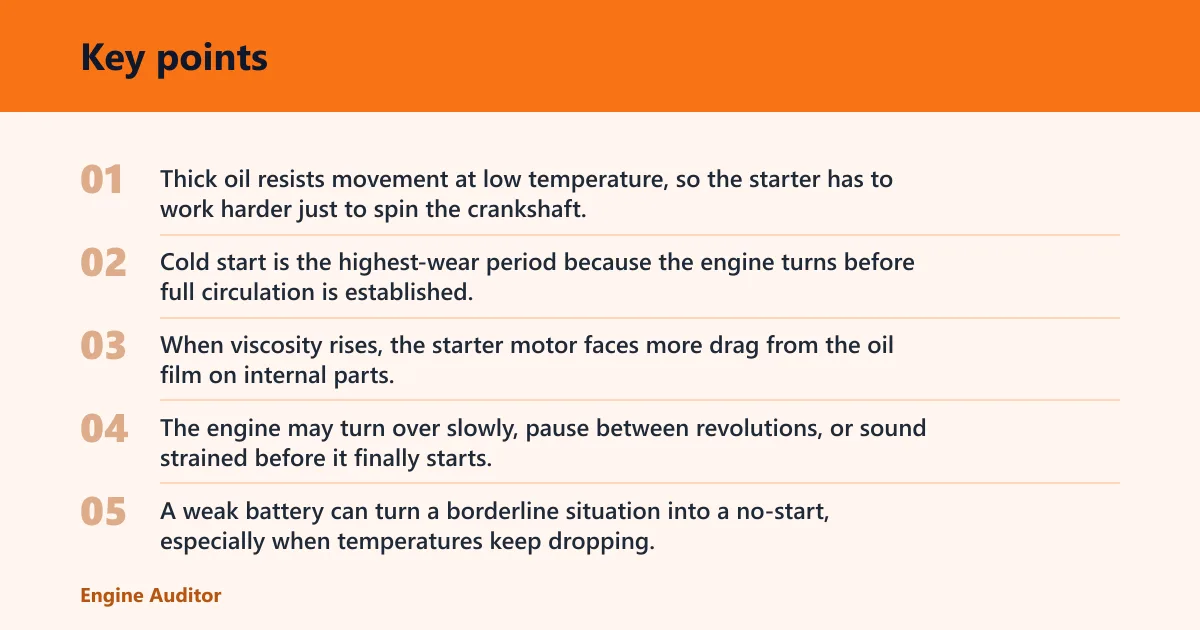

Thick oil resists movement at low temperature, so the starter has to work harder just to spin the crankshaft. That slows cranking, delays oil pressure rise, and leaves bearings and camshafts waiting longer for a protective film. Cold start is the highest-wear period because the engine turns before full circulation is established.
Slow cranking starts the chain
When viscosity rises, the starter motor faces more drag from the oil film on internal parts. The engine may turn over slowly, pause between revolutions, or sound strained before it finally starts.
That extra load matters because the starter, battery, and oil pump are all working harder at the same time. A weak battery can turn a borderline situation into a no-start, especially when temperatures keep dropping.
Delayed circulation leaves parts exposed
After ignition, the oil pump must push thicker oil through narrow passages and galleries. Until pressure builds and flow reaches the top end, camshafts, lifters, and bearings can run with less protection than they should have.
That short delay is the problem. Repeated cold starts with oil that is too viscous can add startup wear even if the engine eventually sounds normal.
Temporary oil starvation is the real risk
“Starvation” here does not mean the sump is empty. It means certain parts do not get a full oil film quickly enough, so metal-to-metal contact becomes more likely for a few seconds.
That is why a noisy first five seconds matters. A brief rattle, ticking, or rough idle right after startup can be an early sign that the oil is moving too slowly for the temperature.
Why does oil flow slower in the cold?
Oil flows slower in the cold because viscosity rises as temperature falls. The fluid becomes thicker, so it takes more force to move through the pickup, pump, galleries, and narrow clearances. In very low temperatures, some oils can also form wax crystals and become slushy rather than free-flowing.
Viscosity changes the whole start-up sequence
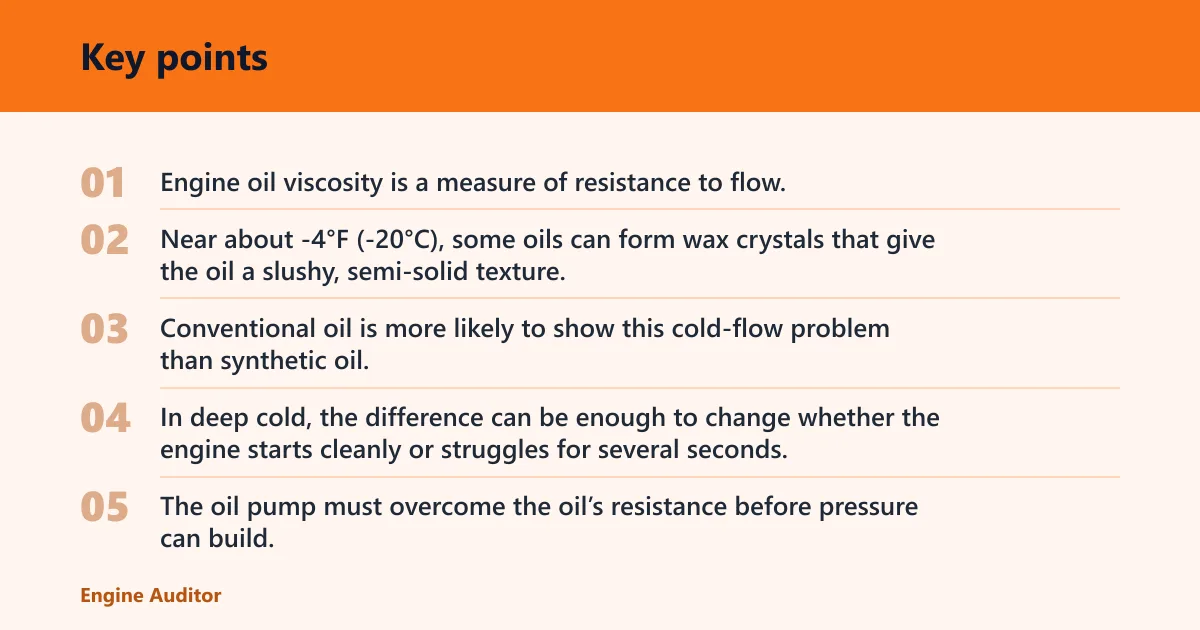
Engine oil viscosity is a measure of resistance to flow. As ambient temperature drops, the oil thickens, which makes it harder for the pump to circulate it quickly during the first moments after start.
That changes lubrication first, then wear. The engine may still run, but the parts that depend on fast film formation get less protection until the oil warms and thins.
Wax precipitation can make oil slushy
Near about -4°F (-20°C), some oils can form wax crystals that give the oil a slushy, semi-solid texture. That is not true freezing, but it can still block fast circulation and make the oil behave as if it were much thicker.
Conventional oil is more likely to show this cold-flow problem than synthetic oil. In deep cold, the difference can be enough to change whether the engine starts cleanly or struggles for several seconds.
The oil pump has to fight the thickness
The oil pump must overcome the oil’s resistance before pressure can build. If the oil is too viscous, the pump may take longer to prime passages, and pressure at the far end of the engine can rise later than it should.
That extra resistance also adds drag to the startup event itself. The crankshaft, starter, and battery all pay the price before the engine settles into idle.
Can engine oil freeze in winter?
Under normal winter conditions, engine oil does not freeze solid like water. It does, however, thicken gradually at low temperatures, and that thickening can be severe enough to cause slow cranking, delayed circulation, and startup wear long before any true freezing would matter.
Slush is not solid ice
The practical concern is not a block of frozen oil in the pan. It is oil that becomes too slow to move, too thick for quick pumping, or slushy enough to delay lubrication when the engine first starts.
Synthetic oils maintain fluidity to around -40°F (-40°C) or lower, which reduces that risk in extreme cold. Conventional oils thicken markedly below -20°F (-29°C), so the gap matters in places with hard winters.
Which temperatures create the biggest risk?
The risk climbs as the temperature drops into severe and extreme cold. Around the mild-cold range, the engine may feel a little slower but still start normally; in deeper cold, the same oil can become a major drag on cranking and circulation.
A common first-timer mistake is assuming one cold start is harmless. One cold start may be tolerable, but repeated starts with the wrong viscosity can add up, especially in older engines, turbocharged engines, and high-mileage engines with looser clearances.
What happens table
| Cold band | Likely driver symptoms | Likely mechanical effect | Recommended response |
|---|---|---|---|
| Mild cold | Engine starts slightly slower than usual; idle may feel rough for a moment; oil-pressure light may stay on briefly | Oil thickens, but circulation usually catches up quickly; startup wear rises modestly if the oil matches the season poorly | Monitor the start, use the correct winter viscosity before the next cold snap, and check battery condition if cranking seems weaker than normal |
| Severe cold | Slow cranking, longer time before the engine fires, ticking or valvetrain noise for several seconds | Oil pump works against greater resistance; oil pressure rise is delayed; bearings and camshafts may see a longer period of limited film protection | Stop repeated long cranking, verify the oil grade on the dipstick cap or manual, and check battery state before another attempt |
| Extreme cold | Very slow crank, no-start after several tries, loud starter strain, persistent noise right after start | Flow can be slow enough for temporary oil starvation at critical parts; pressure buildup may lag enough to raise wear risk sharply | Do not keep grinding the starter; confirm viscosity, battery health, and whether the oil choice fits the temperature before trying again |
What viscosity oil should you use for winter driving?
Use the lowest W grade that your owner’s manual allows for winter conditions. The lower the W number, the better the oil flows at low temperatures, so 0W generally flows better than 5W, and 5W flows better than 10W when the engine is cold.
How to read 0W, 5W, and 10W
The W number is the winter rating. It describes low-temperature flow, not hot-running thickness. A 5W grade is described as suitable for temperatures to about -25°C, and a 10W grade is described as effective down to about -20°C.
That difference matters most at startup. Two oils may both protect a hot engine well, but the one with the lower W number usually reaches critical parts faster on a freezing morning.
When lower W numbers help most
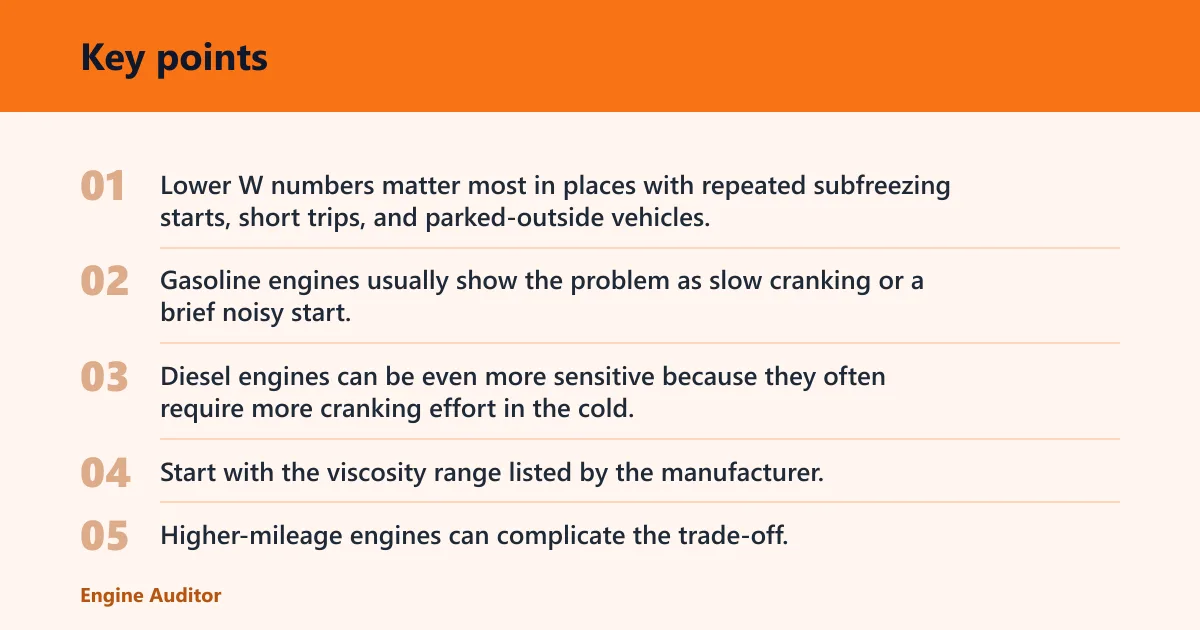
Lower W numbers matter most in places with repeated subfreezing starts, short trips, and parked-outside vehicles. They also matter more for engines that already crank slowly, because any extra drag can make the battery and starter struggle.
Gasoline engines usually show the problem as slow cranking or a brief noisy start. Diesel engines can be even more sensitive because they often require more cranking effort in the cold. Turbocharged engines and older engines may also feel the delay sooner because they depend on quick oil delivery to loaded parts and tighter lubrication timing.
Check the manual first
Start with the viscosity range listed by the manufacturer. If the manual allows a winter grade, choose the lower W rating for colder climates unless there is a specific reason not to, such as an engine design that calls for a different grade for oil pressure or consumption control.
Higher-mileage engines can complicate the trade-off. A thicker oil may help reduce consumption in some worn engines, but if winter starts become sluggish, the cold-start wear penalty can outweigh the benefit.
When should you stop cranking and check the car?
Stop cranking when the engine turns slowly for several seconds, the starter sounds strained, or the oil-pressure light stays on longer than usual after the engine catches. At that point, keep forcing starts to a minimum and verify both battery health and oil viscosity before trying again.
-
Pause for about 30 to 60 seconds after one failed start.
If the engine cranks slowly or catches and stalls, stop and let the starter rest for 30 to 60 seconds. That avoids overheating the starter and gives you a cleaner read on whether the problem is cold oil, battery weakness, or both.
-
Check the cranking sound.
Listen for a labored, uneven, or noticeably slower crank than normal. If the starter speed is weak before the engine fires, the battery may be part of the problem, but thick oil can also be adding enough drag to expose a marginal battery.
-
Watch the warning lights.
If the oil-pressure light lingers longer than usual after start, do not keep revving the engine to “push oil through.” Let idle stabilize first, then confirm the oil grade and consider whether the temperature is below what that grade can comfortably handle.
-
Verify the oil grade.
Read the bottle, the service record, or the owner’s manual and compare the W rating with the cold forecast. If the oil is a summer-grade or warmer-than-recommended winter grade, the next cold start may be the wrong test to keep repeating.
-
Test battery health.
A battery that is marginal in warm weather may fail in the cold when the starter load rises. If cranking is slow even with the correct oil, have the battery, terminals, and charging system checked before the next freeze.
Say the sedan may sit overnight at about -25°C with 10W oil. The first crank may be slow, and the engine may rattle for a few seconds after start, because the oil needs more time to circulate than the temperature allows comfortably. A switch to the correct winter grade can change that behavior without changing anything else.
Suppose a turbocharged hatchback starts fine once but then begins to show a longer oil-pressure light and brief lifter noise on later cold mornings. That pattern points to repeated delayed circulation, not a one-off oddity, and it is a reason to verify both the viscosity grade and battery condition before the next cold snap.
Synthetic oil versus conventional oil in extreme cold
Synthetic oil generally stays fluid longer in deep cold, circulates faster after startup, and reduces the chance of freezing-related lubrication problems. Conventional oil thickens more sharply below -20°F (-29°C), so it usually creates more startup drag and more delay before the engine gets full oil flow.
Cold-flow differences
Synthetic oils maintain fluidity to around -40°F (-40°C) or lower, which gives them a clear edge in extreme cold. Conventional oils thicken markedly below -20°F (-29°C), so they can become sluggish right when the engine needs quick flow the most.
Startup protection differences
Because synthetic oil reaches critical parts faster, it helps bearings and camshafts build an oil film sooner after ignition. That does not make a cold engine wear-proof, but it shortens the vulnerable window when parts are exposed to thin or delayed lubrication.
Where each oil fits best
Conventional oil may be acceptable in mild winter climates if the viscosity grade matches the season and the engine is healthy. Synthetic oil is the better choice in severe and extreme cold, in vehicles that sit outside overnight, and in engines that already have higher start-up loads or tighter oil-delivery demands.
Thicker oil can sometimes help an older engine hold pressure or reduce consumption once warm. The trade-off is that the same oil can make cold starts harder, especially if the temperature drops beyond the grade’s cold-flow comfort zone.
Frequently asked questions
What happens if you use oil that’s too thick in freezing weather?
The engine will usually crank more slowly, build oil pressure later, and spend more time with limited lubrication after startup. The immediate signs are harder starts, brief valvetrain noise, and a starter that sounds strained. If this keeps happening, startup wear rises because bearings and camshafts wait longer for full oil film.
Can engine oil freeze in a car during winter?
Under normal winter conditions, engine oil does not freeze solid like water. It thickens as temperatures fall, and some oils can become slushy near about -4°F (-20°C), but the main problem is slow flow, not a block of solid ice in the crankcase.
Will thick oil cause hard starting in cold weather?
Yes. Thick oil increases the load on the starter because the crankshaft has to move through more resistance before the engine fires. That extra drag can show up as slow cranking, a delayed start, or a battery that seems weak even when the battery is only marginal, not dead.
Does thick oil damage the engine on cold start?
It can add wear if the engine is repeatedly started while the oil is too viscous for the temperature. The risk comes from delayed circulation, not from the oil being “bad” in a general sense. Bearings and camshafts are the concern because they depend on fast oil-film formation.
Is synthetic oil better than conventional oil in extreme cold?
Yes. Synthetic oil maintains fluidity to around -40°F (-40°C) or lower, so it circulates faster after a cold start and reduces freezing-related lubrication problems. Conventional oil thickens markedly below -20°F (-29°C), which makes it more likely to cause slow cranking and delayed oil pressure.
Why does oil flow slower when temperatures drop?
Because viscosity rises as temperature falls. The oil becomes thicker, so the pump has to work harder to move it through galleries and clearances. In very cold weather, wax precipitation can also make the oil slushy, which slows circulation even more.
Can thick oil cause low oil pressure in winter?
It can delay oil-pressure rise at startup and make pressure behave differently until the oil warms. That is not the same as a mechanical pressure failure, but it can still leave the engine under-lubricated for the first seconds after ignition, which is the period when wear risk is highest.
Products related to this article
Sponsored / affiliate links. As an Amazon Associate I earn from qualifying purchases. I may earn additional commission from eligible campaigns.
 RVS Technology G6 Engine oil Treatment; For Gasoline Engines with a Motor oil capacity up to 6 quarts; Save fuel, Boost Power and Safely Restore and protect your Car, Truck, and all other engines
 4.5V Engine Oil Pump, Electric Oil Change Fluid Evacuators,Electric Fluid Transfer Pump for Engine Oil, Equipped With 3 Pipes-Low Noise(no batteries included)