Is 0W Oil Always Better Than 5W Oil in Winter?
0W oil is better than 5W oil only when your coldest starts, overnight parking, and the owner’s manual spec make the extra cold-flow margin worthwhile; otherwise, 5W is usually enough. SAE J300 separates cold-weather performance from hot viscosity, so the right choice depends on both the winter rating and the approved operating grade. This guide explains the difference, when 0W matters, and how to choose the correct SAE grade for daily driving.
What 0W and 5W mean
The W in a viscosity grade stands for winter, not weight. SAE J300 uses that winter number to sort low-temperature flow, while the second number sets hot viscosity at normal engine temperature. That is why 0W-20 and 5W-30 behave differently in cold weather and again once the engine is fully warm.
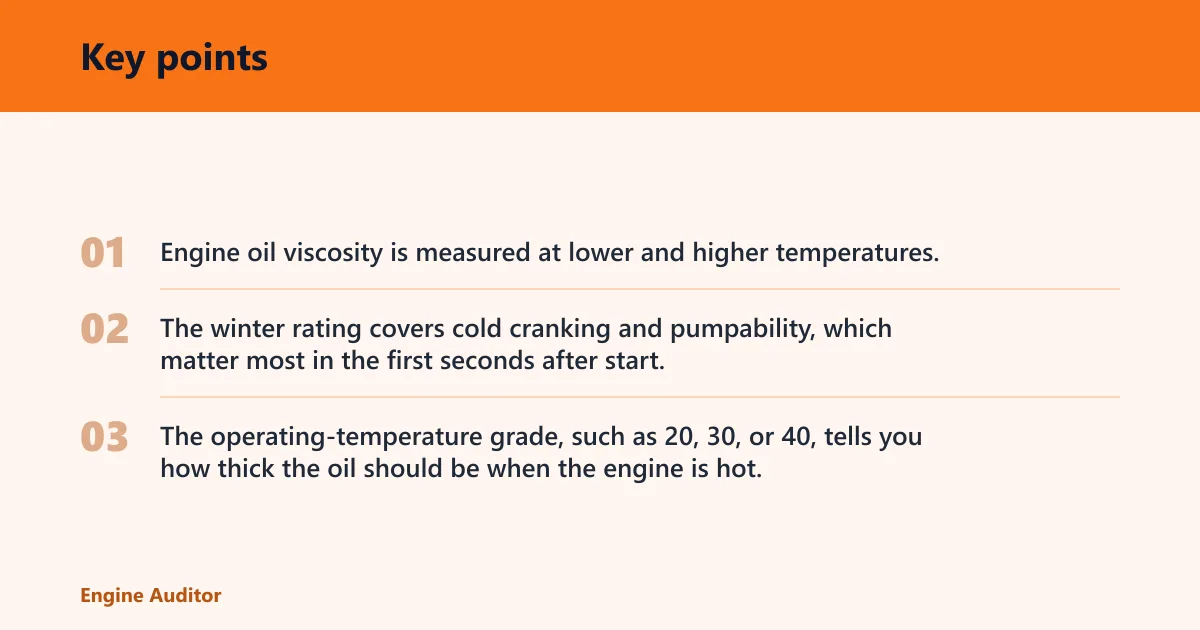
Engine oil viscosity is measured at lower and higher temperatures. The winter rating covers cold cranking and pumpability, which matter most in the first seconds after start. The operating-temperature grade, such as 20, 30, or 40, tells you how thick the oil should be when the engine is hot.
0W-20 is designed to flow like a 0 weight oil in winter temperatures, then behave like 20 weight oil once normal engine temperature is reached. 5W oils sit one step higher on the winter side, so they are still good cold-start oils in many climates, but they do not flow as easily at very low temperatures.
Is 0W oil always better than 5W oil in winter?
No. 0W oil is not always better. It has the lower winter rating, so it usually flows easier during cold starts, but that advantage matters only when your start temperatures are low enough for the difference to show up and when the engine is approved for that grade. If the manual allows 5W and your winters are moderate, the gain from 0W may be small.
Cold-cranking and pumpability are the key low-temperature basics: lower winter numbers are designed to reduce starting resistance and help oil move sooner after startup. That helps most during cold cranking, not during normal hot operation. So the real question is whether your climate and parking make that extra margin useful, and whether the OEM manual lists the grade.
Picture a commuter car parked outside in a place that regularly drops below freezing overnight. A 0W grade can reduce resistance during the first start of the day. Now picture the same car in a garage that stays well above freezing. The practical difference between 0W and 5W shrinks fast.
How cold does it need to be for 0W oil to matter?
0W matters most in arctic and severe-cold conditions, especially when the car sits outside. In cold-winter climates, 0W can still help, but 5W is often acceptable if the owner’s manual approves it. In moderate winter weather, the benefit is usually small enough that the approved grade and hot-viscosity number matter more.
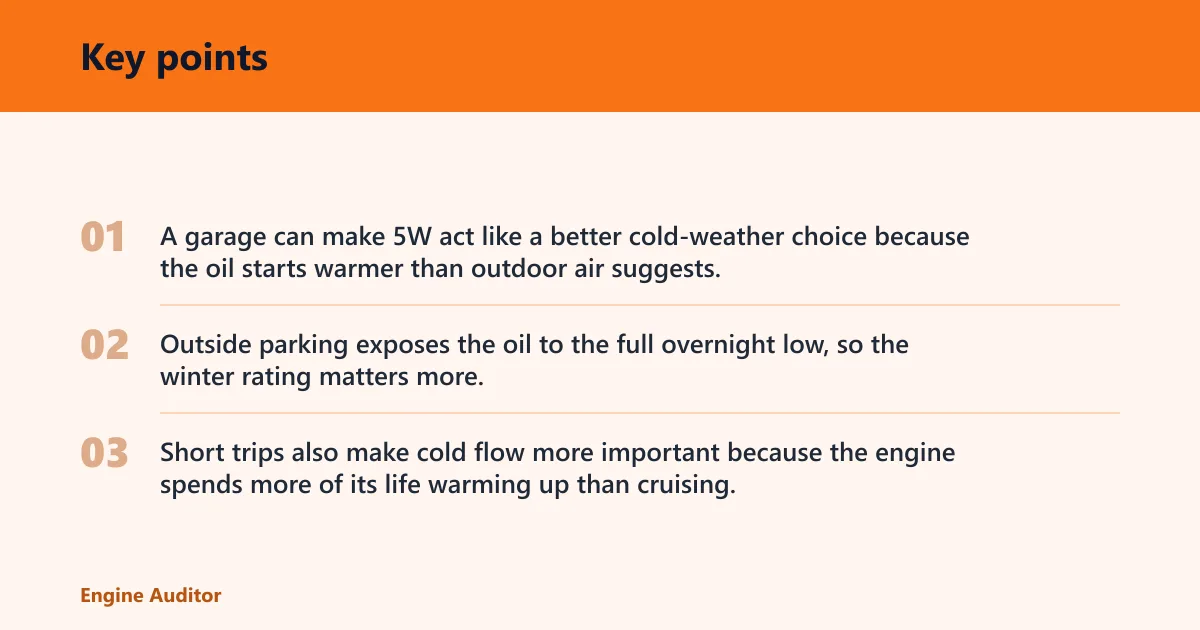
Parking changes the answer. A garage can make 5W act like a better cold-weather choice because the oil starts warmer than outdoor air suggests. Outside parking exposes the oil to the full overnight low, so the winter rating matters more. Short trips also make cold flow more important because the engine spends more of its life warming up than cruising.
Long highway commutes reduce the value of the lower winter rating because the oil reaches operating temperature and stays there. Short-trip driving does the opposite. If you do many five- to ten-minute trips in freezing weather, the start-up interval is a larger share of total engine time, so 0W can have a clearer benefit.
Winter climate bands and practical choice
| Overnight low temperature band | Parking situation | Recommended action |
|---|---|---|
| Below 0°F / -18°C | Outside | Prefer 0W if the owner’s manual approves it. |
| Below 0°F / -18°C | Garage | 0W is still useful, but follow the manual first. |
| 0°F to 20°F / -18°C to -7°C | Outside | 0W is often the better winter choice if approved. |
| 0°F to 20°F / -18°C to -7°C | Garage | 5W is usually acceptable if it meets the spec. |
| 20°F to 40°F / -7°C to 4°C | Outside or garage | Stick to the manual spec; 5W is often fully acceptable. |
| Above 40°F / 4°C | Outside or garage | Winter grade choice usually matters less than approved viscosity. |
Can you switch grades for winter?
Yes, but only within the grades your manual and OEM approvals allow. A winter-only change makes sense when you move into a colder climate band, park outside, and want extra cold-flow margin for repeated starts. If the manual lists both 0W and 5W options, use the one that best fits the coldest expected starts.
Do not change grades just because the number looks better. The owner’s manual viscosity specification comes first, because it can override climate-based advice. Some engines accept several grades, while others have a narrow approved range. If 0W is not listed, a switch to it may create a spec problem even if the weather is cold.
- Check the manual first. Find the approved viscosity grades for your engine, including any notes about temperature ranges or OEM approvals. If 0W is not listed, do not assume it is acceptable just because it flows better in winter.
- Match the coldest starts. Compare the lowest overnight temperature you actually face, not a daytime average. If your car sits outside below freezing, the winter rating matters more than for a garage-kept vehicle.
- Keep the hot grade in range. Make sure the second number still matches the engine’s approved operating-temperature grade. A winter change should not quietly alter the hot-viscosity protection the engine was designed around.
Does 0W protect better once the engine is warm?
No. Once the engine is warm, the second number controls the oil’s thickness and therefore most of the hot-running protection. A 0W-20 behaves like 20 weight oil at normal engine temperature, while a 5W-30 behaves like 30 weight oil. The winter number no longer decides hot protection.
That is why 0W does not automatically beat 5W after startup. The better hot-running choice is the grade the engine was approved to use, not the lower winter number by itself. If your manual calls for 5W-30, that oil can protect better at operating temperature than a 0W-20, even though the 0W starts out thinner in the cold.
Manufacturers use the second number to control film thickness, noise behavior, and oil pressure at operating temperature. In some engines, moving to a lower hot grade can affect consumption or noise. In others, the approved range already includes both grades, and either can work when the climate and spec match.
Special cases that change the answer
Some engines need more caution than the climate chart suggests. High oil consumption, turbocharged designs, and strict OEM approvals can narrow the safe choices. In those cases, the lower winter grade may help cold starts, but the approved viscosity and spec still decide what you should use.
High oil consumption and noise-sensitive engines
If an engine already uses oil between changes, moving to a thinner winter grade can make consumption worse in some cases. Noise-sensitive engines can also react to a lower hot-viscosity grade with extra valvetrain sound after warmup. That is why you should not treat 0W as a free upgrade in older or tired engines.
Turbocharged engines
Turbo engines run hotter in the oil circuit and can be more sensitive to the approved hot-viscosity grade. Many turbos accept 0W and 5W grades, but the exact approval matters. Use the grade the maker lists for the engine, especially if the turbo spec calls for a particular 30 or 40 hot grade.
Strict OEM approvals and warranty limits
Some engines require exact OEM approvals, not just a matching SAE number. That can rule out a grade that looks right on paper. If the manual names a specific approval, follow that first, then choose among the listed grades by climate and parking conditions.
Winter oil
Use this as a short decision rule, not a replacement for the manual. The lower winter number matters most in cold starts, outside parking, and repeated short trips. If those conditions are mild or the manual does not approve the grade, the advantage of 0W shrinks and 5W stays a sound winter choice.
- Read the approved grades. Confirm the SAE grade and any OEM approval in the owner’s manual. If only one grade is listed, stay with it.
- Check the coldest overnight low. Use the lowest start temperature you expect during the season, not the monthly average. That is the temperature that stresses cold cranking and pumpability.
- Account for parking. Outside parking pushes you toward the lower winter grade sooner than garage parking does. A heated or enclosed garage can make 5W fully acceptable in places where outdoor parking would favor 0W.
- Keep the hot grade approved. Make sure the number after the W still matches the engine’s operating-temperature needs. Cold-flow help should not come at the cost of an unapproved hot-viscosity grade.
Sharper decision rule
Stay with the manual spec only if the engine has a strict OEM approval, your manual lists one hot grade only, the engine is turbocharged with a specific approval callout, or the engine already has high oil consumption. In those cases, climate should not override the approved viscosity. Use 0W only when it is explicitly allowed and the cold-start gain is real.
Say your sedan is approved for 0W-20 or 5W-20, and it spends the night outside when the forecast says 5°F / -15°C. In that case, 0W-20 gives more cold-start margin than 5W-20, while still staying within the approved hot grade. That is a meaningful winter-use case.
Suppose a different car is approved for 5W-30, lives in a garage, and sees winter lows around 25°F / -4°C. The owner’s manual still wins, and 5W-30 remains the sensible choice. A lower winter number would add little, and a change outside the approved range would not be justified.
Frequently asked questions
What is the difference between 0W and 5W engine oil in cold weather?
Both are winter grades under SAE J300, but 0W is rated for better low-temperature flow than 5W. That affects cold cranking and pumpability during the first seconds after startup. Once the engine is warm, the number after the W becomes the more important part.
Can I use 0W-20 instead of 5W-30 in winter?
Only if your owner’s manual and OEM approvals allow both grades. These oils do different jobs at operating temperature because the second number is different. A 0W-20 is not a winter substitute for 5W-30 unless the engine is approved for both and the hot-viscosity difference is acceptable.
Does 0W oil protect better than 5W oil once the engine is warm?
No. The second number controls hot protection, not the winter number. A 0W-20 behaves like 20 weight oil at normal engine temperature, while a 5W-30 behaves like 30 weight oil. Choose the approved hot grade for the engine, not the lower winter number alone.
Is synthetic oil required for 0W grades?
Many 0W oils use synthetic base oils, and Castrol says 0W-20 oils require synthetic base oils. Castrol also says 0W-20 oils are not conventional mineral motor oils. That said, the label on the bottle and the engine’s approval still matter more than a blanket rule about all low-viscosity oils.
Will 0W oil help with cold starts and engine wear?
Yes, it can help with cold starts because it flows more easily at low temperatures and reaches parts of the engine faster. That is most useful during subfreezing starts and short trips. It does not fix every cold-start problem, and it should still stay within the approved viscosity range.
Products related to this article
Sponsored / affiliate links. As an Amazon Associate I earn from qualifying purchases. I may earn additional commission from eligible campaigns.