Why Does My Subaru Forester Make a Humming Noise?
A Subaru Forester humming noise is often caused by a wheel bearing, tire, axle, brake contact, or driveline issue. The quickest clue is how the sound changes, by speed, steering load, throttle, or when the car is sitting still. Ignoring it can turn a small repair into tire wear, bearing damage, or a roadside failure. This guide shows how to sort the noise by driving pattern and parked-vs-moving symptoms.
What a Subaru Forester hum usually means
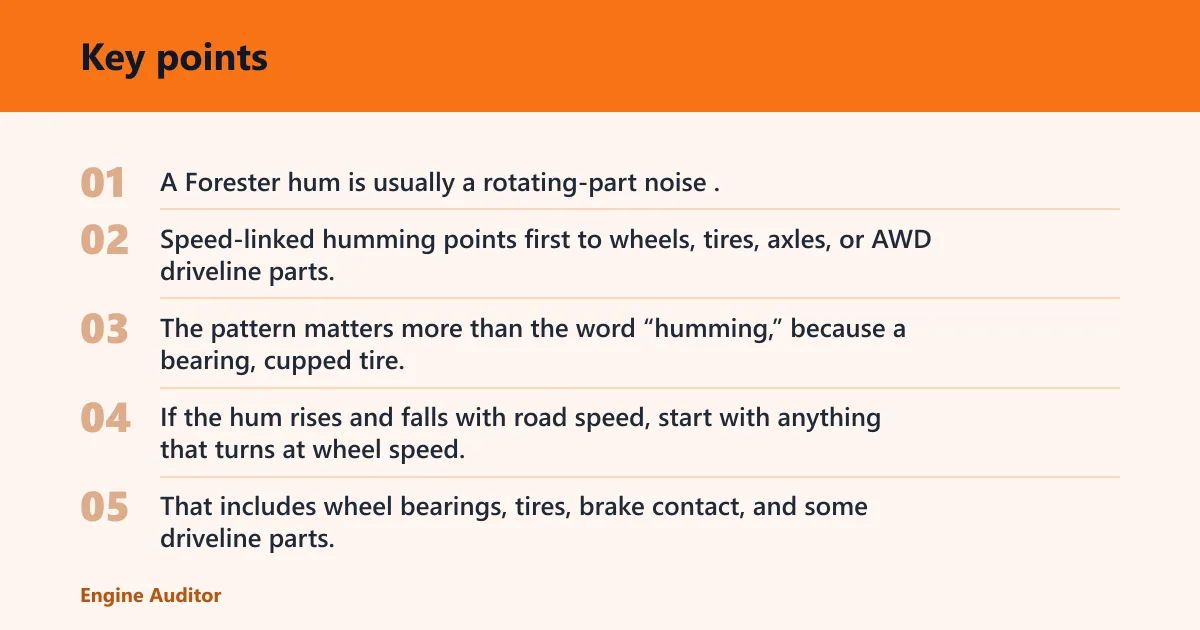


A Forester hum is usually a rotating-part noise. Speed-linked humming points first to wheels, tires, axles, or AWD driveline parts; a parked or off noise points elsewhere. The pattern matters more than the word “humming,” because a bearing, cupped tire, and light brake drag can all sound similar inside the cabin.
How the sound changes with speed
If the hum rises and falls with road speed, start with anything that turns at wheel speed. That includes wheel bearings, tires, brake contact, and some driveline parts. Engine rpm alone is a weaker clue than vehicle speed on a Subaru Forester, because many common noise sources are tied to the axles and hubs.
A hum that appears only above a certain speed often points to tire tread pattern, cupping, or a bearing that becomes audible once load and rotation frequency climb. A sound that starts at about 25 to 35 mph and grows with road speed is a common rule of thumb for something that deserves attention, even if it is quiet at lower speeds.
Why steering, load, and surface matter
Turning changes how weight sits on the front and rear corners. That can make a wheel bearing hum change volume, but there is no single rule that says left turn always means right bearing, or the reverse. Use the steering effect as a clue, not as proof.
Road texture matters too. A coarse asphalt surface can make an aggressive tire tread sound much louder, while smooth pavement may quiet it. If the noise changes sharply from one road surface to another, tire pattern moves higher on the list.
When a parked or off noise points elsewhere
If the noise happens while parked or after shutdown, think beyond wheel speed parts. Cooling fans, belts, relays, electric pumps, or other accessory operation can make a humming or buzzing sound without the car moving. That is a different problem from a wheel bearing or tire hum.
For a parked or off sound, the key question is whether the engine is still running and whether any electrical loads are active. A Forester that hums while sitting still should be checked for fan operation, accessory drive noise, or an electrical component, not just chassis parts.
Forester hum decision table
Use the pattern first, then verify with a simple check. The table below separates the most common Subaru Forester hum patterns without guessing at parts too early.
| Symptom pattern | Most likely source | Quick at-home check | Urgency |
|---|---|---|---|
| Hum changes with speed and is steady at a given road speed | Wheel bearing or tire noise | Compare smooth pavement with coarse pavement; note whether the pitch follows road speed rather than engine rpm | Inspect soon |
| Hum gets louder when turning left or right | Wheel bearing, sometimes a tire that is cupped or worn unevenly | Drive a slow, safe loop and note whether one direction changes the sound more than the other | Inspect soon |
| Hum appears mainly under acceleration | CV axle or CV joint, sometimes rear driveline load noise | Note whether the noise fades on steady cruise or light throttle | Book diagnosis soon |
| Hum is present while coasting | Wheel bearing, tire, brake drag, or differential/driveline noise | Lift off the throttle at the same road speed and listen for any change | Inspect soon |
| Hum or buzz happens while parked or off | Cooling fan, relay, accessory drive, or other electrical component | Check whether the engine is running, whether fans are on, and whether the sound stops when loads change | Depends on source |
Is it a wheel bearing or tire noise?
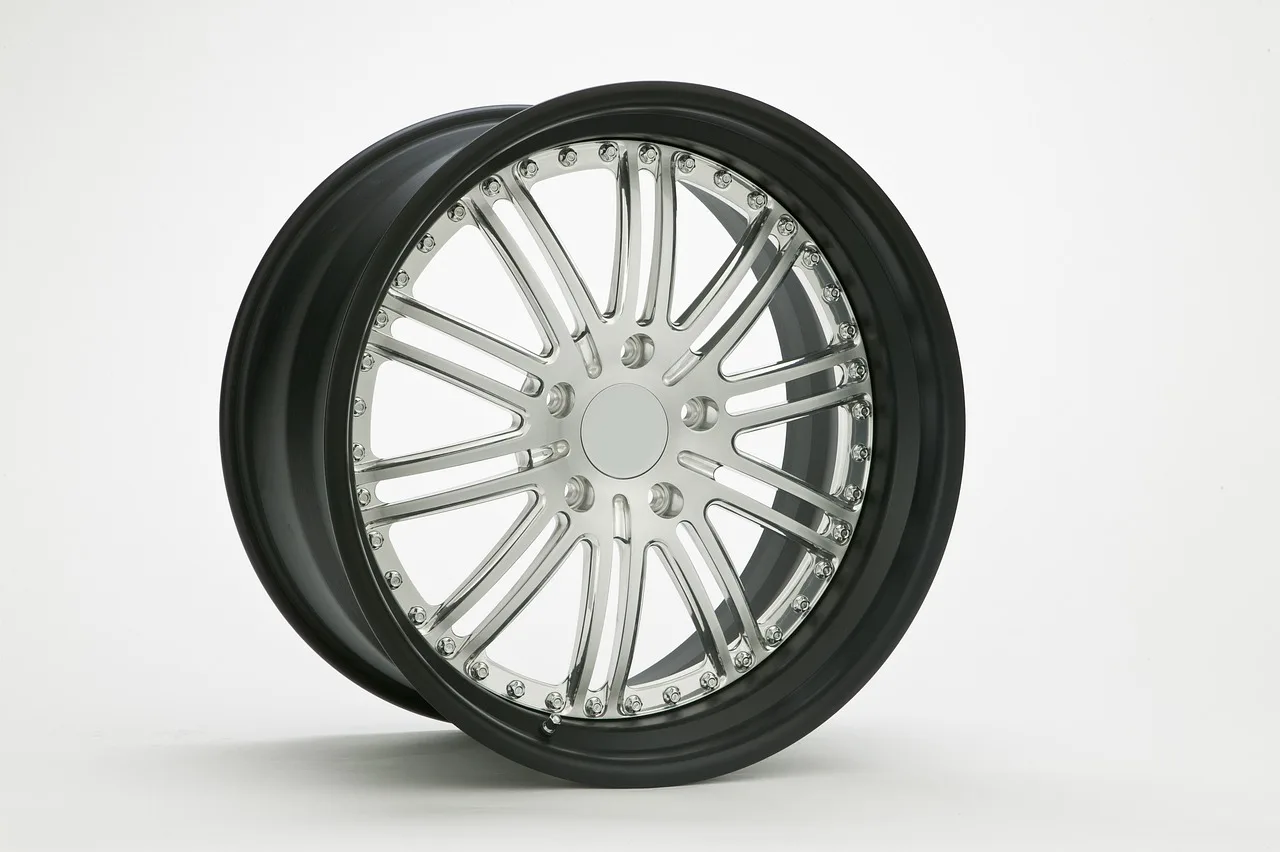
Wheel bearing and tire noise are often among the most common speed-linked hums on a Subaru Forester. A bearing often sounds like a humming, growling, or rumbling tone that rises with speed, while tire noise usually follows tread pattern and road texture more closely. The steering effect helps, but it is not a perfect rule.
Wheel bearing sound patterns
A failing wheel bearing often starts as a low hum and can turn into a growl or rumble. It usually follows vehicle speed, not engine rpm. The corner with the worn bearing may sound rougher in turns because the load changes, but the direction of the change is not always identical from one vehicle to another.
If the hum is present on both smooth and coarse roads, and if it stays close to the same tone at a given speed, a bearing moves higher on the list. A rough or growling note is more suspicious than a thin, light buzz.
Tire cupping and tread hum
Uneven tire wear, especially cupping, can make a Forester sound like a wheel bearing is failing. Aggressive all-terrain tread can also create a low hum that gets louder with speed. If the sound changes a lot with different pavement, the tires deserve a close look first.
Look across the tread, not just at one spot. Feathering, scalloping, or uneven blocks can make a rhythmic hum that is easy to mistake for a hub problem. Tire noise often seems to move or “wash” with pavement texture, while a bad bearing tends to stay more constant.
How rotation can help separate them
Tire rotation is a useful diagnostic step when wear is uneven. If the hum changes after a rotation, the tires are a strong suspect. If the sound stays tied to one corner or changes mostly with steering load, a bearing is more likely.
- Check tread wear across all four tires for cupping, feathering, or a mismatch in depth.
- Compare the noise on smooth pavement and coarse pavement at the same road speed.
- Note whether turning left or right changes the sound more than straight-line driving.
- If the vehicle is due for rotation, have the tires rotated according to the owner’s manual and reevaluate the noise.
Say your Forester wears all-terrain tires and the hum is loud on rough asphalt but much quieter on smooth concrete. That pattern points more toward tread noise than a wheel bearing. If the same sound stays on one rear corner after rotation, the diagnosis shifts back toward a hub or rear drivetrain source.
Why does my Subaru Forester hum louder when I accelerate?
A hum that gets louder on acceleration points toward a load-sensitive part rather than a tire alone. On a Subaru Forester, that often means a front CV axle or CV joint, though rear driveline noise can also change with throttle. The key clue is whether the sound fades on steady cruise or coasting.
CV axle and CV joint clues
CV axle noise often changes under throttle more than at steady speed. On an AWD Forester, the front axles are common places to look because they handle steering and power at the same time. A worn CV joint may add clicking on turns or vibration during acceleration, not just a hum.
If the hum is strongest when pulling away from a stop, then eases on cruise, think about the front axle assembly. A damaged CV boot, grease loss, or joint wear can show up as vibration, clicking, or a dull rhythmic noise under load.
Front-axle sources on AWD models
AWD does not change the diagnosis logic, but it does widen the list of rotating parts. The front hubs, front axles, and front brakes can all make noise that seems to come from the center of the car. That is why pattern testing matters more than guessing by location alone.
Subaru Forester AWD also means tire matching matters. Large differences in tire wear or circumference can create driveline strain and extra noise. Keep all four tires close in size and wear state according to the owner’s manual.
What vibration or clicking adds to the diagnosis
If acceleration hum comes with a click on tight turns, the CV joint moves up the list. If it comes with a shake through the seat or steering wheel, the axle or wheel end is more suspicious. If neither vibration nor clicking is present, tire or bearing noise may still be the better fit.
Picture a Forester that hums only when merging onto a highway, then goes quiet at steady speed. That pattern fits a load-related axle or driveline problem better than a tire tread hum, which usually stays tied to road speed regardless of throttle.
Why does my Subaru Forester make a humming noise from the rear?
A rear hum on a Subaru Forester can come from a rear wheel bearing, rear tire noise, or the rear differential and driveline. On AWD models, rear-end noise deserves serious attention because the sound can travel through the body and seem louder than it is. Fluid condition and service history matter here.
Rear differential and driveline clues
A rear differential noise often shows up as a steady hum, whine, or rumble that tracks vehicle speed. It may be more noticeable under light load or at a certain speed range. If the sound seems centered behind the cabin and not at one wheel, the rear driveline should be considered.
How rear noise differs from wheel bearing noise
Rear wheel bearing noise often localizes to one corner and may change when turning one way more than the other. Rear differential noise usually feels more centered and less tied to one side of the car. That said, cabin resonance can blur the difference, so use speed and load together, not location alone.
If the noise changes little with left or right turns but stays tied to speed, the rear differential or a rear tire pattern becomes more likely. If the sound clearly shifts with cornering load, a rear bearing is still on the table.
Fluid condition and service relevance
Rear differential fluid can matter if the noise is coming from the rear driveline. Check the owner’s manual for the correct service interval and procedure, because Subaru procedures vary by model and year. If the fluid is overdue, contaminated, or low, service may be part of the fix, but diagnosis still comes first.
Do not assume every rear hum is a differential problem. Tire wear, a rear bearing, or brake drag can sound similar. The correct repair depends on whether the hum changes with speed, turning, throttle, or coast-down.
Brake, shield, and tire checks
Brakes and nearby hardware can mimic a wheel or drivetrain hum. Dragging pads, a rotor that lightly contacts hardware, or a bent dust shield can make a steady scrape or hum that seems to come from the wheel area. A light brake application can make the sound change, which helps separate it from tire noise.
Dragging pads or rotor contact
If the hum changes when you lightly press the brake pedal, brake drag moves higher on the list. A rotor that is rubbing a pad, or a pad that is not releasing fully, can make a low noise at speed. Heat at one wheel after a normal drive is another clue, but it is not proof by itself.
Dust shield contact
A bent dust shield can touch the rotor and make a humming, scraping, or ticking sound. The noise may come and go with speed or turning. If the sound started after brake work, a shield contact issue should be checked early.
Uneven wear and aggressive tread
Uneven tire wear can produce a hum that is easy to confuse with a bearing. Aggressive tread designs can do the same, especially on rough pavement. If the tires are worn unevenly across the axle or the tread blocks are scalloped, the tires remain one of the first things to inspect.
Safe lifted inspection and next steps
A lifted inspection can help, but only if it is done safely. Follow the vehicle manual, never work under a vehicle held only by a jack, never exceed the vehicle’s rated roof, hitch, or tow limit, keep items out of airbag zones and the driver’s view, and check local laws. Use jack stands on solid ground before checking wheels.
Jack-stand safety and wheel checks
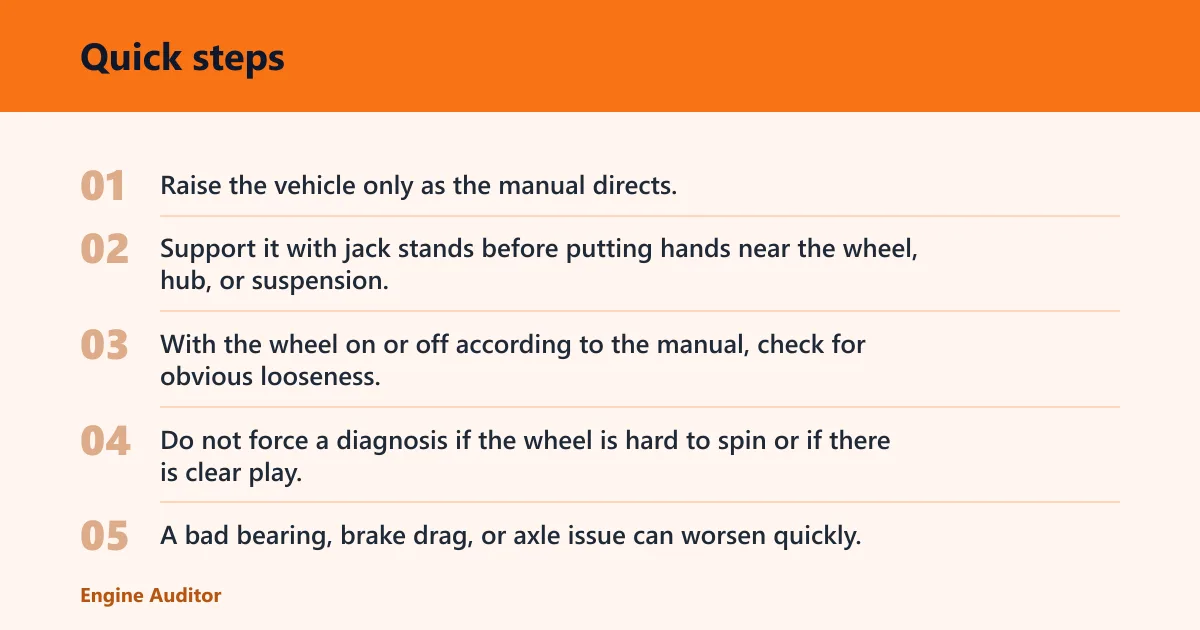
Raise the vehicle only as the manual directs. Support it with jack stands before putting hands near the wheel, hub, or suspension. With the wheel on or off according to the manual, check for obvious looseness, roughness when the wheel is spun by hand, and any contact from shields or pads.
Do not force a diagnosis if the wheel is hard to spin or if there is clear play. A bad bearing, brake drag, or axle issue can worsen quickly. If the noise is getting louder, the car vibrates, or there is heat at one corner, stop guessing and schedule service.
What roughness or play can tell you
A rough, gritty spin points toward a bearing or brake contact. Free play can point to a hub problem, though the exact interpretation depends on suspension design and the inspection method in the manual. Quiet but noisy-road behavior can still be tire-related, so combine the mechanical check with the road test pattern.
Use the same speed on the same road for each comparison. That keeps the result honest. If the sound is worse on one pavement, during one steering direction, or only under throttle, the pattern is doing most of the diagnostic work.
When to stop guessing and book service
Book a professional diagnosis if the hum is getting louder, if it starts to growl or rumble, if steering feel changes, or if the noise is tied to acceleration or rear driveline load. If a wheel feels hot, the car pulls, or the noise appears suddenly, do not wait for it to get worse.
Common first-timer mistake is replacing tires or a bearing based on sound alone. A better order is road test, tire inspection, brake check, then lifted inspection. That sequence cuts the odds of buying the wrong part.
Frequently asked questions
Why is my Subaru Forester making a humming noise?
Most Forester humming noises come from a wheel bearing, tire wear, brake contact, or an axle or driveline part. The quickest way to narrow it down is to note when the hum changes: with speed, with steering input, under acceleration, while coasting, or while parked. That pattern points the search better than location alone.
Why is my Subaru making a humming noise?
For a Subaru, a hum that follows road speed usually points to rotating parts at the wheels or AWD driveline. A parked hum points elsewhere, such as fans, relays, or accessory operation. If the sound changes when turning or braking lightly, the source is more likely at one corner than in the engine itself.
Why is my Subaru buzzing?
A buzz can come from the same places as a hum, but it often sounds lighter and more electrical or sheet-metal-like. On a Forester, check for fan operation, loose trim, dust shield contact, or a tire pattern that is loud on certain pavement. A parked buzz needs a different search than a speed-linked hum.
Why is my Subaru Forester so loud?
If the Forester seems loud overall, look first at tire type, tread wear, and road surface. Aggressive tread and cupping can make the cabin louder at speed. If the noise is a new hum rather than general road noise, wheel bearings, brakes, or a rear drivetrain issue become more likely and should be checked soon.
Why does my Subaru Forester make a humming noise when driving?
A driving hum means a rotating part is usually involved. On a Forester, the main suspects are tires, wheel bearings, brakes, front axles, or the rear differential and driveline. The best clue is whether the hum tracks speed only, changes with turns, or grows under acceleration and fades on coast.
Can I keep driving if my Subaru Forester is humming?
Maybe, but only if the hum is mild and not getting worse. A steady tire hum is less urgent than a growling bearing, brake drag, or a noise that changes fast with throttle or steering. If the sound is increasing, or if there is vibration, heat, or pulling, get it inspected soon.
Why does my Subaru Forester make a humming noise when off?
A noise with the vehicle off points away from wheel bearings and tires. Check for cooling fans, relays, electric pumps, or another accessory that may still be running. If the sound appears only with the key on or after shutdown, the problem is likely electrical or accessory-related, not a wheel-speed fault.
Is a humming noise on a Subaru Forester a wheel bearing or tire noise?
It can be either. A bearing usually sounds like a steady hum, growl, or rumble that follows speed and may change with steering load. Tire noise often changes more with pavement texture and may improve or worsen after rotation. If the sound is corner-specific, a bearing moves higher on the list.
Products related to this article
Sponsored / affiliate links. As an Amazon Associate I earn from qualifying purchases. I may earn additional commission from eligible campaigns.