Why Is My Car Humming While Driving?
A car that hums while driving often points to tires with cupping or uneven wear, a wheel bearing or hub assembly, or a drivetrain part such as a CV joint, differential bearing, or driveshaft support bearing; if the sound changes when you swerve left or right, a wheel bearing is often a leading suspect. Ignoring it can mean uneven tire wear, a failing hub, or a part that turns a low-cost fix into a roadside breakdown. This guide shows how to sort hums by speed, steering load, throttle, and coast so you can narrow the source before buying parts.
What a driving hum usually means

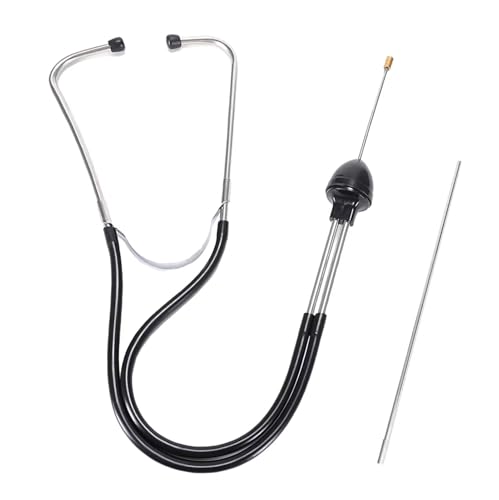

A driving hum that rises and falls with road speed usually points to rotating parts, not engine RPM. That pattern often sounds like a low drone, steady buzz, rumble, or rotating hum. The next step is to separate speed-related noise from engine-speed noise, then note whether turns, throttle changes, or vibration change the sound.
Road speed versus engine RPM
If the hum matches vehicle speed, look first at tire wear, wheel bearings, hub assemblies, axle bearings, driveshaft parts, differential parts, or transfer case parts. If the hum follows engine RPM even when road speed stays steady, the list shifts toward transmission bearings, low transmission fluid, belt-driven accessories, or exhaust resonance that tracks engine load.
That split matters because a wheel bearing can sound bad at 40 mph in one gear and 40 mph in another, while an engine-speed noise will change when you hold road speed steady and move the engine up or down in rpm. Vehicle-speed-related noise points toward rotating components rather than engine RPM.
Why a hum can track tire rotation
Uneven tire wear can create a humming sound that gets louder as speed increases. Tire cupping, feathering, and uneven tread blocks often make a steady drone that can feel like a failed bearing. Alignment issues can create a humming or roaring sound through uneven tire contact, and balance problems can add vibration at the same time.
A common first-timer mistake is to hear a highway drone and assume the wheel bearing is bad before checking tire wear. Suppose the front tires have cupping from worn struts or an alignment issue: the sound may stay after an alignment if the tires are already damaged, because the tread pattern itself is now the noise source.
When vibration changes the diagnosis
If the hum comes with vibration, the problem often shifts away from a simple tire drone. Noise plus vibration can point to balance, bent wheel, tire defect, driveshaft imbalance, axle trouble, or a failing support bearing. Road surface texture can also add a coarse hum that changes on different pavement and mimics a fault.
Why is my car humming when I drive?
When your car hums while driving, start with the parts that spin with road speed: tires, wheel bearings, hubs, axle bearings, driveshaft components, differential bearings, transfer case components, and CV joints. Front-wheel-drive, rear-wheel-drive, and AWD layouts change which parts are most exposed, so the noise path matters as much as the sound itself.
Common noise sources by subsystem
- Tires: cupping, uneven wear, or a tread pattern that drones at speed.
- Wheel bearings and hubs: humming, growling, or droning that changes with steering load.
- Drivetrain: differential bearings, gears, driveshaft parts, transfer case parts, axle bearings, and CV joints.
- Transmission: low fluid, shaft wear, or bearings that hum in more than one gear.
- Steering system: power steering pump noise, especially cold or with the wheel turned at idle.
- Exhaust: leaks or loose pipes that create a humming or vibrating sound.
Front-wheel-drive, rear-wheel-drive, and AWD clues
On front-wheel-drive vehicles, the front wheel bearings, front tires, CV axles, and transaxle parts get the most attention. On rear-wheel-drive vehicles, the rear wheel bearings, rear tires, differential, driveshaft, and support bearings move higher on the list. AWD systems add transfer case parts and more rotating components, so a hum can come from more than one axle path.
Which sounds are most likely from rotating parts? Any hum that rises with road speed, changes during a left-right sweep, or appears after tire wear usually points toward rotating hardware. VehicleRuns says a humming or growling noise while driving usually means tires, wheel bearings, or drivetrain parts are wearing or dragging.
Tires and wheel balance
Tires are one of the most common sources of a humming noise while driving. Uneven wear, cupping, and balance problems can all create a steady drone that gets louder with speed. New tires can still hum if the alignment, suspension, or wheel balance problem that caused the wear is still present.
Tire cupping and uneven wear
Cupped tires often make a rhythmic hum or roar that changes with speed but not much with throttle. The tread wear pattern can imitate a wheel bearing from the driver’s seat. VehicleRuns warns that bad tires can create road vibrations and humming noises, and Car Care Total says wheel bearings and tire wear account for roughly 80% of cases.
Alignment matters here, but it is not always the repair by itself. Camber and toe affect tread contact, and misalignment can cause uneven wear and noise. If the tires already have a scalloped or feathered pattern, the hum may continue after alignment because the worn tread is still rolling against the road.
Balance problems and harmonic drone
Wheel and tire balance problems can create noise and vibration at speed, sometimes as a harmonic resonance. The sound may be clean on smooth local roads and louder on the highway. That pattern is different from a wheel bearing, which often gets louder in one turn and quieter in the other.
Why new tires can still hum
New tires can still hum if the vehicle has worn suspension parts, poor alignment, or a tread pattern that naturally drones on certain pavement. If the old tires were noisy and the new ones are not, the source may have been tire wear all along. If the new tires are noisy right away, balance, inflation, and road surface should be checked before blaming drivetrain parts.
Wheel bearings and hubs
A worn wheel bearing can produce humming, growling, or droning sounds that rise with speed and change with steering load. On many modern vehicles, the bearing may be built into a hub assembly, so the repair can mean replacing the whole assembly rather than only the bearing element. A change during gentle turns is a strong clue.
Left-turn and right-turn loading clues
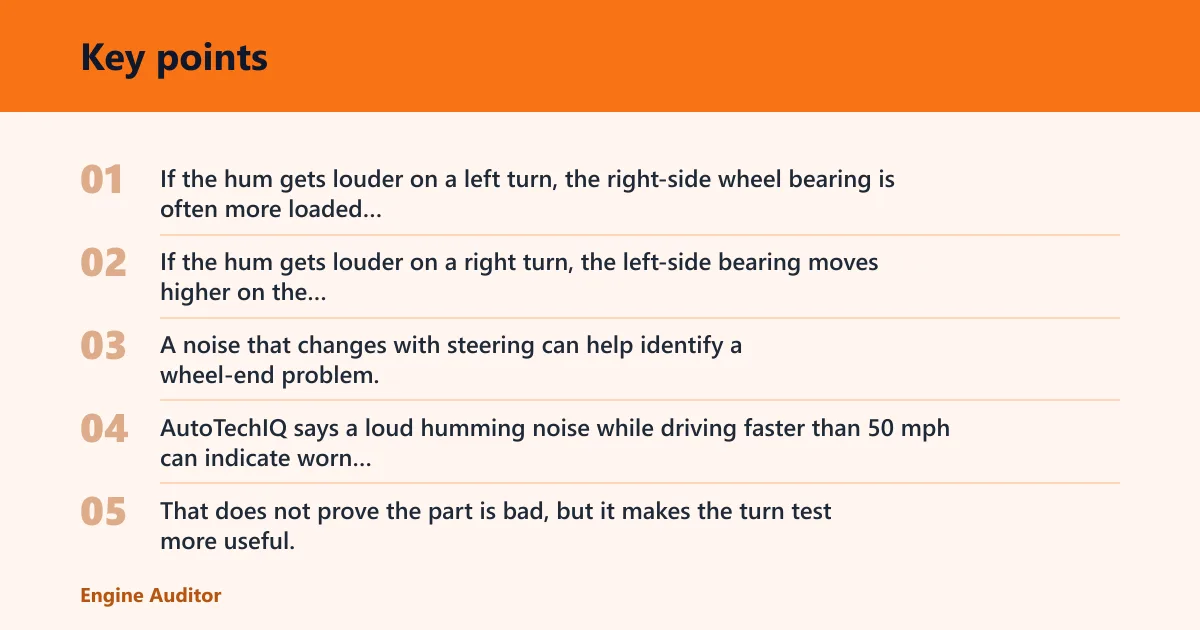
If the hum gets louder on a left turn, the right-side wheel bearing is often more loaded and more likely to be the source. If the hum gets louder on a right turn, the left-side bearing moves higher on the suspect list. A noise that changes with steering can help identify a wheel-end problem.
AutoTechIQ says a loud humming noise while driving faster than 50 mph can indicate worn wheel bearings. That does not prove the part is bad, but it makes the turn test more useful.
Hot wheel checks and hub noise
A wheel bearing that is failing may run hotter than the others after a drive. A hot wheel, especially one with noise that grows after a few miles, can point to bearing drag, brake drag, or hub damage. VehicleRuns warns that brake drag can create a low grinding or growling sound with heat, pull, or a burning smell, so do not confuse heat alone with a bearing diagnosis.
Say your compact sedan hums at 35 mph, then gets louder when you drift left on a gentle curve. If the right-front wheel is also noticeably warmer than the left-front wheel after a short drive, the right-front hub moves high on the list.
When a hub assembly replacement is more likely
A hub assembly replacement becomes more likely when the bearing is integrated into the hub, the wheel has play, the hum changes on turns, and the noise is present at several speeds. Wheel play checks matter here. The same source recommends rocking each wheel at 12 and 6 o’clock and 3 and 9 o’clock to look for movement that should not be there.
Why is my car humming and vibrating while driving?
Noise plus vibration usually means more than a plain tire drone. It can point to wheel balance, tire damage, a bent wheel, axle or driveshaft imbalance, support bearing wear, or a drivetrain part that is moving under load. If the vibration changes with steering, the wheel-end parts move up the list; if it changes with throttle, look deeper in the drivetrain.
How vibration points away from a simple tire hum
A simple tire hum is often steady and mostly audible. A tire or wheel issue with vibration usually adds a shake in the seat, floor, or steering wheel. If the vibration grows with speed but not with engine RPM, rotating parts remain the focus. If the vibration appears only under acceleration, load-sensitive drivetrain parts become more likely.
Driveshaft, axle, and support bearing clues
Driveshaft components, center support bearings, axle bearings, and differential gears can all add vibration with a hum. RWD vehicles often show these clues more clearly because the driveshaft is long and spinning under load. AWD vehicles can hide the source because more shafts and bearings are in play.
Road surface noise that mimics a fault
Some pavement makes a coarse roar that changes when you move to a different lane or different road texture. That sound can feel like a failing wheel bearing, especially at highway speed. The useful clue is whether the hum changes with road surface alone, or whether steering load, throttle, or wheel temperature also change it.
Drivetrain and transmission causes
Drivetrain parts can create a hum that is easy to mistake for tires or bearings. Differential bearings and gears, driveshaft components, transfer case components, axle bearings, and CV joints all belong on the list when the noise changes with load, shows up in multiple gears, or stays present even after tire checks look normal.
Differential bearings and gear noise
Diff bearings or gears often hum or whine with vehicle speed and may change when you accelerate or lift off. Rear-wheel-drive and some AWD vehicles can make this noise from the rear axle area. A gear whine is often more mechanical and consistent than a tire hum, and it may get louder on deceleration.
Transfer case and driveshaft component clues
Transfer case issues are more relevant on AWD and 4WD vehicles. Worn chain parts, bearings, or internal gears can create a hum that comes and goes with load. A bad driveshaft support bearing can also add a low drone or vibration that seems to come from under the center of the vehicle.
Transmission fluid, shafts, and bearing wear
Low transmission fluid can contribute to humming, and gear slipping may accompany the noise. Bad shaft or bearings may hum in all gears. If the hum follows engine RPM more than road speed, or if it appears in park and neutral as well as in gear, the transmission path deserves attention before wheel parts do.
Suppose an SUV hums at about 2,000 rpm whether it is moving slowly or cruising faster. That pattern is not a classic tire or hub clue. It points more toward a transmission, accessory, or exhaust-related source that tracks engine speed rather than road speed.
Why is my car humming when I accelerate?
A hum that appears under acceleration often points to load-related parts rather than a tire-only problem. If the noise fades on coast, that often points to drivetrain load, CV axles, differential parts, or exhaust pieces that shift under torque. If the hum stays the same on throttle and coast at the same speed, tires or bearings rise again.
Load-related noise versus coast-only noise
Noise under acceleration but not on coast often points to a part that changes position or load when torque is applied. Differential gears, driveshaft joints, axle bearings, and CV joints can all do this. If the hum is louder when you lift off the throttle, the pattern can point toward gear mesh, bearing preload, or exhaust contact that changes with engine braking.
CV axle and CV joint clues
CV axles and CV joints can produce hum under load and may be tied to driveline rotation. Boot inspection matters because a torn boot can lead to grease loss and joint wear. The noise may be more obvious on acceleration from a stop or during a moderate pull in a straight line.
Exhaust leaks that get louder on throttle
Exhaust leaks or a loose exhaust pipe can create a humming or vibrating sound, and the noise may worsen on acceleration. That sound is often simpler to identify than a drivetrain fault because it may change with engine load, heat, or physical contact under the car. A loose shield or pipe can buzz at a specific rpm band and feel like a hum from below.
Car humming noise decision matrix
Use this matrix to sort the symptom before replacing parts. Start with when the hum appears, then note what changes it, then compare the likely subsystem and next check. If one row fits better than the others, follow that path first.
| When the hum appears | What changes it | Likely subsystem | Next check |
|---|---|---|---|
| Straight-line speed hum | Gets louder with vehicle speed | Tires, wheel bearings, hub assembly | Check tire wear, then wheel play at 12 and 6 o’clock |
| Hum louder on left turn | Steering load shifts right | Right wheel bearing or hub | Repeat a gentle left-right sweep at steady speed |
| Hum louder on right turn | Steering load shifts left | Left wheel bearing or hub | Check for heat and play on the left side |
| Hum under acceleration | Fades on coast | Differential, CV axle, driveshaft, exhaust | Listen for load-related change at the same road speed |
| Hum on coast | Loudest with throttle lift-off | Differential bearings or gears | Check axle fluid condition and gear noise pattern |
| Hum with vibration | Body or steering wheel shakes | Balance, bent wheel, driveshaft, axle | Inspect tires and wheels for runout or damage |
| Hum after new tires | Started right after tire replacement | Balance, alignment, tread pattern | Verify balance and inspect for uneven wear or cupping |
| Hum with hot wheel | One wheel warmer than the others | Wheel bearing, brake drag, hub | Check for wheel play and brake drag signs |
| Hum with steering input at idle | Wheel turned while stationary | Power steering pump | Check power steering fluid and hose behavior |
| Hum that follows engine RPM | Changes in park, neutral, or in gear | Transmission, exhaust, accessories | Hold road speed steady and vary rpm only |
| Hum plus burning smell or pull | Heat builds during the drive | Brake drag or hub drag | Inspect the affected corner before driving far |
| Hum only on rough pavement | Changes with road surface | Tire pattern noise | Test on smooth pavement to confirm the pattern |
| Hum in all gears at same rpm | Tracks engine speed, not road speed | Transmission bearings or exhaust resonance | Check fluid level and listen near the exhaust path |
How to use the matrix
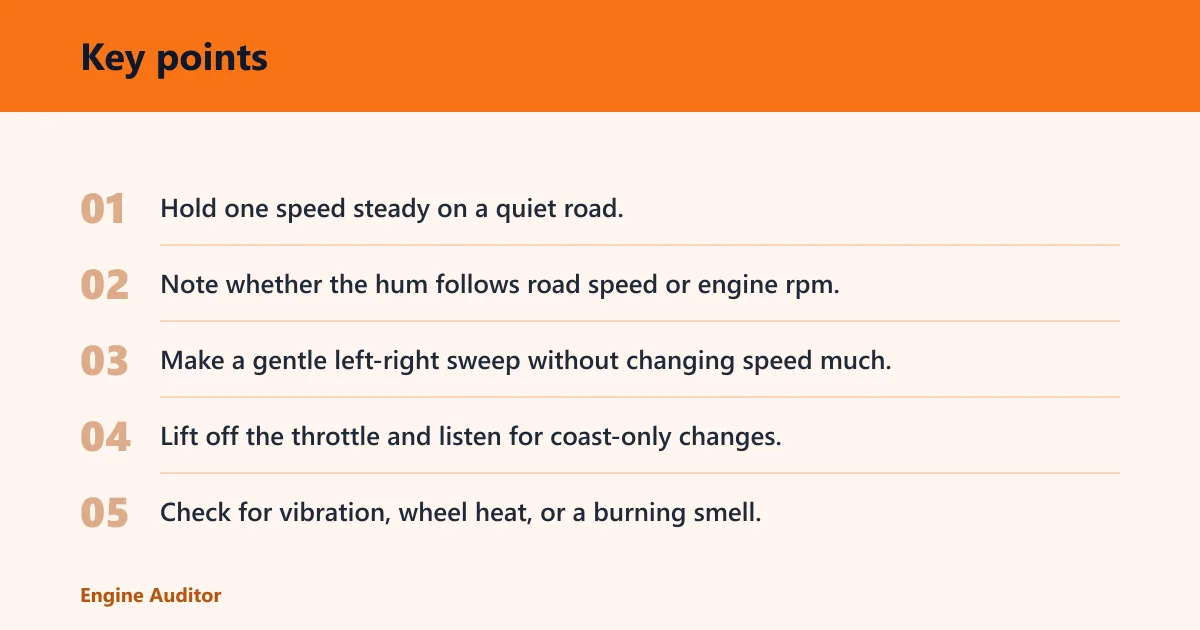
- Hold one speed steady on a quiet road.
- Note whether the hum follows road speed or engine rpm.
- Make a gentle left-right sweep without changing speed much.
- Lift off the throttle and listen for coast-only changes.
- Check for vibration, wheel heat, or a burning smell.
- Look at tire wear, then wheel play, then drivetrain clues.
When to stop driving and get inspected
Stop driving if the hum is joined by a burning smell, severe vibration, a pulling sensation, a hot wheel, or clear wheel play. Those signs can point to brake drag, a failing hub, or a part close to failure. A same-day inspection makes sense when the noise gets louder fast or changes from a hum into a growl.
Frequently asked questions
Why is my car humming while driving?
Most often, a driving hum comes from tires, wheel bearings, hubs, or drivetrain parts that spin with road speed. The key question is whether the sound changes with steering, throttle, or coast. If it does, that behavior usually narrows the source faster than the loudness alone.
Why is my car making a loud humming noise while driving?
A louder hum raises concern for a worn wheel bearing, severe tire wear, a drivetrain bearing, or a loose exhaust part. If the sound gets louder above 50 mph, bearing and tire checks should move to the front of the list. If the wheel also feels hot, inspect sooner rather than later.
What causes humming sound in car?
Common causes include uneven tire wear, bad wheel bearings, alignment issues, balance problems, differential or transfer case wear, CV joint problems, low transmission fluid, and exhaust leaks. The source depends on whether the hum follows speed, rpm, steering load, or throttle position.
What does it mean if your car makes a humming noise?
A humming noise usually means something rotating is worn, out of balance, or under abnormal load. Tires and wheel bearings are the most common first checks, but drivetrain, steering, and exhaust paths can sound similar. The safest path is to sort the noise by speed, turns, and throttle before replacing parts.
Products related to this article
Sponsored / affiliate links. As an Amazon Associate I earn from qualifying purchases. I may earn additional commission from eligible campaigns.