What Does Rod Knock Sound Like?
Rod knock usually sounds like a deep metallic knock that rises with RPM and often gets louder under load; if the noise changes with throttle, treat it as urgent. Ignoring it can turn a bottom-end problem you can still repair into a seized engine or a thrown rod. This guide explains how to identify rod knock by pitch, rhythm, temperature, and load, then separate it from lifter tick, exhaust leaks, and other knock lookalikes.
Tuning by the heavy knock that changes with RPM and load
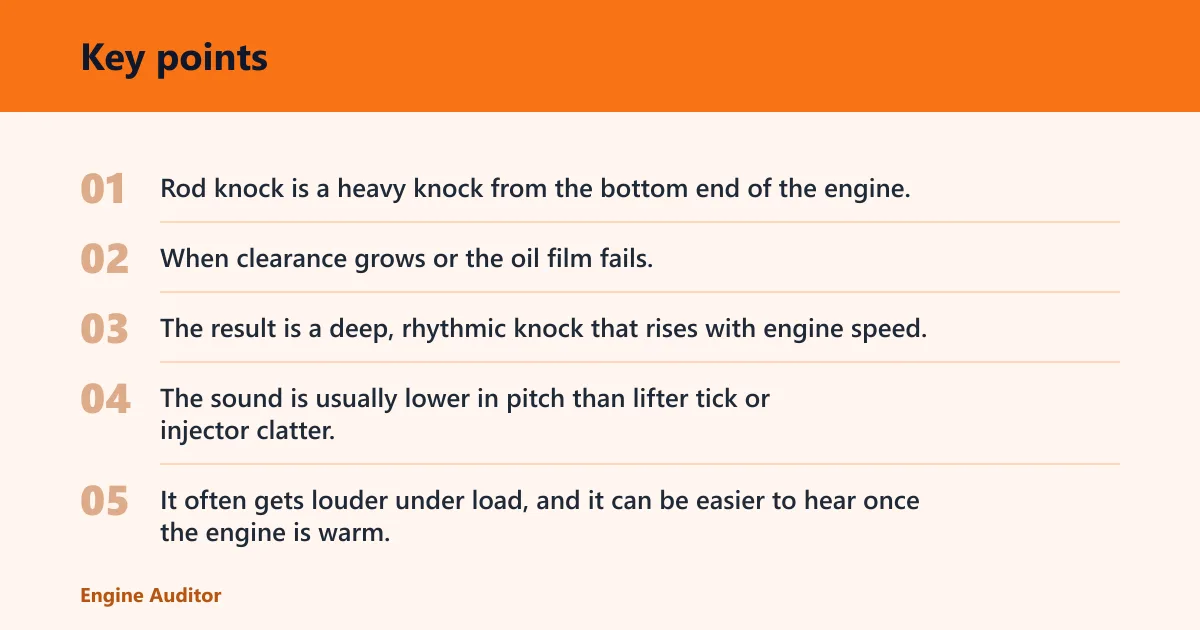

Rod knock is a heavy knock from the bottom end of the engine, where the connecting rod rides on the crankshaft journal through a rod bearing. When clearance grows or the oil film fails, the rod hammers the journal with each revolution. The result is a deep, rhythmic knock that rises with engine speed.
The sound is usually lower in pitch than lifter tick or injector clatter. It often gets louder under load, and it can be easier to hear once the engine is warm. That matters because heat can thin the oil film and make bearing wear easier to hear.
Deep knock versus light tick
A light tick is usually sharper and thinner. Rod knock is heavier, like a dull knock or clunk inside the block. Some guides compare combustion knock to marbles shaking in a tin can, while rod knock is more of a bottom-end hammering sound.
Rhythm helps too. Rod-bearing failure is described as a deep, rhythmic knock that changes with RPM. A sharp tick that does not change much with load points more toward an injector or a top-end source.
Why the sound follows engine speed
Because the connecting rod is tied to crankshaft rotation, the knock speed tracks engine RPM. Faster knock at higher RPM usually means the sound is mechanical, not random debris rattling around. Load sensitivity is the other clue: rod knock often gets louder when the engine has to work harder.
Why it can sound like a hammer inside the engine
When the oil film between the rod bearing and crankshaft journal breaks down, metal contact begins. Excess clearance lets the rod shift and strike on each cycle. That repeated impact is why the noise sounds like hammering from deep inside the block.
Rod knock listening matrix
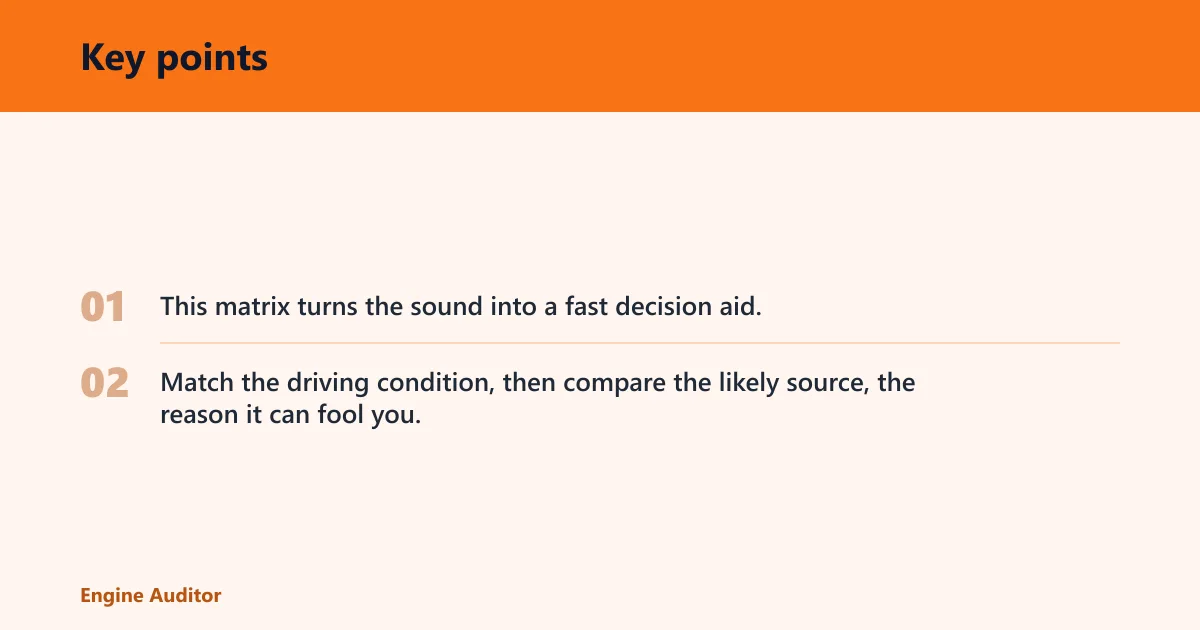
This matrix turns the sound into a fast decision aid. Match the driving condition, then compare the likely source, the reason it can fool you, and one quick check before you decide whether to shut the engine down.
| Scenario | Likely source | Why it sounds similar | One quick check | Stop driving? |
|---|---|---|---|---|
| Idle | Rod bearing wear | May be most noticeable at idle on some engines | Raise RPM slightly and listen for a deeper, faster knock from the block | Yes, if deep and persistent |
| Cold start | Piston slap or lifter noise | Cold-only noise can seem like bottom-end knock | See whether it fades within 30–60 seconds and improves with warm-up | Usually monitor if it clears fast |
| Warm idle | Rod bearing wear | Rod knock from low oil can persist at operating temperature | Check oil level, then recheck noise at warm operating temperature | Yes |
| Light throttle | Rod knock | Load often makes the knock easier to hear | Feather the throttle and note whether the knock grows with load | Yes |
| Hard acceleration | Rod knock | Higher cylinder pressure can make the knock much louder | Lift off briefly; if the noise drops, bearing wear is likely | Yes |
| Steady cruise | Rod bearing wear or exhaust leak | Some noises only show at a narrow RPM band | Hold speed, then change load with a small throttle input | Tow if the knock is deep |
| Deceleration | Exhaust leak or accessory noise | Rod knock often changes less on overrun than on throttle | Compare throttle-on and throttle-off sound at the same RPM | Depends on severity |
| High load uphill | Rod knock | Load sensitivity is a classic clue | Listen for a stronger hammering sound when the engine strains | Yes |
| One-cylinder-like knock | Injector or combustion issue | Can sound like a single cylinder is unhappy | Check if the noise stays sharp and does not track load much | Maybe, if oil pressure is normal |
| Top-end tick | Lifter or valve-train noise | Higher-pitched and more visible near the valve cover | Listen at the valve cover rather than the block | Usually not immediate, unless severe |
| Accessory-area knock | Alternator, belt tensioner, or pulley | Front-of-engine knocks can fool the ear | Listen at the accessory drive with a stethoscope only after securing clothing and tools | Usually no, if clearly accessory-related |
| Oil-light scenario | Oil starvation with bearing risk | Low oil pressure can cause or follow bearing damage | Stop the engine and check oil pressure immediately | Yes, stop driving |
What does rod knock sound like at idle?
At idle, rod knock can sound like a dull, regular knock from the lower engine area. Some engines make it most obvious at idle, where the lower RPM leaves a slower, easier-to-hear beat. If the noise deepens and stays with the block as RPM rises a little, suspect rod bearing wear.
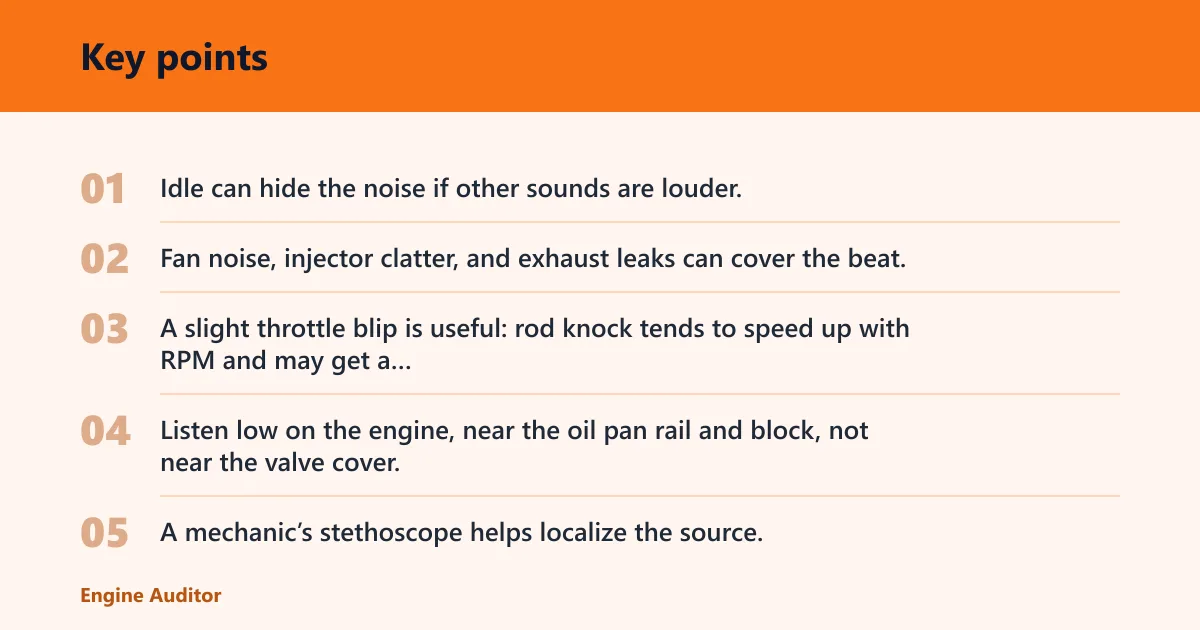
Idle can hide the noise if other sounds are louder. Fan noise, injector clatter, and exhaust leaks can cover the beat. A slight throttle blip is useful: rod knock tends to speed up with RPM and may get a little more obvious instead of fading away.
What to listen for near the block
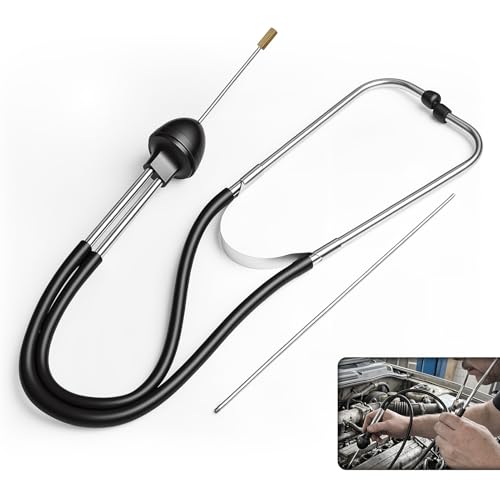
Listen low on the engine, near the oil pan rail and block, not near the valve cover. A mechanic’s stethoscope helps localize the source. If the knock is strongest on the block and not on the accessory case or top end, the bottom end moves up the list.
Suppose a 4-cylinder engine idles with a deep knock that is slow and regular. If the sound rises in step with a small RPM increase and gets louder when the engine is loaded, that pattern fits rod bearing damage more than a loose shield or a lifter tick.
What does rod knock sound like when accelerating?
Under acceleration, rod knock often gets louder because cylinder pressure rises and the bearing sees more force. A deep knock that sharpens as you roll into the throttle is a strong clue. If the sound eases when you lift off, that load sensitivity points toward the rod bearings and crankshaft journal.
Acceleration also helps separate rod knock from noises that stay nearly unchanged. A sharp tick that does not change much with load can indicate an injector. Combustion knock is usually a light, fast metallic ping rather than a heavy bottom-end clunk.
Why throttle matters
The connecting rod transfers combustion force to the crankshaft journal. When clearance is too large, the rod can hammer the journal harder under load. That is why a car may sound only mildly noisy at cruise and much worse climbing a hill or merging onto a highway.
One practical check is to compare the sound at the same RPM with different throttle angles. If it is loudest when the engine is pulling, and quieter when you back out of the throttle, rod knock moves higher on the list than top-end tick or accessory noise.
Rod knock is one of several engine noises that can sound serious. The fastest way to sort them is by where the sound comes from, when it appears, and how it changes with load and temperature. That is more useful than trying to guess from a single noisy idle.
Piston slap
A cold-only knock that clears on warm-up points toward piston slap. It often sounds hollow and shows up right after start, then fades as parts expand. Persistent warm knock is more concerning for rod bearings.
Lifter tick
Lifter noise is usually a lighter, faster tick from the top end. Modern engines can have lifter noise on cold startup that fades within 30–60 seconds. If the sound is highest at the valve cover and not the block, the valve train is a better fit than rod knock.
Combustion knock
Combustion knock is described as a light, fast metallic ping. It often appears under load, but the pitch is higher and the rhythm is crisper than rod knock. It can sound more like gravel in a tin can than a deep hammering from the crankcase.
Accessory noise and exhaust leaks
Accessory problems usually sound loudest at the front of the engine. A belt tensioner, alternator, or pulley can make a clack or knock that seems internal until you listen near the accessory drive. Exhaust leaks are often sharper and puffier, especially on decel, and they do not usually track engine RPM like rod knock.
How to check the engine fast
Start with the basics. Low oil level or low oil pressure is a known rod-knock cause, and low pressure can also result from bearing damage. If the oil warning light is on, stop driving. That warning is not a background noise to ignore.
- Check the oil level on the dipstick.
- Look for an oil warning light or low oil pressure message.
- Listen again at idle, light throttle, and warm operating temperature.
- Use a mechanic’s stethoscope to compare the block, valve cover, and accessory area.
- Inspect the oil and filter for metal contamination.
Using a mechanic’s stethoscope
A mechanic’s stethoscope helps separate block noise from top-end and accessory noise. Touch the probe to the block near the suspected cylinder bank, then compare it with the valve cover and accessory housing. The loudest point often tells you where the problem lives.
If a stethoscope is not available, a long screwdriver can help as a listening tool, but keep clear of belts and fans. The goal is localization, not a perfect diagnosis. A deep knock on the block and a quiet valve cover strongly favors the bottom end.
Checking for metal in oil
Metal contamination in oil is a warning sign of active bearing wear. A simple sample check on the drain plug, dipstick, or filter media can reveal flecks or gritty debris before teardown. Shiny metallic bits make the problem more urgent, not less.
Adding oil and rechecking at warm operating temperature is a useful test when the level is low. If the knock remains after the level is corrected, bearing damage is still on the table. Do not assume fresh oil erases the problem.
When should you stop driving?
Stop driving if the knock is deep, rhythmic, and clearly tied to RPM, especially if it gets louder under load or with heat. An oil warning light means stop driving immediately. Persistent rod knock can move quickly from diagnosis to damage, and advanced failure can mean rebuild-or-replace.
Say your engine starts with a faint idle knock, then the sound becomes louder after 10 minutes of driving and shows up harder on hills. That pattern fits worsening bearing clearance, not a harmless startup tick. Same-day diagnosis is the right move, and towing is safer than hoping it settles down.
A common first-timer mistake is to add oil, hear the noise soften a little, and keep driving. That can buy a short reprieve, but it does not clear rod damage. If the knock returns at warm operating temperature, treat it as a bottom-end problem until proved otherwise.
Repair severity and failure timeline
Early wear may still be diagnosable before major damage spreads. Once the bearing clears enough to hammer the crankshaft journal, the noise can worsen fast. Severe rod knock can sometimes lead to bearing failure, journal damage, or even engine seizure.
That is why the repair decision changes with symptoms. A brief cold tick that fades is one thing. A persistent warm knock with metal in the oil is another. Continuing to drive with advanced rod knock is not an option.
Frequently asked questions
What does rod knock sound like?
Rod knock sounds like a deep metallic knock from the lower engine. It usually follows RPM, often gets louder under load, and can become more obvious once the engine is warm. A light tick or high-pitched ping points more toward other causes.
What does rod knock sound like in a car?
In a car, rod knock is usually heard as a deep knock from inside the engine bay, not a rattly body noise. It often seems to come from low in the block and becomes louder during acceleration or uphill driving. Oil pressure checks should happen before more driving.
What does rod knock sound like in a diesel?
In a diesel, a knock can be confused with normal diesel clatter, so oil pressure becomes the first check. A deep, rhythmic knock that changes with RPM and gets louder under load is more serious than ordinary injector or combustion noise. If the oil light is on, stop driving.
What does rod knock sound like wrx?
On a WRX or other boxer engine, rod knock can seem to come from one side of the engine rather than dead center. Boxer layout can confuse location checks, so listen near each bank and compare block, valve cover, and accessory areas. Warm, load-sensitive knock is still the key clue.
What does rod knock sound like on a motorcycle?
On a motorcycle, rod knock may sound sharper because the engine is smaller and more exposed, but the pattern is similar: deep, rhythmic, and tied to RPM. Listen for a knock that grows with throttle and load rather than a light top-end tick. Metal in the oil makes the problem more urgent.
Products related to this article
Sponsored / affiliate links. As an Amazon Associate I earn from qualifying purchases. I may earn additional commission from eligible campaigns.