Why Is My Subaru Outback Rattling Under the Car?
A Subaru Outback rattle underneath usually comes from a loose heat shield, exhaust hanger, sway-bar link, brake hardware, or driveline shield. Location and trigger point to the problem faster than the sound alone. Ignore it and you can chase the wrong repair, miss a failing exhaust mount, or let a small rattle become a broken bracket, gouged exhaust, or safety issue. This guide separates front, center, and rear clues by speed, bumps, idle, braking, and cold starts.
Map where and when the rattle appears
The sound usually means something under the vehicle is loose, touching, or worn enough to vibrate against another part. On an Outback, the key is separating where the noise comes from and when it happens, because a front heat shield, center tunnel exhaust contact, rear hanger, or suspension joint all leave different clues.
Why location matters more than the noise alone
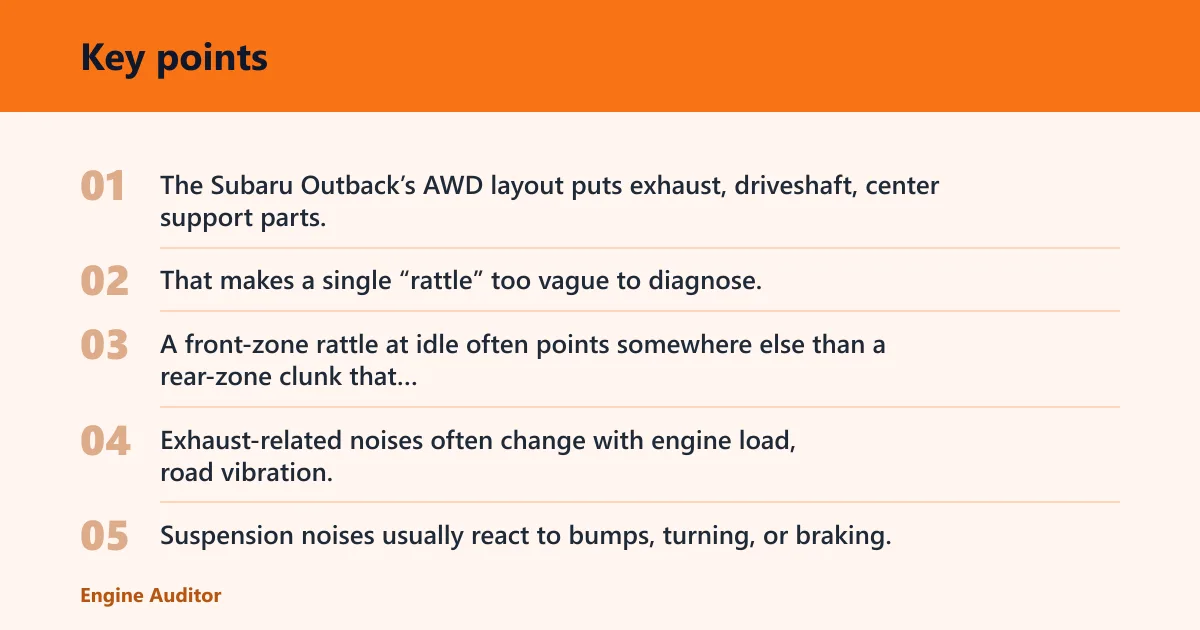
The Subaru Outback’s AWD layout puts exhaust, driveshaft, center support parts, and rear hardware along the full underside. That makes a single “rattle” too vague to diagnose. A front-zone rattle at idle often points somewhere else than a rear-zone clunk that appears over bumps or during throttle changes.
When a rattle points to exhaust, suspension, or drivetrain
Exhaust-related noises often change with engine load, road vibration, or a specific RPM band. Suspension noises usually react to bumps, turning, or braking. Drivetrain noises are more likely to move with vehicle speed, steering angle, or rear-axle load. That split helps rule parts in or out before a lift inspection.
Car subaru outback rattling triage table
| Noise location | Trigger condition | Likely cause | Quick driveway check | Urgency level |
|---|---|---|---|---|
| Front underside | Idle, light throttle, or a narrow RPM range | Heat shield near the catalytic converter, loose exhaust clamp, or front pipe contact | Look for shiny rub marks, loose shield tabs, missing bolts, or a pipe touching the body | Monitor if light; inspect soon if it gets louder |
| Front wheels / front corners | Turns or low-speed bumps | Sway bar link, control arm bushing, ball joint, strut mount, or CV joint | Check for torn boots, visible play, or a clunk when steering at parking-lot speed | Prompt inspection if the noise changes with steering |
| Center tunnel | Bumps, road vibration, or acceleration | Center exhaust bracket, catalytic converter shield, midpipe contact, or center support area on AWD models | Look for loose shields, dangling hangers, or exhaust contact near the tunnel | Inspect soon; higher if the contact is constant |
| Middle underbody | Idle or certain RPMs | Loose catalytic converter shield or bracket | Tap gently with a rubber mallet or hand pressure only when cool; listen for a tinny buzz | Monitor if it is minor; inspect if it worsens |
| Rear underside | Bumps, acceleration, or vibration at speed | Muffler hanger, rear exhaust bracket, pipe contact, or rear differential area hardware | Check for broken rubber hangers, loose brackets, or exhaust touching the body or heat protection | Inspect soon; urgent if a part hangs low |
| Rear axle / driveline zone | Speed changes or repeated vibration | Driveshaft, center support, rear differential area, or related mounts | Look for damaged mounts, missing fasteners, or visible wobble in shields and brackets | Prompt inspection |
Front underside rattles
Front-zone rattles often come from the heat shield, front exhaust piping, or suspension parts near the front wheels. If the sound appears at idle or a certain RPM, the exhaust side rises on the list. If it changes with turning or bumps, suspension or a CV joint becomes more likely.
The heat shield is a thin metal shield around exhaust parts. When a clamp loosens, a bolt rusts out, or a tab cracks, the shield can buzz or chatter against the exhaust or body. Near the catalytic converter, that sound often shows up as a metallic rattle, especially at idle or during a short blip of throttle.
A catalytic converter can also rattle if its internal substrate breaks apart. That noise usually comes from the front or middle underside and often sounds less like a loose sheet of metal and more like pieces shifting inside a can. If the car also has reduced power or a check engine light, treat it as more than a trim problem.
If your Outback rattles at about 1,500 to 2,000 rpm while sitting still, then quiets at higher revs, that pattern can fit a catalytic converter rattle. That pattern leans toward a loose shield, bracket, or pipe contact near the front exhaust rather than a rear suspension issue.
Middle underside rattles
Center tunnel noise often points to the exhaust system or the AWD drivetrain packaging around the middle of the car. A loose catalytic converter shield, a failed exhaust hanger, or a pipe touching the tunnel can create a sharp metallic buzz over rough pavement. The center support and driveshaft area also matter on Outback models with AWD.
Exhaust hangers are rubber or metal supports that keep the system from swinging into the body. When one breaks, the pipe can move enough to clunk or rattle during throttle changes or road vibration. A missing bracket or loose clamp can do the same thing, especially if the noise shows up right after a bump.
Suppose the sound appears mostly on rough roads and fades on smooth pavement. That pattern fits a center tunnel contact point or hanger problem better than an engine accessory issue, because the road vibration is what wakes the noise up.
Rear underside rattles
Rear-zone rattles often come from the muffler, rear hanger, rear exhaust bracket, or hardware near the rear differential area. If the noise gets louder over bumps or when the back of the car moves, inspect the rear exhaust path first. A broken hanger can let the muffler shift enough to strike the body or shield.
AWD packaging adds rear and center components that some other vehicles do not have. That includes the driveshaft, center support, and rear differential area, any of which can contribute to vibration-related rattles, clunks, or humming that feels like it comes from “under the back.” A rear noise that changes with speed but not with engine revs deserves a different path than an exhaust shield buzz.
Is the rattling under my Outback worse when accelerating or idling?
Yes, and the trigger matters. A rattle that shows up at idle or a narrow RPM range often points toward a loose heat shield, bracket, or catalytic converter shield. A rattle that appears with acceleration, braking, or road load is more likely to involve the exhaust hangers, driveline, or suspension moving under force.
Idle versus acceleration
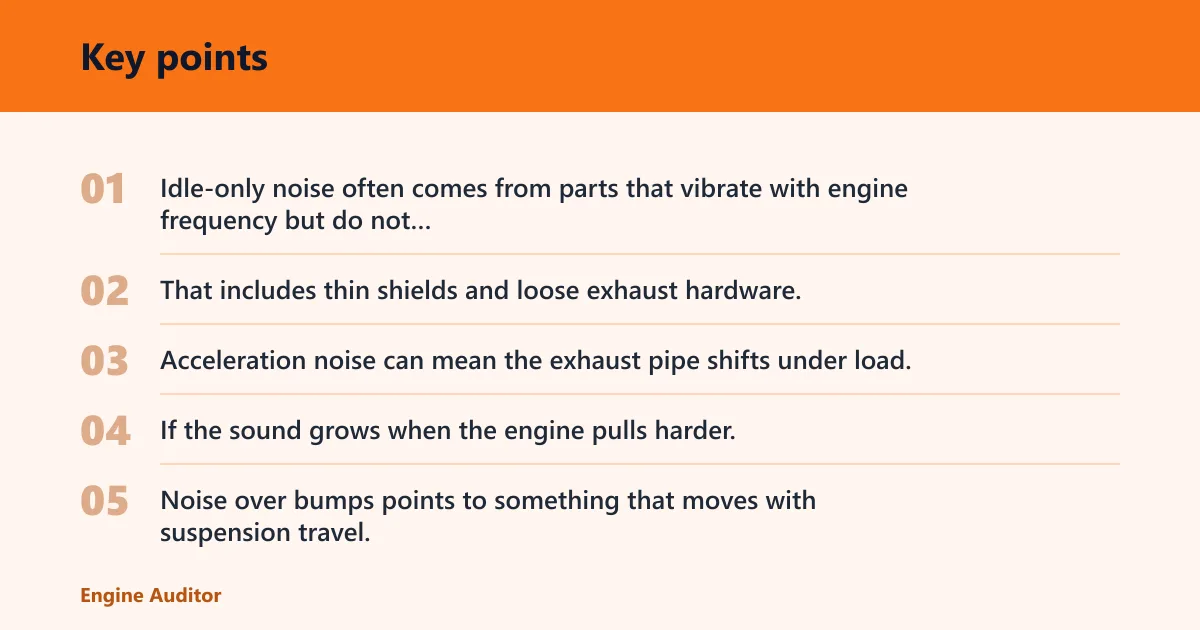
Idle-only noise often comes from parts that vibrate with engine frequency but do not need vehicle motion. That includes thin shields and loose exhaust hardware. Acceleration noise can mean the exhaust pipe shifts under load, or that a drivetrain mount moves enough to make contact. If the sound grows when the engine pulls harder, trace the exhaust path and center tunnel first.
Bumps versus smooth pavement
Noise over bumps points to something that moves with suspension travel. Control arm bushings, sway bar links, ball joints, struts, and loose underbody hardware can all clunk or rattle when the wheels move up and down. Exhaust parts can still be involved, but a bump-only trigger is a strong clue that the suspension deserves inspection too.
Turning clues that point away from exhaust noise
A rattle or clicking noise that appears when turning, especially at low speed, raises suspicion for a CV axle or CV joint. A steering-angle change is less useful for a simple heat shield issue. If the noise gets sharper when the wheel is turned left or right, the front axle and suspension are better suspects than the muffler.
Could the heat shield be causing the rattle on my Subaru Outback?
A loose heat shield is commonly cited as a cause of a metallic underbody rattle on an Outback, and it often sounds worse at idle, over bumps, or at certain RPMs. The shield may loosen at a clamp, bolt, rust point, or tab near the catalytic converter or muffler.
What a heat shield rattle sounds like
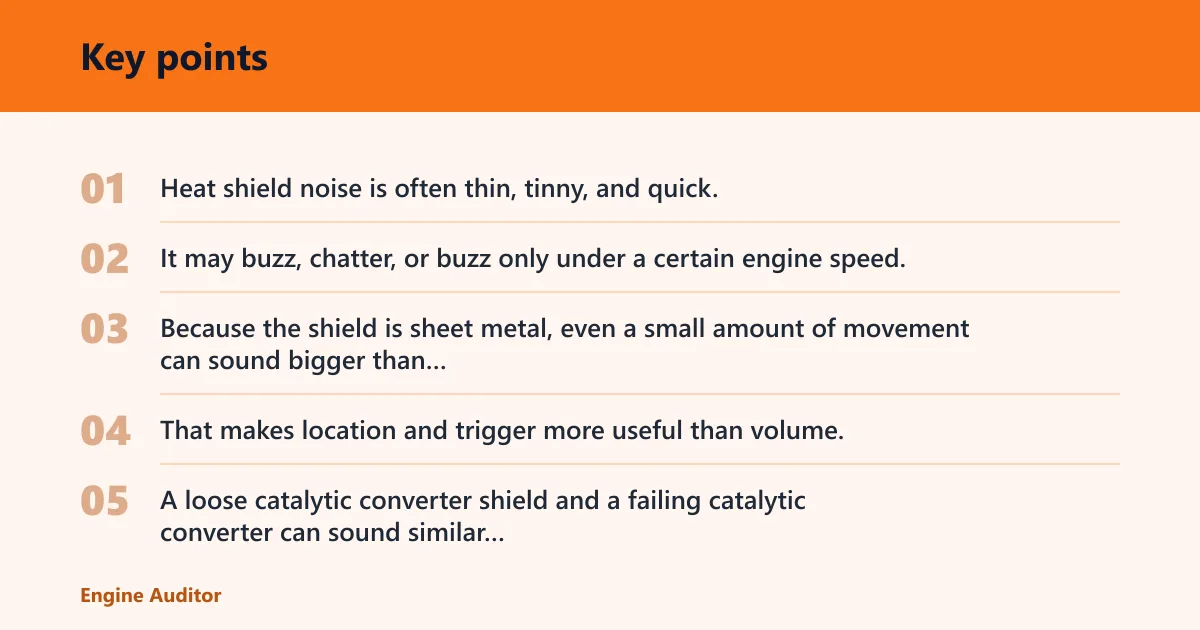
Heat shield noise is often thin, tinny, and quick. It may buzz, chatter, or buzz only under a certain engine speed. Because the shield is sheet metal, even a small amount of movement can sound bigger than the actual fault. That makes location and trigger more useful than volume.
How to separate it from a bad catalytic converter
A loose catalytic converter shield and a failing catalytic converter can sound similar at first, but they are not the same problem. A shield usually rattles from outside the converter case and may change when touched or tapped lightly after the exhaust cools. Internal converter damage tends to sound deeper, may come with reduced engine performance, and can set a warning light.
What to look for near the converter and muffler
Check for missing bolts, cracked tabs, rusted seams, or a shield edge that can move by hand. Look at the areas around the catalytic converter, resonator, and muffler where the shield or bracket mounts. If the pipe has a shiny spot where it contacts the body, that is a strong sign of vibration contact rather than engine knock.
What should you check first before taking your Subaru Outback to a mechanic?
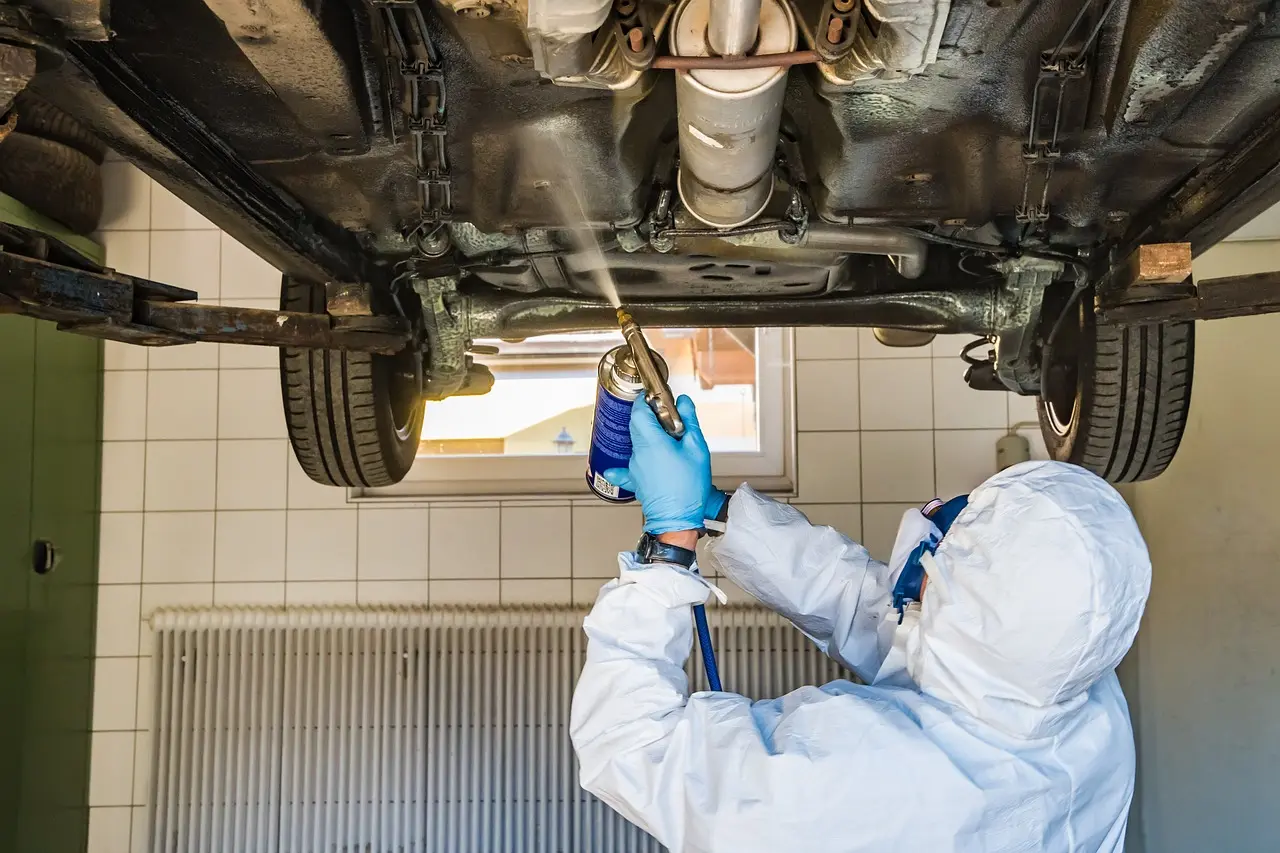
Start with a safe visual check underneath, then narrow the noise by location and trigger. Look for loose hardware, missing fasteners, dangling shields, obvious debris, and any part touching another part. If the rattle is light and does not change into a clunk, you can often gather enough clues for a faster diagnosis.
Quick driveway inspection
- Park on level ground, set the parking brake, and let the exhaust cool.
- Look under the front, center, and rear zones for hanging shields, bent brackets, or broken hangers.
- Check for rocks, sticks, or road debris trapped between shields and exhaust parts.
- Look for shiny rub marks on the exhaust, tunnel, or crossmembers.
- Check that no obvious fastener is missing from a shield, hanger, or bracket.
When to stop driving and book an inspection
If the rattle becomes a hard clunk, if a part hangs low, or if the noise comes with a check engine light, reduced power, burning smell, or vibration, get it inspected promptly. A severe exhaust contact point can damage nearby parts. A driveline or suspension fault can also become a safety issue if ignored.
Monitor or inspect?
Light heat shield buzz with no warning lights can often be monitored for a short time while you schedule service. A noise that changes with turns, gets louder over bumps, or appears with drivetrain vibration should move up the list. If the car pulls, shudders, or sounds like a wheel or axle issue, do not wait.
Why does my Subaru Outback make noise when turning or going over bumps?
Turning and bump noises usually point away from a simple loose shield and toward suspension or CV parts. A sway bar link, control arm bushing, ball joint, strut mount, or CV joint can clunk or rattle when the wheels are loaded differently. That load shift is the clue.
Suspension parts that commonly rattle
Control arm bushings can knock when they are worn. Sway bar links can click over small sharp bumps. Ball joints and struts can produce a dull clunk or repeated rattle if there is play. These parts are more likely to react to road input than to engine RPM.
CV axle and CV joint clues
A CV joint usually announces itself with clicking or rattling that changes with steering angle, especially at low speed. If the noise gets worse on a tight turn and changes when you turn the wheel the other direction, the front axle should move up the list. That pattern is different from a shield that rattles at a set RPM regardless of steering.
Braking and load shift clues
A clunk or rattle during braking can come from loose brake hardware, suspension movement, or a bracket shifting as the car’s weight transfers forward. If braking changes the sound more than engine speed does, the fault may be in the wheel-end hardware rather than the exhaust.
Frequently asked questions
Why is my Subaru Outback rattling under the car?
The most common causes are a loose heat shield, exhaust hanger, suspension joint, brake hardware, or driveline shield. The best clue is where the sound comes from and what triggers it. Front, center, and rear noises often point to different parts, so start there before guessing at a repair.
Could suspension parts cause a rattling sound under my Subaru Outback?
Yes. Control arm bushings, sway bar links, ball joints, and struts can all make rattles or clunks, especially over bumps or during turning. If the noise changes with steering angle or road impact, suspension parts deserve attention before you blame the exhaust system.
Does a loose exhaust or catalytic converter sound like a rattling undercar noise?
Yes. A loose exhaust hanger, bracket, or pipe can rattle against the body, and a damaged catalytic converter can rattle internally. A shield rattle is usually tinny and external, while internal converter damage may sound deeper and may come with a warning light or drivability change.
Can I keep driving if my Outback is rattling underneath?
A mild shield buzz with no warning lights is often safe to monitor briefly, but a loud clunk, hanging part, vibration, reduced power, or check engine light needs prompt inspection. If the noise suggests a wheel, axle, or driveline issue, do not keep driving far before a check.
How do I tell if the noise is from the exhaust, heat shield, or drivetrain?
Use the trigger. Idle or specific RPM points to exhaust or shield. Bumps point to suspension or loose hardware. Turning points to CV or suspension. Speed-related vibration near the rear or center tunnel points toward driveshaft, center support, or rear differential area hardware. Location and trigger together narrow it fastest.
Products related to this article
Sponsored / affiliate links. As an Amazon Associate I earn from qualifying purchases. I may earn additional commission from eligible campaigns.