Can a Bad Thermostat Cause Poor Gas Mileage?
Yes. If a thermostat sticks open and keeps coolant below roughly 190°F/88°C, the engine can stay in warm-up enrichment longer and lose fuel economy. Ignoring it can waste fuel, weaken cabin heat, and hide other faults until they become more expensive. This guide shows the warning signs, the temperature checks, and how to prove the thermostat is the cause before you replace parts.
How engine temperature impacts fuel use
Yes. A thermostat that stays open can keep the engine below its intended operating temperature, and that delays the shift out of cold-start fuel enrichment. The ECU keeps mixture and idle strategy conservative until coolant temperature rises, so a too-cool engine can burn more fuel for longer on every drive.
How engine temperature affects MPG
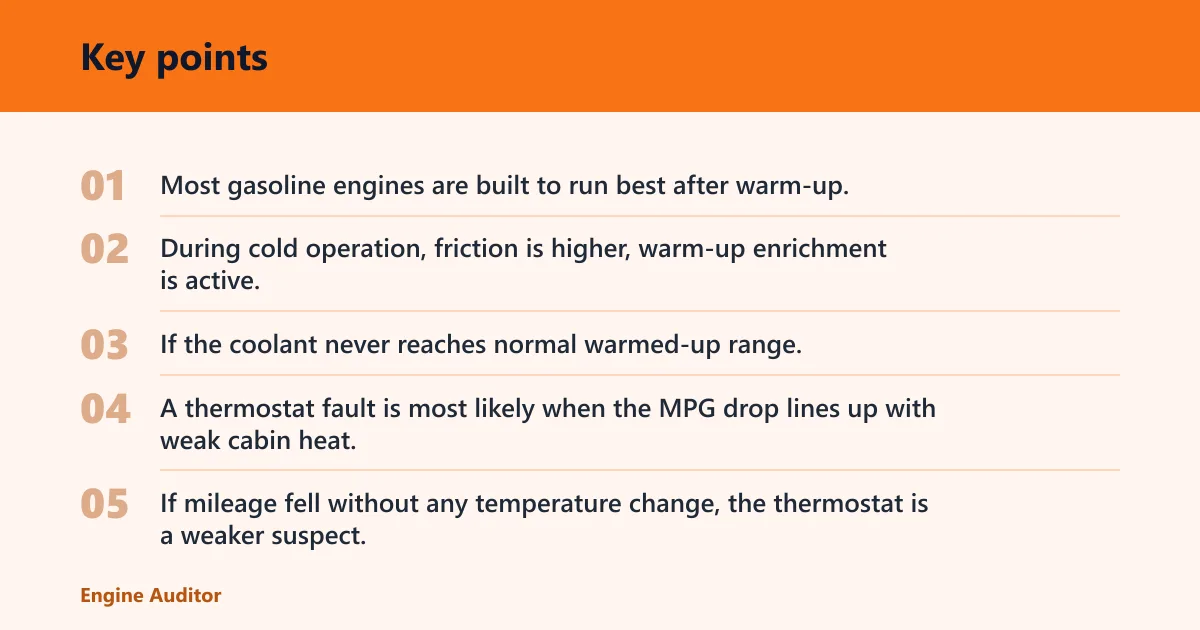
Most gasoline engines are built to run best after warm-up. During cold operation, friction is higher, warm-up enrichment is active, and emissions controls often stay in a less efficient state. If the coolant never reaches normal warmed-up range, the fuel penalty can be real and repeatable.
A thermostat fault is most likely when the MPG drop lines up with weak cabin heat, a slow temperature rise, and a coolant reading that never settles where similar engines usually run. If mileage fell without any temperature change, the thermostat is a weaker suspect.
How a thermostat changes fuel use
The engine thermostat regulates coolant flow to help the engine hold operating temperature. When it works, coolant bypasses the radiator during warm-up and then routes through the radiator as temperature rises. That balance matters because a too-cool engine can stay in open-loop warmup operation longer than it should.
In that condition, fuel enrichment remains in play and MPG drops. On many cars, the dash gauge may still look “normal” because the gauge is damped and not very precise. That is why live coolant data matters more than the needle alone.
Stuck open and underheating
A thermostat stuck open is the common MPG problem. Coolant circulates through the radiator too early, especially on cool mornings or at highway speed, so the engine struggles to reach its target temperature. Cabin heat is often weak or delayed because the heater core gets lukewarm coolant instead of hot coolant.
Say your compact sedan usually warms to a stable scan-tool reading near normal within a few miles, but now it sits much lower on the highway and the heater stays mild. That pattern fits a thermostat that is opening too soon or not closing fully.
Open-loop warmup and enrichment
Cold engines run richer for a reason. Fuel does not vaporize as well on cold metal, so the ECU adds fuel during warm-up to keep the engine running smoothly. If the thermostat fault keeps coolant temperature down, that richer strategy lasts longer and can lower MPG without setting a dramatic drivability complaint.
Direct-injection, turbocharged, and hybrid vehicles can manage warm-up differently, but the principle is the same: a motor that stays cold usually uses more fuel than one that reaches target temperature promptly. Hybrids may hide the symptom with electric assist, so scan data becomes even more important.
Thermostat failure signs to watch
Thermostat problems usually show up as temperature-control symptoms first. Weak heat, slow warm-up, a gauge that never reaches its usual mark, or a warning lamp are the common clues. A stuck-closed thermostat can cause the opposite problem: overheating, rising pressure, and sometimes a sudden hot-coolant smell or boilover risk.
Weak cabin heat
Weak cabin heat is one of the clearest underheating clues. If the blower is strong but the air stays cool after several minutes of driving, the engine may not be reaching or holding its designed operating temperature. That symptom is more persuasive when outside temperatures are mild and coolant level is correct.
Gauge behavior and warm-up time
A fast-moving gauge that climbs and then falls back can point to a thermostat that is cycling or opening too early. A gauge that barely moves can mean the engine is never getting hot enough, but it can also mean the coolant temperature sensor or dash circuit is lying. Warm-up time alone is not enough.
Stuck closed overheating signs
A thermostat stuck closed blocks coolant flow and can cause overheating quickly. Watch for a hot gauge, upper radiator hose that stays cooler than expected, boiling overflow, and heater output that changes strangely as the engine spikes in temperature. That failure mode is not an MPG issue first; it is a damage-risk issue first.
Thermostat diagnosis decision table
| Engine warm-up time | Gauge behavior | Cabin heat | Live coolant temperature | Likely fault | Confidence level |
|---|---|---|---|---|---|
| Slow, still cool after normal driving | Stays below usual mark or falls at speed | Weak or delayed | Stays below about 190°F/88°C | Thermostat stuck open or opening too early | High |
| Normal at first, then climbs quickly | Moves above normal or warning light appears | May get hot then fluctuate | Rises past normal warmed-up range | Thermostat stuck closed, low coolant, or airflow problem | High |
| Slow warm-up with unstable reading | Needle or scan data jumps around | Intermittent | Unreadably low, then sudden jumps | Air pocket, bad coolant temperature sensor, or wiring fault | Medium |
| Warm-up seems normal | Gauge looks normal | Heat is fine | Normal temperature, but MPG still poor | Thermostat less likely; look elsewhere | Low |
What else can mimic thermostat trouble?
Other faults can look almost identical to a bad thermostat. A faulty coolant temperature sensor can tell the ECU the engine is colder or hotter than it really is, which changes fuel trim and enrichment. Low coolant, trapped air, fan-control faults, or even another engine problem can create the same complaint.
Coolant temperature sensor faults
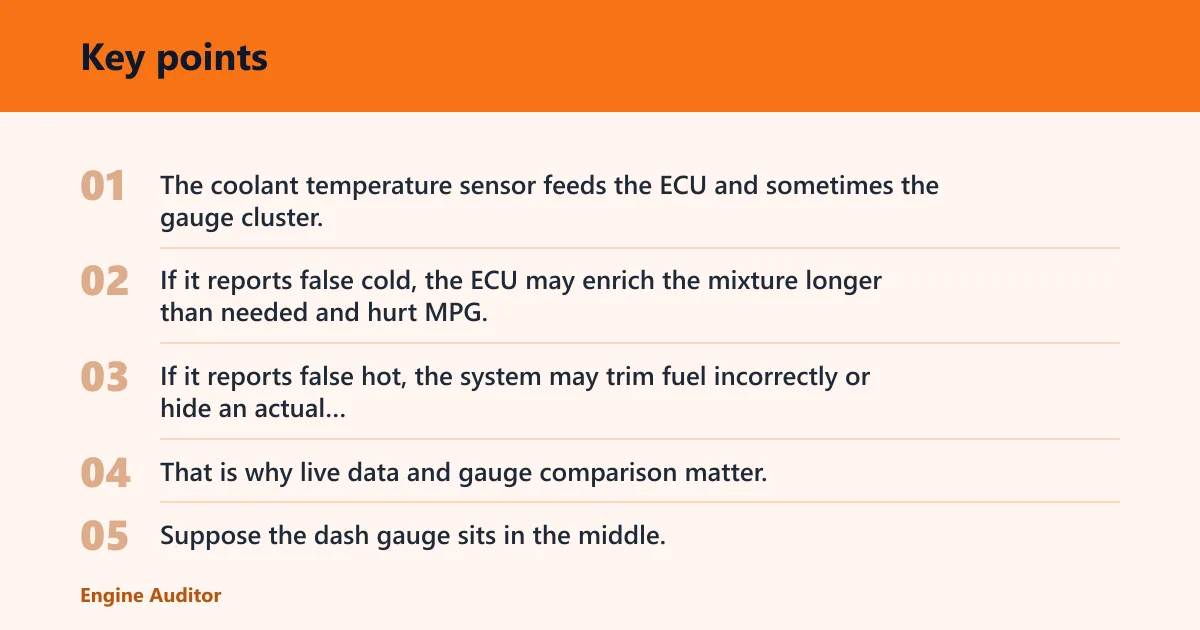
The coolant temperature sensor feeds the ECU and sometimes the gauge cluster. If it reports false cold, the ECU may enrich the mixture longer than needed and hurt MPG. If it reports false hot, the system may trim fuel incorrectly or hide an actual underheating problem. That is why live data and gauge comparison matter.
Suppose the dash gauge sits in the middle, but the scan tool shows a coolant temperature that never rises past a low value. That points away from the gauge itself and toward the sensor, the thermostat, or the cooling system. If the gauge and scan tool disagree badly, treat the sensor circuit as a suspect.
Low coolant or air pockets
Low coolant can keep the thermostat and sensor from seeing solid liquid flow. Air trapped after a service or leak can delay heat, create erratic readings, and make the heater blow cool air. That is why a bleed procedure matters after thermostat replacement, especially on engines with bleed screws or high-mounted hoses.
Fan control problems
The radiator fan system also matters. A fan relay stuck on or a fan command that comes on too early can keep coolant temperature below target and imitate a thermostat that is stuck open. The reverse can happen too: if the fan never comes on, an overheating problem may look like a thermostat failure when it is really a fan-control fault.
How to confirm the fault with a scan tool
An OBD-II scan tool is the fastest way to separate a thermostat issue from a sensor or airflow issue. You want live coolant temperature PIDs, pending codes, and a comparison between scan data and dash behavior. The goal is simple: prove that the engine truly stays too cool, or prove that the reading is false.
- Start with a cold engine and note ambient temperature.
- Watch live coolant temperature as the engine idles and then drives.
- Compare the scan reading to the dash gauge.
- Check whether the temperature rises, stabilizes, or drops at highway speed.
- Look for pending codes that point to sensor range, thermostat efficiency, or warm-up faults.
- Confirm the radiator fan command is not forcing unnecessary cooling.
Compare scan data with the dash gauge
The dash gauge can hide a lot. Many clusters smooth the reading so the needle looks stable over a wide temperature band. If the scan tool shows the engine hovering well below normal warmed-up range while the gauge looks “fine,” trust the live PID first. If the scan tool and gauge disagree sharply, the sensor or its circuit needs attention before the thermostat is condemned.
Look at pending codes and fuel trim clues
Pending codes can point to warm-up or sensor problems before a warning light stays on. Fuel trim can also help, but it is indirect. A thermostat that keeps the engine cold often shows its damage through longer enrichment and a mileage drop, while a bad sensor may create correction behavior without a real temperature problem. Do not diagnose from trim alone.
Should you drive or replace it now?
If the thermostat is stuck open and the engine runs cool, driving is usually a fuel-economy and comfort problem more than an immediate safety problem. If it is stuck closed, the risk changes fast because overheating can damage the engine. The decision depends on whether you are seeing underheating or overheating.
Risk of underheating
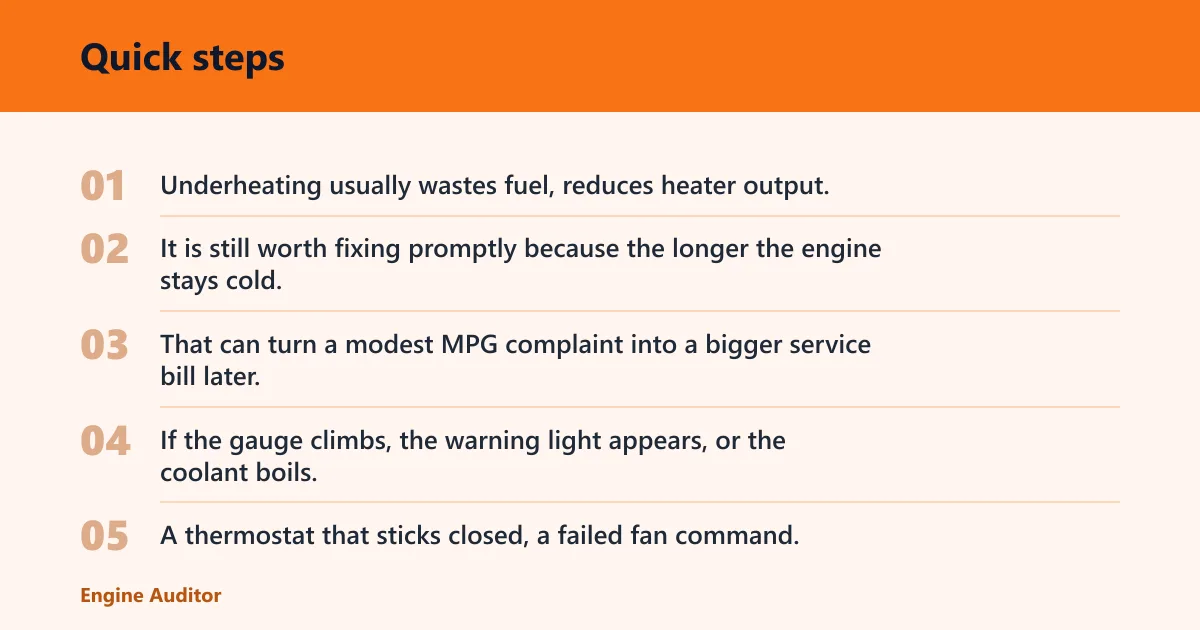
Underheating usually wastes fuel, reduces heater output, and can keep emissions systems from working at their best. It is still worth fixing promptly because the longer the engine stays cold, the longer it can run rich. That can turn a modest MPG complaint into a bigger service bill later.
Risk of overheating
Overheating is the urgent case. If the gauge climbs, the warning light appears, or the coolant boils, shut the engine down and verify coolant level and flow before driving farther. A thermostat that sticks closed, a failed fan command, or low coolant can all create heat so fast that further driving becomes risky.
Thermostat fitment and bleed checks
Replace the thermostat with the correct OEM temperature rating and fitment for the engine. A part that opens at the wrong temperature can shift warm-up behavior even if it “fits.” Also inspect the thermostat housing, gasket, and seal, because a leak or trapped air can recreate the same symptoms after repair unless the system is bled correctly.
A common first-timer mistake is replacing the thermostat without checking coolant level and air purge first. That can leave the engine with the same weak heat and low temperature reading, even though the new part is fine.
Fuel economy should be checked with tank-to-tank MPG tracking after the repair, not just the trip computer. Trip displays can lag, round aggressively, or react to short drives. A baseline over several fill-ups gives you a cleaner comparison and tells you whether the temperature fix actually solved the mileage loss.
Frequently asked questions
Is my car thermostat bad?
It might be if the engine warms slowly, the heater stays weak, and live coolant temperature stays below normal warmed-up range. Confirm it with an OBD-II scan tool before replacing parts. A bad coolant temperature sensor, low coolant, or trapped air can create a similar pattern.
What happens when car thermostat fails
A thermostat that sticks open usually keeps the engine too cool, which can extend fuel enrichment and lower MPG. A thermostat that sticks closed can cause overheating and a rapid temperature rise. Either way, the failure changes engine temperature control, heater output, and sometimes gauge behavior.
Can you drive with a bad thermostat?
You can sometimes drive a car with a thermostat stuck open, but it may waste fuel and run poorly until repaired. Driving with a stuck-closed thermostat is much riskier because overheating can happen fast. If the temperature gauge climbs or coolant boils, stop driving.
When a thermostat goes bad
When a thermostat goes bad, the first clues are often temperature-related: slow warm-up, weak heat, or overheating. The exact symptom depends on whether it sticks open or closed. Before replacing it, check coolant level, scan live temperature data, and make sure the fan system is behaving correctly.
What makes a thermostat go bad
Heat cycling, age, corrosion, contaminated coolant, and mechanical wear can keep a thermostat from opening or closing at the right time. Housing damage, a poor seal, or trapped air after service can also create thermostat-like symptoms. The thermostat should match the engine’s OEM temperature rating and fitment.
What happens to your gas mileage when your thermostat is stuck?
If the thermostat is stuck open, gas mileage usually drops because the engine stays in warm-up enrichment longer and never settles into normal operating temperature. If it is stuck closed, the engine may overheat before MPG becomes the main issue. The real clue is whether live coolant temperature stays too low or climbs too high.
Products related to this article
Sponsored / affiliate links. As an Amazon Associate I earn from qualifying purchases. I may earn additional commission from eligible campaigns.