Why Does My Car Overheat When Towing?
Your car overheats when towing because the extra load exposes weak cooling, poor airflow, low fluid, or excess transmission heat. If the gauge keeps climbing after you ease off, stop towing and inspect it. Ignoring it can warp heads, boil coolant, cook the transmission, and turn a tow into a roadside repair. This guide shows how to tell engine cooling faults from tow-setup problems and what to check first.
Why towing makes heat climb
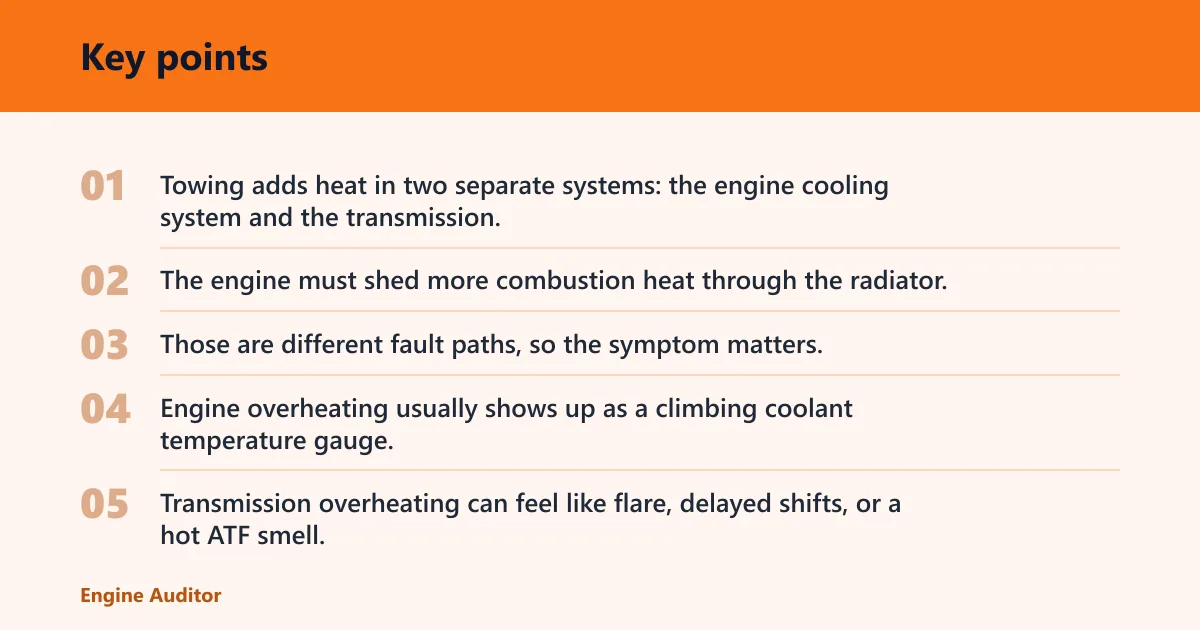


Towing adds heat in two separate systems: the engine cooling system and the transmission. The engine must shed more combustion heat through the radiator, while the transmission may dump more automatic-transmission fluid heat through its cooler. Those are different fault paths, so the symptom matters.
Engine heat versus transmission heat
Engine overheating usually shows up as a climbing coolant temperature gauge, a red warning light, steam, or a sweet coolant smell. Transmission overheating can feel like flare, delayed shifts, or a hot ATF smell, sometimes before the engine gauge moves. A vehicle can have one problem, the other, or both.
When the engine is under load, higher RPM, more throttle, and more fueling raise heat output. The cooling system has to move coolant through the radiator, push air across the fins, and keep pressure high enough to raise the boiling point. If any part falls short, heat builds fast.
Why the problem shows up after 20 to 40 minutes
Towing complaints are often reported after about 20 to 40 minutes, when the system can cope briefly and then may run out of heat rejection capacity. The coolant, transmission fluid, radiator, and underhood air all soak heat over time. Once the heat reservoir fills, temperature climbs even if the gauge looked fine at the start.
That delay often points to a marginal part rather than a dead one. A weak fan clutch, a radiator with blocked fins, a slipping belt, or a water pump that moves enough coolant at light load but not under towing load can pass a short check and fail on a long grade.
How hills, speed, and hot weather raise load
Hill climbing increases engine load and transmission heat because the vehicle needs more torque for longer. Hot ambient air cuts the radiator’s ability to reject heat. Sustained highway towing adds aerodynamic drag, which keeps throttle open and raises both engine and transmission temperature.
Towing overheating decision table
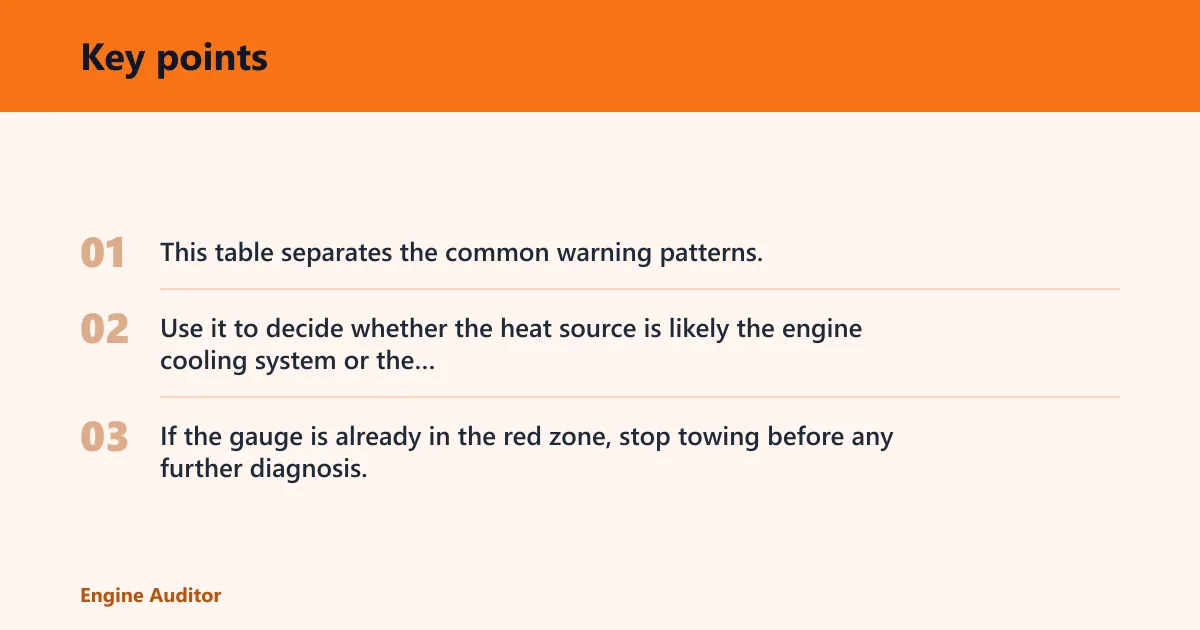
This table separates the common warning patterns. Use it to decide whether the heat source is likely the engine cooling system or the transmission, then choose the next check. If the gauge is already in the red zone, stop towing before any further diagnosis.
| Symptom | Likely subsystem | Quick roadside check | Keep towing? |
|---|---|---|---|
| Coolant gauge climbs on hills, drops on level ground | Engine cooling system | Check radiator fan operation, coolant level in the reservoir when cold, and for visible leaks | Stop if it reaches the red zone or will not recover after easing off |
| Temperature rises after 20 to 40 minutes of towing | Engine cooling or transmission, depending on warning signs | Look for steam, A/C fan behavior, hot ATF smell, and delayed or harsh shifts | Do not keep towing until the hot subsystem is identified |
| Heat climbs at high speed on flat highway | Engine cooling or transmission cooler airflow problem | Check for blocked radiator fins, missing tow-package cooler, or fan that is not helping at speed | Stop if the warning persists after backing out of the throttle |
| Gauge climbs while parked with the A/C on | Radiator airflow or fan control | Verify electric fan comes on, or clutch fan engages when hot; inspect fan relay and shroud | Do not tow until airflow fault is found |
| Coolant level looks full but the engine still overheats | Air pocket, thermostat, water pump, radiator cap, or blocked radiator | Check for trapped air, cap seal issues, hose collapse, or weak circulation | Stop if the gauge keeps climbing |
| Engine gauge stays near normal, but shifts are late or harsh | Transmission | Feel for hot ATF odor and check whether the vehicle has an auxiliary cooler or tow package cooler | Reduce load and stop if symptoms continue |
Why does my car overheat only when I tow?
That pattern usually means the vehicle is close to its cooling limit, tow limit, or both. Towing adds gross trailer weight, payload, and aerodynamic drag, and those loads can push a marginal radiator, fan, or transmission cooler over the edge even when solo driving seems normal.
Tow rating, payload, and GCWR
Check the manufacturer limits for gross trailer weight, payload, and GCWR. GCWR is the combined weight of the vehicle, passengers, cargo, fuel, and trailer. If the setup is near or over those limits, the engine and transmission may be asked to shed more heat than the vehicle was designed to handle.
Trailer drag and weight distribution
A tall trailer can create more drag than its weight suggests. Poor weight distribution, low tire pressure on the trailer, or a nose-high attitude can add strain on hills and at highway speed. That extra drag keeps the throttle open longer and raises both coolant and ATF temperature.
Say your SUV tows a 3,000-pound trailer fine on local roads, then overheats after 30 minutes on a warm interstate climb. If the radiator fan is working and coolant is full, the next likely issue is load: the trailer may be close to the limit, poorly balanced, or simply too much for sustained speed.
When the setup is the problem
A towing problem can be setup-related even when no parts are broken. Missing auxiliary coolers, a weak factory fan, a marginal radiator, or a vehicle without the proper tow package can all pass light-duty driving and fail under trailer load. In that case, the fix is not more patience. It is less load or better cooling capacity.
Cooling system parts to check first
Start with the parts that move coolant and reject heat: radiator, water pump, thermostat, coolant, and radiator cap. A full reservoir does not rule out a problem. Air pockets, wrong coolant mix, poor pressure control, or blocked flow can still let the engine overheat under towing load.
Radiator, water pump, and thermostat
The radiator sheds heat to outside air. The water pump moves coolant through the engine and radiator. The thermostat controls when coolant flow opens to the radiator. If the radiator is clogged, the pump is weak, or the thermostat sticks, heat cannot leave the engine fast enough.
Coolant level, mix, and air pockets
A proper 50/50 coolant mix generally offers better boil protection than plain water and can help with corrosion control. Under pressure, coolant boils at a higher temperature than it would in an open container. Low coolant, trapped air, or degraded coolant reduces heat transfer and can create hot spots that show up only under load.
Check the level only when the engine is cold. A reservoir at the correct mark does not guarantee a full radiator, and a system with air pockets can overheat while the bottle still looks normal. If there is evidence of a leak, wet hose clamps, or a smell of coolant, stop and inspect before more towing.
Radiator cap pressure and seal condition
The radiator cap is a pressure valve, not a lid. Its rating helps raise system pressure and the boiling point of the coolant. If the seal is damaged or the cap cannot hold pressure, coolant can push out early and boil sooner. That becomes more obvious during long pulls and hot weather.
A common first-timer mistake is to add coolant to the reservoir and assume the job is done. If the cap is weak or the system has air, the level may look fine until the grade starts and the gauge climbs again.
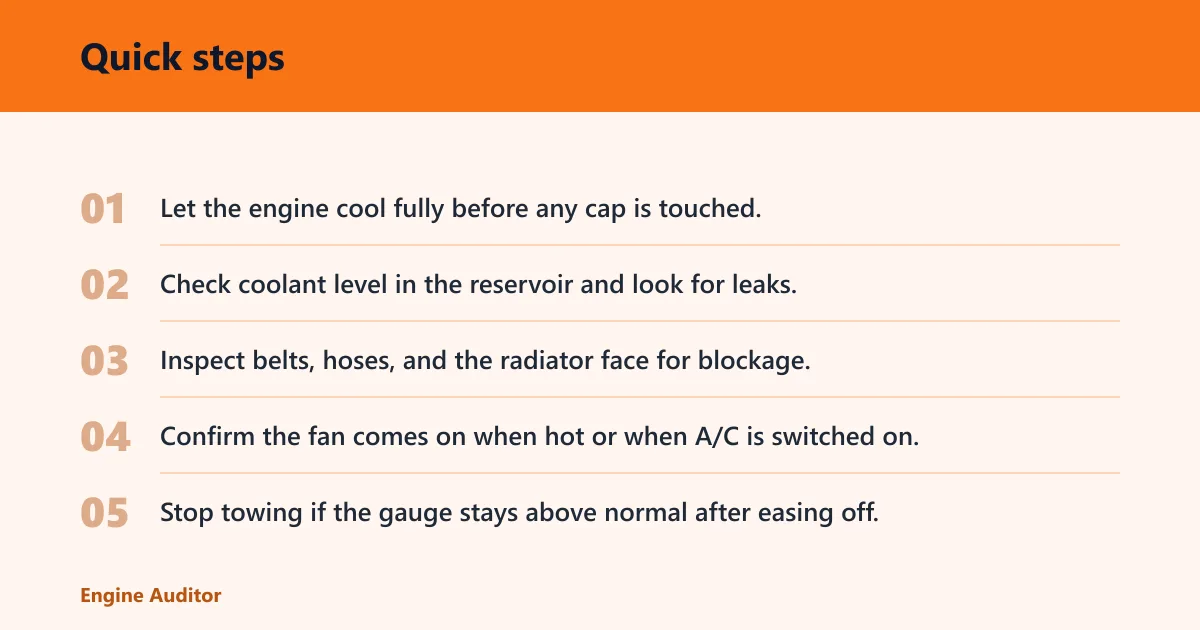
- Let the engine cool fully before any cap is touched.
- Check coolant level in the reservoir and look for leaks.
- Inspect belts, hoses, and the radiator face for blockage.
- Confirm the fan comes on when hot or when A/C is switched on.
- Stop towing if the gauge stays above normal after easing off.
Why does my car overheat at high speeds?
High-speed overheating often points to airflow, not just coolant level. At speed, the radiator must reject more heat while the engine fights aerodynamic drag. If the fan, shroud, radiator core, or airflow path is weak, temperature can rise even though the vehicle is moving fast.
Radiator airflow and fan behavior
Electric fans should come on when commanded by the fan relay or control module. A clutch-driven fan should engage as temperature rises. If the fan does not pull enough air at low speed, or the clutch never locks up, towing in traffic and on grades becomes a problem. A/C demand can also increase fan need.
A/C load and low-speed airflow
With the A/C on, many vehicles ask for more fan help because the condenser adds heat in front of the radiator. At low speed, hill climbs, or stop-and-go towing, airflow matters more than vehicle speed. A weak fan may hide at cruise and fail when the truck slows for traffic or a grade.
Why high speed can still overheat
High speed does not guarantee cooling if the radiator is restricted, the grille is blocked, or the engine is making high power for long periods. Picture a pickup towing a box trailer into a headwind on a 95-degree day. The speed is steady, but the drag load is high and the radiator may be near its limit.
Transmission cooling problems to rule out
Transmission heat can be the main issue even when the coolant gauge stays near normal. The automatic transmission makes more heat when it is pulling hard, hunting gears, or operating with a heavy trailer. If the cooler is undersized, blocked, or missing, the ATF can overheat before the engine does.
Integrated cooler versus auxiliary cooler
Some vehicles rely on an integrated cooler in the radiator or heat exchanger. Tow-package models often add a larger auxiliary cooler to handle higher ATF heat load. If the vehicle was sold without that package, the factory cooler may be enough for daily driving but not for long grades or hot-weather towing.
Signs that the transmission is the hot one
Look for late shifts, gear hunting, flare between shifts, slipping, or a hot ATF smell. If the engine coolant gauge is stable but the transmission behavior changes under load, focus on cooler capacity, fluid level, and whether the cooler airflow is blocked by dirt, debris, or poor mounting.
Suppose a sedan pulls a small camper and the engine gauge stays normal, yet the transmission starts shifting harshly after 25 minutes at 65 mph. That pattern points more toward ATF heat load and cooler capacity than toward a coolant problem, especially if the radiator fan is cycling normally and there is no steam.
Frequently asked questions
Why does my car overheat when towing?
Towing increases both engine and transmission heat. If the cooling system cannot shed that heat through the radiator, fan, coolant, and cap, temperature rises. The most common triggers are hills, hot weather, sustained highway towing, or a trailer that pushes the vehicle close to its rated limits.
Why does my car overheat after 30 minutes?
That timing often means the system works at first, then runs out of capacity once heat soak builds. A marginal water pump, restricted radiator, weak fan clutch, or undersized transmission cooler may only fail after 20 to 40 minutes of steady load, especially on grades or in hot air.
Why does my car overheat when parked?
Overheating at idle or while parked usually points to airflow. Electric fan failure, a bad fan relay, a weak clutch fan, or a blocked radiator can let temperature climb when road speed is gone. If it only overheats parked with the A/C on, the fan path deserves first attention.
What should I check first if my car overheats while towing?
Check whether the warning is engine coolant heat or transmission heat. Then inspect coolant level when cold, fan operation, visible leaks, belt condition, radiator blockage, and any ATF smell or shift changes. If the gauge is in the red or keeps climbing, stop towing immediately.
Can towing cause overheating even if coolant is full?
Yes. A full reservoir does not rule out low coolant in the radiator, trapped air, a weak cap, a stuck thermostat, a clogged radiator, or poor transmission cooling. Towing can expose a problem that never showed up in normal driving because the load and heat rejection demand are much higher.
Is it safe to keep towing if the temperature gauge climbs?
If the gauge keeps climbing after backing off the throttle, towing should stop immediately. If the needle reaches the red zone or the warning light comes on, stop towing and let the vehicle cool. Continued pulling can damage the head gasket, warp aluminum parts, or overheat the transmission fluid.
Products related to this article
Sponsored / affiliate links. As an Amazon Associate I earn from qualifying purchases. I may earn additional commission from eligible campaigns.