
Why Your Car Is Dead After Sitting for a Few Days
If your car dies after sitting a few days, start with battery age and voltage: 12.6 volts rested is usually considered normal, about 12.2 volts is weak, and a parasitic draw above about 50 milliamps can drain a healthy battery. Skip that check and you can chase the wrong part for days. This guide separates battery self-discharge, parasitic draw, charging failure, and bad connections so you can test the right fault first.
Dead-car troubleshooting table

- Reads dark current after systems sleep
- Built-in volt/current display simplifies setup
- Pull fuses and watch current drop
| Branch | Telltale symptom pattern | First test | Expected result | Next action |
|---|---|---|---|---|
| Battery self-discharge | Starts after a jump, then fades again after a few days; battery is old, heat-cycled, or undersized for the car | Measure resting voltage after the car has been off and asleep | About 12.6 V is full, 12.2 V is weak, and 12.0 V or lower is very low | Load-test or replace the battery with the correct group size and CCA rating |
| Parasitic drain | Battery is fine after driving, but it is flat after sitting; a fuse pull changes the current draw | Measure key-off current after sleep mode with a multimeter | Normal is often under 50 mA after modules time out | Pull fuses one by one to isolate the circuit and inspect modules, lights, relays, or accessories |
| Undercharging alternator | Starts now, then the battery keeps going dead between drives; charge warning light may stay on or flicker | Measure charging voltage at the battery with the engine running | About 13.5 to 14.7 V is typical on many vehicles | Inspect belt drive, wiring, and alternator output; check for diode leakage with the engine off |
| Bad connection or ground | Click-no-crank, dim lights, erratic electronics, corrosion at clamps, or a loose ground strap | Check voltage drop across the positive side and ground side during crank | Very low drop is expected; a larger drop points to resistance in the cable, clamp, or strap | Clean, tighten, and retest terminals, clamps, and ground points |
What you’ll need
- Digital multimeter with DC volts and amp measurement
- Test light for quick power checks
- Basic hand tools for battery clamps, fuses, and ground bolts
- Battery maintainer or trickle charger for storage support
- Access to the fuse box and battery
Why did it die after sitting?

A 12-volt starter battery can lose enough capacity from age, heat, cold, or the wrong group size and CCA match that a car still needs a jump after only a few days. Resting voltage tells you charge level, but state of charge is not the same as cranking ability. A weak battery can read acceptable and still fail under load.
Start with age and voltage
- Open the hood and note the battery date code or replacement label.
- Set a multimeter to DC volts and read across the posts after the car has been off for several hours.
- Use 12.6 V as a healthy resting target, around 12.2 V as weak, and 12.0 V or lower as low.
Check the easy connection faults
- Inspect both battery terminals for white or green corrosion, looseness, leakage, or swollen cable ends.
- Clean the posts and clamps, then tighten them so they do not twist by hand.
- Recheck voltage at the posts, not on the clamp bolts, so you read the battery itself.
Picture a five-year-old battery that reads 12.2 V after a night outside. That number does not prove a drain by itself. If the battery is also the wrong CCA for the vehicle, or if it struggles to crank after a jump, replacement moves ahead of deeper electrical testing.
A jump start only confirms that the starter circuit can work with outside help. It does not clear the battery, alternator, ground, or parasitic draw as the root cause. If the car dies again after one or two days, keep going through the tree instead of swapping parts at random.
Is it the battery or alternator?
If the car starts after a jump, the alternator still may not be charging enough to recover the battery. A bad alternator can also leak current through failed diodes when the engine is off, which can mimic a parked-car drain. Test both charging voltage and off-state current before replacing anything.
Measure charging voltage
- Start the engine and set the multimeter to DC volts.
- Measure across the battery posts with the engine idling.
- Look for roughly 13.5 to 14.7 V on many systems, then raise engine speed slightly and watch for stability.
Look for no-charge and undercharge patterns
- Turn on headlights, rear defogger, and blower to add load.
- Recheck voltage at the battery posts.
- If voltage stays near battery resting level, inspect the belt, alternator wiring, and output circuit.
If the battery dies while parked after recent driving, a diode leak is worth checking. With the engine off and the vehicle asleep, a bad alternator diode can pass current the wrong way and drain the battery. That fault often looks like a parasitic draw until the alternator is isolated.
Could a parasitic draw be draining it?
A parked vehicle should settle into sleep mode before current is measured. Many modules stay awake for several minutes after lock, door closing, or key removal, and a door-open reset can restart that timer. Once asleep, key-off current should usually settle below about 50 milliamps.
Wait for sleep mode
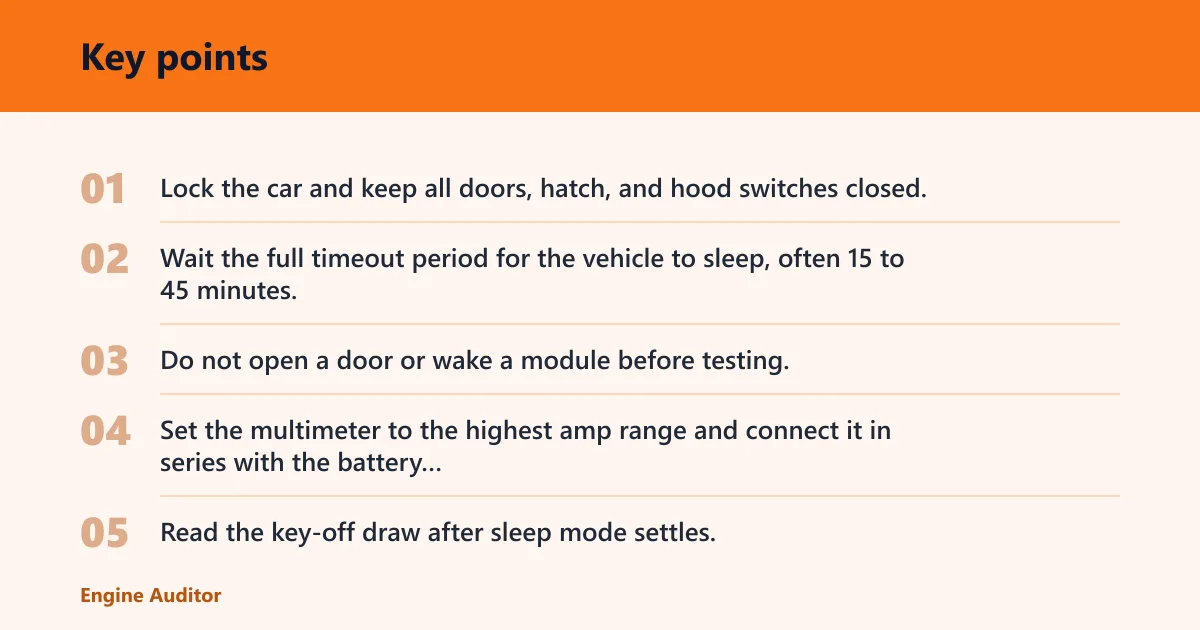
- Lock the car and keep all doors, hatch, and hood switches closed.
- Wait the full timeout period for the vehicle to sleep, often 15 to 45 minutes.
- Do not open a door or wake a module before testing.
Measure key-off current
- Set the multimeter to the highest amp range and connect it in series with the battery negative cable.
- Read the key-off draw after sleep mode settles.
- Compare the reading to about 50 mA; higher draw points to a drain that can empty a battery over a few days.
Isolate the circuit
- Pull one fuse at a time from the fuse box.
- Watch for a large current drop when the bad circuit is removed.
- Inspect that branch for modules, relays, lamps, glove box lights, or accessories that stay on.
Suppose a sedan sits for two nights and still starts, then by day four it clicks once and goes dead. If the key-off draw drops from 180 mA to 30 mA when the interior-light fuse is pulled, the battery is not the cause. The fault is the circuit that kept drawing current.
Check grounds and the starter circuit
Bad grounds and loose battery connections can mimic a dead battery because they add resistance where the starter needs high current. During crank, a weak cable, corroded clamp, or rusted ground strap can cause click-no-crank even when the battery voltage is decent. Voltage drop testing finds that resistance.
Inspect terminals and clamps
- Check for corrosion, looseness, cracked clamps, or sulfation around the posts.
- Clean the contact surfaces and retighten both clamps.
- Recheck crank behavior before replacing the battery or starter.
Inspect engine and chassis grounds
- Find the battery-to-body and engine ground straps.
- Look for torn braid, rust, paint, or oily contamination at the mounting points.
- Measure voltage drop from battery negative to the engine block while cranking; a higher-than-expected reading points to a bad ground path.
Watch the starter circuit symptoms
- Turn the key to start and listen for a single click, rapid clicking, or no sound.
- Check voltage at the battery while cranking.
- If voltage holds up but the starter does not turn, inspect the relay, solenoid, and starter motor circuit.
A common first-timer mistake is replacing the battery when the clamp is barely tight enough to hold by hand. That can create the same dead-car symptom every morning. A 10 mm wrench and a voltage drop check often save a return trip.
Common mistakes
- Testing too soon after locking the car. Wait for sleep mode, or the draw reading will be false.
- Replacing the battery before checking current draw or charging voltage. That can hide the real fault for a few days.
- Ignoring a loose clamp or corroded ground strap. High resistance can imitate a bad battery or starter.
- Using a test light alone for drain diagnosis. It can show power, but it cannot measure current accurately.
Frequently asked questions
Why does my car battery die after sitting for a few days?
Most often, the battery is weak, the car has a parasitic draw, or the alternator never replenished the charge. Check resting voltage first, then key-off current after sleep mode. If the battery is below about 12.2 V or the draw stays above about 50 mA, further testing is warranted.
How long can a car sit before the battery dies?
It depends on battery age, temperature, and parked current draw. A healthy battery may last weeks in mild weather, while an older battery or one with a small drain can fail in days. Use 12.6 V rested as a starting point, then measure key-off current to see how fast it will fall.
Is it the battery or alternator if the car starts after a jump?
A jump only proves the engine can crank with outside help. If the car dies again after driving, measure charging voltage with the engine running. Around 13.5 to 14.7 V is typical on many vehicles. Lower readings point to a charging problem, not just a dead battery.
Can cold weather drain a car battery while it sits?
Yes. Cold reduces available cranking capacity, and an aging battery loses more margin in low temperatures. A battery that is only mildly weak in warm weather may fail after a cold night. Check resting voltage and keep the battery fully charged if the car sits outside for long periods.
What electrical drain kills a battery when the car is parked?
Common offenders are modules that stay awake, interior or cargo lights, stuck relays, aftermarket accessories, and a bad alternator diode. After the vehicle sleeps, the key-off draw should usually fall below about 50 mA. Pull fuses one by one to find the circuit that keeps drawing current.
Can a bad ground cause a car to die while parked?
A bad ground usually shows up as cranking trouble, dim lights, or voltage drop rather than a true parked drain. Corroded or loose grounds can still make the car seem dead because the starter and electronics cannot pull current normally. Test voltage drop at the engine block and battery negative during crank.
Products related to this article
Sponsored / affiliate links. As an Amazon Associate I earn from qualifying purchases. I may earn additional commission from eligible campaigns.