Top-rated Budget Car Batteries That Still Perform Well
The best budget car batteries are usually OEM-equivalent flooded options like Walmart EverStart Maxx, Costco Interstate MT, and Exide Value. AGM is worth extra money when a vehicle has start-stop operation, heavy accessory draw, or severe heat and cold. Choose wrong, and you may get weak cranking, early failure, or a roadside no-start. This guide ranks the top low-cost picks by value and gives a simple rule for choosing AGM.
Top budget battery picks

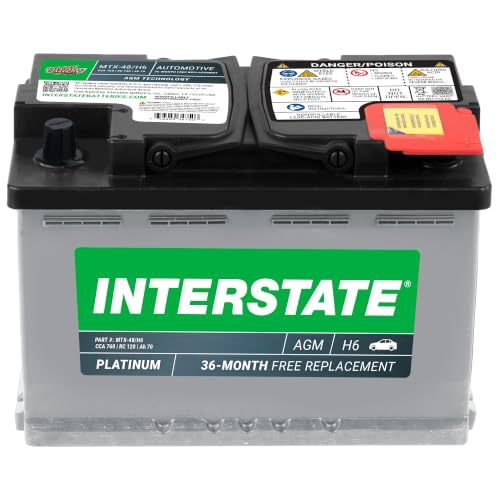
- Supports vehicles with start-stop technology and high accessories
- 70AH capacity delivers consistent power over time
- 760 CCA ensures quick and reliable starting power
The best overall value pick is the EverStart Maxx line, because it targets the low-price replacement sweet spot without pushing you into AGM pricing. For drivers who want the cheapest sensible flooded option, Interstate MT is the safer lean-budget choice. For buyers who truly need AGM, EverStart Platinum AGM is the budget-friendly step up.
Quick picks by budget and use
| Pick | Best for | Battery type | Budget tier | Why it makes sense |
|---|---|---|---|---|
| EverStart Maxx | Most shoppers who want the best value per dollar | Flooded lead-acid | Lower-budget replacement | Strong price-to-performance balance for typical daily drivers |
| Interstate MT | Cheapest practical buy for a simple car or truck | Flooded lead-acid | Entry budget | Good if you mainly need correct fit and dependable cranking |
| Exide Value | Shoppers comparing store-brand alternatives | Flooded lead-acid | Lower-budget replacement | Worth a look when the price is lower than the better-known labels |
| EverStart Platinum AGM | Start-stop systems, accessory-heavy use, deep-discharge risk | AGM | Budget AGM | Costs more, but can pay off where reserve and discharge tolerance matter |
Best overall value: EverStart Maxx
EverStart Maxx is the strongest general-purpose value pick because it sits in the middle ground most drivers need: decent cold starting, reasonable durability, and a price below many AGM alternatives. If your vehicle uses a standard flooded battery and does not carry heavy accessory loads, this is the first place to look.
That said, the correct group size still matters more than the brand on the label. Physical fit depends on make, model, year, engine size, terminal placement, and mounting style.
Best low-cost lead-acid pick: Interstate MT
Interstate MT is the leanest buy here. It makes sense when you want a lower-cost flooded battery and your use pattern is ordinary: commuting, basic electronics, and normal parking times. It fits a tight budget without pushing you into a weaker product class.
Lead-acid is the lower-cost battery technology, and some models can score very well. Cheap does not automatically mean poor.
Best budget AGM pick: EverStart Platinum AGM
EverStart Platinum AGM is the budget AGM option in this list. AGM, or absorbed glass mat construction, usually costs more, but it often earns that premium when the vehicle has start-stop operation, higher accessory loads, or repeated discharge.
AGM batteries are known for better deep-discharge tolerance, and some top-scoring batteries use AGM technology. That does not mean every AGM is worth the upgrade.
Best for accessory-heavy vehicles: Exide Value AGM
For a driver who leaves the lights, audio, camera system, or other accessories drawing power for longer periods, an AGM option deserves a closer look. Exide Value AGM belongs in that conversation because reserve capacity and discharge tolerance matter more when the charging system is not the whole story.
Reserve capacity is backup power if the charging system fails, or if accessory draw keeps the battery working while the engine is off.
Budget battery value table
This table ranks common shopping scenarios by total value, not by sticker price alone. A cheaper battery is a better buy only when it still fits the car, starts reliably in your weather, and matches the way you drive.
| Shopping scenario | Expected price band | Best-fit battery type | Winter suitability | Short-trip tolerance | When to upgrade to AGM |
|---|---|---|---|---|---|
| Basic commuter, mild climate, normal electrical load | Under $150 | Flooded lead-acid | Good if cold starts are not extreme | Moderate | Upgrade only if the car sits often or draws power with the engine off |
| Budget family car, cold winters, mostly short trips | About $130-$180 | Higher-quality flooded lead-acid | Strong cold-start priority | Moderate to weak | Move up if winter cranking is already marginal or reserve capacity is low |
| Start-stop vehicle or accessory-heavy SUV | About $180-$260 | AGM | Very good | Good | AGM is often justified here because deeper cycling is more likely |
| Truck or crossover with long parking periods and parasitic draw risk | About $160-$250 | AGM or top-tier flooded lead-acid | Good to very good | Moderate | Upgrade if reserve capacity or deep-discharge resistance is a priority |
| Plain replacement for an older vehicle with simple electrical needs | Under $130 | Flooded lead-acid | Depends on local climate | Good enough | Only if the battery is repeatedly drained or the climate is harsh |
- Reserve capacity check: choose AGM or a stronger flooded battery if you need backup power for long accessory use or charging-system failure.
- Cold-start check: move up a tier if winters are severe and the current battery struggles in cold mornings.
- Deep-discharge check: choose AGM sooner if the battery has a real chance of being drawn down by lights, doors, or repeated short starts.
Which budget car batteries are worth buying?
The best budget car batteries are the ones that pay off on three fronts at once: low price, acceptable cold-start strength, and usable life. A cheap battery is worth buying when it still fits the vehicle, holds enough reserve capacity for your driving pattern, and does not fall apart under short-trip use.
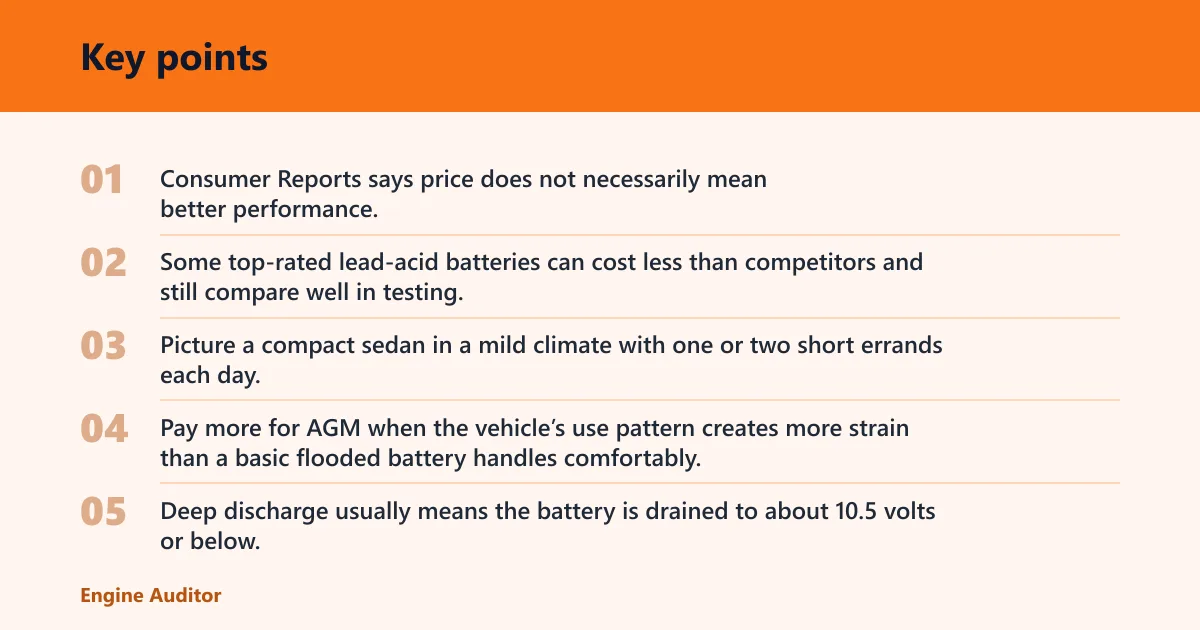
Consumer Reports says it tests more than 100 individual car batteries every year, uses five units of each rated model to improve reliability, and runs batteries through 180 charge and discharge cycles. It also uses a 167º F water bath to simulate under-hood heat and freezes batteries at 0º F to assess cold performance. That matters because value is more than sticker price. (Consumerreports)
What the best-value rankings should reward
Value should favor batteries that score well on the measures that matter most in daily use: overall score, cold weather performance, life, and reserve capacity. Those are the dimensions that tell you whether a battery is cheap for a reason or cheap because the market price is simply lower.
Do not treat a high price as a guarantee. The same source says price does not necessarily mean better performance.
Why a cheap battery can still score well
A cheaper lead-acid battery can score well when the manufacturer gets the basics right: enough reserve capacity, reasonable cold-cranking performance, and durability under repeated charging and discharging. Some top-rated lead-acid batteries can cost less than competitors and still compare well in testing.
Picture a compact sedan in a mild climate with one or two short errands each day. If it uses a standard flooded battery and does not power many accessories when parked, a good-budget lead-acid unit is often the smarter buy than an AGM that adds cost without fixing a real problem.
When a pricier battery earns its cost
Pay more for AGM when the vehicle’s use pattern creates more strain than a basic flooded battery handles comfortably. That includes start-stop systems, lots of short trips, long accessory use with the engine off, or a history of deep discharge.
Deep discharge usually means the battery is drained to about 10.5 volts or below. AGM batteries are known for tolerating that kind of abuse better, but that is a resilience advantage, not permission to drain them that far on purpose.
How do you choose the right battery size?
The correct group size depends on the vehicle. Common budget-friendly sizes in this guide are 24/24F, 35, 47, 48, 49, 51R, and 65, and some vehicles may also use 94R even when it is not in the shorter buying list. Fit depends on the make, model, year, engine size, terminal placement, and mounting style.
Always check the owner’s manual or the battery label before buying. Replace the battery with the correct physical fit, not the cheapest battery that happens to be on the shelf.
Group size and physical fit
-
Check the listed group size.
Look in the owner’s manual or on the old battery label for the exact size, such as 35, 47 (H5), or 48 (H6). The wrong case size can interfere with the tray or hold-down. -
Match terminal placement.
A battery can be the right group size and still be wrong if the positive and negative posts are reversed or placed differently. Terminal placement matters for cable reach and safe routing. -
Confirm the hold-down style.
Some batteries need a base clamp, side clamp, or a specific tray shape. If the battery cannot be secured correctly, do not force the install.
Terminal placement and hold-down style
Terminal placement matters because cables are only so long, and a battery that fits physically can still be unusable if the posts are on the wrong side. Hold-down style matters for the same reason: the battery should sit solidly in the tray and not move under braking or vibration.
A common first-timer mistake is choosing by brand first and fit second. That is backward. Start with size, terminal layout, and mounting style, then choose the best-performing model that fits.
Owner’s manual and battery label checks
The owner’s manual is still the safest source for the correct group size and any special requirement. The old battery label can confirm the same thing, but only if the previous battery was correct in the first place.
If the label and manual disagree, use the vehicle manual or a parts catalog tied to the exact make, model, year, and engine.
When is AGM worth the extra cost?
AGM is worth the extra cost when your vehicle needs more reserve, more discharge tolerance, or better handling of repeated cycling. It is not the default answer for every car, even in hot climates. A good flooded battery can be the better value when the vehicle is simple and the budget is tight.
AGM batteries are often among the top-scoring batteries, but the score only matters if the added capability fits the use case.
Short-trip and accessory load
Short-trip driving can keep a battery from fully recovering between starts, especially when headlights, infotainment, heated seats, and other accessories are in use. In that situation, AGM can be a better buy because it tends to handle repeated partial charging better than a basic flooded unit.
Say your crossover runs five-minute errands all winter, then sits overnight with a dash cam or remote start system drawing power. That is exactly the kind of pattern that can justify AGM even when the sticker price is higher.
Reserve capacity needs
Reserve capacity matters when the charging system fails or when the vehicle has accessory loads that keep drawing power during parking. If the vehicle carries extra electrical demand, a battery with stronger reserve capacity is a better insurance policy than a cheaper battery with less backup power.
Deep-discharge risk
Choose AGM sooner if the battery is likely to be drained by parked accessories, long storage, or repeated no-start situations. AGM has better deep-discharge tolerance, but no battery should be treated as if deep discharge is harmless.
Do not confuse tolerance with a target. The value case for AGM is that it gives you more margin when things go wrong.
What the lab numbers should mean to you
The numbers matter only when you connect them to your own driving pattern. Cold-weather performance, life, reserve capacity, and extreme-temperature testing each describe a different kind of risk, and budget buyers need all four in view.
Cold-weather performance
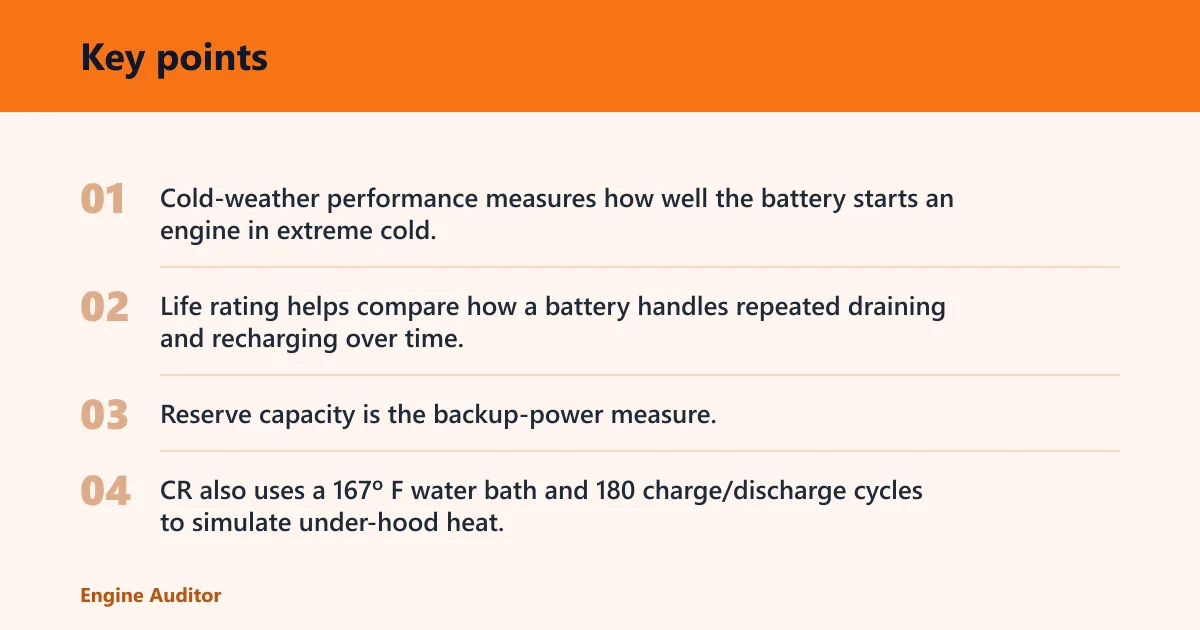
Cold-weather performance measures how well the battery starts an engine in extreme cold. CR freezes batteries at 0º F for this part of the evaluation, which matters if winter mornings are part of your reality and you want a reliable crank when temperatures drop.
If winter is your main concern, do not overpay for a battery that looks good on paper but is weaker in the cold-start part of the score.
Life rating
Life rating helps compare how a battery handles repeated draining and recharging over time. That makes it especially useful for budget shoppers, because a cheap battery that wears out early is not really cheap.
Reserve capacity
Reserve capacity is the backup-power measure. It tells you more about failure-case planning than about normal commuting, which is why it matters more in vehicles with more accessories or more risk of charging-system trouble.
Extreme-temperature testing
CR also uses a 167º F water bath and 180 charge/discharge cycles to simulate under-hood heat. That combination matters because heat degrades batteries over time, even when the battery still starts fine on day one.
Do expensive car batteries last longer? Often, but not always. The better question is whether the battery’s construction and test results fit your climate, short-trip pattern, and accessory load.
Are cheap car batteries worth buying?
Yes, if the cheap battery is the right type and fits the vehicle. A lower-priced flooded battery can be the smarter buy when the car has a simple electrical load, the climate is manageable, and you want the best return on each dollar spent.
The mistake is buying the lowest sticker price without checking reserve capacity, cold-start strength, and fitment. That is how a bargain turns into a repeat replacement.
Frequently asked questions
What are the best budget car batteries that still perform well?
The best budget batteries are usually the ones that combine a low purchase price with acceptable cold-weather performance and decent life. For most shoppers, that means a good flooded lead-acid battery such as EverStart Maxx, Interstate MT, or Exide Value. AGM is worth considering when the vehicle’s demands are higher.
Which budget car battery lasts the longest?
The longest-lasting budget battery is usually the one matched to the vehicle’s use pattern, not the one with the highest sticker price. A higher-quality flooded battery can last well in a simple commuter car, while AGM may last longer in a vehicle with short trips or accessory draw. Fit and use matter.
Is AGM worth it if I’m on a budget?
AGM is worth it on a budget only when the vehicle needs it. Start-stop systems, frequent short trips, accessory-heavy use, and deep-discharge risk are the main reasons to spend more. If none of those apply, a good flooded battery usually gives better value per dollar.
How do I know which battery group size my car needs?
Check the owner’s manual first, then verify the label on the old battery. The correct group size depends on the make, model, year, engine size, terminal placement, and mounting style. Common sizes include 24/24F, 35, 47, 48, 49, 51R, and 65, with 94R appearing on some vehicles.
Can a cheaper lead-acid battery still score well in testing?
Yes. Some top-rated lead-acid batteries can cost less than competitors and still score well. That happens when the battery delivers acceptable cold-start performance, life, and reserve capacity without unnecessary extras. Lower cost does not automatically mean weaker performance.
How do weather conditions affect budget car battery performance?
Cold weather hurts starting performance, which is why 0º F testing matters. Heat also shortens battery life over time, and CR simulates under-hood heat with a 167º F water bath. A budget battery that performs well in both conditions is usually the better all-around buy.
Products related to this article
Sponsored / affiliate links. As an Amazon Associate I earn from qualifying purchases. I may earn additional commission from eligible campaigns.