When to Change Ford Coolant and Why It Matters
Many Ford coolant systems are time-due, not color-due. For some newer orange or yellow OAT applications, a common aftermarket interval is about 5 years or 100,000 miles, while Ford UK’s published guidance for the specified antifreeze and coolant is 10 years or 125,000 miles. If the fluid is rusty, oily, low, or the engine has overheated, treat it as condition-due or problem-due now. Skip service and you can corrode the radiator, water pump, heater core, and head gaskets, turning a simple job into a major repair. This guide tells you when to top off, test, drain-and-fill, flush, or book an inspection based on Ford model history, mileage, coolant type, and symptoms.
What coolant does in a Ford
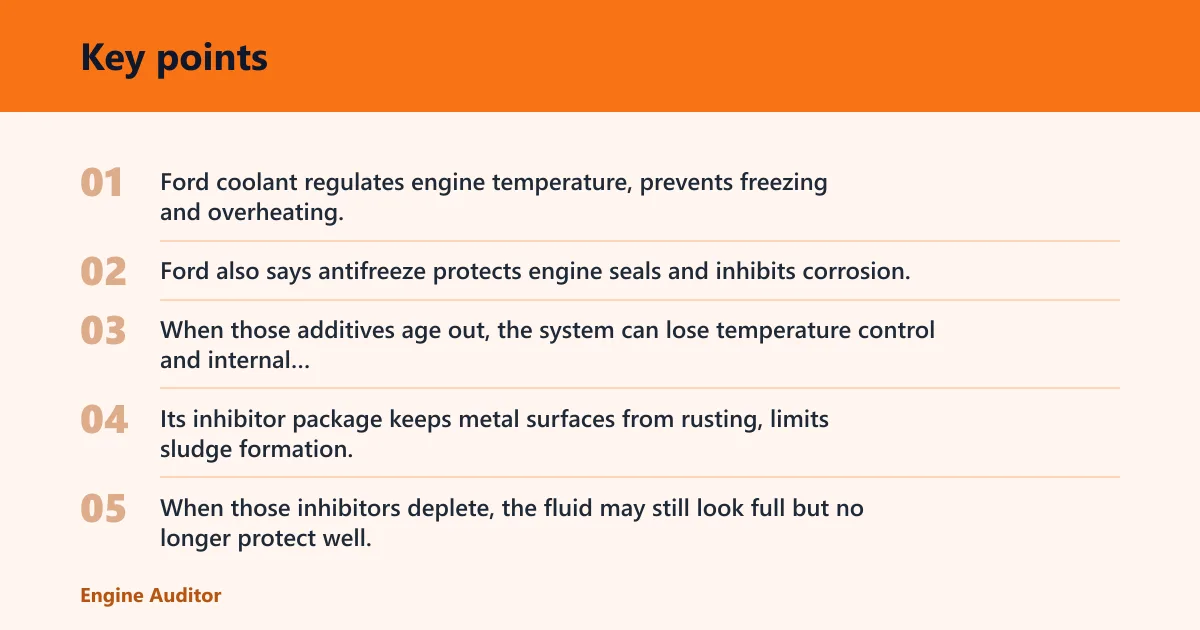


Ford coolant regulates engine temperature, prevents freezing and overheating, and carries corrosion inhibitors through the radiator, water pump, hoses, thermostat, and heater core. Ford also says antifreeze protects engine seals and inhibits corrosion. When those additives age out, the system can lose temperature control and internal protection.
Why old coolant can turn into a repair issue
The coolant does more than move heat. Its inhibitor package keeps metal surfaces from rusting, limits sludge formation, and slows acid buildup inside the passages and around the seals. When those inhibitors deplete, the fluid may still look full but no longer protect well.
That matters because aged coolant can allow rust, scale, sludge, and acid buildup. Those byproducts reduce heater performance, clog narrow passages, and can wear pumps and seals. If the engine has already overheated, the problem may have moved beyond service timing and into fault diagnosis.
When should Ford coolant be changed?
Ford UK recommends changing antifreeze and coolant every ten years or 125,000 miles for the specified product. That is useful, but it is not universal for every Ford in every market, model year, or engine family. Match the service interval to the vehicle’s own literature and coolant specification.
Why model year, engine family, and market matter
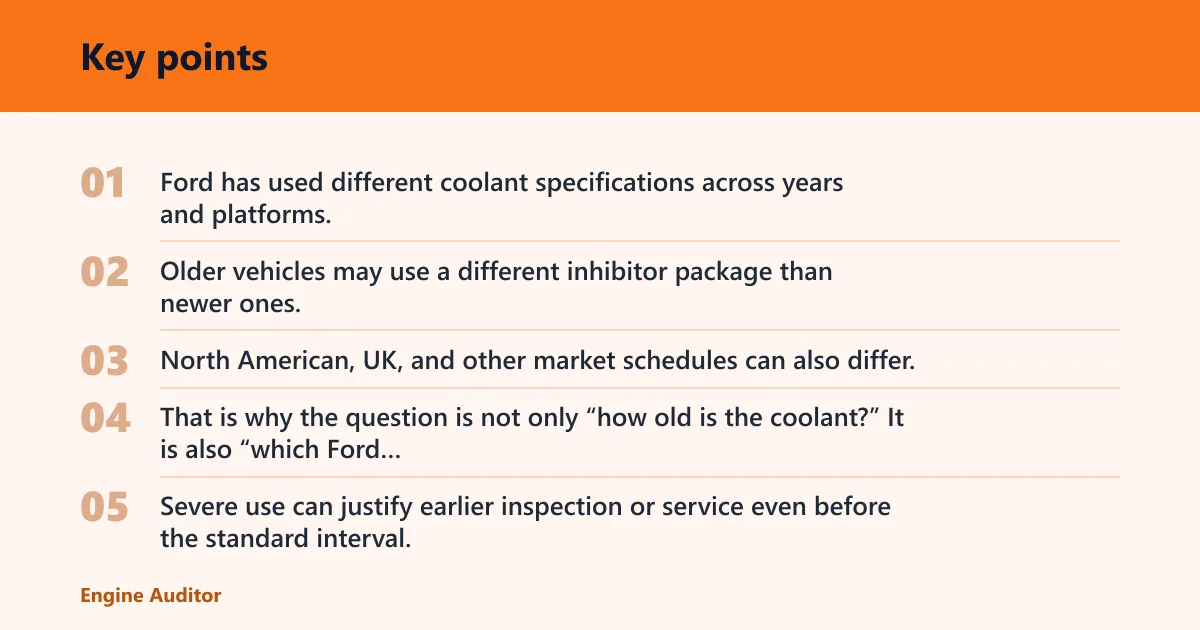
Ford has used different coolant specifications across years and platforms, and the service interval can change with the coolant chemistry. Older vehicles may use a different inhibitor package than newer ones. North American, UK, and other market schedules can also differ, so a generic mileage rule can miss the mark.
That is why the question is not only “how old is the coolant?” It is also “which Ford coolant spec does this engine require?” A late-model turbo engine, a hybrid, and an older truck may not follow the same service logic even if the coolant color looks similar.
When severe use shortens the window
Severe use can justify earlier inspection or service even before the standard interval. That can include towing, repeated short trips, stop-and-go driving, long idling, and extreme heat or cold. Those conditions drive more heat cycles and can speed up additive wear.
Say your F-150 tows a trailer every weekend in hot weather. The coolant may need testing before the interval is due, because heat load and load duration matter. Suppose your Escape only makes 3-mile winter trips. Moisture and repeated cold starts can still shorten the useful life of the fluid and make testing worthwhile earlier.
What coolant does Ford use?
Use the exact Ford specification for the vehicle, not the bottle color. Ford Motorcraft coolant is the Ford-branded reference point for aftermarket comparisons, but the correct choice still depends on model year and powertrain. Color is not a reliable identifier for compatibility or condition.
Why color is not enough
Healthy coolant is often bright and translucent, but that does not prove it is the right chemistry. Different brands can tint similar formulas differently, and old coolant can stay deceptively clear while its inhibitors are already depleted. Matching the specification matters more than matching the shade.
Generic comparison charts often place Ford in the HOAT family, or Hybrid Organic Acid Technology. TheFixCar lists HOAT as used by Ford, BMW, Mercedes, and Mopar, and describes it as a 3–5 year type in generic guides. That is a comparison point, not a substitute for the vehicle’s service data.
Signs coolant is due
Coolant is due when the service history is old or unknown, when contamination appears, or when the system shows fault signs. Repeated low-coolant events, heater output loss, reservoir residue, overheating, warning lights, and air-pocket symptoms after service all deserve attention. A dashboard coolant or temperature warning light is a fault signal, not a command to replace coolant blindly.
Common Ford-specific clues
A Ford with recurring low level may have a small leak, a cap issue, a bleeding problem, or an internal fault that has not been found yet. Heater output that drops at idle can point to low level or trapped air. A milky, rusty, or sludgy reservoir points to contamination rather than a simple top-off need.
The warning light should trigger inspection for low level, overheating, leaks, thermostat issues, water-pump problems, or air trapped in the system. Ford says coolant replacement is needed if the coolant warning light is displayed, but that warning is really the sign to diagnose the cause first. Fix the fault, then decide on service.
Ford coolant decision table
| Service history | Symptoms | Recommended action | Note for towing, short-trip, and severe use |
|---|---|---|---|
| Known, within interval | Absent | Top off only if level is slightly low and the correct coolant spec is available; otherwise test the coolant first | If the vehicle tows, idles a lot, or sees extreme heat or cold, test earlier than the usual interval |
| Known, overdue | Absent | Drain-and-fill or service per Ford procedure; use the correct coolant spec and bleed the system fully | Short-trip and stop-and-go use support earlier replacement because the fluid sees more heat cycles |
| Unknown | Absent | Test pH and freeze protection first; if results are poor or the coolant looks questionable, plan drain-and-fill or inspection | For towing or extreme climates, treat unknown history as higher priority and inspect sooner |
| Known or unknown | Present: repeated low level, residue, sludge, overheating, warning light, heater loss, or air-pocket symptoms | Shop inspection first, then service based on the fault found; a flush is not automatic | Severe use can expose leaks, weak caps, weak pumps, or marginal cooling capacity faster |
| Known, mixed or contaminated fluid | Present: discoloration, deposits, or oily film | Test, then drain-and-fill or model-specific flush if the service literature calls for it | Earlier action is sensible if the vehicle works hard or the coolant history is uncertain |
How to check coolant condition
Use pH and freeze-point testing when the coolant looks questionable or the service history is unknown. The same source notes that pH can drift acidic as inhibitors deplete. That is a practical warning sign because acidic coolant no longer protects the system well, even if the level looks normal.
How to read the result
Freeze protection should match the climate the vehicle must survive. If protection is weak, the coolant is no longer fit for the season or the region. If pH is abnormal or the fluid cannot meet the needed freeze-point protection, service is due rather than optional.
Testing is enough when the fluid is clean, the history is known, and the results are acceptable. It is not enough when there is sludge, oil contamination, repeated low level, overheating, or warning lights. In those cases, the test is only the first step.
When a visual check helps
Healthy coolant is usually bright and translucent. Murky fluid, visible particles, or a reservoir film can point to corrosion or mixed coolant. A visual check is useful, but it should not overrule the test results or the service history.
Drain-and-fill or flush?
For many Ford systems, the right answer is a drain-and-fill carried out to the model’s procedure, not an automatic full flush. Some service charts call for coolant replacement with exact bleeding steps rather than a generic flush. That distinction matters because Ford cooling systems vary in layout and bleed requirements.
Why distilled water matters
If a flush cycle is used, distilled water should be used, not tap water. Minerals in ordinary water can leave deposits that work against the corrosion inhibitors and reduce long-term protection. That is especially important in systems with narrow passages or sensitive heater cores.
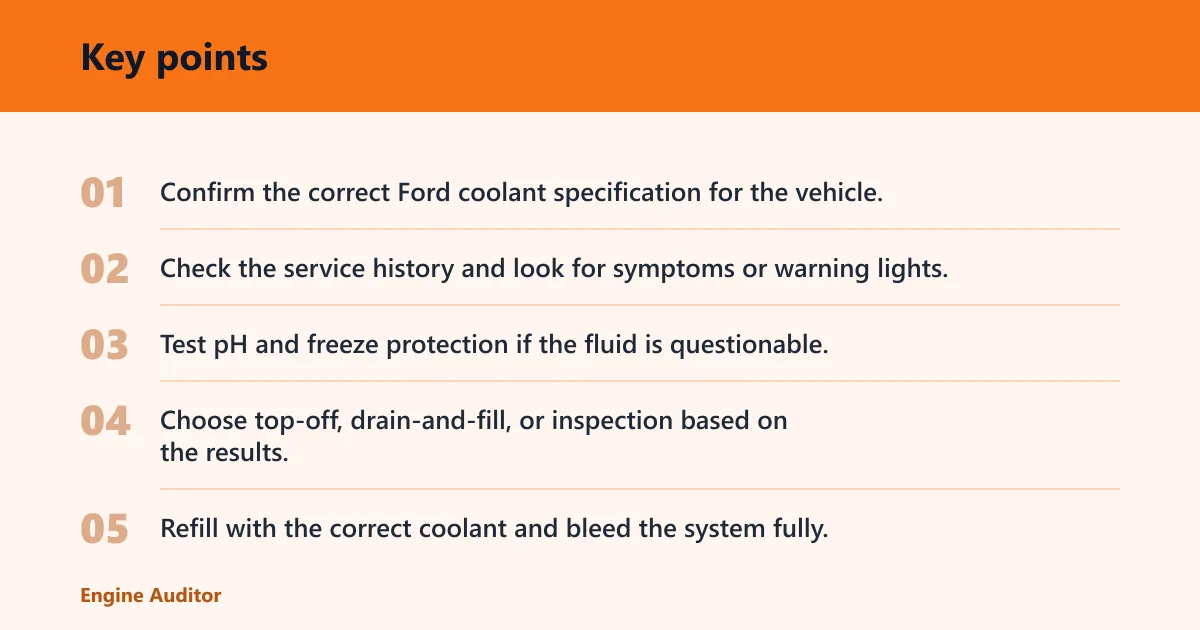
- Confirm the correct Ford coolant specification for the vehicle.
- Check the service history and look for symptoms or warning lights.
- Test pH and freeze protection if the fluid is questionable.
- Choose top-off, drain-and-fill, or inspection based on the results.
- Refill with the correct coolant and bleed the system fully.
Why bleeding matters after refill
Many vehicles need a bleed screw or a specific bleed sequence after refill. If air is trapped, the heater may blow cold, the gauge may swing, or the engine may overheat even though the reservoir looks full. Poor bleeding creates a new problem right after service.
Cost follows the work being done. A dealer or Ford-trained technician may charge more because the correct coolant, model-specific steps, and bleeding procedure take time. An independent shop can be a good option if it follows the exact Ford spec and bleeding process for that engine family.
Frequently asked questions
Why should I replace my coolant?
You replace coolant because its corrosion inhibitors deplete over time. When that happens, the fluid can stop protecting seals and metal parts inside the radiator, water pump, hoses, thermostat, and heater core. Old coolant may still look normal while its protection has already dropped off.
Does coolant need to be changed?
Yes, coolant needs to be changed on schedule or when condition calls for it. The same source recommends ten years or 125,000 miles for the specified product, but model year, engine family, and market can change the correct interval. Unknown history or poor test results justify earlier service.
Should you change your coolant?
You should change it if the interval is overdue, if the coolant tests poorly, or if the vehicle shows signs of a cooling-system fault. Repeated low level, sludge, overheating, or a warning light mean the issue is not just age. Inspection comes first when a fault is present.
How often should Ford coolant be changed?
Ford UK’s published interval is ten years or 125,000 miles for the specified antifreeze and coolant. That is not universal for every Ford. Some coolant families and service guides use shorter periods, and severe use can shorten the practical service window even more.
Can I use any coolant in my Ford?
No. Use the exact coolant specification for the vehicle, not the bottle color. Ford Motorcraft coolant is the brand reference point, but the required chemistry depends on the model and powertrain. Mixing the wrong type can reduce protection and create compatibility problems.
How do you know coolant is due?
Coolant is due when the service history says so, when pH or freeze-point testing shows weak protection, or when symptoms appear. Watch for repeated low level, heater output loss, reservoir residue, overheating, air-pocket symptoms after service, or a coolant warning light.
Products related to this article
Sponsored / affiliate links. As an Amazon Associate I earn from qualifying purchases. I may earn additional commission from eligible campaigns.