Why Does My Car Rattle When the AC Is on?
If your car rattles only when the A/C turns on, check the compressor clutch, serpentine belt, idler pulley, belt tensioner, and idle control first; if the noise stays with A/C off, look elsewhere. Ignoring it can turn a minor belt or mount issue into stalling, broken accessories, or compressor damage. This guide separates load-related engine vibration from exhaust, mount, oil, and interior-rattle causes so you can narrow the source faster.
Why the AC makes a rattle more obvious

- OEM aramid cord construction
- Designed to reduce noise and vibration
- Replaces listed belt part numbers
The A/C compressor typically adds load as soon as it engages. That extra load can drop idle speed slightly, expose a weak mount, or make a worn pulley, belt, or tensioner speak up only when the engine is already near its smooth limit.
That is why the noise may show up at a halt, in gear, or with the brake held. It may sound like a rattle, a rough rumble, or a shake. The symptom matters more than the word you use.
What load-related vibration usually means
If the sound changes with engine speed, shifts when you move from park to drive, or fades when the A/C cycles off, treat it as an engine-bay or load issue first. A compressor clutch, idler pulley, belt tensioner, or serpentine belt can all transmit a bad bearing or a weak spring into the cabin.
Borderline engine mounts can behave the same way. The extra A/C load may make the engine rock enough for a mount problem to become obvious only at idle.
When the sound is vibration, not a loose part
A loose part usually has a sharper, more metallic character and often stays tied to one road surface, one body panel, or one engine speed range. A true load-related vibration is more likely to change the whole idle feel, especially in gear.
Suppose the car idles smoothly with the A/C off, then starts to buzz and shake only after the compressor clicks in. That points away from a random loose object and toward a load-sensitive part under the hood.
AC rattle diagnostic matrix
Use the table to separate sound type, engine state, and likely source before you open parts up. Start with the easiest checks first. If the noise changes only at idle, only in gear, or only with the A/C on, that pattern is more useful than the word “rattle.”
| Noise type | Engine state | A/C state | Sound location | Likely component | First check |
|---|---|---|---|---|---|
| Light rattle or buzz | Idle, parked | On | Top or front of engine | A/C compressor clutch | Watch for engagement and listen for a change when the clutch cycles |
| Whir, chirp, or light rattle | Idle, parked or in gear | On | Belt side of engine | Idler pulley | Inspect for roughness, wobble, or a noisy bearing |
| Rattle with belt flutter | Idle or low speed | On | Front of engine | Belt tensioner | Check tensioner arm movement, spring control, and belt tracking |
| Squeal, slap, or flutter | Idle, acceleration, or load change | On or off | Front of engine | Serpentine belt | Look for glazing, cracks, contamination, or misrouting |
| Metallic rattle at idle | Idle, parked | On or off | Underbody | Heat shield | Tap suspect shields gently when the exhaust is cool |
| Metal can full of rocks | Idle, in gear, or driving | On or off | Underbody | Catalytic converter | Check for internal break-up; inspect promptly |
| Deep roughness or shake | Idle, especially in gear | On | Whole car or engine | Low engine oil or weak mount | Check the oil level first, then inspect mounts for excess movement |
| Cabin-only rattle | Idle, driving, or bumps | On or off | Dash, door, cargo area | Loose interior trim or screws | Remove loose items, then check panels, clips, and screws |
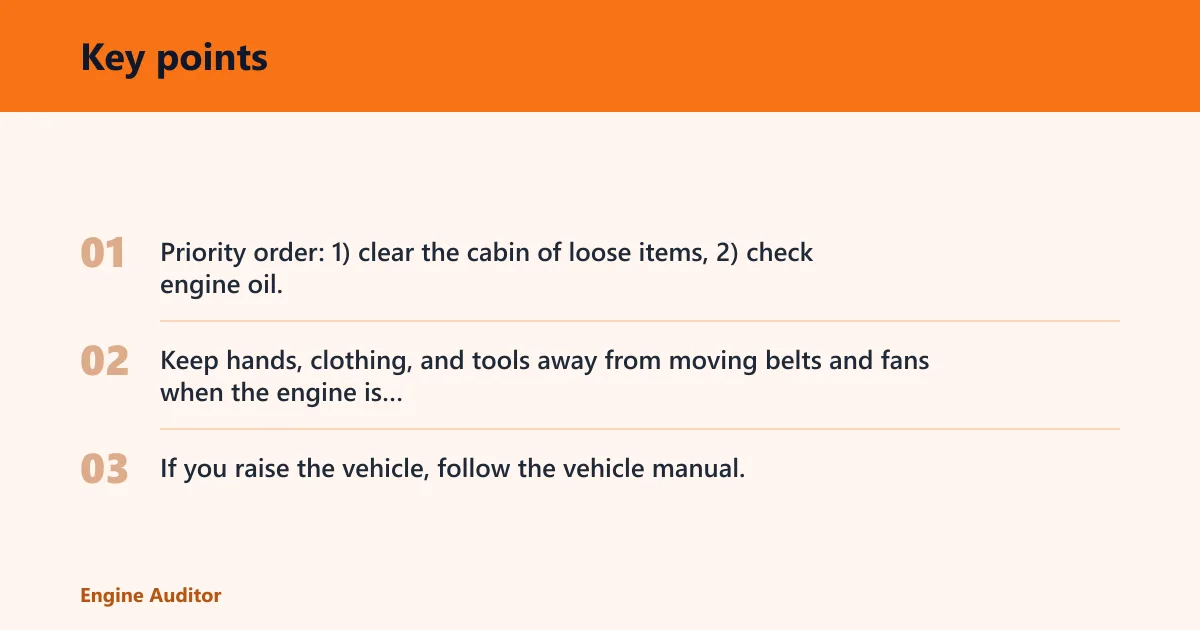
Priority order: 1) clear the cabin of loose items, 2) check engine oil, 3) listen with the hood open and the engine idling safely away from moving parts, 4) inspect the serpentine belt, pulleys, and tensioner, 5) check underbody shields and exhaust hardware, 6) use a shop inspection if the source is still unclear.
Keep hands, clothing, and tools away from moving belts and fans when the engine is running. If you raise the vehicle, follow the vehicle manual, never work under a vehicle held only by a jack, and check local laws for repair work and parking restrictions.
Is the noise coming from the engine bay?
If the sound tracks engine speed, changes when the A/C turns on, or is loudest near the front of the engine, start with the compressor clutch, idler pulley, belt tensioner, and serpentine belt. Those parts share the load path, so one weak part can make the others sound bad.
A sound that gets louder only when the A/C engages is more suspicious than one that stays constant. A constant rattle is more likely to be exhaust, trim, or cargo related.
A/C compressor clutch symptoms
The A/C compressor clutch engages the compressor and adds engine load when the A/C turns on. If the clutch is worn or failing, it may rattle or shake as it comes in, especially at idle or in gear. That kind of fault often shows up as a change right at the moment the compressor cycles.
Listen for a brief rattle, click, or roughness at engagement, then compare it with A/C off. If the symptom appears only when the compressor is commanded on, the clutch deserves attention before you start replacing unrelated parts.
Idler pulley and belt tensioner clues
The idler pulley supports belt routing, and the belt tensioner keeps the serpentine belt tight. Either one can rattle, squeal, or chatter under A/C load if the bearing is worn or the tensioner is loose. The belt may also flutter or wander if the spring is weak.
A simple clue is noise that changes with belt load but not with cabin settings. If the engine quiets down when the A/C is off and the front of the engine sounds rough only under load, inspect the pulley path next.
Serpentine belt slip, chirp, or flutter
The serpentine belt drives the accessory components and can carry noise from a failing pulley or tensioner. Cracks, glazing, fluid contamination, and poor tension can all turn a mild load change into a visible shake or a chirp.
Look for belt flutter at idle and during A/C engagement. A belt that flaps or hesitates under load is telling you that the drive path is not stable.
Could it be exhaust or heat shield noise?
Yes. A loose heat shield can rattle at idle, and a catalytic converter can also make a metal-can sound if it has broken internal material. Extra engine load from the A/C can make an already loose exhaust part seem worse because idle vibration changes.
The key distinction is location. Exhaust and shield noise usually comes from below the car, not from the top or front of the engine.
Loose heat shield at idle
Heat shields cover exhaust components and are susceptible to corrosion. When a shield loosens, the vibration can sound like a small sheet of metal shaking or buzzing at stoplights and in drive.
The page notes a loose heat shield as a common source of noise. If the sound is most obvious at a halt and less obvious once speed rises, look under the car once the exhaust is cool.
Catalytic converter rattle
A catalytic converter rattle can sound like rocks in a metal can. That is not a harmless noise to ignore. It should be investigated quickly because the converter reduces pollutants, and internal damage can worsen with continued use.
If the sound comes from under the floor and grows when the engine load changes, do not assume it is just trim. A failing converter can imitate a loose shield until you get close enough to inspect it properly.
How load can make exhaust resonance louder
Extra A/C load can lower idle quality just enough to wake up a loose shield or another exhaust piece. That does not mean the A/C caused the exhaust fault. It means the added vibration made an existing problem easier to hear.
Check for changes at idle, in gear, and with engine speed raised slightly. If the rattle is strongest at idle and fades as rpm rises, exhaust resonance becomes more likely.
Why does it shake only at idle or in gear?
If the car shakes most at idle, especially in gear, think about engine load first. Low engine oil can contribute to rattling at idle if there is a leak, and a weak mount can let the engine move enough for the whole car to feel rough when the A/C turns on.
That pattern is not the same as a road-speed vibration. A problem that shows up only while stopped is often load related, not tire related.
Low engine oil and idle roughness
Low oil levels can cause rattling if there is a leak. Check the dipstick before you chase deeper causes, because low oil can make a mild valvetrain or timing-related noise seem worse at idle.
Do not treat low oil as a minor side note. It needs prompt correction because continued driving can damage the engine, even if the car still runs normally for the moment.
Borderline mounts exposed by AC load
A weak engine mount may not make noise by itself until the A/C adds load. Then the engine can rock far enough to produce a shake, thump, or contact noise at idle or in gear.
Picture a car that feels smooth in park, then buzzes and shudders the instant it goes into drive with the A/C on. That change points toward mount movement or an idle problem that the compressor load has exposed.
What a normal idle drop should feel like
A small change when the compressor engages is normal. A harsh drop, a stumble, or a repeated surge is not. If the engine hunts for idle, stalls near stoplights, or shakes so much that the steering wheel trembles, treat it as a diagnostic clue rather than a normal A/C hum.
At that point, compare A/C on and off with the car in park, then in gear with the brake held. The difference between those two tests often separates a true engine-load problem from a random rattle.
Check interior trim and cargo first
Loose interior trim or screws can create false rattle sources, including panels, clips, screws, and cargo-area items. Because cabin noise can echo, it may sound as if the engine bay is rattling when the source is actually inside the car.
Start with the easiest elimination steps. Empty the cargo area, remove loose objects, and press on trim panels while the car is stationary to see whether the sound changes.
Loose screws, clips, panels, and seats
The sourced material specifically points to screws that hold interior panels and trim, and it advises replacing missing screws and broken clips. Those small parts can create a surprising amount of noise, especially when the engine idle changes with the A/C.
If a panel buzzes when the compressor engages, do not assume a major engine fault. A missing clip behind a dash panel can mimic a far more expensive problem.
Cargo-area items that mimic an engine rattle
Seat latches, folded tools, floor mats, luggage, and loose cargo can all move enough to rattle under a slight shake. That matters because the A/C can create just enough vibration to wake up a hidden cabin noise.
Suppose a compact hatchback rattles only with the A/C on and the sound seems to come from the rear. A loose jack, cargo hook, or spare-tire cover may be the entire problem.
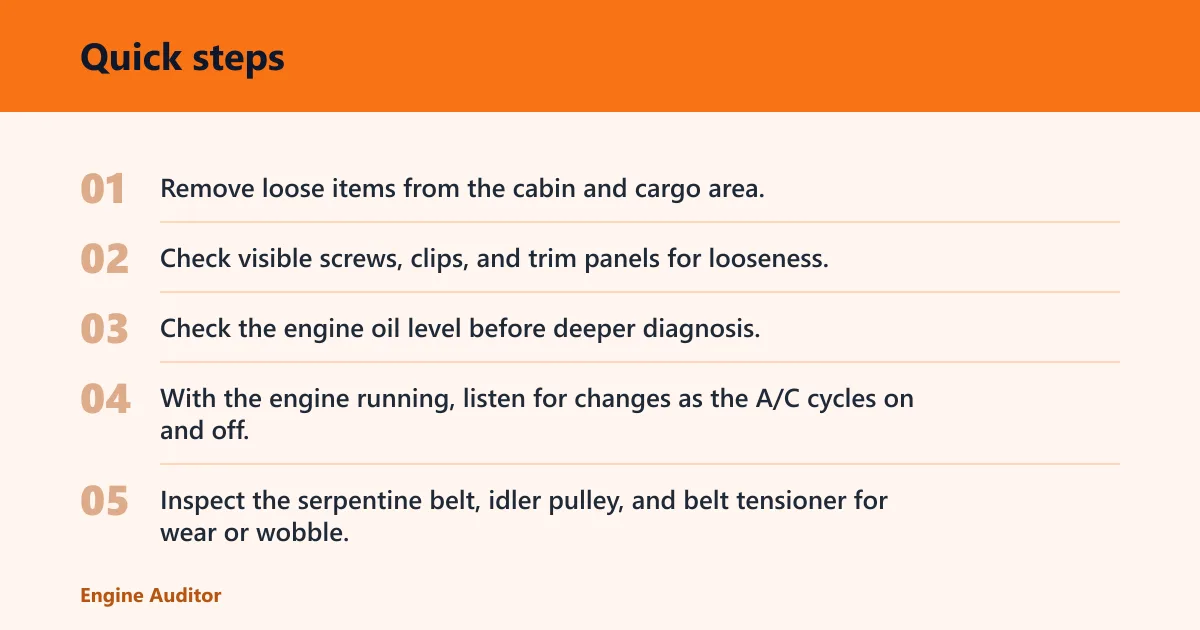
- Remove loose items from the cabin and cargo area.
- Check visible screws, clips, and trim panels for looseness.
- Check the engine oil level before deeper diagnosis.
- With the engine running, listen for changes as the A/C cycles on and off, keeping clear of belts and fans.
- Inspect the serpentine belt, idler pulley, and belt tensioner for wear or wobble.
- Look underneath for loose heat shields or exhaust parts once the exhaust is cool.
- If the source is still unclear, schedule a shop inspection of the compressor drive and exhaust system.
If the A/C clutch, pulley, belt, or compressor area looks suspect, stop short of guessing. A worn pulley bearing, slipping belt, or failing compressor can get worse fast. A heat shield or trim panel is cheaper and simpler, but a catalytic converter or compressor fault needs quicker attention.
Frequently asked questions
Why does my car rattle when the ac?
Most of the time, the A/C adds load and exposes a borderline part: compressor clutch, idler pulley, tensioner, belt, mount, or a loose shield. The quickest separator is whether the noise changes only when the compressor engages. If it does, start in the engine bay before chasing interior trim.
Why does my car shake when the ac?
A shake usually means the A/C load is affecting idle quality or engine movement, not just making a loose part noisier. Check the oil level, then compare park versus drive with the A/C on. If the shake appears mainly in gear, a mount, idle, or compressor-load issue moves up the list.
Why does my car shake when the ac is on and idling?
Idle is where A/C load shows up most clearly. A compressor clutch, weak tensioner, or borderline engine mount can all turn a mild idle drop into a noticeable shake. If the car smooths out as rpm rises, that pattern leans away from wheel or road-speed causes.
Why does my car rumble when the ac?
A rumble can be a rough idle, a resonating heat shield, or a worn pulley bearing that becomes louder under load. Listen for where it comes from. Underbody rumble points toward exhaust or shields; front-of-engine rumble points more toward the belt drive, compressor clutch, or tensioner.
Why does my car shake only when the ac?
That pattern usually means the A/C is not the root cause, but it is the trigger. The compressor load can expose a weak mount, a slipping belt, a noisy pulley, or a rough idle that is already close to the edge. Start with the easiest checks first.
Why is my car rattling when the ac?
Rattling with the A/C on can come from the compressor clutch, idler pulley, belt tensioner, serpentine belt, heat shield, catalytic converter, low oil, or loose interior parts. The location matters most. Top, front, underbody, and cabin noises each point to a different branch of diagnosis.
Why would my car shake when the ac?
Because the A/C adds mechanical load. That extra load can lower idle quality enough to make a weak mount, worn pulley, or low-oil problem show itself. If the shake is strongest at stoplights or in drive, focus on idle and load response before thinking about tires or suspension.
Why does my car engine shake when the ac?
An engine shake usually means the engine itself is reacting to the compressor load. Check for a rough idle, a visible engine rock, or a change when the A/C cycles. If the engine bay seems to move too much, mount condition and compressor drag deserve a closer look.
Why does my car shake when the air conditioner?
The air conditioner can push a marginal system over the line. That can show up as a slight idle drop, a belt-drive noise, or a cabin vibration that only happens with the compressor engaged. A careful A/C on versus off comparison is the fastest way to narrow it down.
Why does my car shake more when the ac?
More shake means more load sensitivity. The extra strain from the compressor can make a worn pulley bearing louder, a tensioner weaker, or a mount more noticeable. If the shake worsens in gear, that is a strong sign the idle system or engine supports need attention.
Why does my car shake sometimes when the ac?
Intermittent shaking often means an intermittent clutch, belt-slip, or idle-control problem. It may happen only when the compressor cycles, when the engine is hot, or when the car is stopped in traffic. A repeatable test at idle, in gear, and with the A/C off helps catch the pattern.
Products related to this article
Sponsored / affiliate links. As an Amazon Associate I earn from qualifying purchases. I may earn additional commission from eligible campaigns.