How Do You Know When Your Coolant Needs to Be Changed?
Change coolant at the manufacturer’s interval, which is often 30,000 to 100,000 miles, or sooner if it looks rusty, oily, sludged, foamy, or the wrong color. Leave it too long and you can overheat the engine, corrode passages, and replace parts a proper diagnosis might have saved. This guide shows when to flush coolant, when to test first, and which faults to fix before any flush.
When should coolant be changed?
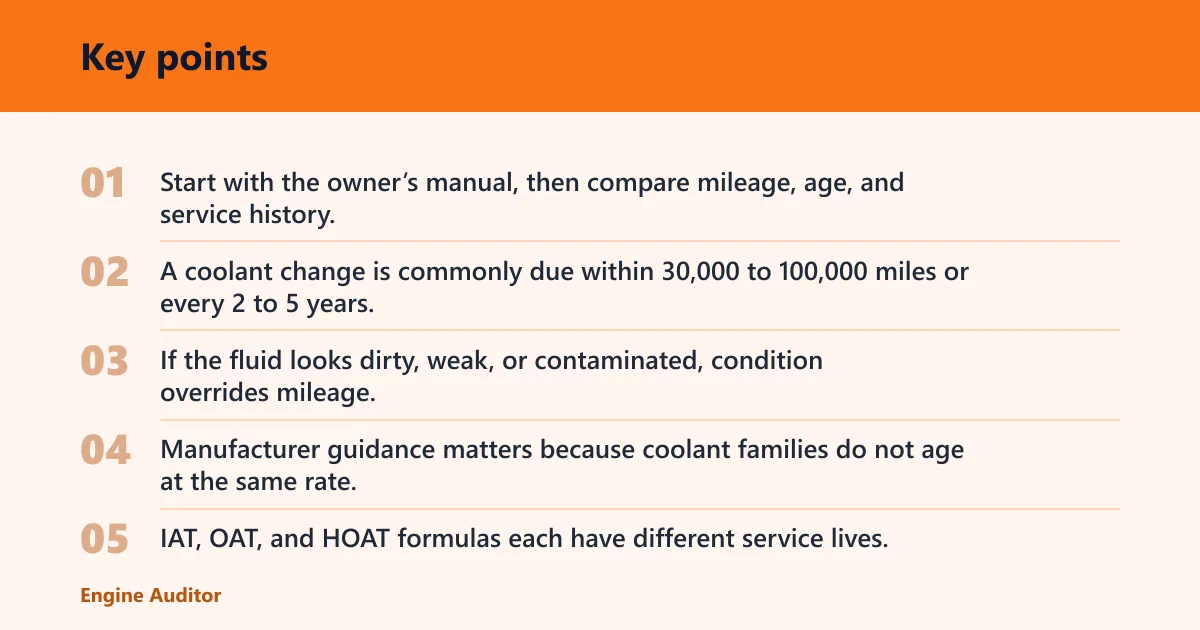
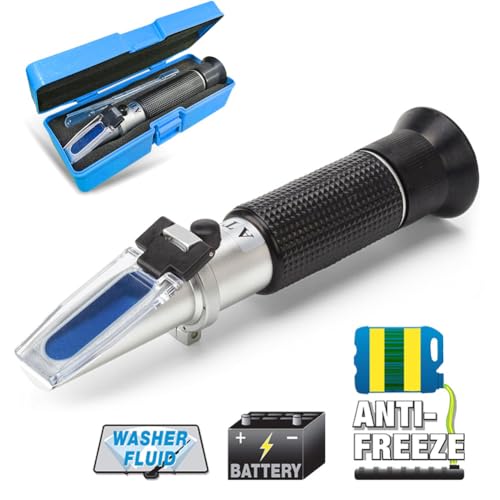

Start with the owner’s manual, then compare mileage, age, and service history. A coolant change is commonly due within 30,000 to 100,000 miles or every 2 to 5 years, but the manual wins when it lists a longer or shorter interval. If the fluid looks dirty, weak, or contaminated, condition overrides mileage.
Use the manual before generic advice
Manufacturer guidance matters because coolant families do not age at the same rate. IAT, OAT, and HOAT formulas each have different service lives, and newer vehicles may specify longer intervals than older ones. If the manual calls for a specific coolant type, use that spec instead of choosing by color.
Combine time, miles, and service history
If the record is incomplete, treat the last known change date as a clue rather than proof. Coolant should be changed if it has not been changed in a year or in the past 20,000 miles. That is a conservative trigger, not a universal factory rule, so it should be weighed against the manual and the fluid’s condition.
Adjust for severe-duty use
Extreme cold or heat, stop-and-go traffic, towing, heavy loads, frequent air-conditioning use, and long idling shorten coolant life. Those conditions make the cooling system work harder and can age the additive package faster. High-mileage and older cars deserve closer checks, especially if service history is spotty.
What healthy coolant looks like
Healthy coolant is usually clear enough to see through, at the right level, and free of rust, foam, oil sheen, or floating debris. Color alone is only a starting point. Coolant can be green, greenish yellow, orange, red, or blue, and none of those colors proves the fluid is good or bad.
Where to inspect it
Check the cooling system reservoir first if the vehicle is designed that way. Some systems also allow inspection at the radiator. Use the correct cold-engine procedure from the owner’s manual, because a pressurized system can be dangerous when hot.
Normal used coolant can still look slightly duller than fresh fluid. That is not the same as contamination. A little color shift over time is expected, but rust particles, sludge, milkiness, or foaming are not.
What normal used coolant may look like
Used coolant may be less bright than new fluid and still be serviceable if the protection level is adequate and the system is clean. A proper inspection looks for overall condition, not showroom color. You are checking for clarity, level, and signs that something else is entering the system.
Signs coolant needs attention
Rust, sludge, foam, oil contamination, repeated low level, overheating, a creeping temperature gauge, warning lights, an unusual smell, and rapid fluid loss can all point to a need for attention now. Some signs mean the coolant itself is aging. Others mean the cooling system needs diagnosis before any flush or top-off.
Rust, sludge, foam, or oil contamination
If the liquid looks rusty or has debris floating in it, a coolant change may be due. Foam can point to aeration, a cap issue, or contamination. Oil in the coolant is a separate problem and should not be treated as simple wear; it can mean a failed seal, gasket, or another internal fault.
Low level that keeps coming back
A low reservoir that returns to low after topping off usually means the system is losing fluid. A sweet smell under the hood can indicate a coolant leak. At that point, topping off only hides the fault for a short time. You need to inspect hoses, the radiator, the cap, the reservoir, and surrounding joints for leaks.
Overheating, warning lights, and gauge creep
An overheating engine is one of the most obvious signs coolant may need changing, but it can also mean a fan, thermostat, water pump, cap, or airflow problem. A temperature gauge creeping upward or a warning light activation deserves diagnosis first. The engine coolant temperature sensor, or ECT sensor, can help the car report temperature, but it does not rule out a cooling-system fault on its own.
Say your sedan’s reservoir is at the full mark on Monday and empty again by Friday, with no puddle under the car. That is not a flush problem first. That pattern calls for leak inspection, because repeated loss points to an unresolved fault.
Should you flush or diagnose first?
Flush dirty or weak coolant after you confirm the fluid is due and the system is otherwise sound. Diagnose first when the level keeps dropping, the engine overheats, or the fluid shows contamination. A flush will not fix a leak, combustion-gas intrusion, or a bad cap, and it can delay the real repair.
When dirty fluid points to a flush
If coolant is old, rusty, or filled with debris but the level is stable and the engine is not overheating, a coolant flush is often the next step. A flush removes rust, gunk, and contaminants that can narrow passages and reduce protection. It is a service step, not a diagnosis for a failing component.
When repeated loss points to leaks
If you must keep topping off, stop treating that as routine maintenance. Repeated low level points to an external leak, a weak cap, or, in some cases, an internal fault that allows coolant to escape into the engine. Flush after repair, not before, so the new coolant is not lost the same way.
When overheating points to internal faults
Overheating can mean low coolant, but it can also point to circulation or combustion issues. If the temperature gauge creeps up, the warning light comes on, or the engine gets hot in traffic, the system needs diagnosis first. A flush is only useful once the cause of overheating is identified.
Coolant condition decision table
This quick table helps you separate a normal service interval from a repair-first problem. Use it after you check the level, look at the fluid, and compare the result with the owner’s manual.
| Observed sign | Likely meaning | Next step |
|---|---|---|
| Clear fluid, normal level, no warning lights | Healthy coolant or acceptable used coolant | Compare mileage and age with the owner’s manual |
| Fluid looks rusty or has debris floating in it | Coolant aging, corrosion, or contamination | Plan a coolant change and inspect for system deposits |
| Level keeps dropping after topping off | Leak or internal loss | Stop topping off and inspect for leaks or internal faults |
| Engine overheats or gauge creeps up | Cooling-system problem, possibly low or weak coolant | Diagnose first; do not rely on a flush alone |
| Foam, oil sheen, or milky contamination | Cross-contamination or another mechanical fault | Inspect for gasket, cap, or internal engine issues before any flush |
| Level low only once, with no other symptom | Possible evaporation, recent service, or minor loss | Verify the cap, hoses, and reservoir, then recheck |
How to check coolant protection
Use a coolant tester or hydrometer when the fluid looks serviceable but its protection level is unknown. These tools draw a sample from the radiator or reservoir and indicate whether the freeze and boil protection is adequate. They are cheap and easy to use, and they help you avoid flushing coolant that still has usable protection.
Why a tester helps before a flush
A tester gives a better answer than color alone. It tells you whether the coolant still protects the engine against overheating and freezing. Coolant’s job is to raise the boiling point and lower the freezing point, so protection level matters even when the fluid still looks acceptable.
A common first-timer mistake is to see orange coolant, assume it must be bad, and order a flush. Color by itself does not prove chemistry or service life. Test first, then decide.
When to ask a mechanic to verify the result
If the tester says protection is weak but the fluid is not dirty, the next step may be a change rather than a repair. If the tester and the symptoms disagree, such as good freeze protection but repeated overheating, the system needs diagnosis. A tester is useful, but it is not a substitute for inspecting hoses, caps, the radiator, the reservoir, or leak traces.
What shortens coolant life?
Heat, cold, towing, stop-and-go traffic, heavy loads, frequent A/C use, and long idling all shorten coolant life. Those conditions increase thermal stress and can speed corrosion or additive breakdown. Severe-duty use matters most in older cars, high-mileage vehicles, and vehicles that spend a lot of time under load.
Climate and coolant type
A 50/50 solution is recommended for year-round use in most areas, and you should never exceed a 70/30 mixture of antifreeze to water. Ethylene glycol is commonly used where colder-climate freeze protection matters because it lowers the freezing point and has lower viscosity. Propylene glycol is often chosen as a safer option around children and pets, and it is commonly mentioned for hotter-climate use in competitor guidance.
Different coolant families age differently
IAT coolant, the older green type, needs changing every two years or 30,000 miles. OAT coolant can last up to 100,000 miles or five years. HOAT coolant can last up to 150,000 miles in some cases. Those are broad service-life examples, not a reason to ignore the manual or the fluid’s condition.
Practical short-list for high-mileage vehicles
- Check the owner’s manual for the exact interval.
- Inspect the reservoir or radiator when the engine is cold.
- Look for rust, foam, oil contamination, and low level.
- Use a coolant tester if the fluid looks clean but the service history is unclear.
- Diagnose leaks or overheating before scheduling a flush.
Frequently asked questions
How do you know when your coolant needs to be changed?
Change it when the owner’s manual says to, or sooner if the coolant looks rusty, dirty, oily, or full of debris. A coolant tester can confirm whether protection is still adequate. If the level keeps falling or the engine overheats, diagnose the system first instead of just flushing it.
How often do you have to change your coolant?
Older green IAT coolant usually needs replacement every two years or 30,000 miles. OAT and HOAT formulas can last longer, depending on the vehicle.
Does coolant need to be changed?
Yes. Coolant loses corrosion protection and can pick up rust or contamination over time. It also ages under heat and load. If you ignore it, the cooling system can corrode, overheat, or clog, which can turn a routine service into a repair bill.
How do I know when my coolant needs to be changed?
Check the fluid level, color, and clarity, then compare the result with the manual and the last service date. Dirty fluid, visible rust, floating material, or weak protection on a tester all point toward a change. Repeated low level or overheating means you should diagnose the cause first.
Can I change my coolant myself?
Yes, if you can follow the manufacturer procedure, use the correct coolant type, and safely bleed the system. A DIY change is reasonable on many vehicles. If the system is losing fluid, overheating, or showing contamination, fix the cause before adding fresh coolant so the new fluid is not wasted.
When should coolant be flushed instead of topped up?
Flush when the coolant is dirty, rusty, or weak but the system is not showing repeated loss or overheating. Top off only after you confirm the level is slightly low and the cause is known. If the level keeps dropping, stop topping off and inspect for leaks or internal faults.
Products related to this article
Sponsored / affiliate links. As an Amazon Associate I earn from qualifying purchases. I may earn additional commission from eligible campaigns.