What Car Battery Reviews Actually Matter Most
Match the review score to the job you need done: cold-cranking amps for hard winter starts, reserve capacity for short-trip driving, and warranty only after fit and spec line up. Pick the wrong metric and you can end up with weak starts, early failure, or a second purchase. This guide shows how to read battery reviews for power, life, and warranty by climate, vehicle load, and driving pattern.
Which battery reviews matter most?


Start with fitment. Then weigh the review signal that tracks the failure you most want to avoid. For many shoppers, that means checking group size and electrical requirements first, then choosing between starting power, backup runtime, and endurance based on climate and driving pattern. One high score does not serve every driver the same way.
Consumer Reports rates batteries within group sizes, which matters because a strong result in one class should still be judged against the same physical size and fitment. Consumer Reports also gives more weight to life-test results than reserve capacity, and says that trade-off against reserve capacity and cold-cranking performance is usually worth it.
Separate starting power, backup runtime, and durability
Cold-cranking amps, reserve capacity, and life-test results answer different questions. CCA measures starting power in cold weather. Reserve capacity shows how long the battery can support the vehicle’s electrical load if charging is limited. Life-test results speak to endurance and repeated use over time.
That means a battery with the highest CCA is not automatically the best buy for every driver. A lower headline start number may still be the better choice if it lasts longer under repeated use, fits the vehicle correctly, and has warranty terms that protect the purchase.
Match review signals to your driving pattern
Use the review that fits the battery’s main job. Cold-climate drivers should put more weight on starting performance. Short-trip drivers need reserve capacity and endurance because the battery may not fully recharge between starts. Stop-start vehicles need cycle durability, not only a strong one-time crank.
High-mileage commuters often benefit from strong life-test results because frequent starts and recharging cycles punish weak batteries. Emergency backup use is different again, reserve capacity matters more than a short burst of starting power.
Why one top rating can mislead
A battery can look excellent in one category and still be the wrong purchase. A model with strong CCA but weak reserve capacity may handle a cold morning and then disappoint on short trips with accessory load. A model with strong durability may still miss the mark if it does not meet the vehicle’s required group size or electrical spec.
📊 Consumer Reports currently lists 124 car batteries in its ratings. Source: Consumerreports.
Battery review signals matrix
This matrix ranks the review signals by driving scenario. Use it as a weighting guide, not as a universal scorecard. The best battery review is the one that matches your climate, driving pattern, and vehicle requirements.
| Driving scenario | CCA | Reserve capacity | Life-test weight | Warranty length | Recommended priority order |
|---|---|---|---|---|---|
| Cold climate | High | Medium | High | Medium | CCA, life-test results, reserve capacity, warranty |
| Hot climate | Medium | Medium | Very high | Medium | Life-test results, CCA, reserve capacity, warranty |
| Short trips | Medium | High | High | Medium | Reserve capacity, life-test results, CCA, warranty |
| Stop-start vehicle | Medium | High | Very high | Medium | Life-test results, reserve capacity, fitment, CCA, warranty |
| High-mileage commuting | Medium | Medium | Very high | Low to medium | Life-test results, CCA, reserve capacity, warranty |
| Emergency backup use | Low | Very high | Medium | Medium | Reserve capacity, life-test results, warranty, CCA |
Cold climate priority order
In cold weather, starting power moves up the list. Low temperatures slow chemical activity inside the battery and make engine cranking harder, so CCA should be compared against the vehicle’s requirement first. After that, look at life-test results for durability and reserve capacity for backup support.
Hot climate priority order
Hot weather affects car batteries and can cut reliability. Heat often shortens service life more than cold-start difficulty does, so life-test results deserve the most attention. CCA still matters, but a battery that survives heat stress and repeated charging cycles is usually the better long-term choice.
Short-trip and stop-start priority order
Short-trip driving can leave a battery undercharged, especially when lights, infotainment, or climate systems are on. Reserve capacity becomes more important because the battery may need to carry more of the load between charging events. For stop-start vehicles, endurance under frequent cycling matters even more.
High-mileage and emergency backup priority order
High-mileage commuters should lean on life-test results first, because frequent starts and recharging cycles punish weak batteries. For emergency backup use, reserve capacity matters most because the question is how long the battery can support the vehicle and accessories if charging is interrupted.
How to read CCA, reserve capacity, and life-test results
Read each metric as a separate part of the buying decision. CCA tells you how hard the battery can crank. Reserve capacity tells you how long it can keep supplying power under load. Life-test results tell you how well it holds up across repeated use, which often matters more than one headline number.
Cold-cranking amps and starting load
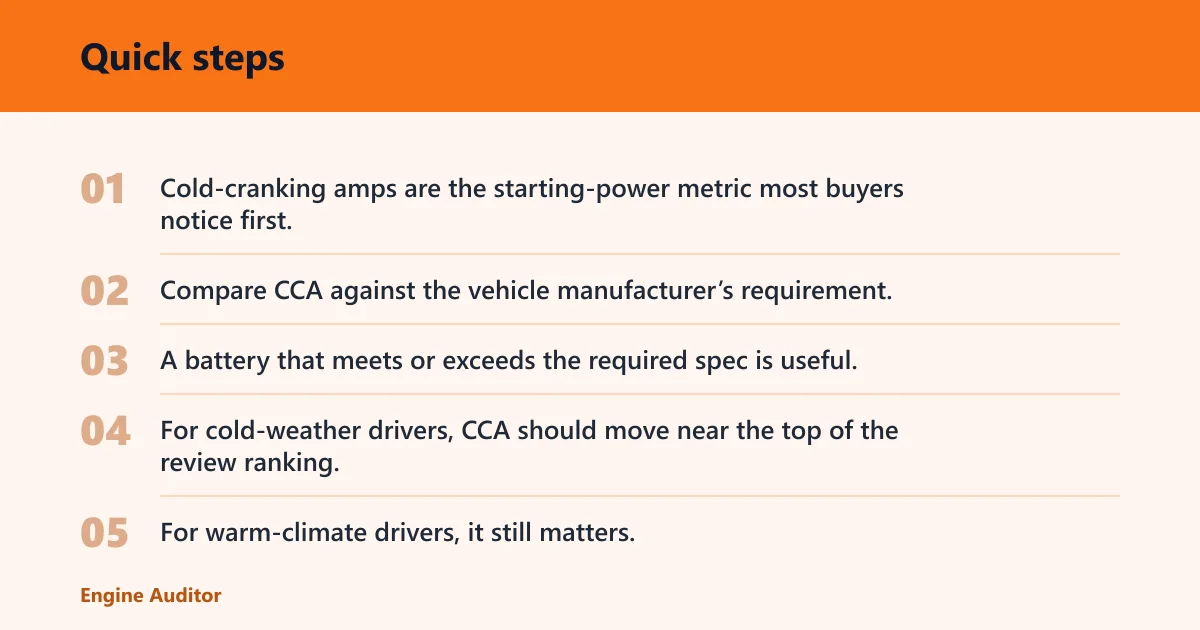
Cold-cranking amps are the starting-power metric most buyers notice first. Compare CCA against the vehicle manufacturer’s requirement, not against a random higher number. A battery that meets or exceeds the required spec is useful; a much higher number does not automatically mean a better fit or longer life.
For cold-weather drivers, CCA should move near the top of the review ranking. For warm-climate drivers, it still matters, but endurance and fit can matter more than chasing the biggest starting number.
Reserve capacity and accessory support
Reserve capacity is the backup runtime metric. It helps when the vehicle is sitting in traffic, idling with accessories on, or making repeated short trips that do not fully recharge the battery. It is also useful when a weak charging event or parasitic drain leaves the battery carrying more of the load than usual.
Picture a driver making several five-minute errands with the fan, headlights, and screen running. A battery with stronger reserve capacity can handle that pattern better than one chosen only for a high starting number.
Life-test results and overall endurance
Battery life-test results measure overall endurance more than headline specs. The same source puts more weight on these results than on reserve capacity, and says the trade-off is usually worth it. That makes sense for drivers who care about long service life, repeated starts, and resistance to age-related decline.
Consumer Reports currently lists 124 car batteries in its ratings, which is a reminder that the useful comparison is usually inside a group size, not across all batteries at once. It also notes there is an affordable car battery option for small cars and big pickup trucks.
What battery warranty terms really mean
Compare warranty terms by structure, not by headline length alone. The practical value of a warranty depends on the free-replacement period, the prorated period, and the exclusions. A long warranty with a short free-replacement window can be less useful than a shorter warranty with stronger early coverage.
Free-replacement period versus prorated coverage
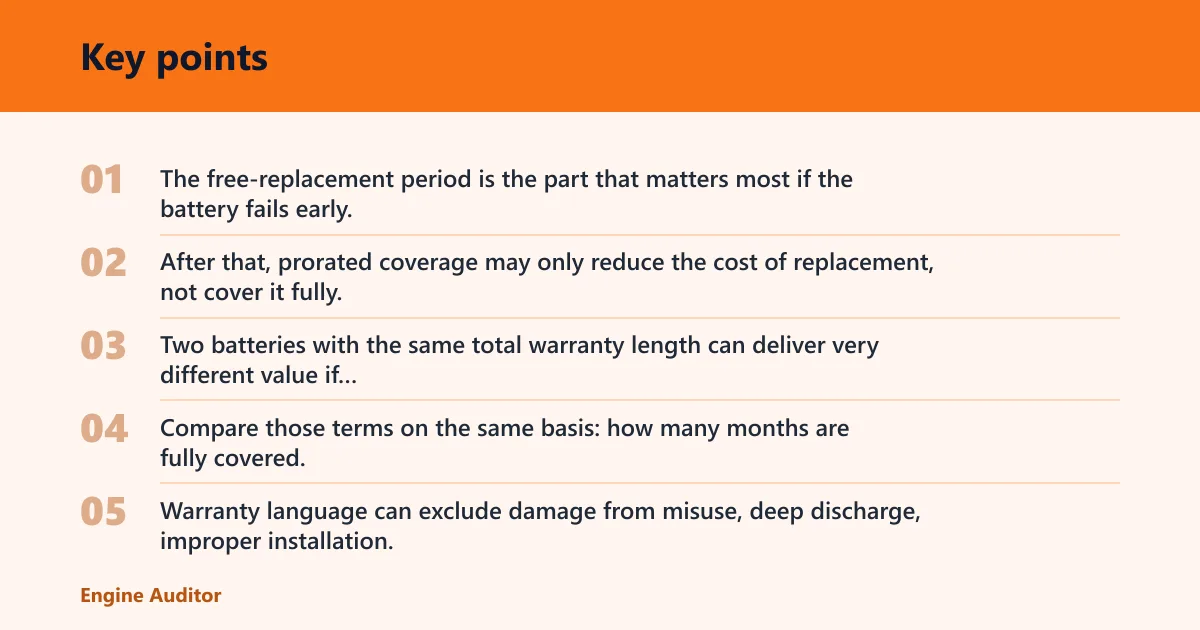
The free-replacement period is the part that matters most if the battery fails early. After that, prorated coverage may only reduce the cost of replacement, not cover it fully. Two batteries with the same total warranty length can deliver very different value if one has a longer free-replacement period.
Compare those terms on the same basis: how many months are fully covered, how many are prorated, and what the consumer actually pays in each stage.
Exclusions, date codes, and claim limits
Warranty language can exclude damage from misuse, deep discharge, improper installation, or a charging system problem. Date codes and installation timing also matter, because warranty clocks may start before the battery goes into service. Check claim limits so the buyer knows whether the warranty is full replacement, partial credit, or something narrower.
When a longer warranty is worth paying
A longer warranty is worth extra money when the battery also matches the vehicle’s fitment, climate demands, and cycle load. If two batteries are otherwise similar, stronger early coverage and fewer exclusions can justify a higher price. Warranty alone should not rescue a battery that scores poorly for the way the vehicle is used.
Does a higher-priced battery perform better?
Not always. A higher price may buy better endurance, a longer free-replacement period, or a design better suited to repeated cycling, but it does not guarantee stronger real-world performance. If the battery is the wrong size, the wrong chemistry, or the wrong match for the climate, the extra cost can be wasted.
When price reflects stronger endurance
Price often tracks better life-test results, stronger cycling tolerance, or a more suitable design for stop-start use. That matters most when the vehicle sees frequent starts, heat, or undercharging from short trips. In those cases, paying more can be sensible if the review data shows the battery outlasts cheaper choices.
When price mainly buys warranty coverage
Sometimes the extra cost buys a longer free-replacement window or a better prorated structure more than better performance. That can still be worthwhile, especially for drivers who want lower risk on the first failure. But the buyer should verify that the performance numbers still fit the vehicle and climate.
When a budget battery is enough
A budget battery can be the right answer if it matches group size, meets the required CCA, and scores well enough for the driving pattern. A simple commuter in mild weather may not need the most expensive model. The key is avoiding a low-end battery that gives up reserve capacity or endurance that the car actually needs.
Which specs matter for your vehicle and climate?
The best battery review depends on how the vehicle is used. Cold weather pushes CCA higher on the list. Hot weather pushes endurance higher. Short trips and parasitic drain push reserve capacity higher. Stop-start systems push cycle durability and fitment higher than a basic replacement does.
Cold weather and CCA
Cold-weather drivers should treat CCA as a primary filter. A battery that falls short of the vehicle’s required starting power is the wrong choice, no matter how good the warranty looks. For winter use, the first question is whether the battery will reliably crank the engine when temperatures drop.
Hot weather and heat stress
Hot weather punishes batteries through heat stress and faster wear. That makes life-test results more useful than a narrow focus on starting power. A battery that survives heat better may save more money over time than one with a slightly better headline spec but weaker endurance.
Short trips, parasitic drain, and reserve capacity
Short-trip driving and parasitic drain can wear out a battery before age alone would suggest replacement. The same source notes batteries may need replacement because they get old or are unintentionally drained, and that lights or another electrical accessory left on can drain a battery. Reserve capacity matters here because the battery must carry more of the load between charging events.
Say your compact car sits outside, gets driven for ten minutes at a time, and often powers a dash camera and a phone charger. That pattern makes reserve capacity and endurance more valuable than chasing the highest CCA score on the shelf.
Start-stop systems and cycle durability
Start-stop vehicles need a battery built for frequent cycling, often AGM or equivalent construction. Fitment and electrical compatibility still come first, but cycle durability moves to the front of the review. A standard battery can work poorly here even when the price looks attractive.
Battery size, sealing, and start-stop fitment
Group size and physical fit come first. A battery review is not useful if the battery does not fit the tray, terminals, and hold-down hardware the vehicle needs. Electrical requirements matter just as much, especially when the vehicle has start-stop equipment or a demanding charging system.
Group size and physical fit
Group size is the battery’s physical size category. Compare batteries only within the same group size, because direct comparisons across sizes can mislead. The wrong size can create installation problems or fail to match the vehicle’s electrical design, even if the review score looks strong.
Maintenance-free versus sealed batteries
Consumer Reports identifies batteries that are sealed and maintenance-free. That label means less topping-up maintenance, not automatic superiority in life or starting power. Choose sealed or maintenance-free if the convenience matters, but still judge the battery on fit, performance, and warranty terms.
A common first-timer mistake is choosing a maintenance-free battery because it sounds premium, then ignoring reserve capacity for a short-trip vehicle. The construction type is useful. It is not a shortcut around the rest of the spec sheet.
Why start-stop batteries need special attention
Start-stop batteries face more charge-discharge cycles than a standard battery. That is why their reviews should be judged with life-test results and cycle tolerance near the top, followed by fitment and compatibility. A standard battery can work poorly here even when the price looks attractive.
Frequently asked questions
What car battery review ratings matter most: cold cranking amps, reserve capacity, or life-test results?
It depends on the use case. CCA matters most in cold weather and for hard starts. Reserve capacity matters more for short trips, accessory load, and backup runtime. Life-test results often matter most for overall durability, especially in hot climates, stop-start vehicles, and high-mileage use.
How do I compare car battery warranties the right way?
Compare the free-replacement period first, then the prorated period, then exclusions and claim limits. A longer total warranty is not always better if the free-replacement window is short. Also check whether the warranty starts at manufacture date or installation date, since that changes real value.
Is a more expensive car battery actually better in real-world use?
Sometimes, but not automatically. Higher price may reflect better endurance, a better stop-start design, or a longer free-replacement period. It can also just buy warranty coverage. If the cheaper battery matches the group size, CCA requirement, and duty cycle, it may be the smarter purchase.
What does a car battery life test measure?
A life test measures how well a battery holds up across repeated use, not just one start. It is a better guide to overall endurance than a single headline spec. The same source puts more weight on life-test results than reserve capacity and says that trade-off is usually worth it.
How much weight should I give cold-cranking performance in reviews?
Give CCA heavy weight in cold climates and moderate weight in mild climates. Compare the number to the vehicle’s requirement first, not to the biggest number available. If the battery meets the needed CCA and the climate is mild, reserve capacity and life-test results may matter more.
How long do car batteries last in real-world use?
There is no fixed number that fits every driver. Real-world life depends on climate, trip length, charging quality, accessory load, and how often the battery is deeply discharged. The same source notes drivers will likely replace a car battery several times during a vehicle’s life, which fits normal wear and age.
Products related to this article
Sponsored / affiliate links. As an Amazon Associate I earn from qualifying purchases. I may earn additional commission from eligible campaigns.