How to Compare Car Battery Reviews Without Getting Misled
Ignore any battery review that does not match your vehicle’s group size, terminal layout, and required CCA, then compare only reviews that state test conditions and measured performance. Bad comparisons can send you to the wrong battery, leaving you with hard starts, fitment problems, or an avoidable return. This guide helps you separate fitment errors, test-method differences, and real performance signals before you buy.
What makes a battery review trustworthy?
A trustworthy battery review tells you what was tested, under what conditions, and on how many units. It also confirms fitment before scoring the battery, because a wrong-size or wrong-terminal install can make a good battery look bad for the wrong reason.
Source type, test conditions, and sample size
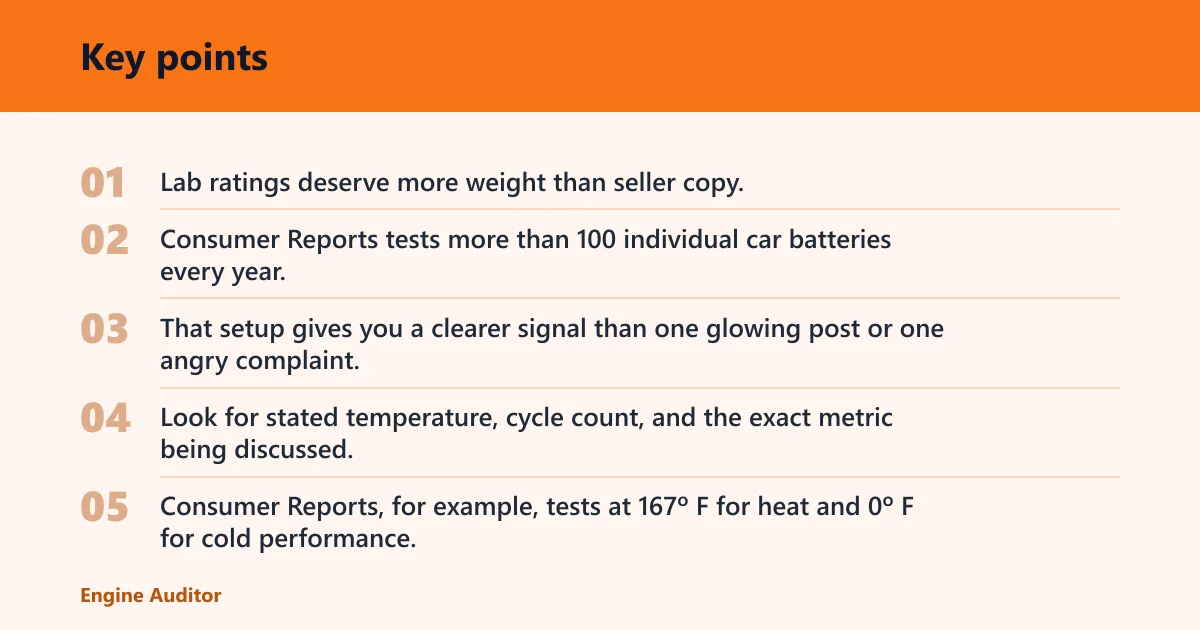
Lab ratings deserve more weight than seller copy, and usually more than a single owner comment. Consumer Reports tests more than 100 individual car batteries every year, and it tests five units of each rated model to check consistency. That setup gives you a clearer signal than one glowing post or one angry complaint.
Look for stated temperature, cycle count, and the exact metric being discussed. Consumer Reports, for example, tests at 167º F for heat and 0º F for cold performance, and it cycles batteries 180 times during testing. Those numbers matter because a review that says only “great battery” gives you no way to judge why it scored well. (Consumerreports)
Why fitment confirmation changes the meaning of a review
Fitment changes the whole reading of a review. If the battery is the wrong group size, has the wrong terminal placement, or does not match the mounting style, the complaint may reflect installation mismatch rather than battery quality. Consumer Reports says replacement batteries must match physical size, terminal placement, and mounting style, and it advises replacing a battery with one from the same group so it fits properly.
📊 Their battery tests simulate under-hood heat at 167º F. Source: Consumerreports.
Battery review sanity-check matrix
Use this matrix to separate strong evidence from weak evidence. The goal is simple: if a review cannot tell you what battery was tested, under what conditions, and whether the fit was confirmed, treat the score as soft evidence, not a buying decision.
| Review source | Test conditions | Group size | Cold-start claim | Life-cycle claim | Reserve-capacity claim | Fitment confirmation |
|---|---|---|---|---|---|---|
| Lab rating | Stated temperature, cycle count, and method | Named | Measured or rated | Measured over cycles | Measured | Confirmed against vehicle fit |
| Owner review | Often missing or partial | Sometimes named | Usually anecdotal | May be long-term, but uneven | Rarely measured | Must be stated by the reviewer |
| Seller copy | Usually vague | Listed, but not verified | Marketing claim only | Marketing claim only | Marketing claim only | Needs outside confirmation |
Scoring rule for misleading claims
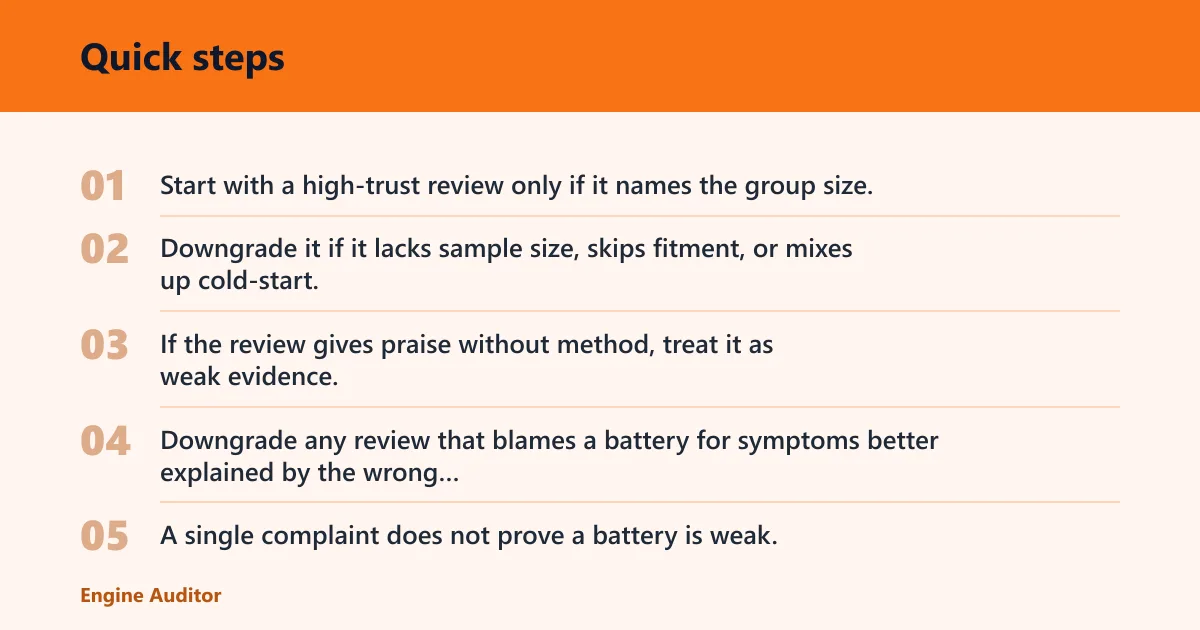
Start with a high-trust review only if it names the group size, states at least one test condition, and gives a measurable result. Downgrade it if it lacks sample size, skips fitment, or mixes up cold-start, reserve capacity, and lifespan as if they were the same thing. If the review gives praise without method, treat it as weak evidence.
When to downgrade a review
Downgrade any review that blames a battery for symptoms better explained by the wrong size, a charging-system fault, or a poor installation. A single complaint does not prove a battery is weak, and a single rave does not prove it will last. The source matters as much as the score.
Why group size should come first
Group size comes first because the battery has to fit the tray, terminals, and hold-down hardware before any performance claim matters. Car battery group numbers vary by make, model, year, and engine size, so a battery that works in one vehicle can be wrong in another even when the reviews sound strong.
Common sizes to compare
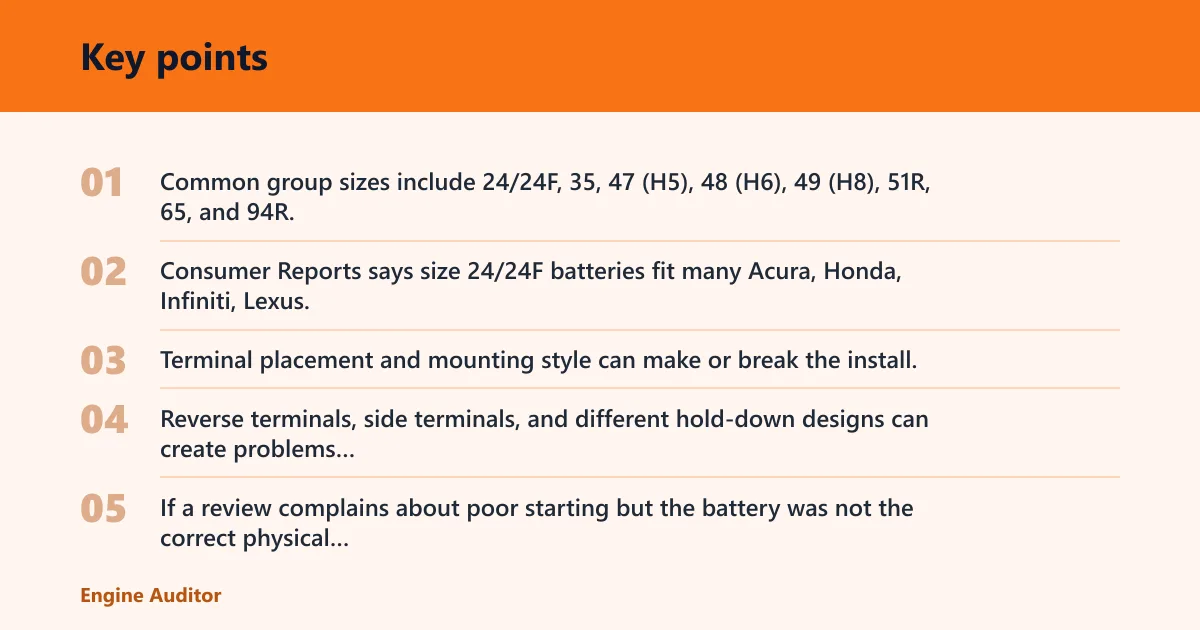
Common group sizes include 24/24F, 35, 47 (H5), 48 (H6), 49 (H8), 51R, 65, and 94R. The same source says size 24/24F batteries fit many Acura, Honda, Infiniti, Lexus, Nissan, and Toyota vehicles, but that is still a fitment check, not a promise that every 24/24F battery will suit every car in those brands.
How terminals and mounting style affect fit
Terminal placement and mounting style can make or break the install. Reverse terminals, side terminals, and different hold-down designs can create problems that look like battery failure. If a review complains about poor starting but the battery was not the correct physical match, the complaint is less useful than it first appears.
Say your sedan needs a 35 battery, but a review you found praises a 47 (H5) model for winter starting. That praise does not help unless the 47 actually fits your tray and terminals. The right battery in the wrong size is still the wrong battery.
How do you read cold-weather battery claims?
Cold-start performance tells you how well the battery can start the engine in cold weather, but it is separate from overall score and reserve capacity. A review that praises winter starting may still say little about lifespan, and a battery with a strong reserve-capacity claim may not be the best cold starter.
Cold-start performance versus overall score
Consumer Reports includes cold weather performance as one rating dimension, alongside overall score, life, and reserve capacity. That structure is useful because it keeps you from treating one good number as proof of total quality. A battery can start well in the cold and still be only average in cycle life.
Signs a review reflects real cold testing
Real cold testing should name the test temperature or at least the method. Consumer Reports uses 0º F freezer testing, which is much more useful than a vague claim like “performed great last winter.” If the review does not say how cold, for how long, or on how many batteries, the claim is thin.
What to ignore in vague winter praise
Ignore winter praise that sounds like a weather report but reads like marketing. “Never let me down in January” tells you almost nothing. The better signal is a measured cold-start result, tied to a specific group size and test setup.
How important is reserve capacity?
Reserve capacity matters because it shows how long the battery can supply energy if the charging system fails. It is useful in failure scenarios, but it should not be confused with cold-start strength or with lifespan. A battery can have solid reserve capacity and still rank differently on winter starting.
How to compare reserve-capacity claims across reviews
Compare reserve-capacity claims only when the reviews use the same battery group and the same type of test language. If one source gives a measured value and another gives a vague claim, the measured one carries more weight. Consumer Reports includes reserve capacity as one of its rating dimensions, but it says the rankings give more weight to life-test results than to reserve capacity and cold-cranking performance.
Suppose one review says a battery kept accessories running after the alternator quit, while another says it “lasted a while” during a power loss. The first is more useful because it points to the failure case the metric is meant to address. The second is hard to compare.
AGM vs lead-acid reviews
AGM and standard lead-acid batteries should not be lumped together as if they behave the same way. AGM batteries use absorbed glass mat construction, often cost more, and are commonly reported to offer long service life and better tolerance of deep discharge. Lead-acid batteries are the lower-cost baseline, but they can still score very well.
What AGM construction changes
AGM batteries are often favored when the vehicle sees deep discharge or more demanding electrical use. The same source says AGM batteries can tolerate deep discharges to 10.5 volts or below. That makes them a different comparison class from standard flooded lead-acid batteries when you are reading reviews about repeated drain-and-recharge use.
Why standard lead-acid can still rate well
Do not assume a lower price means lower performance. The same source says some less expensive batteries score very well. That means you should read the score, the test method, and the fitment details before deciding that AGM is automatically the better buy.
Weather and cycle tests matter
Weather changes battery behavior. Heat speeds wear, cold exposes weak starting ability, and repeated drain-and-recharge testing shows how a battery holds up over time. A review that omits climate and cycle depth leaves out the context that can explain a good or bad result.
Heat, cold, and battery life
Consumer Reports simulates under-hood heat at 167º F and also tests at 0º F. That matters because a battery that looks fine in mild weather can age faster in heat or struggle in cold. Review claims should reflect those conditions, not just average driving weather.
Deep discharge and repeated cycling
Battery life results should tell you how the battery handled repeated draining and recharging. Consumer Reports cycles batteries 180 times during testing, and that repeated stress is a better sign of durability than a single start. This is especially relevant if the car sees short trips, accessory use, or start-stop duty.
A common first-timer mistake is reading a battery complaint about “dead after overnight lights-on” as a simple quality verdict. That can be a deep-discharge scenario, a charging issue, or a battery that was never a good match for the vehicle’s use pattern. The complaint only becomes useful when the review explains the test condition and the battery type.
What should you check before you buy?
Start with the owner’s manual, then cross-check the group size with battery company websites, in-store guides, and a local mechanic. After that, compare reviews that match the same group size and the same technology. That order keeps you from buying a battery that reads well online but fails in the tray.
Use the owner’s manual first
The manual is the first fitment check because it ties the battery to the vehicle’s actual requirements. From there, verify the same group number with other fitment sources. If those sources disagree, stop and confirm before buying.
Separate true battery problems from install or charging issues
When a review mentions hard starts, low voltage, or early failure, check whether the complaint could come from the install or the charging system instead. A wrong terminal layout, weak alternator, or loose hold-down can create symptoms that look like a bad battery. That is why fitment confirmation belongs ahead of any star rating.
Use the matrix before you trust the stars
Star ratings can hide weak method. A battery with four stars from mixed buyers may still be a poor fit if the reviews never mention group size, test conditions, or cycle life. The matrix helps you separate a real performance signal from praise that only sounds convincing.
Frequently asked questions
How do I tell if a car battery review is actually trustworthy?
Trust reviews that name the battery group, state the test method, and give a measurable result. A good review should also confirm fitment. If it only offers praise or blame with no conditions, treat it as weak evidence rather than a buying guide.
What specs matter most when comparing car battery reviews?
Group size, terminal placement, mounting style, cold-weather performance, reserve capacity, and life-test results matter most. Compare those before price or star ratings. A battery that looks strong on one metric may be mediocre on another, so read the full set of claims.
Should I trust star ratings or lab test results for car batteries?
Lab test results should carry more weight because they show conditions, sample size, and measured performance. Star ratings can be useful as a quick filter, but they often mix fitment problems, poor installs, and real battery faults into the same score.
How do I compare AGM and lead-acid battery reviews fairly?
Compare AGM to AGM and lead-acid to lead-acid whenever possible. AGM can handle deep discharge better and often lasts longer in demanding use, while lead-acid can still score very well at a lower price. Do not merge the two technologies as if they have the same behavior.
What is the best way to compare car battery reviews by group size?
Start by confirming the exact group size in the owner’s manual, then check the same group in battery maker data and store guides. Compare reviews only within that group. A battery that ranks well in one size may not perform the same in another size class.
Why do some car battery reviews disagree so much on lifespan?
Lifespan depends on climate, cycle depth, charging system health, and battery type. Heat shortens life, repeated deep discharge changes results, and AGM and lead-acid do not age the same way. Reviews that ignore those factors are often describing different use cases, not the same battery.
Products related to this article
Sponsored / affiliate links. As an Amazon Associate I earn from qualifying purchases. I may earn additional commission from eligible campaigns.