Car Battery Review Checklist for Smart Shoppers
Buy it if your goal is the right battery on the first trip, with no wasted money on a wrong-size or stale unit. The label should give you fitment, starting power, backup capacity, age, and warranty value quickly enough to decide at the shelf.
Use the group-size number, terminal layout, reserve capacity, and cold-cranking amps to confirm fit, then buy only a battery with a recent date code and a warranty that clearly states free-replacement terms. Miss one of those checks, and you can leave with a battery that will not fit, starts weakly, or loses warranty value before installation. This checklist shows how to compare labels side by side, decode freshness marks, and make a fast yes/no purchase decision.
What should you check before buying?
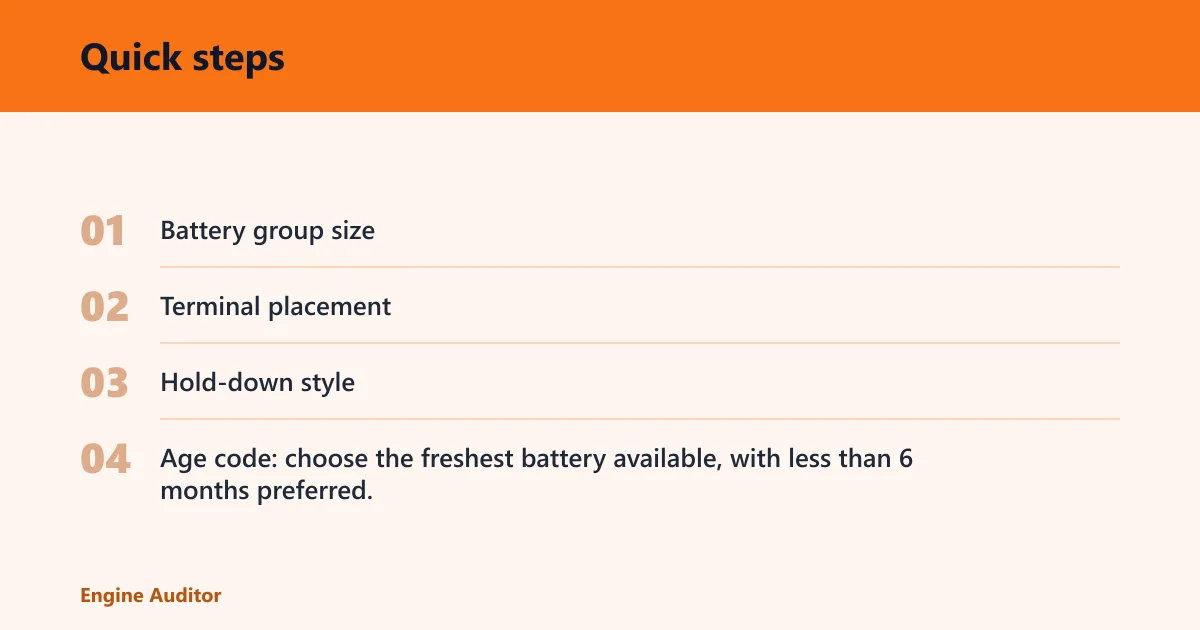

Check fitment first, then starting power, backup capacity, age, and warranty. Miss any one of those, and the battery can be the wrong choice even if the price looks attractive. The quickest store-floor filter is: correct group size, correct terminal layout, acceptable date code, and a warranty with meaningful free replacement months.
Fitment checks that come first
- Battery group size: match the physical case, tray, and cable reach. Common groups include 24/24F, 35, 47, 48, 49, 51R, 65, and 94R.
- Terminal placement: the positive and negative posts must land on the correct side for your cables.
- Hold-down style: confirm the case has the correct mounting lip or base profile for the clamp in your vehicle.
- Age code: choose the freshest battery available, with less than 6 months preferred.
Label numbers that matter
Cold-cranking amps, or CCA, is the battery’s starting-power number in cold weather. Reserve capacity, or RC, helps separate two batteries that look similar on the shelf because it shows how long the battery can supply energy if the charging system fails. If both fit, these two numbers often decide which battery is the better buy.
What to ignore on the shelf
Skip vague marketing copy that says “premium,” “heavy duty,” or “maximum power” without posting the actual CCA, RC, battery type, and warranty terms. A battery review or product card that hides the free replacement months or buries the date code is not giving you the information you need.
Battery shopping checklist
Use this table as a side-by-side pass/fail screen. It is built for store comparison, not for browsing broad category pages. If a battery fails fitment or age, the rest of the specs stop mattering.
| Battery | Fitment | CCA | RC | Battery type | Date code | Warranty | Terminal layout | Red flags | Pass/fail score |
|---|---|---|---|---|---|---|---|---|---|
| Battery A | Group 35 fits tray and clamp | 640 | 100 | AGM | 4 months old | 36/84 | Correct post side, correct height | None visible | Pass, 8/8 |
| Battery B | Group 35 case fits, but posts are reversed | 700 | 110 | Lead-acid | 9 months old | 24/84 | Wrong terminal layout | Old stock, weak free replacement window | Fail, 3/8 |
| Battery C | Group 65 fits tray, clamp needs adapter check | 750 | 120 | Lead-acid | 5 months old | 24/60 | Correct post side | Shorter free replacement period than Battery A | Pass, 7/8 |
How do I know which car battery size fits my vehicle?
Use the owner’s manual or fit guide first, then confirm the tray dimensions, cable reach, terminal side, and hold-down style. The correct group size is a physical fitment code, but it does not solve every fitment problem by itself. Two batteries can share a group size and still fail because the posts land on the wrong side.
Confirm the group size first
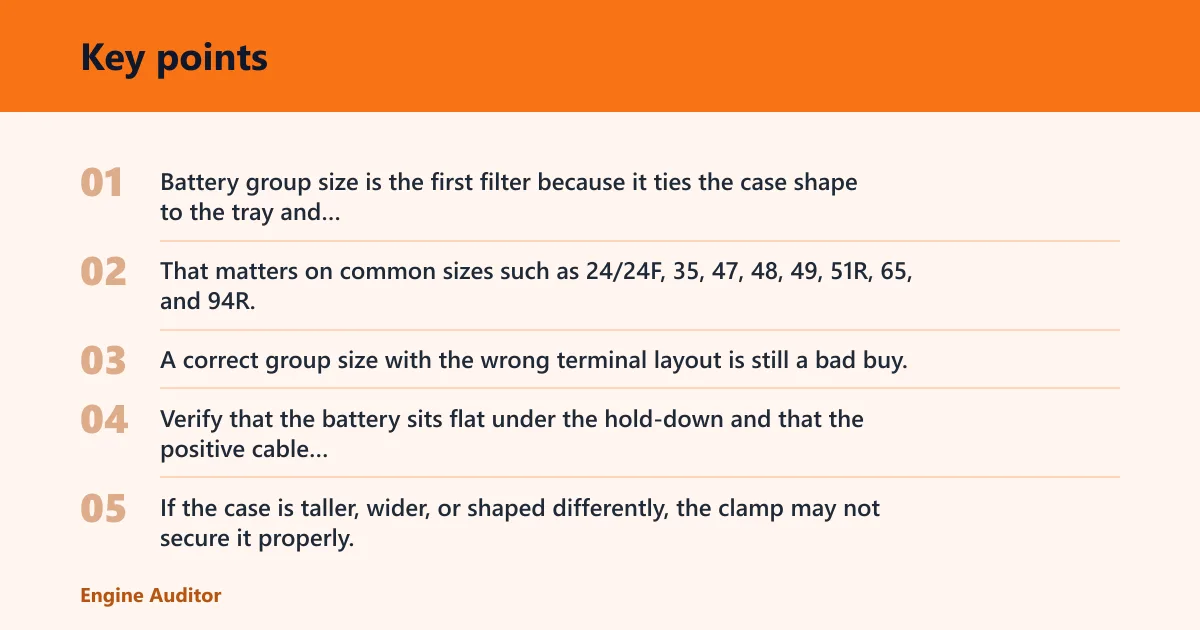
Battery group size is the first filter because it ties the case shape to the tray and terminal placement. That matters on common sizes such as 24/24F, 35, 47, 48, 49, 51R, 65, and 94R. A correct group size with the wrong terminal layout is still a bad buy.
Check the hold-down and cable reach
Verify that the battery sits flat under the hold-down and that the positive cable reaches without strain. If the case is taller, wider, or shaped differently, the clamp may not secure it properly. That is not a minor issue. Improper installation can also affect warranty coverage on some maintenance-free batteries.
Watch for the wrong terminal side
A common first-timer mistake is grabbing the right group size and then discovering the posts are reversed. The battery will not connect cleanly, or the cable may cross over in a way that creates stress and awkward routing. Check the “R” in group names such as 51R when the terminal side matters.
Say your vehicle calls for a 24F but the shelf has a 24 with the terminals flipped. The case may look close enough from across the aisle, but the cable will not land cleanly. That is a pass/fail miss, not a minor inconvenience.
What does CCA mean on a car battery label?
CCA means cold-cranking amps, the battery’s starting-power number in cold weather. Use it to judge whether the battery can turn the engine over with confidence when temperatures drop. If you live where winter starting is hard, CCA should carry more weight than flashy packaging or a vague “high output” claim.
How to use CCA in a store comparison
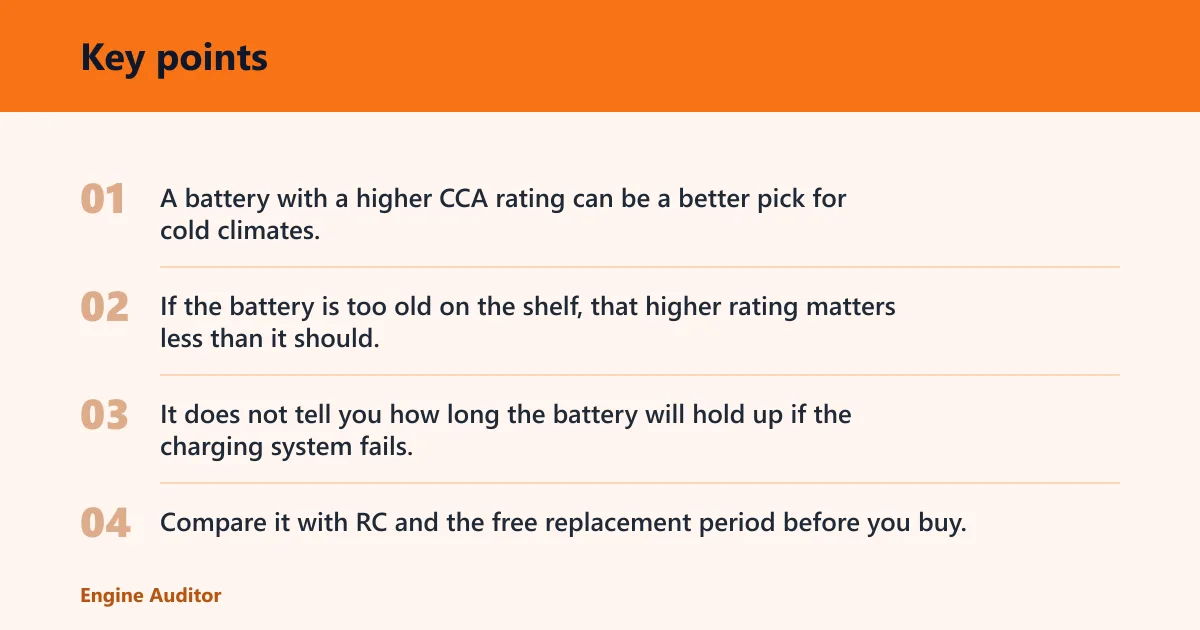
Compare CCA only after fitment checks pass. A battery with a higher CCA rating can be a better pick for cold climates, but only if it is the right size and the terminal layout matches. If the battery is too old on the shelf, that higher rating matters less than it should.
Don’t let CCA replace the rest of the label
CCA tells you starting ability. It does not tell you how long the battery will hold up if the charging system fails, and it does not tell you whether the warranty is worth paying for. Compare it with RC and the free replacement period before you buy.
How important is reserve capacity when choosing a battery?
Reserve capacity matters because it tells you how long the battery can supply energy if charging stops working. That makes it useful for shoppers comparing two batteries with similar CCA. A battery with stronger RC can be the safer choice for accessory-heavy driving, short-trip use, or a vehicle that may sit between starts.
When RC should influence the decision
RC deserves more attention if the vehicle runs lights, infotainment, heated seats, or other loads while idling or at low speed. It also matters if your driving pattern leaves the battery undercharged. In that case, a battery with only good CCA may still disappoint.
When RC matters less
If the vehicle is used for normal commuting, the charging system is healthy, and the battery fits the vehicle’s original spec, RC can be a tie-breaker rather than the main reason to buy. Start with fitment and age. Then use RC to separate two acceptable options.
Should I buy AGM or regular lead-acid?
Choose AGM when the vehicle calls for it, or when deeper discharge tolerance, higher accessory load, or longer service life is worth the added cost. Choose a standard flooded lead-acid battery when the vehicle does not require AGM and you want better value. AGM is not the default answer for every shopper.
When AGM is worth paying
AGM batteries are known for long service life and deep-discharge tolerance. That makes them a strong fit for vehicles with start-stop systems, higher electrical demand, or use patterns that drain the battery more than average. Many top-scoring batteries are AGM for a reason.
When lead-acid is enough
Lead-acid batteries can cost less and still compete well on performance. If the vehicle does not require AGM, and if your driving pattern is ordinary, a fresh standard battery with the right size, solid CCA, and fair warranty can be the smarter buy.
Warranty terms that matter most
The free replacement period matters more than the prorated period. A 24/84 warranty, for example, means 24 months of free replacement and 84 months prorated. Once the free replacement window ends, coverage value drops quickly, so a long prorated period should not make a weak warranty look strong. (Consumerreports)
- Best coverage signal: more free replacement months.
- Weaker signal: a long prorated period with a short free replacement period.
- Watch for exclusions: improper installation, corrosion, or neglect can affect coverage.
How old should a battery be before I avoid buying it?
Avoid older stock if the date code shows the battery has sat too long. Freshness matters because battery performance can drop while it sits on the shelf. As a practical rule, less than 6 months old is preferred, and 3 months old is even better when the price and specs are otherwise close.
Read the date code
The age or date code is usually stamped or printed on the case. It may be a shipping or manufacture code, not a plain calendar date, so you may need the retailer’s code chart or staff help to decode it. If the store cannot explain the code quickly, treat that as a warning sign.
Freshness rule of thumb
Buy the freshest unit you can find. The practical cutoff is simple: under 6 months old is preferred, and older inventory should only win if the warranty and specs are clearly better. That keeps you from paying full price for a battery that has already spent too long in storage.
Suppose two batteries have the same group size and CCA, but one has a 4-month-old code and the other shows 9 months. The newer battery is the cleaner buy unless the older one has a clearly stronger warranty or a lower price that justifies the risk.
Check for corrosion or swelling
On a maintenance-free battery, inspect the case for swelling, leaks, cracked corners, or corrosion around the terminals. Corrosion can point to poor storage or prior handling, and visible damage can complicate warranty claims. A clean case is not proof of quality, but damage is a reason to pass.
Who it’s for
This checklist fits drivers who want a fast, practical decision at the counter. It is especially useful if you live in a cold climate, compare batteries across two or three stores, or want a value pick without guessing at label jargon. It is less useful for shoppers who want the cheapest sticker price and nothing else.
Cold-climate drivers
If winters are harsh, put more weight on CCA, freshness, and annual testing once the battery is older. Consumer Reports says batteries are charged and discharged 180 times in testing, with a 167º F water bath to simulate under-hood heat and freezing at 0º F. That kind of heat-and-cold stress is exactly why CCA and age matter. (Consumerreports)
Daily commuters
If the car sees regular commuting and a healthy charging system, a standard lead-acid battery can be a fine value choice. Focus on correct fitment, a reasonable warranty, and a fresh date code. Do not pay extra for AGM unless the vehicle or usage pattern truly benefits from it.
Shoppers comparing value and longevity
If the goal is to balance price against service life, compare the free replacement months first, then the battery’s age and RC. CR says car batteries typically last three to five years, and AAA data cited by CR says lifespan can reach 58 months or more in far northern regions and can be less than 41 months in southern regions.
What should I check before buying a car battery?
Check the group size, terminal layout, hold-down style, CCA, RC, date code, and warranty terms before you pay. That sequence catches the most expensive mistakes first. If any of those items fail, especially fitment or age, walk away and compare another battery.
How do you tell if a battery is fresh or old in the store?
Read the case date code and look for a battery that is less than 6 months old. A 3-month-old battery is even better. Also inspect the terminals and case for corrosion, bulging, or damage, since those signs can mean poor storage or handling.
How do you know which car battery size fits your vehicle?
Use the owner’s manual or fit guide, then verify the tray dimensions, cable reach, terminal side, and hold-down style. Group size alone is not enough if the posts are reversed or the clamp does not match the case. Common sizes include 24/24F, 35, 47, 48, 49, 51R, 65, and 94R.
Can I replace my battery with the same model as before?
Yes, if the same model still matches the vehicle’s fitment, terminal layout, and electrical needs. Still check the date code and warranty before you buy another one. A familiar model can still be old inventory, and a same-name battery can still be the wrong fit if the vehicle has changed.
What are the key signs of a good car battery review?
A good battery review names the exact battery type, group size, CCA, RC, warranty terms, and age or date code. It should separate free replacement coverage from prorated coverage and say whether the battery fits the vehicle cleanly. Reviews that stay vague about specs are weak buying guides.
Products related to this article
Sponsored / affiliate links. As an Amazon Associate I earn from qualifying purchases. I may earn additional commission from eligible campaigns.