Best Car Battery Brands for Reliability (2026): Research Shows
For most drivers, the best car battery brands are Interstate, ACDelco, DieHard, Odyssey, and Optima; start with the brand that fits your exact group size and offers the strongest free-replacement warranty for your climate. A weak battery choice can mean slow starts, repeat jump-offs, and paying twice when warranty terms are short or fitment is wrong. This guide ranks brands by reliability, warranty value, and fitment confidence for daily drivers, harsh weather, and long-term replacement planning.
Quick comparison
| Product | Badge | Best for | Price | ||
|---|---|---|---|---|---|
 |
Weize Platinum AGM Battery Group 35WEIZE | Our pick | Group 35 · 650 CCA · AGM battery | $159.99
Price as of 2 Nov 2026
|
View |
 |
OPTIMA® Batteries High Performance D34/78 YELLOWTOP® SealedOPTIMA | Also great | D34/78 · 750 CCA · YELLOWTOP AGM | $319.99
Price as of 2 Nov 2026
|
View |
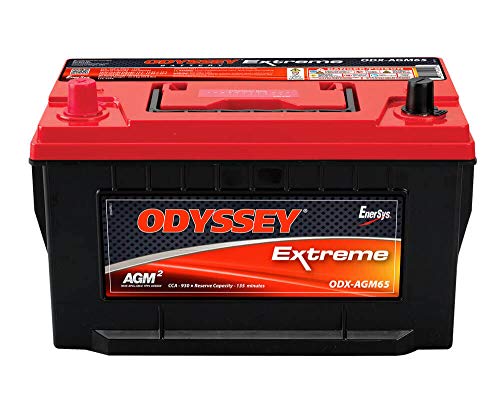 |
Odyssey Battery ODX-AGM65 Extreme Series AGM BatteryOdyssey | Upgrade pick | Group 65 · 930 CCA · AGM battery | $406.85
Price as of 2 Nov 2026
|
View |
Use the table to separate everyday value from harsh-condition durability. The strongest brand name is not enough if the battery does not match your group size, CCA target, and terminal layout.
How we chose
The ranking weighs four things that matter in a real replacement: fitment confidence, chemistry choice, warranty usefulness, and channel convenience. A battery can be well made and still be a poor buy if the free replacement period is short or the exchange process is inconvenient.
We also separate daily-driver value from severe-duty use. That matters because a standard flooded battery can be the smarter buy for a mild-climate commuter, while AGM makes more sense for vibration, start-stop systems, or heavier accessory loads.
Warranty value is judged by usable coverage, not headline length alone. Free replacement beats prorating, and retailer swap friction matters when you need a fast exchange.
Battery brand matrix
| Brand | Chemistry options | Warranty length | Retailer swap friction | Likely use case | Who should skip it |
|---|---|---|---|---|---|
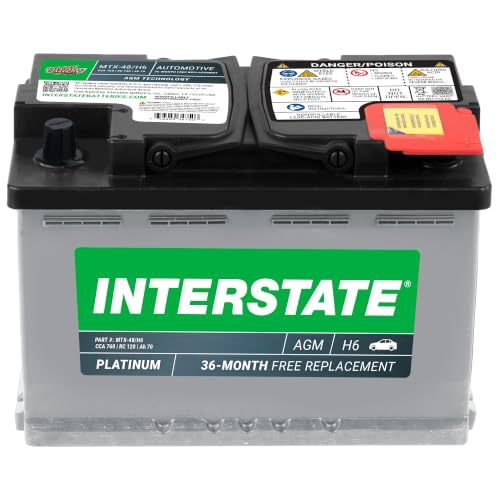
| Interstate | Flooded and AGM, with broad group-size coverage | 18 to 48 months | Moderate; depends on the retailer or installer | Daily drivers, mixed climates, shoppers who want wide availability | Drivers who need the lowest upfront price and do not care about brand spread |
| DieHard | Red, Silver, Gold, Platinum, and Platinum AGM | One year on Red; three years on Gold; four years free replacement on Platinum AGM | Lower through Advance Auto Parts if the store handles the swap cleanly | Retail shoppers who want clear tiering and a familiar counter process | Buyers who need the broadest channel choice |
| Optima | SPIRALCELL AGM | 36 months | Moderate; premium pricing can slow the value case | Performance vehicles, off-road use, dual-purpose setups | Shoppers who only need a basic commuter battery |
| Odyssey | Premium AGM | 36 months | Moderate to high; price is the main barrier | Harsh-climate starts, trucks, off-road vehicles, high-demand electrical systems | Budget shoppers and mild-weather commuters |
| EverStart | Flooded and AGM by line | One year on Value; up to 3 years on Maxx | Low at Walmart, but exchange rules depend on store policy | Low-cost replacements and quick retail pickup | Drivers who want the strongest warranty or premium cold-weather margin |
| ACDelco | Flooded and AGM variants | Varies by line and seller | Moderate; fitment is often straightforward for GM-leaning applications | OEM-matching replacements, especially for GM vehicles | Buyers who need a brand with clearly stated universal warranty terms |
Interstate Batteries: best for broad fitment
Interstate ranks high because it combines broad availability with multiple group sizes and warranty coverage that runs from 18 months to 48 months. That mix makes it a strong first stop for drivers who want a mainstream replacement without narrowing the search too early.
It is a good daily-driver choice when you want a familiar brand and a reasonable chance of finding the correct tray, terminal, and hold-down match. For commuters in mixed climates, a standard flooded model is often enough; AGM becomes more attractive when the vehicle carries heavier electrical loads or sees more vibration.
The main drawback is not performance on paper. It is that warranty value can vary by the specific line and seller, so you still need to check whether the best-looking option is the one with the best free-replacement period.
DieHard: best for retail warranty shoppers
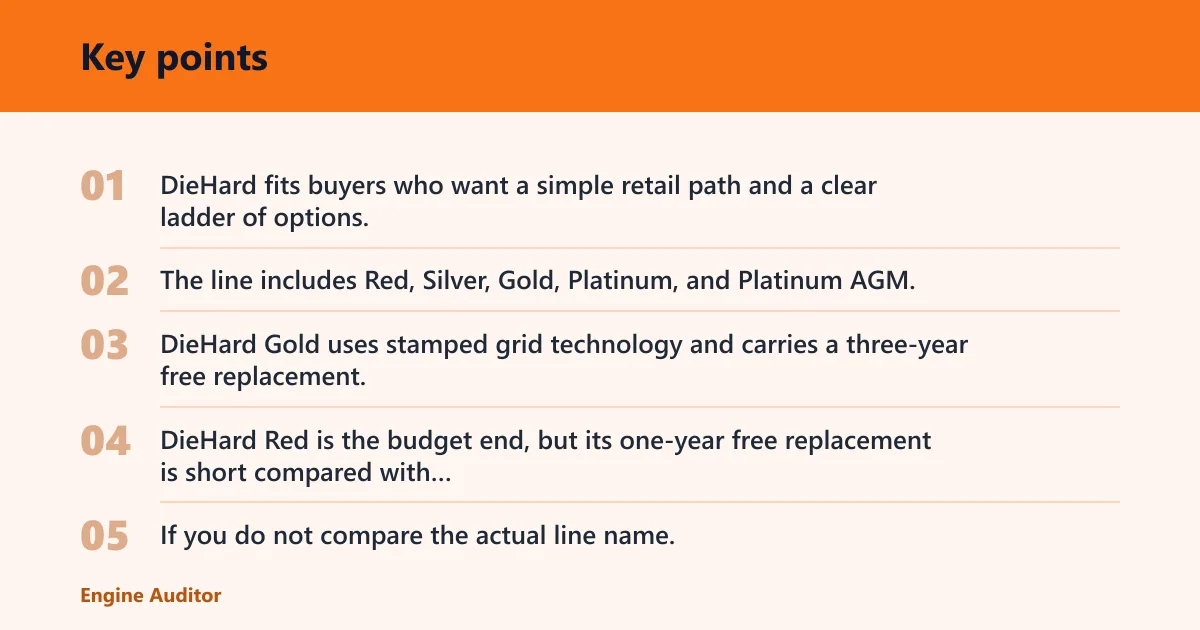
DieHard fits buyers who want a simple retail path and a clear ladder of options. The line includes Red, Silver, Gold, Platinum, and Platinum AGM, so you can move from basic replacement to stronger coverage without leaving the brand family.
Its best value case is the higher tiers. DieHard Gold uses stamped grid technology and carries a three-year free replacement, while DieHard Platinum AGM has a four-year free replacement warranty. DieHard Red is the budget end, but its one-year free replacement is short compared with the better tiers.
The drawback is tier confusion. If you do not compare the actual line name, you can end up paying more for a shorter warranty than a competing battery with similar fitment.
Optima: best for AGM performance
Optima is the pick for buyers who want SPIRALCELL AGM construction and a battery aimed at performance and off-road use. The 36-month warranty gives it a clear place in the premium AGM set, and the dual-terminal layout adds flexibility for some installs.
The listed Optima battery is reported at about 750 CCA. That makes it appealing for dual-purpose vehicles and setups that need more buffer for accessories or longer engine-off load demands.
The drawback is price. At $319.99, it costs far more than a basic flooded replacement, so it makes sense only when AGM benefits are actually useful to your vehicle and use pattern.
Odyssey: best for harsh conditions
The listed Odyssey battery is reported at about 930 CCA. It is aimed at trucks and off-road vehicles, and the listed battery brings 930 CCA, 135-minute reserve capacity, and tin-plated brass SAE posts.
That specification set is why it ranks near the top for harsh-weather starting and high-demand applications. If your vehicle sits outside in winter, carries significant accessory load, or needs strong reserve support, Odyssey belongs on the short list.
The drawback is cost. At $406.85, it is expensive, and that premium is hard to justify for a mild-climate commuter that only needs a straightforward replacement.
EverStart and ACDelco: best budget and OEM-match picks
EverStart is Walmart’s house brand and the obvious low-cost option. Its Value Group 65 is reported at about 650 CCA and carries about a one-year warranty, while Maxx is reported at about 850 CCA and includes about a three-year warranty. That makes the line useful, but the tier matters a lot.
ACDelco is the better OEM-leaning pick, especially for GM applications, and it comes in flooded and AGM variants. Motorcraft batteries are made by Clarios, which is a reminder that brand name and factory source are not always the same thing; several retail labels share manufacturing roots or supply chains.
The drawback for EverStart is straightforward: the cheapest line has the weakest warranty. The drawback for ACDelco is that warranty terms and fitment can vary by exact model and seller, so you still need to verify the label before buying.
Which one should you buy?
If you drive daily in mild weather, start with Interstate, ACDelco, or a mid-tier DieHard. Those brands usually balance fitment confidence and warranty value without forcing you into a premium AGM price.
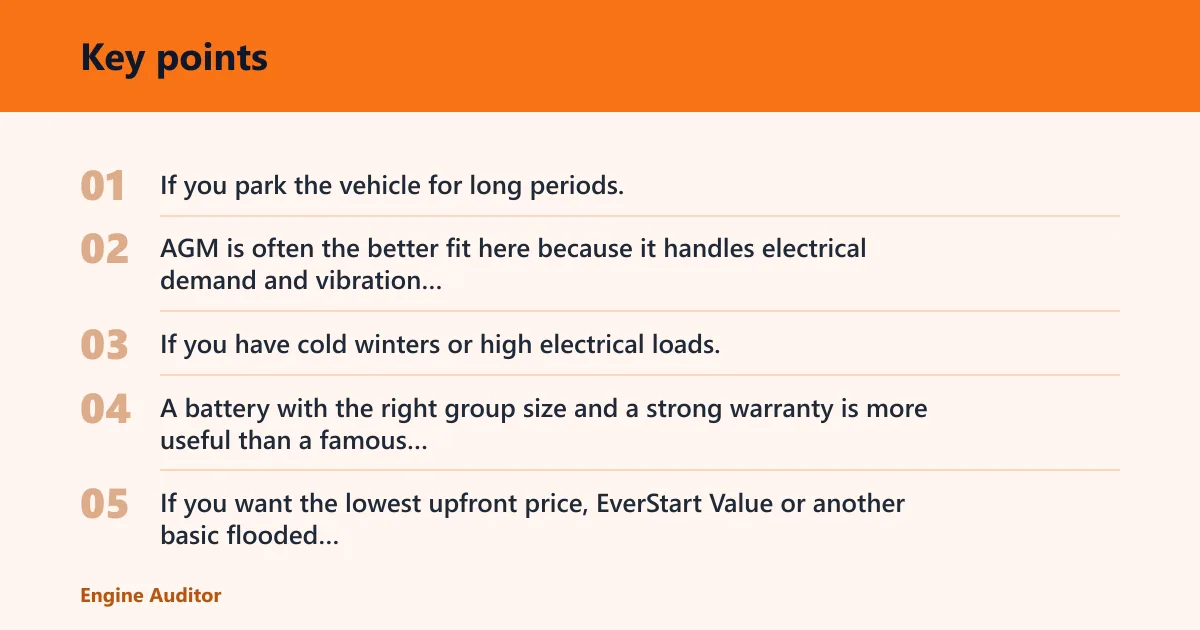
If you park the vehicle for long periods, look for stronger reserve capacity and a longer free-replacement term. AGM is often the better fit here because it handles electrical demand and vibration better, but a high-quality flooded battery can still be the smarter buy if the vehicle has simple electrical needs.
If you have cold winters or high electrical loads, move up to AGM and compare CCA against the vehicle minimum spec. A battery with the right group size and a strong warranty is more useful than a famous brand with weak starting power.
If you want the lowest upfront price, EverStart Value or another basic flooded replacement can work, but only if the group size and terminal layout match exactly. Say your car needs group 35 and the old battery was a tight fit; a cheaper battery that misses the tray dimensions or post orientation is no bargain.
Suppose your truck sits outside, runs extra lighting, and gets cold starts at dawn. In that case, a premium AGM with strong CCA and reserve capacity is the safer route than a budget flooded battery with a short warranty.
What car battery brands are most reliable?
Interstate, Odyssey, Optima, DieHard’s higher tiers, and ACDelco are the most reliable choices for most shoppers because they cover a wide range of fitments and use cases. Reliability improves when the brand’s line matches the job: daily driving, cold starts, or heavier electrical demand. Fitment still matters more than logo alone.
Which car battery brand has the best warranty?
DieHard Platinum AGM stands out with a four-year free replacement warranty. Interstate can reach 48 months on some lines, and EverStart Maxx carries a three-year warranty. The best warranty is the one with the longest free replacement, the clearest terms, and the least exchange friction at the seller.
Are AGM car batteries worth paying more for?
AGM is worth paying more for when you need better vibration resistance, stronger reserve capacity, or support for higher electrical loads. It is usually not worth the premium for a mild-climate commuter with few accessories. A standard flooded lead-acid battery is still the smarter buy when the vehicle’s electrical demand is simple.
Which battery brand is best for cold weather starting?
Odyssey and Optima are the strongest cold-weather candidates in this group because they are premium AGM lines aimed at demanding applications. That said, the correct CCA number matters more than brand name. Always compare the battery’s CCA to the vehicle’s minimum specification before you buy.
How do I compare car battery warranty terms?
Compare three things: the free replacement period, whether prorating starts after that period, and how easy the retailer makes an exchange. A long headline warranty is less useful if the store requires a slow approval process or if most of the coverage is prorated. The shortest useful number is the free replacement term.
Do all car battery brands come from the same manufacturer?
No. Some brands do share factories or parent-company supply chains, but that does not mean every label comes from the same manufacturer. Motorcraft batteries are made by Clarios, and several retail brands are sourced through shared OEM plants. That is why comparing brand reputation without checking the actual line can be misleading.
What should you check before buying a replacement car battery?
Start with the vehicle’s group size, terminal layout, and hold-down style. Then check CCA, reserve capacity, and battery type against the car’s needs. If the vehicle uses start-stop or has heavier accessory loads, AGM is often the better fit. If not, a quality flooded battery may be enough.
Next, compare the warranty terms and the seller’s swap process. A battery with a strong free replacement period is more useful than a flashy label if the exchange is slow or limited.
- Confirm the correct group size, such as 24F, 35, or H6.
- Match CCA to the vehicle’s minimum spec, especially for winter starts.
- Check reserve capacity if the car sits, idles, or runs accessories.
- Choose AGM for vibration, start-stop use, or heavier electrical demand.
- Use flooded lead-acid for a standard daily driver when cost matters most.
- Compare free replacement length before you compare brand slogans.
- Check retailer return and exchange rules before you leave the aisle.
Products related to this article
Sponsored / affiliate links. As an Amazon Associate I earn from qualifying purchases. I may earn additional commission from eligible campaigns.