What Causes a Lifter Tick?
A lifter tick usually comes from low oil pressure, clogged oil passages, valve-train wear, or valve lash that is out of spec. If it fades within a few seconds after startup, it is often normal bleed-down noise. Ignore it, and you can chase the wrong repair or miss a lubrication fault that damages cam and lifter parts. This guide shows how to separate harmless startup tick from oiling, lash, and wear faults before you replace parts.
What a lifter tick means



A lifter tick is a rhythmic valvetrain noise that often points to hydraulic lifter bleed-down, dirty oil passages, worn parts, or lash that is out of spec. It is a symptom pattern, not a final diagnosis. The same sound can come from different engine layouts, and access differs between pushrod V8s and overhead-cam engines.
Hydraulic lifters vs solid lifters
Hydraulic lifters use oil pressure to fill internal clearance and keep the valvetrain quiet. They are the more common type in modern passenger vehicles. Solid lifters are mechanical lifters found more often in older vehicles, performance engines, or racing applications, and they depend on a precisely set valve lash.
That difference matters for diagnosis. A hydraulic lifter that ticks may be reacting to oil supply or internal wear. A solid lifter may tick more by design, especially when cold, because its lash is set mechanically and can be heard until the engine reaches operating temperature.
What the noise usually sounds like
F1 says lifter noise is usually a ticking or knocking sound from the valvetrain. It often sounds light and regular, like a fast metal tap. Because lifters sit near the top of the engine, the noise often seems loudest near the valve cover, especially when the hood is open.
Engine speed changes the clue. A tick that rises with rpm often points toward valvetrain or injector-related noise. A knock that deepens with load and sounds lower in the engine needs a different path, because rod knock and valvetrain tick do not behave the same way.
What causes a lifter tick?
Most lifter tick comes from oil supply problems, dirty oil passages, wear at the lifter or camshaft interface, or valve lash that is wrong for the engine. Low oil level or pressure can keep hydraulic lifters from filling. Old or dirty oil can also slow lifter action and make ticking worse.
Oil level and oil pressure
Hydraulic lifters need engine oil pressure to fill and hold their internal clearance. Low pressure can cause bleed-down, which is why a tick may be louder on startup or when hot oil thins out. A worn oil pump, clogged pickup, or low oil level can all reduce the supply that lifters need.
Sludge, dirty oil, and sticky lifters
Narrow oil passages feed lifters, and sludge can restrict that flow. Dirty or thickened oil can make a lifter stick, especially after short trips or neglected maintenance. The valvetrain article notes that dirty, thickened, or sludged oil is a leading cause of VVT faults, and the same contamination can affect lifter motion.
Valve lash that is out of spec
Solid lifters rely on a correctly set valve lash. Too loose, and the valve train can tick. Too tight, and the engine can lose performance and wear parts faster. Valve lash is the gap between the rocker arm and valve stem, and the specification comes from the service manual, not guesswork.
A feeler gauge is the tool used to measure lash. On engines that call for adjustment, the steps usually include warming the engine to normal temperature before checking, because lash readings can change with heat. That is why a cold measurement without the right spec can send you in the wrong direction. (Wikipedia)
Wear at the camshaft and lifter interface
The camshaft drives the valvetrain through its lobes, and lifters are the first point of cam contact. If a cam lobe wears or pits the lifter face, the tick can become persistent and may come with misfire, rough idle, or power loss. Once that interface is damaged, oil changes alone rarely solve it.
What a lifter tick sounds like
A lifter tick can change with temperature, speed, and load. Cold-start tick that fades after a few seconds is often less alarming than a hot-idle tick that stays. If the sound rises with engine speed and stays near the top of the engine, lifter or injector noise becomes more likely than a deep lower-engine knock.
Cold-start tick that fades
F7 says a lifter tick can be louder when the engine is cold and may lessen as it warms up. That pattern often fits hydraulic lifter bleed-down or oil that has drained from the upper valvetrain during shutdown. If the noise disappears quickly and does not return hot, it is often less urgent.
Hot-idle tick that stays
A tick that is still present at full operating temperature deserves more attention. F6 notes that a common symptom is noise louder on startup or when the engine is hot. When hot idle noise persists, think about low pressure, thin oil, worn lifters, or a lash problem that does not correct itself.
Tick that rises with rpm
A speed-related tick usually gets faster with engine rpm. That points toward a source tied to camshaft speed, injector action, or valve train motion. An exhaust leak can also tick in time with pulses, but it often sounds sharper near the manifold or flange than at the valve cover.
Oil checks and first fixes
Begin with oil level and oil condition before any teardown. Then confirm the viscosity matches the manufacturer spec. If the oil is low, dirty, or the wrong grade, fix that first. A simple oil service may quiet a lifter that is only reacting to poor oil supply or wrong viscosity.
Check level and condition first
Pull the dipstick on level ground after the engine has sat long enough for oil to drain back according to the maker’s procedure. Look for a low level, dark sludge, fuel smell, or glitter. Those signs can point to restricted passages, contamination, or wear that a top-off alone will not correct.
Match oil viscosity to the spec
Oil viscosity matters because lifters depend on the right flow and pressure behavior. Too thick, and the upper valvetrain may fill slowly. Too thin, and pressure can drop when the engine is hot. If the tick started after an oil change, the wrong viscosity is a real possibility.
Say your engine calls for 5W-30 and the noise begins after a switch to a heavier grade. A cold start may sound normal, then the tick stays at hot idle because the oil does not move through small passages the way the engine expects. The repair path starts with correcting the oil grade, not replacing parts.
When an oil change may help
An oil change can help when the tick comes from dirty oil, sludge, or a viscosity mismatch. It is less likely to help a worn lifter or a damaged cam lobe. Additives sometimes quiet noise briefly, but they should not be treated as a fix for worn parts or low oil pressure.
Lifter noise decision table
This table maps common noise patterns to the most likely causes, the first checks, and the usual repair path. Use it to decide whether the next step is an oil service, a valve-cover inspection, or a deeper repair.
| Noise pattern | Likely cause | First three checks | Most likely repair path |
|---|---|---|---|
| Cold-start-only tick | Hydraulic lifter bleed-down, oil draining from the upper valvetrain | 1) Check oil level 2) Check oil condition 3) Listen for fade after 5-30 seconds |
Oil service with correct viscosity; inspect further only if it persists or returns hot |
| Hot-idle tick | Low oil pressure, thin oil, worn lifter, restricted oil passage | 1) Verify oil pressure warning status 2) Check oil level and viscosity 3) Localize noise with a stethoscope |
Oil pressure diagnosis, then valve-cover inspection and possible lifter replacement |
| Rpm-matching tick | Valvetrain noise, injector click, exhaust leak | 1) Compare cold and hot behavior 2) Probe near valve cover and exhaust area 3) Check for misfire or power loss |
Pinpoint source before parts replacement; fix leak, injector issue, or valvetrain wear as needed |
| One-bank tick | Bank-specific lifter, cam lobe, exhaust leak, or oil feed issue | 1) Compare left and right banks 2) Use a mechanic’s stethoscope 3) Inspect oil feed paths and valve cover area |
Bank-specific inspection, then lash check, leak repair, or lifter/cam repair |
| Tick plus misfire | Worn lifter, damaged cam lobe, valve train fault | 1) Scan for misfire codes 2) Check oil pressure and oil condition 3) Inspect valve motion under the cover |
Do not stop at an oil change; inspect cam and lifter surfaces and repair the failed parts |
| Tick plus low oil pressure | Oil pump wear, clogged pickup, low oil level, restricted passages | 1) Confirm actual oil pressure 2) Check oil level 3) Inspect for sludge or blockage |
Oil system repair first; lifter replacement may follow if damage already occurred |
| Tick after oil change | Wrong viscosity, poor filter choice, trapped air, preexisting wear now audible | 1) Verify the oil grade 2) Confirm filter installation 3) Recheck noise after full warm-up |
Correct the oil spec first; if noise remains, inspect lifters and lash |
| Tick with rough idle | Valve train wear, low compression on one cylinder, lash error, cam damage | 1) Check for rough idle and power loss 2) Look for misfire codes 3) Inspect valve-train motion |
Valve-cover inspection, compression-related diagnosis, then repair or replace the failed valvetrain parts |
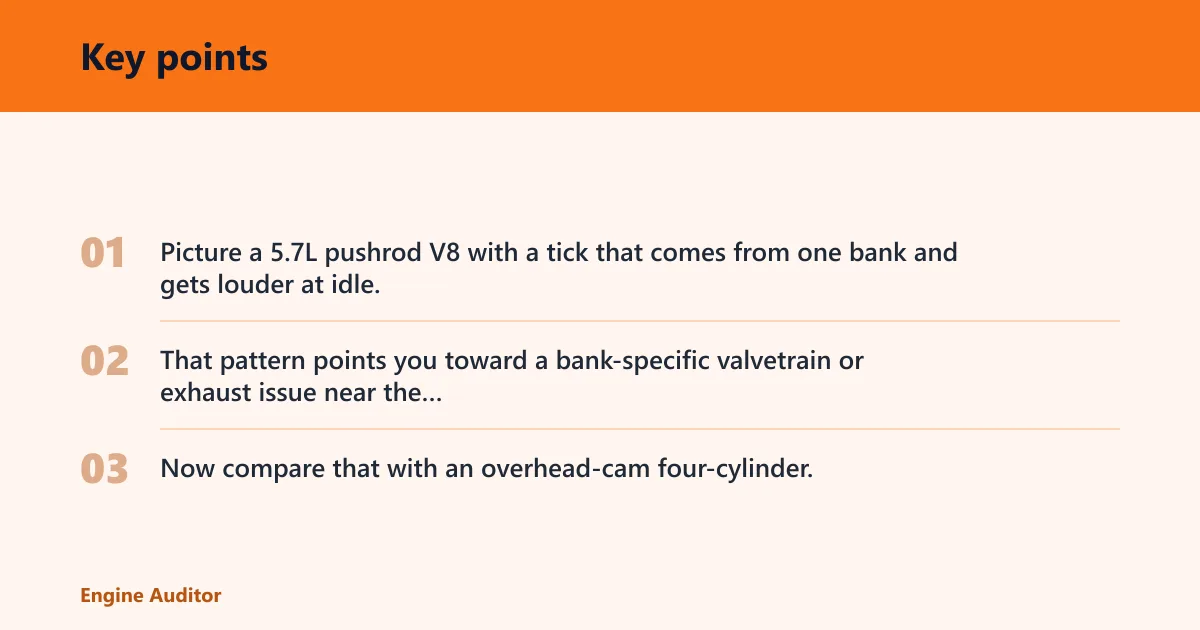
Picture a 5.7L pushrod V8 with a tick that comes from one bank and gets louder at idle, but the engine runs smoothly. That pattern points you toward a bank-specific valvetrain or exhaust issue near the valve cover. Now compare that with an overhead-cam four-cylinder, where access is tighter and a stethoscope matters more for narrowing the source.
How to separate lifter tick from other engine noise
The best next step is localization. A mechanic’s stethoscope helps you hear whether the sound is coming from the valve cover, the fuel injector area, the exhaust manifold, or lower in the engine. That matters because rod knock, injector click, exhaust leaks, and timing chain noise can all be mistaken for lifter tick.
Using a mechanic’s stethoscope
Place the probe near the valve cover, then compare it with the intake, exhaust manifold, and lower block. If the tick is much louder at the valve cover, a valvetrain source is more likely. If the lower block is louder and the sound deepens under load, move away from lifter diagnosis.
Valve cover area vs lower engine
The valve cover is the access point for rocker arms and lifters on many engines, so a top-end noise often sounds loudest there. That is useful, but not final proof. A strong exhaust leak can echo upward, and injector noise can seem similar on some engines, especially from the top of the engine bay.
Lifter tick vs rod knock
Lifter tick is usually lighter, quicker, and closer to the top of the engine. Rod knock is deeper and often gets worse under load or during acceleration. If the noise follows engine speed but sounds heavy and metallic from the lower block, do not keep treating it like a simple lifter problem.
Lifter tick vs exhaust leak or injector noise
An exhaust leak often makes a sharp puffing tick near the manifold or flange, especially on cold start. Injector noise is a fast, regular click and can be normal on many engines. A timing chain noise tends to come from the front cover area rather than the valve cover, which changes where you listen first.
When repair goes beyond oil service
Once oil level, oil condition, and viscosity are ruled out, move to inspection. The usual escalation is oil service, then valve-cover inspection, then lash adjustment or lifter replacement if the noise persists. If low oil pressure is present, the repair may need to go deeper than the valvetrain.
Valve cover inspection
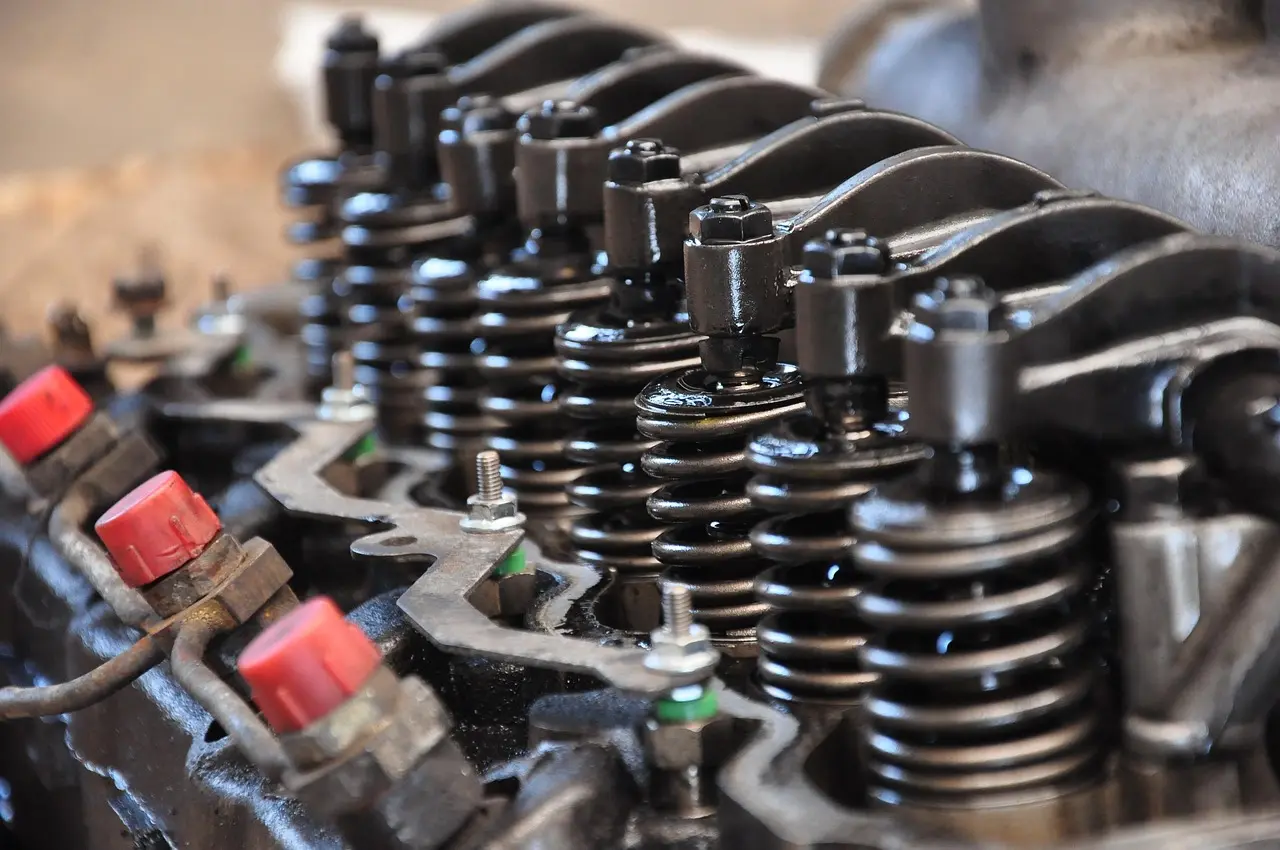
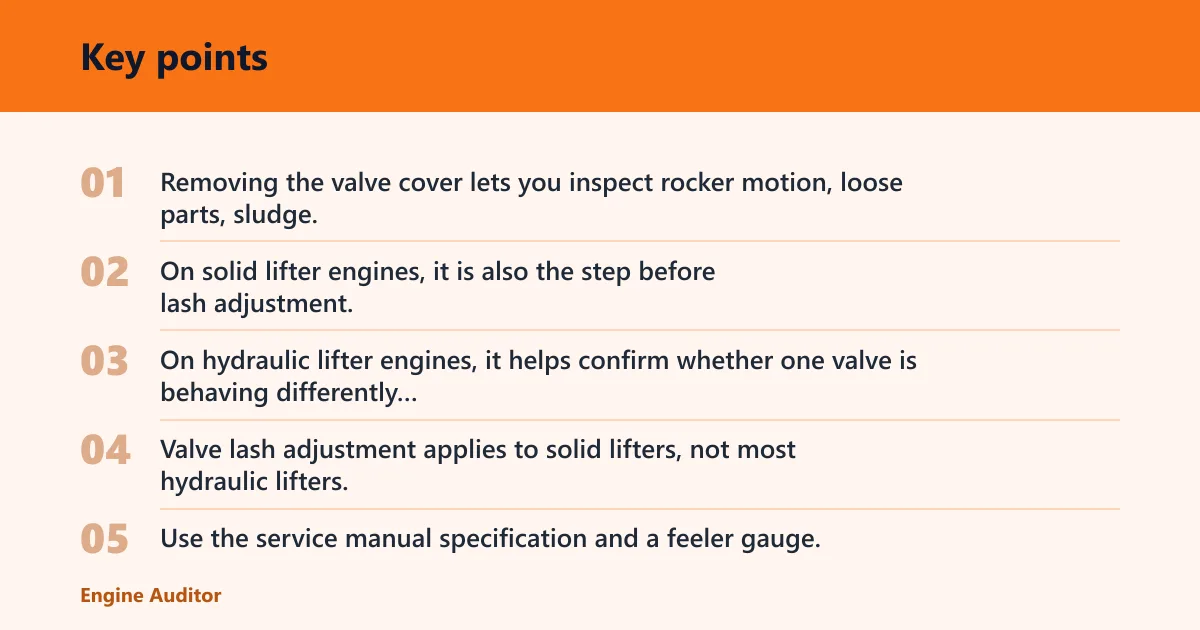
Removing the valve cover lets you inspect rocker motion, loose parts, sludge, and obvious wear. On solid lifter engines, it is also the step before lash adjustment. On hydraulic lifter engines, it helps confirm whether one valve is behaving differently from the others.
Valve lash adjustment
Valve lash adjustment applies to solid lifters, not most hydraulic lifters. Use the service manual specification and a feeler gauge. If lash is loose, the tick can continue. If it is too tight, the engine can lose compression and wear the valve train, so a careful setting matters.
When lifter replacement makes sense
Replacement makes sense when a lifter is worn, sticking, or collapsing, or when cam lobe damage has already affected the lifter face. That repair usually sits above a simple oil change in cost and labor. On some engines, access through the valve train is straightforward; on others, the job is much larger.
A common early mistake is replacing lifters before checking oil pressure on a hot engine. If pressure is low because of a worn pump or clogged pickup, new lifters may still tick. Fix the oil supply problem first, then address any parts that were damaged by it.
When low oil pressure points deeper
If the tick comes with a warning light, low gauge reading, or persistent hot idle noise, look beyond the lifter. Low pressure can come from pump wear, a clogged pickup, or sludge in narrow passages. In that case, the ticking is a warning sign, not the root problem.
Frequently asked questions
What is a lifter tick?
A lifter tick is a repeating ticking or knocking sound from the valvetrain area. It usually points to a lifter, cam, oiling, or lash problem rather than a single fixed failure. The pattern matters more than the label, because the same noise can come from different engine systems.
What does a lifter tick sound like?
It often sounds like a fast metal tap from the top of the engine, close to the valve cover. It may be louder on startup, fade as the engine warms, or stay at hot idle. A sound that deepens under load may be something else entirely.
Lifter tick after engine warms up
A tick that appears or stays after warm-up is more concerning than brief cold-start noise. Hot oil is thinner, so weak oil pressure, worn lifters, or a restricted oil passage can show up then. If the noise remains hot and is paired with rough idle or misfire, inspect the valvetrain.
Lifter tick on startup then goes away
That pattern often fits hydraulic lifter bleed-down. Oil drains from the upper valvetrain during shutdown, then refills after startup. If the tick fades in a few seconds and does not return, it is often less urgent. If it becomes longer or returns hot, keep diagnosing.
Will lifter ticking damage engine?
It can, especially if the tick comes from low oil pressure, sludge, or a worn cam-lifter interface. A brief cold-start tick is often less risky than a persistent hot tick with rough idle, misfire, or power loss. The warning signs tell you whether the problem is progressing.
Products related to this article
Sponsored / affiliate links. As an Amazon Associate I earn from qualifying purchases. I may earn additional commission from eligible campaigns.