Best Scan Tools for Diagnosing Transmission Control Faults
Choose a scan tool with transmission-specific fault codes, live data, bidirectional tests, and relearn functions; for most DIY buyers, that means at least enhanced OEM coverage plus ABS/PCM access, not a basic code reader. Wrong coverage can send you after the wrong solenoid, sensor, or fluid issue and waste repair money. This guide compares scan tools by fault path, codes, data, active tests, and relearn support.
Best picks for transmission faults


The best overall choice is an enhanced scan tool with transmission-module access, live data, and service functions, because that combination reads the fault, checks the data that triggered it, and supports relearn steps after repairs. A basic OBD2 reader is often fine for first-pass code retrieval, but it is not enough for most transmission diagnosis.
Quick picks
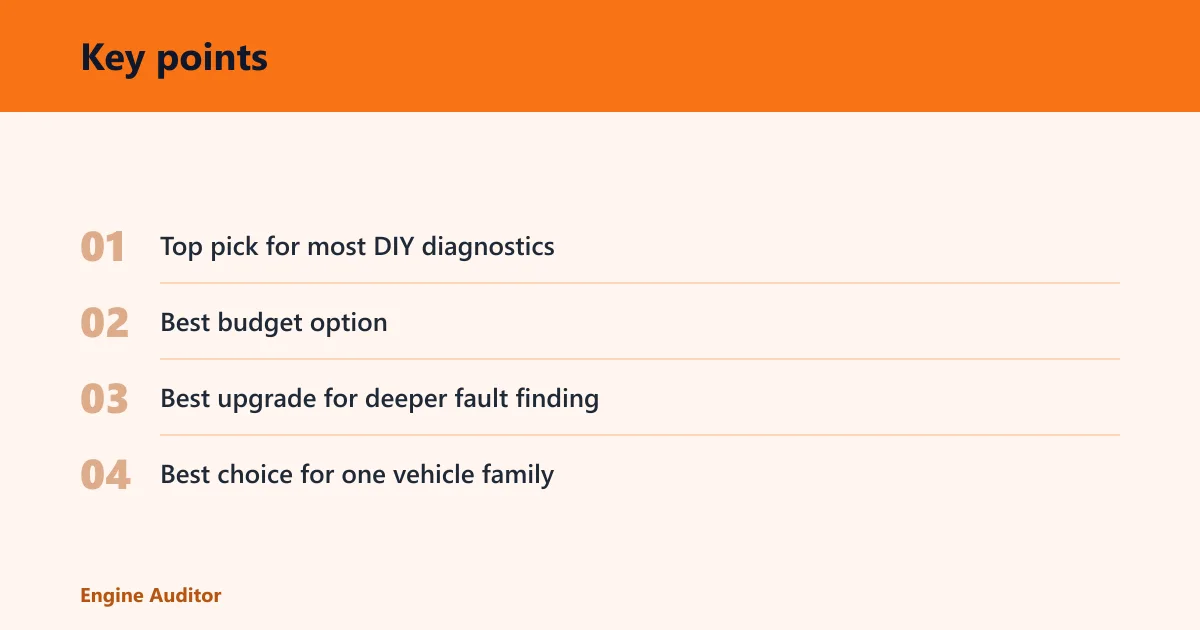
- Top pick for most DIY diagnostics: enhanced scan tool with TCM access, live data, and at least a few service functions.
- Best budget option: basic OBD2 reader for generic codes and freeze frame, only for a first look.
- Best upgrade for deeper fault finding: bidirectional scanner with solenoid commands and adaptation support.
- Best choice for one vehicle family: make-specific diagnostic tool with stronger module access and relearn coverage.
Top pick for most DIY diagnostics
Pick an enhanced scanner that can enter the transmission control module, read manufacturer-specific codes, view live PIDs, and run at least a few active tests. That tier is the first one that can separate a sensor fault from a wiring problem, then help confirm whether a relearn is needed after repair.
Best budget option for code reading
A basic OBD2 reader is a low-cost way to pull generic powertrain codes and freeze frame data. It can point you toward a transmission-related complaint, but it usually stops short of module-specific codes, deep live data, and any useful actuator testing.
Best upgrade for live data and active tests
Choose a bidirectional scanner if you need to command shift solenoids, pressure controls, or other actuators and watch the response. That matters when the code points to a circuit problem and you need more than static code reading to confirm the failure path.
Best choice for make-specific coverage
If you work on one brand or platform family, a make-specific tool often gives better access to transmission modules, enhanced PIDs, and relearn routines than a general-purpose scanner at the same price. Vehicle coverage matters more than the logo on the case.
What transmission faults need from a scanner
Transmission diagnosis usually needs more than generic powertrain codes. A scanner should read TCM codes, show the live signals behind the fault, and expose service functions if the repair includes an adaptation or reset. That is the only way to avoid replacing parts based on one code alone.
How TCM codes differ from generic powertrain codes
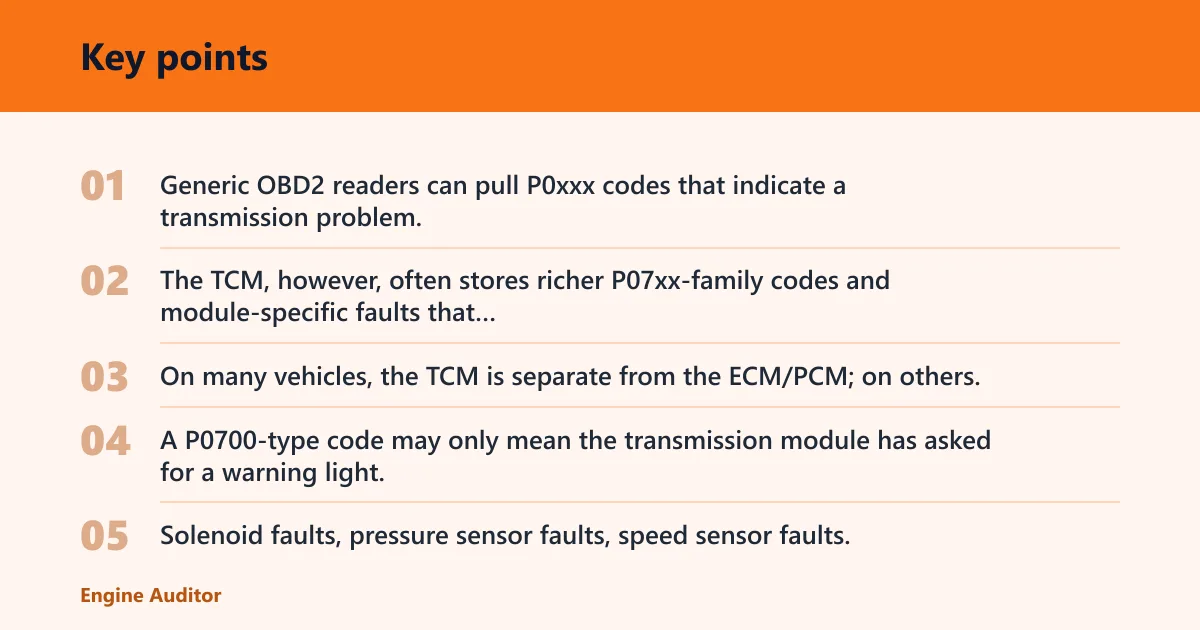
Generic OBD2 readers can pull P0xxx codes that indicate a transmission problem, such as ratio errors, shift issues, or communication faults. The TCM, however, often stores richer P07xx-family codes and module-specific faults that a basic reader cannot see. On many vehicles, the TCM is separate from the ECM/PCM; on others, it is integrated and still requires enhanced access.
That difference matters. A P0700-type code may only mean the transmission module has asked for a warning light, while the actual fault lives deeper in TCM data. Solenoid faults, pressure sensor faults, speed sensor faults, and communication faults all need different checks.
Why live data matters more than code reading alone
Live data can show what the transmission is doing right now, including input speed, output speed, gear command, commanded shift state, fluid temperature, and sometimes line pressure or pressure control duty cycle. Those values help you see whether the module is commanding the right action and whether the hardware is responding.
Use live data to separate a wrong gear ratio from a bad sensor signal. If gear command changes but input speed does not track correctly, you may be dealing with a sensor, wiring, clutch, or mechanical issue rather than a dead module.
Where freeze frame helps with intermittent faults
Freeze frame captures the conditions present when the code set. That includes engine load, speed, temperature, and sometimes transmission-related data. It is especially useful for intermittent electrical faults, because it shows whether the issue appeared hot, cold, under load, or during a shift event.
Low voltage and poor grounds can create false transmission faults. Freeze frame helps you see if the code appeared during crank, after a battery dip, or while another module was also dropping communication.
Transmission scan tool matrix
| Tier | Supported functions | Vehicle coverage | Best use case |
|---|---|---|---|
| Basic OBD2 | Generic powertrain codes, freeze frame, code clearing, limited live data | Broad, but shallow and protocol dependent | First-pass check for a warning light and simple code retrieval |
| Enhanced midrange | Generic and enhanced transmission codes, more live PIDs, some service functions | Better make-specific support, varies by brand and model year | Most DIY transmission diagnosis on a budget |
| Bidirectional and relearn tier | Enhanced codes, live data, bidirectional control, adaptations, relearn support, reset procedures | Strongest access on supported vehicle families | Active testing, post-repair relearns, and deeper fault isolation |
A basic reader is enough only when you want to verify whether the warning light is tied to a generic code and grab freeze frame. The enhanced tier is the better floor for transmission work. The bidirectional tier is the right answer when diagnosis depends on commanded movement or a post-repair relearn.
Can a basic OBD2 reader read transmission codes?
Yes, a basic OBD2 reader can read some transmission-related generic codes, especially P0xxx powertrain faults and freeze frame data. No, it cannot read every transmission control module code, and it usually misses the enhanced P07xx detail that actually points to the failing circuit or control path.
What generic P-codes can reveal
Generic codes can tell you that the fault is transmission-related, that the module wants attention, or that a ratio or communication issue exists. They are useful for triage. They are not enough for a full repair decision when the vehicle stores enhanced transmission data.
What transmission data basic readers miss
Basic readers often miss module-specific solenoid codes, pressure-control faults, manufacturer-specific adaptation data, and deeper TCM parameters. They also tend to show limited live data, with fewer transmission PIDs and little context for interpreting the failure.
Say your 2016 sedan flashes a transmission warning and stores a generic code after a cold start. A basic reader may tell you the fault exists, but only enhanced data can show whether the issue came from a shift solenoid circuit, a speed sensor mismatch, or a communication drop.
When a cheap reader is enough
A cheap reader is enough for a first scan, a quick code clear, or confirming whether a complaint is tied to a generic powertrain fault. It is not enough for diagnosis once the code points toward the transmission control module or the fault returns after clearing.
Which live data PIDs matter most?
Commonly useful transmission PIDs include input speed, output speed, gear command, shift state, fluid temperature, and any available line pressure or pressure-control signal. Those values tell you whether the module is asking for the right action and whether the transmission is responding as expected.
Input and output speed signals
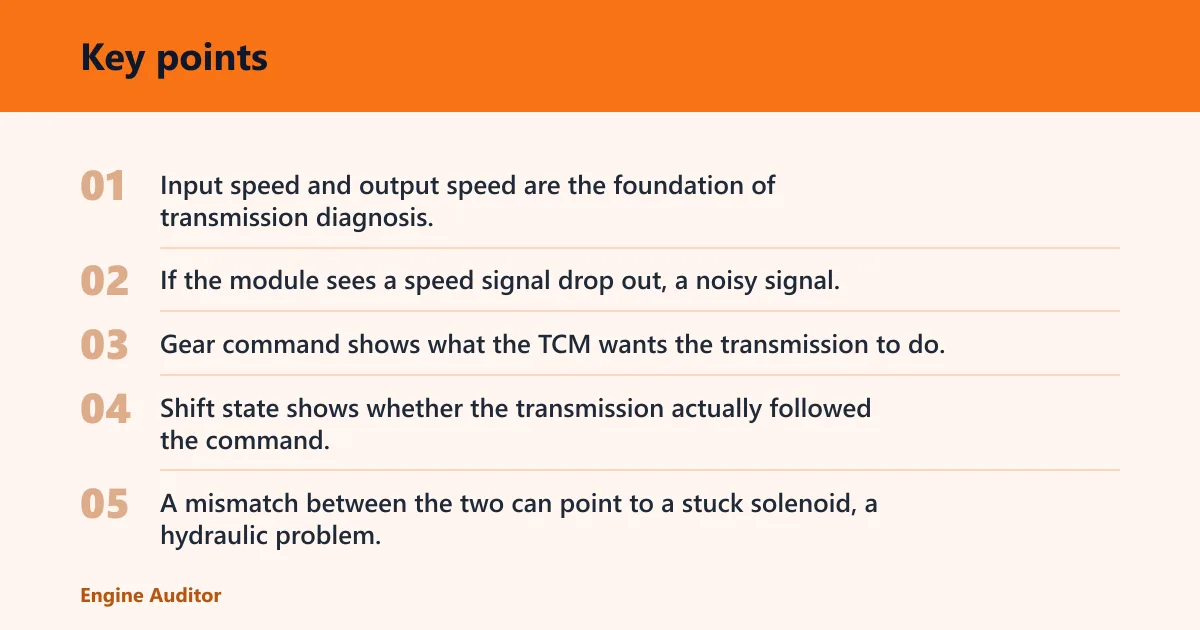
Input speed and output speed are the foundation of transmission diagnosis. If the module sees a speed signal drop out, a noisy signal, or a ratio that does not match the commanded gear, you may be looking at a sensor, wiring, connector, or internal transmission issue.
Gear command and shift state
Gear command shows what the TCM wants the transmission to do. Shift state shows whether the transmission actually followed the command. A mismatch between the two can point to a stuck solenoid, a hydraulic problem, a software issue, or a mechanical fault.
Fluid temperature and pressure data
Fluid temperature matters because many shift complaints change as the transmission warms up. Pressure data, when available, helps you confirm whether the pump, control solenoid, or pressure sensor is behaving under load. A cold-only fault and a hot-only fault do not lead to the same repair path.
Using live data to spot sensor and wiring faults
Live data can expose a sensor signal that drops to zero, spikes, or disagrees with other PIDs. That pattern often points to wiring, connector corrosion, poor ground, or low system voltage instead of a failed transmission hard part. Live data alone does not prove a bad TCM.
When do you need bidirectional control?
You need bidirectional control when diagnosis depends on commanding a solenoid, valve, relay, or actuator and then confirming the response. It is the best way to verify whether the circuit and hardware can respond under load, instead of assuming a code means the part is bad.
Solenoid and actuator commands
Bidirectional tools can command solenoids on and off, cycle outputs, or trigger specific tests supported by the vehicle. That helps verify whether the commanded part moves, changes pressure, or alters gear state as expected.
Active tests under load
Active tests matter because some faults only appear when the system is asked to work. A solenoid that looks fine in static data may fail when commanded. A pressure control valve may react slowly, which you can catch only while the scanner is issuing the test.
Confirming response before replacing parts
Before replacing a valve body, TCM, or solenoid pack, use bidirectional control to check response if the vehicle supports it. That step helps avoid guessing. It also reduces the risk of replacing a part when the real problem is voltage supply, ground loss, or a broken wire.
How to choose the right scanner
Start with vehicle coverage, then check for transmission-module access, live data depth, bidirectional tests, and relearn support. Update support and software coverage matter because enhanced access can vary by model year, engine family, and transmission family more than by price tag.
Vehicle coverage and make-specific support
Modern transmissions often need make-specific diagnostics for enhanced codes and module functions. A scanner that works well on one brand may be shallow on another. Check support by exact year, make, model, engine, and transmission family before buying.
Service functions and relearn support
Look for code clearing, adaptation resets, and relearn routines where supported. Some vehicles need a shift adaptation after repair, battery replacement, or module replacement. If the tool cannot run the required procedure, the repair may not complete correctly.
Display, app model, updates, and budget
Handheld tools are often faster at the car. App-based tools can be cheaper and easier to update, but software support and vehicle coverage vary. Check how updates are delivered, whether the company still supports the platform, and whether the tool can access the transmission functions you need.
Suppose a crossover sets a transmission code after a weak battery event and then shifts normally on the road. A scanner with freeze frame, live data, and module communication checks can help separate a low-voltage false fault from a real solenoid or sensor failure. A basic code reader may only clear the light and miss the cause.
Frequently asked questions
What is the best scan tool for diagnosing transmission control faults?
The best choice is an enhanced scanner with TCM access, live data, bidirectional tests, and relearn support. That combination lets you read the correct codes, inspect the right PIDs, command outputs, and complete service procedures after repair. For most DIY buyers, that is the practical minimum.
Do I need a bidirectional scanner for transmission codes?
No, not for every transmission code. You need bidirectional control when the fault path requires active testing of solenoids, actuators, or pressure controls, or when you must confirm a response under load. For simple code retrieval and live data, a midrange enhanced scanner may be enough.
Can a basic OBD2 reader read transmission control module codes?
It can read some generic powertrain codes, including certain transmission-related P-codes, but it usually cannot access full TCM data or manufacturer-specific faults. That means it is useful for triage, not for complete diagnosis when the vehicle stores enhanced transmission codes.
Which scan tool can read live data from the transmission control module?
Enhanced midrange scanners and bidirectional tools are the better fit because they can access more transmission PIDs than a basic reader. Look for input speed, output speed, gear command, fluid temperature, and pressure-related data. Coverage still depends on the exact vehicle family.
What features matter most for transmission diagnosis: bi-directional control, live data, or special functions?
Live data matters first, because it shows what the transmission is doing. Bidirectional control matters next when you need to command outputs and verify response. Special functions matter after repair, when the vehicle needs adaptation, relearn, or reset procedures. The right order depends on the fault path.
Can a scan tool diagnose a bad TCM versus wiring or solenoid problems?
A scan tool can help separate those possibilities, but it should not be the only proof. Module communication faults, low voltage, and poor grounds can mimic a bad TCM. Live data, freeze frame, and bidirectional tests can point you in the right direction, but wiring checks still matter.
What scan tool do mechanics use for transmission diagnosis?
Mechanics usually use enhanced or professional scan tools with strong make-specific coverage, transmission live data, bidirectional testing, and relearn support. The exact brand matters less than whether the tool reaches the correct module on the exact vehicle and supports the needed service functions.
Products related to this article
Sponsored / affiliate links. As an Amazon Associate I earn from qualifying purchases. I may earn additional commission from eligible campaigns.