Transmission Control System Relearn Procedure After Repairs
A post-repair transmission relearn is needed only when the OEM procedure calls for it, or when shifts, flare, harsh engagement, or shift timing issues remain after the repair. Skip the wrong reset and you can hide a failed repair, or create new drivability problems. Some modules also need a scan tool or programming step before the job is complete. Verify the repair first, then decide which reset path applies. In OEM service information and major scan-tool workflows, the rule is the same: confirm the mechanical fix, verify fluid condition and temperature, then choose adaptation reset, programming, or diagnosis based on the transmission’s control strategy.
What a post-repair relearn can and cannot fix


A relearn can rebuild stored shift values after certain repairs, but it cannot cure a bad hydraulic, electrical, or software fault. Modern automatic gearboxes combine mechanical parts, hydraulic pressure, electronic sensors, and software, so confirm the repair before you ask the transmission to relearn. Mercedes-Benz examples such as 7G-Tronic and 9G-Tronic are commonly reported in OEM service workflows to use adaptation behavior after service, but the exact reset, retention, and drive-cycle requirements still come from the factory procedure and the scan tool that supports it.
Use the relearn as a checkpoint. If the gearbox still has DTCs, limp mode, low fluid, or a valve body problem, the next step is diagnosis, not another drive cycle. Reputable transmission training references and OEM documentation consistently treat adaptation as a final step after the underlying fault is fixed, not as a cure for slipping, pressure loss, or network faults.
Post-repair decision checklist
| Branch | Trigger symptoms | Required scan data | Likely root cause | Next action |
|---|---|---|---|---|
| Relearn likely enough | Clean shifts with mild flare, light delay, or minor harshness after fluid service, solenoid replacement, or adaptation-related repairs | No active transmission DTCs; adaptation values stored; transmission temperature in OEM range; battery support stable; brake-switch input normal; commanded gear matches actual gear after shift | Adaptation values out of date after a valid repair, or shift timing is still settling | Perform OEM relearn: complete the guided adaptation, road-test, then recheck codes and shift quality. |
| Scan-tool reset plus relearn needed | Harsh upshifts, delayed engagement, or odd shift timing after TCM work, valve body service, or solenoid replacement | Scan tool can access transmission data, command adaptation reset, and confirm gear commanded vs. gear achieved, shift counts, line pressure or pressure-control status, and stored learn values | Control module values need to be cleared before a fresh learn can begin, or a calibration/setup step is pending | Use the OEM function: reset adaptations, then run the correct drive cycle or stationary learn. |
| Repair still unresolved | Limp mode, slip, flare under load, harsh neutral-to-drive, or repeated fault codes right after reset | Active DTCs remain; fluid level or specification is wrong; electrical fault, wiring issue, solenoid circuit fault, or valve body wear still present | Hydraulic, electrical, or software fault is still active | Stop relearn attempts: diagnose DTC family, pressure data, harness, connector sealing, and fluid condition first. |
| Programming may be separate | New TCM, software update, variant coding change, or network communication problem after module replacement | Part number, software level, coding status, network communication, and any “programming required” or “initialization incomplete” message | Module configuration or firmware is not correct yet | Program first: complete coding/configuration, then perform relearn only if the OEM still requires it. |
If a transmission shifts hard into second after a solenoid replacement, but the scan tool shows no active codes, stable temperature, and normal brake-switch status, that points to a relearn or reset path. If the same car still shows a pressure-control code, that points to a diagnostic branch, not a relearn branch. Scan data to compare should include commanded gear versus actual gear, transmission fluid temperature, line pressure or solenoid status, and the code family involved, such as ratio, pressure-control, shift-solenoid, or communication faults.
What you’ll need before you start
Gather the right tools first. A scan tool with transmission data access matters because it can read transmission DTCs, monitor live data, and in some vehicles command reset or relearn functions. You also need the correct ATF specification for that transmission, not a generic top-off fluid. OEM service information and scan-tool maker procedures are the most reliable sources for whether adaptation is retained, reset automatically, or requires a guided function. For fluid-temperature checks and fill-level verification, use the transmission maker’s specification and the exact temperature window listed for that unit.
Follow the vehicle and product manual for every step; never work under a vehicle held only by a jack, and check local laws where road testing or lifting rules apply.
Scan-tool and information sources
- Scan tool with transmission data access and adaptation functions
- OEM service information for the exact transmission
- Correct automatic transmission fluid specification
- Battery support or charger set to maintain stable voltage
- Basic hand tools for inspection, not guesswork
- Clean drain pan and refill equipment if service work is open
What the scan tool should be able to show
For a real diagnosis, the scan tool should show transmission DTC families, live shift data, fluid temperature, selector position, brake switch input, and any available adaptation or clutch fill values. On many OEM platforms and major aftermarket scan tools, the useful functions are not just “clear codes,” but adaptation reset, clutch/shift learn, guided service functions, and module identification for programming or coding.
How do you relearn a transmission after repairs?
Start with the repair, then move to the reset. Clear faults only after the fix is confirmed, then follow the manufacturer’s adaptation or drive-cycle steps if the transmission calls for them. Some units need a scan-tool command before the relearn starts; others use a guided route or stationary sequence instead of a generic road test. OEM procedures and transmission training references also stress that temperature, fluid level, and battery support must be correct before adaptation begins.
Step 1: confirm the repair and scan for DTCs
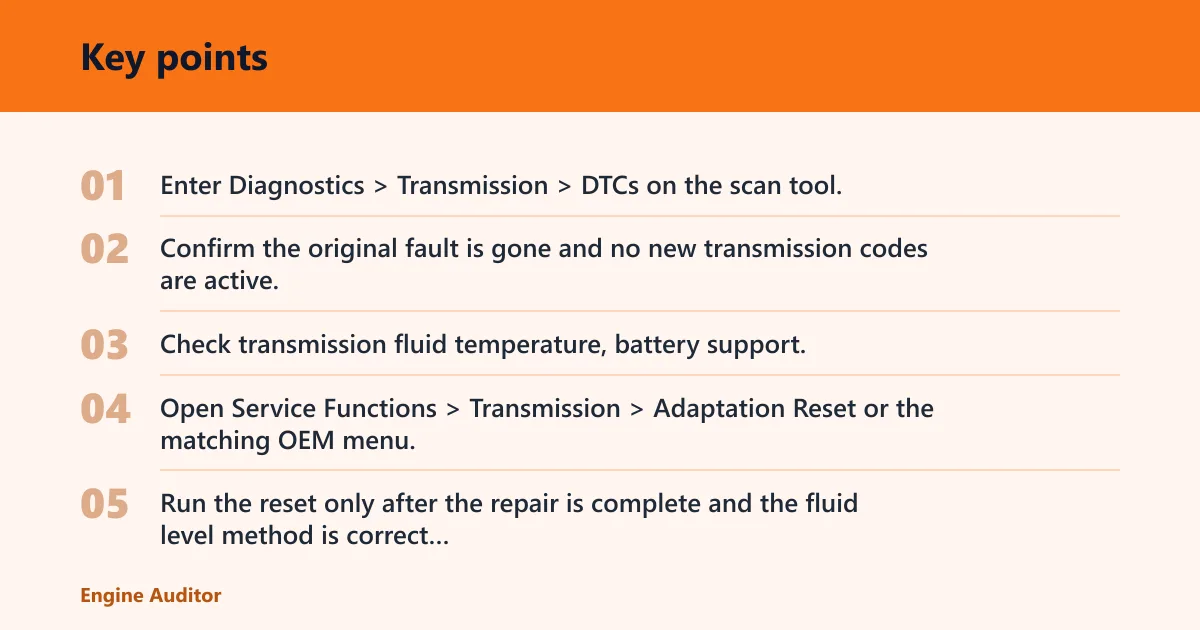
- Enter Diagnostics > Transmission > DTCs on the scan tool.
- Confirm the original fault is gone and no new transmission codes are active.
- Check transmission fluid temperature, battery support, and brake-switch status before moving on.
Step 2: reset adaptations only if the OEM calls for it
- Open Service Functions > Transmission > Adaptation Reset or the matching OEM menu.
- Run the reset only after the repair is complete and the fluid level method is correct for that unit.
- Do not assume a battery disconnect will clear learned values; many modules retain them, and several OEMs state the relearn remains stored unless the specific adaptation-reset function is used.
Battery reset: sometimes no
| Question | Answer | What to do instead |
|---|---|---|
| Will disconnecting the battery clear transmission adaptations? | Sometimes no. Many control modules retain adaptation values or require a specific OEM reset. | Use the scan tool’s adaptation reset or the factory service function for that transmission. |
| Will a battery disconnect fix harsh shifting? | No, not if the problem is hydraulic, electrical, or software-related. | Check DTCs, fluid level/spec, line pressure, solenoid control, and wiring first. |
Step 3: follow the OEM drive cycle or guided relearn
- Use the scan tool’s guided relearn, or follow the OEM route for the exact transmission type.
- Keep throttle, speed, and shift inputs within the specified pattern for that gearbox.
- For a sealed transmission, use the exact temperature-based fill check the manual specifies.
Step 4: verify shift quality and recheck codes
- Road-test the vehicle and record shift timing, flare, flare-free engagement, and any abnormal delays.
- Re-scan for transmission DTCs and compare adaptation values if the tool allows it.
- If the same fault returns, stop the relearn and recheck the repair.
Do you need a reset after replacing a solenoid?
Often, yes, but only when the OEM procedure calls for it. A solenoid manages gear engagement electronically, so the control module may need fresh learned values after replacement. If the new solenoid fixed the fault, the scan data should show clean codes, normal commanded gear changes, and no stuck-gear behavior. OEM service data and scan-tool procedures commonly pair solenoid replacement with an adaptation reset when the valve body or shift solenoid strategy is affected.
What scan data to check after replacement
- Open Transmission Data Stream and confirm no active solenoid or ratio codes.
- Check commanded gear versus actual gear, shift time, and adaptation status.
- Verify fluid level and condition if the pan was opened or the valve body was disturbed.
When rough shifts point to another fault
If harsh shifts remain after a solenoid swap, inspect the valve body, wiring, connector sealing, and fluid quality before you repeat the relearn. Old or contaminated ATF can change shift quality, and low fluid can cause pressure and overheating issues. A relearn will not fix a worn valve body. If the scan tool shows pressure-control, ratio, or solenoid performance codes, stop and diagnose the circuit or hydraulic path rather than repeating the learn.
Suppose a 9G-Tronic shows a delayed reverse engagement after solenoid service. If the scan tool still reports a pressure-control fault, that is a diagnostic branch, not a relearn branch.
Mercedes-Benz 7G-Tronic and 9G-Tronic: when adaptation is required and when programming is separate
Mercedes-Benz automatic transmissions are a useful example because the brand uses clear separation between adaptation, coding, and programming in factory workflows. On 7G-Tronic and 9G-Tronic units, adaptation is commonly needed after fluid service, valve body work, mechatronic work, or component replacement that changes shift feel or clutch fill behavior. Programming is separate and becomes relevant when the control unit itself is replaced, software is updated, or variant coding and setup data must be written before relearn can start.

For these transmissions, the scan tool typically needs to access transmission adaptations, clear stored values, run guided teach-in or initialization, and confirm temperature-sensitive service checks. Mercedes service information and mainstream scan-tool procedures also emphasize that a battery reset is not a universal adaptation reset. If the gearbox is in limp mode, has pressure-control or gear-ratio faults, or shows communication errors, stop and diagnose first rather than forcing adaptation.
7G-Tronic: common adaptation path
On 7G-Tronic applications, adaptation is often required after valve body work, conductor plate or mechatronic-related service, or any repair that changes fill times and shift feel. The scan tool may need to clear adaptation values, initialize the transmission, and then run a guided drive pattern so the control unit can relearn shift timing. If programming or coding is required, that is usually a separate step before adaptation, not a replacement for it.
9G-Tronic: common adaptation path
On 9G-Tronic applications, the relearn is often more sensitive to exact fluid temperature, fill level, and scan-tool support because the transmission strategy uses more gear states and tighter pressure control. Typical scan-tool tasks include adaptation reset, teach-in, confirmation of selector status, and checking whether the module accepts the stored calibration. If the vehicle still shows harsh engagement, delayed reverse, or repeated pressure faults after the guided learn, diagnose before repeating the procedure.
When to stop and diagnose on Mercedes
Stop the relearn and diagnose if you see slipping under load, limp mode, repeated fault codes, no reverse engagement, a gear-command mismatch, or pressure-control codes that return immediately. Those symptoms usually mean the issue is not just adaptation. They can point to fluid level problems, valve body wear, solenoid control faults, wiring damage, or a software/coding issue that must be solved before adaptation will hold.
Mercedes checklist clues that matter
- Commanded gear should match actual gear after the shift completes.
- Transmission fluid temperature must be within the factory window before fill verification.
- Line pressure or pressure-control data should be stable, not erratic.
- Active DTC families should be understood before reset: ratio, pressure, solenoid, selector, or communication.
When does a transmission need programming instead of relearning?
Programming is different from relearning. Relearning adjusts shift values the module already uses, while programming can load calibration, setup, or configuration data after module replacement or major software changes. Capitaland notes that many modern repairs require module programming, calibration, configuration, or relearn procedures, and transmission is one of the modules they program. In scan-tool terms, programming comes first when the module’s software or variant coding is wrong; relearning comes after the module is correctly configured.
TCM replacement or software update cases
- Check whether the replacement TCM needs coding, calibration, or setup in the OEM menu.
- Use the scan tool to confirm network communication, correct part number, and current software status.
- Do not road-test until the module accepts the required programming or setup steps.
Why programming is different from adaptation
The transmission control module stores learned shift values and can also need new software after replacement. That is why programming is not always the right solution by itself. If the module cannot communicate, or if electrical and network diagnosis has not been completed, relearn steps may fail before they start. Many OEM service docs also treat “programming required” and “adaptation required” as separate job types, even when both happen on the same visit.
What to confirm before sending the car out
- Confirm no active transmission or network DTCs remain.
- Verify the transmission shifts cleanly through all expected ranges.
- Recheck fluid level by the OEM temperature method if service work was open.
Common mistakes that make relearn fail
Most relearn failures come from an unresolved repair. Wrong ATF, low ATF, trapped air, a wiring problem, valve body wear, or limp mode can all block a normal adaptation cycle. A generic drive pattern is also a problem when the vehicle needs a manufacturer-specific reset or a stationary routine. Scan-tool guidance, OEM service bulletins, and ATF-spec references all point to the same rule: fluid specification and temperature matter as much as the reset itself.
- Skipping fluid checks after pan, cooler, or valve body work
- Using the wrong ATF specification
- Running the relearn with active transmission DTCs
- Ignoring limp mode and trying to drive through it
- Assuming a battery reset clears adaptations on every vehicle
- Using a generic road test on a transmission that needs OEM-guided steps
If that didn’t work, try this next
- Re-scan the transmission and save all DTCs before clearing anything.
- Inspect the valve body, solenoids, connectors, and harness for a fault that the relearn cannot cover.
- Check whether the transmission type needs a different method, such as a CVT or DCT-specific adaptation routine.
Prevention
Use the exact fluid specification and the OEM temperature check every time you open the transmission. That step prevents many false relearn failures, especially on sealed units where fluid level cannot be judged by eye. It also prevents the common mistake of chasing a shift complaint that is actually a fill-level or viscosity problem.
Frequently asked questions
Do you need to reset the transmission after replacing a solenoid?
Often yes, if the OEM procedure calls for adaptation reset. After replacement, confirm no solenoid or ratio codes remain, then check shift timing, gear command data, and fluid condition. If harsh shifts persist, the valve body or wiring may still be the real fault.
What is a transmission adaptation relearn procedure?
It is the OEM method the transmission uses to rebuild shift values after certain repairs or component replacement. Some vehicles use a scan-tool command, while others use a guided drive cycle. The goal is to restore normal shift timing and engagement after the module has been reset or replaced.
Can you drive normally after a transmission repair without relearning?
Only if the manufacturer does not call for adaptation and the transmission already shifts correctly. If the gearbox was serviced, a reset or relearn may still be required. If you drive with flare, slip, or limp mode still active, you are not confirming the repair.
What tools do you need to perform a transmission relearn?
You need a scan tool that can read transmission DTCs and access live data, plus the OEM service steps for that exact model. Battery support helps keep voltage stable. If the transmission is sealed, you also need the correct fluid and the method for checking it at the required temperature.
Do Mercedes automatic transmissions need adaptation after repair?
Often, yes. Mercedes-Benz examples such as 7G-Tronic and 9G-Tronic use electronic control and adaptation behavior after service. After certain gearbox repairs, adaptation procedures may be required to relearn shift values. The exact routine still depends on the transmission and the OEM service information.
Products related to this article
Sponsored / affiliate links. As an Amazon Associate I earn from qualifying purchases. I may earn additional commission from eligible campaigns.