Why Is Dc Not Used For Power Transmission? Simple Answer
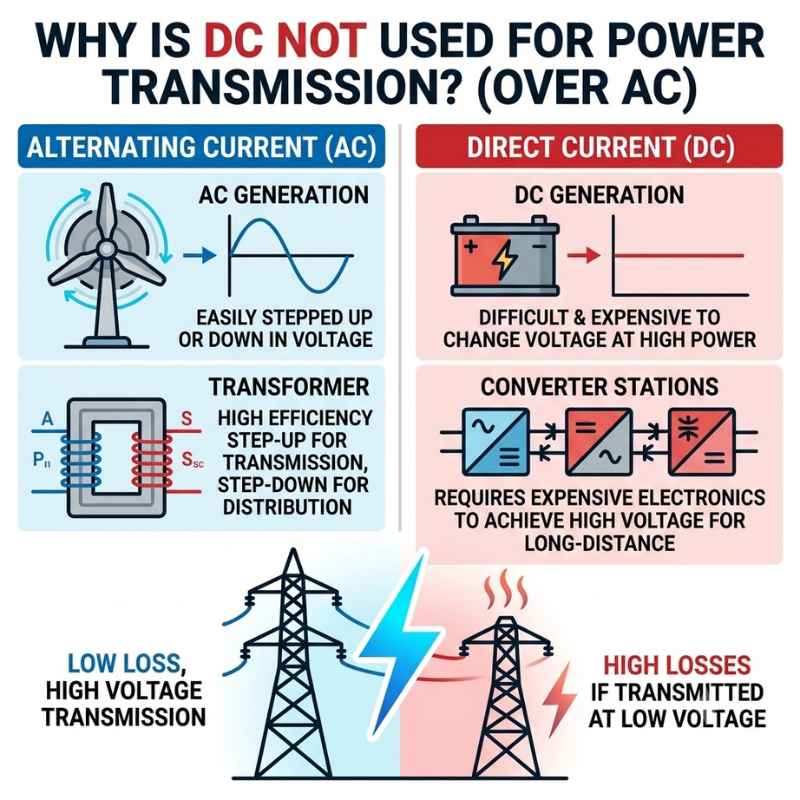
For long-distance power transmission, alternating current (AC) is used instead of direct current (DC). This is mainly because AC voltage can be easily changed using transformers. This allows power to be sent at very high voltages, which greatly reduces energy loss over long distances. DC voltage is much harder to change efficiently.
The Big AC vs. DC for Power Grids
Electricity can flow in two main ways: direct current (DC) and alternating current (AC). Think of DC like water flowing steadily in one direction in a pipe. Batteries provide DC power. Think of AC like water that sloshes back and forth. The power from your wall outlet is AC.
For a long time, people debated which type was best for sending power to homes and businesses. This was a huge argument in the early days of electricity. It was called the “War of the Currents.” Thomas Edison was a big supporter of DC. Nikola Tesla and George Westinghouse championed AC.
In the end, AC won out for power transmission. There are strong reasons why. These reasons have to do with how electricity travels and how we use it. It’s not just about which one is newer or more complicated. It’s about what works best for the job.
Why AC Voltage is Easy to Change
The most important reason AC wins is because its voltage can be easily changed. This is done with a device called a transformer. Transformers use the back-and-forth nature of AC. They can step voltage up very high or step it down very low.
Imagine you have to move a lot of heavy boxes. You can carry one box at a time, but it takes many trips. Or, you can use a special truck. The truck can carry many boxes at once. It’s much faster and easier.
Sending electricity is similar. Power is like the “boxes” of energy. Voltage is like the “size” of the truck. When sending power over long distances, we want to use a “big truck.” That means very high voltage.
High Voltage Means Less Waste
When electricity travels through wires, some energy is lost. This loss happens because the wires have resistance. Resistance is like friction. It heats up the wires. This heat is wasted energy.
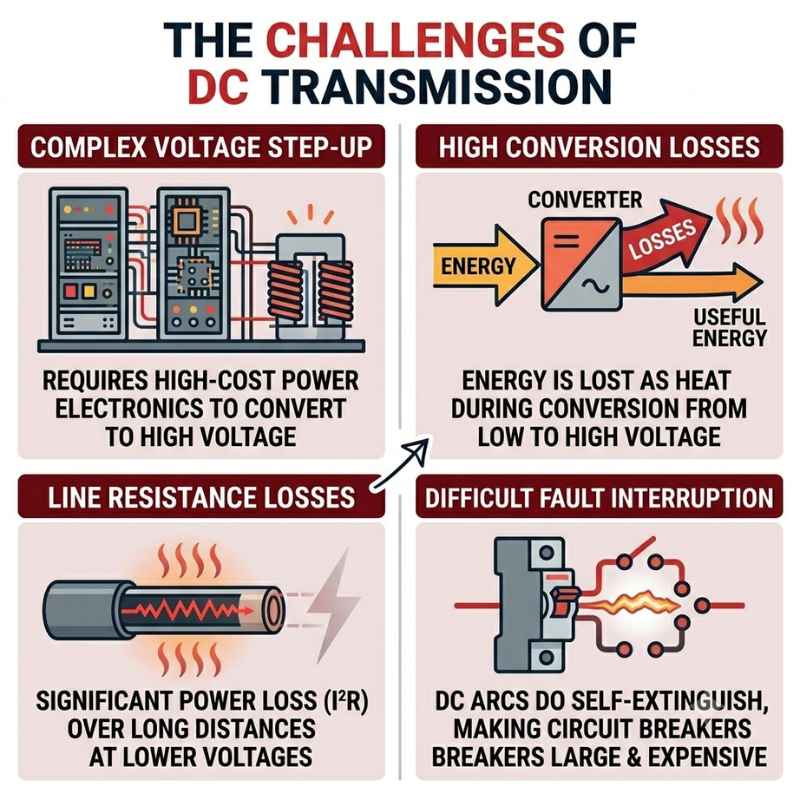
The amount of energy lost depends on the voltage. Higher voltage means less energy is lost. This is a key point. If you try to send DC power over many miles at a low voltage, so much energy would be lost. It would be like sending those boxes one by one in a small car. Most of the effort would be wasted.
By using AC, we can step the voltage up to hundreds of thousands of volts. This is very high! At these high voltages, the energy loss over long wires is very small. This is why AC is so good for sending power from where it’s made to where we need it.
DC Voltage is Hard to Change
Now, why is changing DC voltage so hard? DC is a steady flow. To change its voltage, you need more complex equipment. This equipment was not very efficient or reliable when AC systems were being developed.
Think of the water pipe again. If the water flows steadily, it’s hard to suddenly make it flow much faster or slower with simple tools. You need pumps and special valves. These can be bulky and waste energy.
Early DC systems had to send power at the voltage it was used. So, if you wanted to send power to a city miles away, you had to send it at a relatively low voltage. This meant huge, thick copper wires were needed. These were very expensive and heavy. Also, the energy loss was still too high.
The “War of the Currents”
The debate between AC and DC wasn’t just technical. It was also a business and marketing battle.
Thomas Edison was a brilliant inventor. He invented the first practical incandescent light bulb. He also designed early electrical systems. His systems were based on DC. He had a strong belief that DC was safer and better. He even tried to discredit AC by demonstrating how dangerous high-voltage AC could be. He famously used AC to electrocute animals to show its danger.
Nikola Tesla, on the other hand, was a genius with electricity. He invented the AC induction motor. He also developed the AC power system we use today. George Westinghouse was a wealthy industrialist who saw the potential in Tesla’s AC ideas. He bought Tesla’s patents and funded his research.
Westinghouse and Tesla showed that AC systems could be built more cheaply. They could send power much further. They won major contracts, like the one to light up Niagara Falls with electricity. This was a huge victory for AC. It proved AC could handle big power needs.
How AC Power Transmission Works
The AC power system has a few key parts that work together.
First, power is generated at a power plant. This could be from coal, natural gas, nuclear, hydro, or wind. The generators produce electricity at a certain voltage.
Then, this power goes to a substation. Here, large transformers step up the voltage. They make it very high, like 100,000 volts or more. This is for sending it long distances.
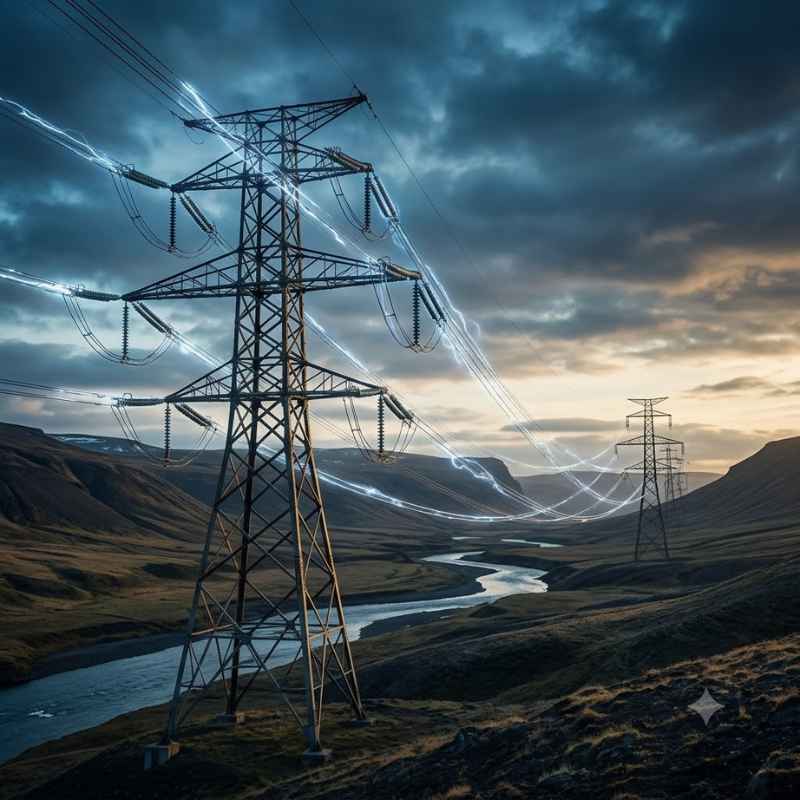
The high-voltage AC power travels through transmission lines. These are the tall towers you see carrying thick wires across the country. These lines are designed to carry power with minimal loss.
As the power gets closer to towns and cities, it goes to another substation. Here, transformers step the voltage down. It might be lowered to something like 4,000 to 35,000 volts. This is still high, but safer for local distribution.
Finally, power poles in your neighborhood have smaller transformers. These step the voltage down again. They bring it to the voltage that your home appliances use, typically 120 or 240 volts.
When Is DC Still Used?
Even though AC is king for long-distance power lines, DC still has important uses.
One major area is in electronics. Most of your gadgets, like phones, laptops, and TVs, use DC power internally. That’s why they have power adapters. These adapters take the AC from your wall and convert it to the low-voltage DC that the electronics need.
Batteries are also DC. So, electric cars, solar panels (which produce DC), and battery storage systems all deal with DC.
Sometimes, for very specific long-distance power needs, DC is used. This is called High-Voltage Direct Current (HVDC). HVDC is good for sending power underwater or across very long distances where building AC transmission lines might be difficult or too expensive. It requires special converters at each end to change AC to DC and then DC back to AC. For these specific cases, the advantages of DC transmission can outweigh the difficulties.
The Role of Transformers
Transformers are the unsung heroes of the AC power system. They are simple devices that work only with AC. They have two coils of wire wrapped around an iron core.
When AC electricity flows through the first coil, it creates a changing magnetic field. This magnetic field then passes through the second coil. The changing magnetic field induces an AC voltage in the second coil.
The ratio of the number of turns of wire in the two coils determines the voltage change. More turns in the second coil mean higher voltage (step-up). Fewer turns mean lower voltage (step-down).
This ability to easily and efficiently change voltage is what makes AC so practical for power grids. Without transformers, our modern electrical systems would not be possible.
Understanding Energy Loss (The Technical Side, Simply)
Energy loss in wires is due to resistance. Resistance causes electrical energy to turn into heat. The power lost due to resistance is calculated by this formula: Power Loss = I²R.
Here, ‘I’ is the current flowing through the wire, and ‘R’ is the resistance of the wire.
In AC systems, we can send power at a high voltage (V). The power (P) being sent is P = V * I. If we need to send a certain amount of power (P), and we increase the voltage (V), the current (I) must decrease.
So, when we send power at very high voltage, the current is very low. Because the current (I) is squared in the power loss formula (I²R), a lower current means a massive reduction in energy loss.
For DC, to send the same amount of power at a low voltage, the current would have to be very high. This high current would lead to very large energy losses due to resistance. To avoid this with DC, you would need enormous, impractical wires.
A Quick Look at Capacitance and Inductance in AC
AC circuits have other properties that matter, like capacitance and inductance. These can cause issues over very long distances.
Capacitance is like a tiny battery in the wire. It can store electrical charge. Inductance is like a tiny electromagnet in the wire. It resists changes in current.
When AC power travels long distances, these effects can cause problems. They can create voltage drops or surges that are hard to control. Special equipment is needed to manage these.
For DC, these effects are much less of a problem. However, the inability to change voltage easily remains the primary barrier for long-distance DC transmission.
The Practicalities of Building a Grid
Beyond the science, think about the practical side of building power lines.
Imagine needing to build thousands of miles of cables that could carry DC power safely over long distances. These cables would need to be incredibly thick to handle the high currents required at lower voltages. This would mean enormous costs for materials and installation. The towers would need to be huge and strong. Maintenance would be a nightmare.
With AC, we can use thinner wires. We can send power at high voltage to reduce losses. We can then step it down closer to where it’s used. This makes the whole system much more manageable and cost-effective.
What About Safety?
Both AC and DC can be dangerous at high voltages. The “War of the Currents” often focused on the dangers of AC. However, high-voltage DC is also extremely dangerous.
The way AC interacts with the body is different from DC. AC at common household frequencies (like 60 Hz in the U.S.) can cause muscles to contract. This can make it hard to let go if you touch a live wire. This is one reason why AC can seem more dangerous in certain situations.
However, the primary reason AC was chosen for transmission was not safety, but efficiency. The safety concerns are managed through proper insulation, grounding, and safety protocols for both AC and DC systems.
The Future: Blending AC and DC
While AC dominates long-distance transmission, the future of electricity is likely to involve more DC.
As we use more electronics and renewable energy sources like solar and wind (which produce DC), there’s a growing need for DC power within our systems.
Companies are investing in HVDC technology. This allows them to connect different AC grids or to transmit power from offshore wind farms back to shore more efficiently than AC.
So, it’s not a case of AC vs. DC forever. It’s more about using the right tool for the right job. AC is excellent for distributing power across vast networks. DC is essential for our devices and is becoming more important for specific high-power tasks.
When It’s Normal and When to Worry
For everyday power usage, the AC system works like a charm. It’s designed to deliver power safely and efficiently to your home. The voltage drops and changes you experience when power is distributed are normal.
They are managed by the grid.
You don’t usually need to worry about the AC or DC conversion. The power company handles all of that. The main thing to watch for is how your appliances perform.
If an appliance is acting strangely, it might be due to a local issue. This could be a problem with your home’s wiring or the power coming to your house.
Quick Tips for Understanding Your Power
Here are some simple points to remember:
- AC is for distance: Alternating current (AC) is used for long power lines.
- DC is for devices: Direct current (DC) is used inside most electronics and by batteries.
- Transformers are key: They easily change AC voltage up or down.
- High voltage saves energy: Sending power at high voltage cuts down on waste.
- DC is hard to change: Changing DC voltage is much more difficult and less efficient.
Frequently Asked Questions About DC Power Transmission
Why can’t we just use DC power for everything?
DC power is great for batteries and electronics. But for sending electricity long distances, it’s not efficient. You can’t easily change DC voltage.
This leads to too much energy loss over miles of wire. AC voltage can be changed easily with transformers, which makes it much better for transmission.
What is the main problem with transmitting DC power over long distances?
The biggest problem is that it’s very hard to change the voltage of DC power. To send power far away, you need very high voltage to reduce energy loss. Since DC voltage is hard to change, you would need huge, expensive wires and still lose a lot of energy.
How do transformers help AC power?
Transformers let us easily “step up” AC voltage to very high levels for long-distance travel. This high voltage greatly reduces the amount of energy wasted as heat in the transmission lines. Closer to homes, transformers “step down” the voltage to safe, usable levels.
Isn’t DC power safer than AC power?
Both AC and DC can be dangerous at high voltages. While AC at household frequencies can cause muscles to seize, making it hard to let go, high-voltage DC is also extremely hazardous. Safety depends on proper insulation and handling, not just the type of current.
When is DC power used today?
DC power is essential for all battery-powered devices and most electronics. It’s also used in specialized long-distance transmission systems called High-Voltage Direct Current (HVDC). HVDC is useful for subsea cables or connecting different power grids.
Did Edison really try to prove AC was dangerous?
Yes, Thomas Edison famously conducted public demonstrations. He used AC electricity to electrocute animals to highlight its perceived dangers. This was part of a larger marketing and business battle against the AC system championed by Nikola Tesla and George Westinghouse.
Final Thoughts on Power Transmission
Understanding why AC powers our world over vast distances is fascinating. It’s a story of innovation, smart engineering, and a bit of competition. The ability to change voltage easily with transformers is the key. It allows us to send power efficiently and affordably from power plants to every home. While DC has its own important roles, AC remains the backbone of our electrical transmission.
See also can tcu transmission controller how it works explained. See also what is an electronically controlled transmission explained.
Products related to this article
Sponsored / affiliate links. As an Amazon Associate I earn from qualifying purchases. I may earn additional commission from eligible campaigns.