Car Battery vs Alternator: How to Tell Which One Is Failing
Mercer notes that the most common false positives come from corroded battery grounds, smart-charging systems that do not hold a fixed voltage, belt slip under load, and a starter that draws too much current even when the battery and alternator test clean.
Battery vs alternator basics
If the battery reads below about 12.4 volts engine off, or the system stays below about 13.5 volts while running, the battery or alternator may be failing; if voltage is normal but it still cranks slowly, check the starter, cables, or grounds. A fully charged 12-volt battery should read about 12.6 volts at rest, and running voltage is typically in the 13.7 to 14.7-volt range on conventional systems. Wrong parts add cost fast, and they will not fix the fault. This guide uses one test order with voltage cutoffs for battery, alternator, starter, belt, and connection faults.
| Decision factor | Car Battery | Alternator | Winner |
|---|---|---|---|
| Engine off voltage | Healthy reads about 12.6 volts; 12.4 volts is weak; 12.0 volts or below is nearly flat. | Does not set the resting reading with the engine off. | Car Battery |
| Cranking behavior | A battery that sags well below 9.6 volts during cranking is a strong failure clue. | Can look innocent at cranking if it is still spinning the engine from stored charge. | Car Battery |
| Running voltage | A weak battery may still sit under charge while the engine runs, so this reading alone is not enough. | A healthy charging system holds 13.7 to 14.7 volts. | Alternator |
| Dim lights or warning lamp | Can happen if the battery is too weak to support system load, but it is not the usual driver of a battery light. | A battery light on the dashboard can indicate alternator trouble; dim headlights can also show a charging fault. | Alternator |
| Typical symptom pattern | Slow crank, repeated jump starts, age near three to five years, swelling, or a sulfur smell. | Battery keeps dying while driving, whining or growling noise, belt slip, or low running voltage. | Depends on reading |
Engine-off voltage favors the battery
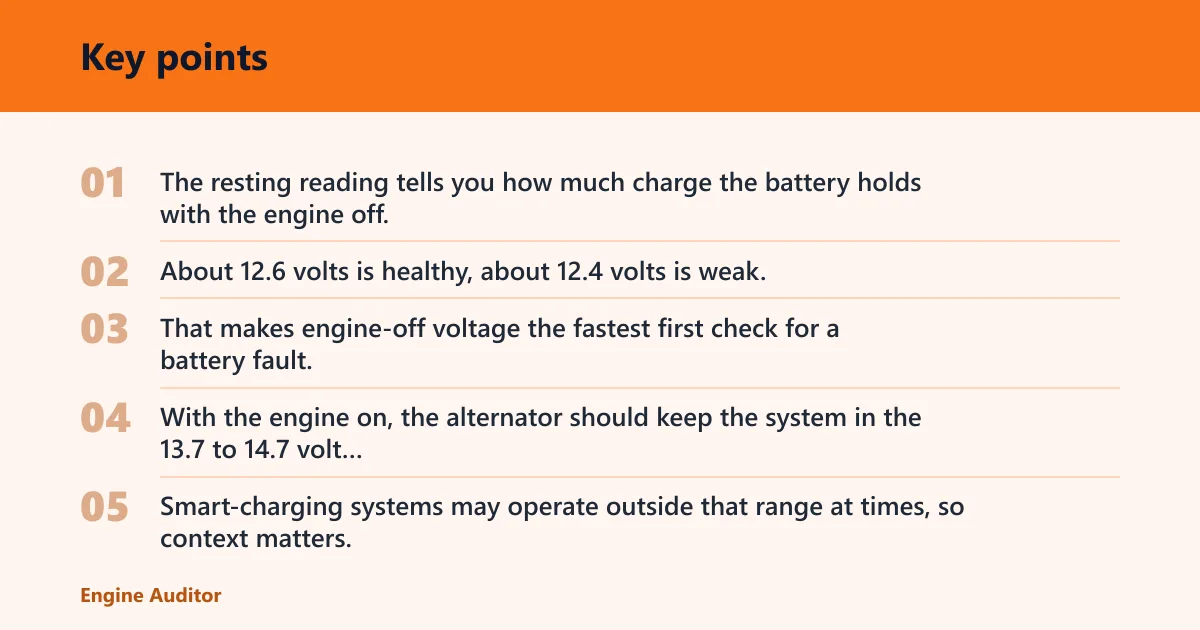
The resting reading tells you how much charge the battery holds with the engine off. About 12.6 volts is healthy, about 12.4 volts is weak, and 12.0 volts or below is nearly flat. That makes engine-off voltage the fastest first check for a battery fault.
Running voltage favors the alternator
With the engine on, the alternator should keep the system in the 13.7 to 14.7 volt window on conventional charging systems. Smart-charging systems may operate outside that range at times, so context matters. If the voltage is not where it should be for the charging strategy in use, or it cannot hold under load, the charging system deserves attention. A battery cannot create that charging voltage on its own.
Cranking voltage and symptom pattern separate the rest
Cranking voltage that drops unusually low points strongly toward battery failure. If the numbers look normal but the engine still cranks slowly, the starter, cables, or grounds move higher on the list. That is where a symptom check keeps you from replacing the wrong part.
Warning lights and noise point to charging faults
The battery warning light usually means a charging-system issue, not only a bad battery. A whining, grinding, or growling alternator, or a lamp that stays on while driving, pushes suspicion toward the alternator, a loose belt, or a voltage regulator fault rather than the battery itself.
Car battery alternator worksheet
Use this worksheet in order: resting voltage first, cranking voltage second, and running voltage third. Fill in the readings, then compare the pattern with the likely-cause verdict. If the numbers do not fit cleanly, connections, belt slip, starter trouble, parasitic draw, or smart-charging strategy may be hiding the real fault. For drain-prone vehicles and short-trip stress, see stop-start battery lifespan for why repeated short trips can accelerate discharge.
| Symptom | Resting voltage | Cranking voltage | Running voltage under load | Likely-cause verdict |
|---|---|---|---|---|
| Slow crank after sitting overnight | 12.4 volts or below | Below 9.6 volts | Normal or slightly low | Car Battery |
| Starts with a jump, then dies after cables come off | Often low | May be acceptable with a jump | Falls below 13.7 volts or will not hold under load | Alternator |
| Battery light stays on while driving, headlights dim | May look normal at rest | May start fine | Below 13.7 volts or unstable at about 2,000 rpm | Alternator |
| Single click, normal lights, no crank | Often normal | May not drop much | Usually not the main clue | Starter |
| Voltage readings look fine, but terminals are corroded or loose | Can appear normal | Can sag at the posts | Can vary with load | Connection issue |
How do you tell if the battery is bad?
A bad battery usually shows up first in the engine-off and cranking readings. About 12.6 volts at rest is healthy, about 12.4 volts is weak, and 12.0 volts or below is nearly flat. If the battery sags well below normal while cranking, that is a strong failure clue.
Look at age, shape, and smell
Standard car batteries generally last about three to five years, so age matters when the readings start to drift. Swelling, case distortion, or a rotten-egg smell can point to internal failure. Stop treating it as a simple recharge problem when those signs appear. (Firestonecompleteautocare)
Use the crank test with the multimeter
Set a digital multimeter to DC volts, place the probes on the battery posts, and watch the minimum reading while a helper cranks the engine. If the number dives unusually low, the battery is failing or heavily discharged. If the number stays near normal and the engine still does not spin well, move to the starter and cable checks. A load tester is the better next step when the battery passes a quick voltage check but still seems weak, because a static reading alone can miss internal plate failure.
How do you tell if the alternator is bad?
A bad alternator usually shows up while the engine is running, not at rest. A healthy charging system holds 13.7 to 14.7 volts on conventional systems, and it should support the vehicle under load as appropriate for the charging strategy in use. If voltage sits low, swings around, or drops when the electrical load increases, the alternator or its drive belt moves to the top of the list.
Watch the running voltage under load
Turn on the headlights, blower, and rear defroster, then hold the engine near 2,000 rpm and read the battery terminals again. If the voltage cannot stay in range for that charging system, charging output is suspect. A failing alternator can also fail to recharge the battery while driving, so the battery may keep dying even after a jump.
Listen and look for charging clues
Whining, grinding, or growling noises from the front of the engine can point to alternator trouble. A battery warning light on the dashboard usually means a charging-system fault and can also involve the belt, wiring, or voltage regulator. Dim headlights fit either a battery or alternator issue, but a battery light while driving is a stronger charging clue.
Can a jump-start mislead you?
Yes. A jump-start can get a weak battery or a bad charging system past the first hurdle, so it is not proof by itself. Newer smart-charging systems can make that result less reliable. A jump should lead to measurement, not replacement.
Use the jump result as a clue, not a verdict
Suppose a sedan starts instantly with jumper cables, then dies after two minutes when the cables come off. That pattern points toward alternator output, belt slip, or a charging-control issue. Suppose the same car keeps running after the jump, but later cranks slowly again the next morning. That points more toward a weak battery or a drain problem.
Why newer cars can blur the picture
Some newer charging systems do not hold a fixed voltage all the time, so a jump-start result can be misleading. That is why the resting, cranking, and running checks matter more than a single “starts or dies” moment. A jump should lead to measurement, not replacement.
What else can mimic both faults?
Several faults can imitate a bad battery or alternator. A starter motor can make a healthy electrical system look weak, and a loose or corroded terminal can fake a failed component. A slipping serpentine belt can also starve the alternator, while parasitic draw can drain a good battery overnight. The diagnosis order matters because many “bad alternator” complaints are actually connection, belt, or starter problems.
Starter trouble can look electrical
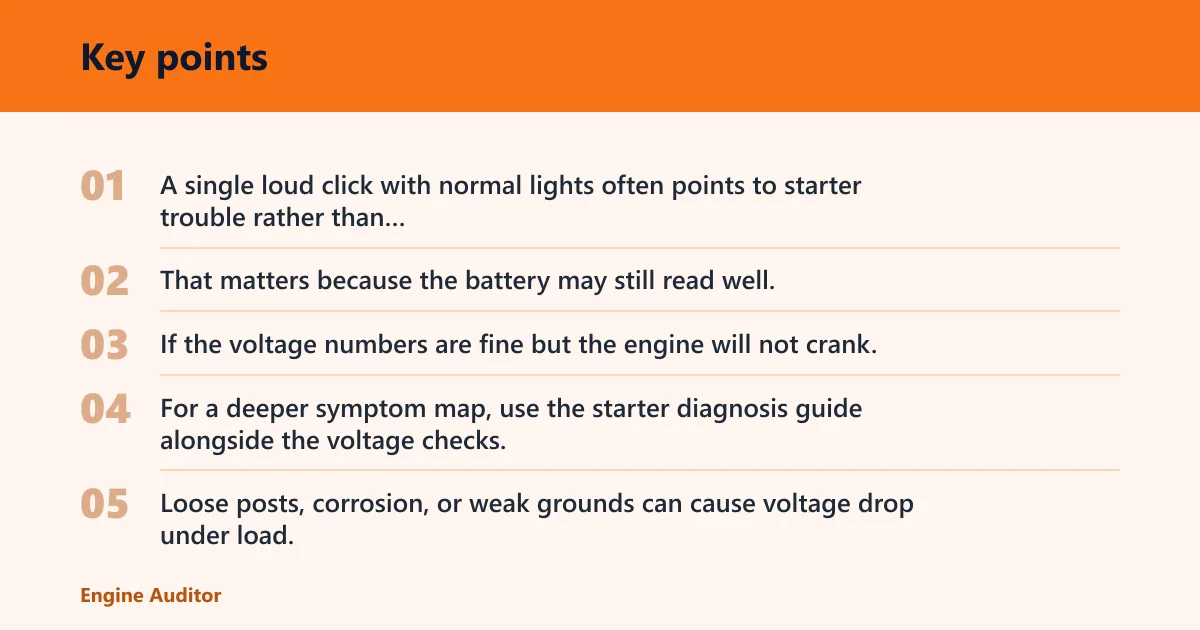
A single loud click with normal lights often points to starter trouble rather than battery or alternator failure. That matters because the battery may still read well, and the alternator may charge normally once the engine is running. If the voltage numbers are fine but the engine will not crank, the starter moves up the list. For a deeper symptom map, use the starter diagnosis guide alongside the voltage checks.
Connections and belt condition matter
Loose posts, corrosion, or weak grounds can cause voltage drop under load. Inspect the serpentine belt for glazing, looseness, or obvious slip marks, because a belt that cannot grip will keep the alternator from producing enough output. That inspection belongs in every charging-system diagnosis. For belt-related clues, see serpentine belt symptoms.
Parasitic draw can hide behind a good battery
A vehicle that sits and then starts poorly may have a drain instead of a bad battery. Short-trip drivers, hot-climate owners, and stop-start vehicles are more likely to see repeated battery stress, because the battery may not get enough time or charge recovery between drives. If the readings are inconsistent after charging, draw testing is the next step. If you need the meter setup, use the multimeter testing guide before pulling fuses.
What tools and tests do you need?
For home diagnosis, the basic toolkit is small: a digital multimeter, access to the battery posts, and a clear way to read voltage with the engine off and running. For anything beyond that, a load tester becomes the better tool because it can show how the battery behaves under demand, not only at rest.
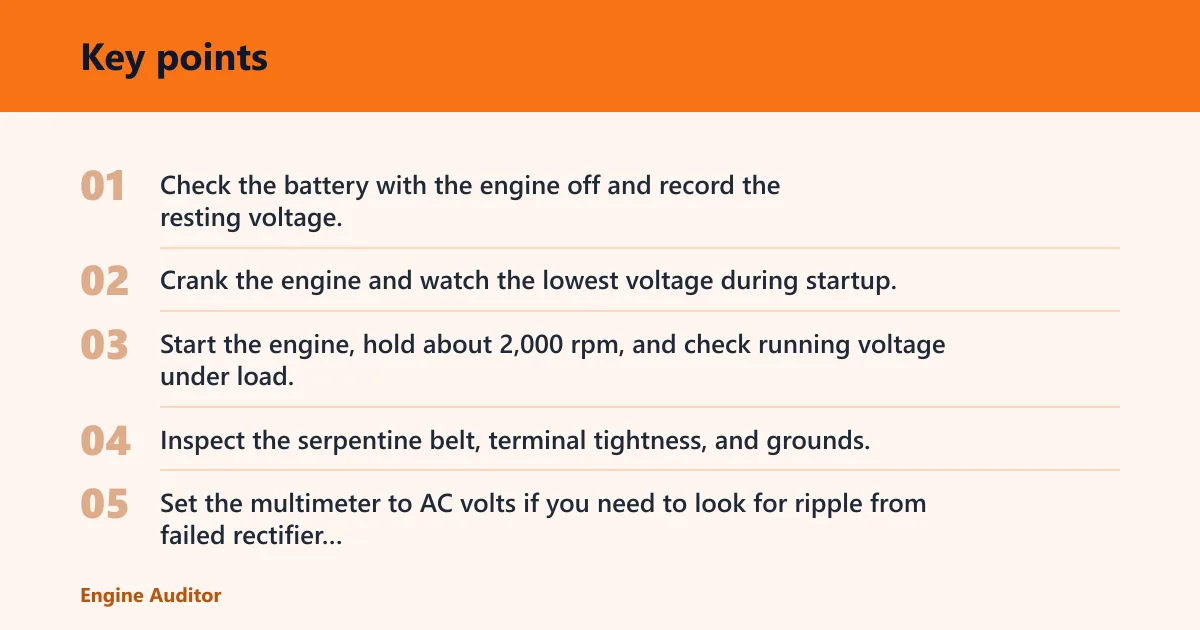
- Check the battery with the engine off and record the resting voltage.
- Crank the engine and watch the lowest voltage during startup.
- Start the engine, hold about 2,000 rpm, and check running voltage under load.
- Inspect the serpentine belt, terminal tightness, and grounds.
- Set the multimeter to AC volts if you need to look for ripple from failed rectifier diodes.
- Use a load tester if the numbers are close but the symptom remains.
Use AC volts to look for ripple
AC ripple on the DC line points to failed rectifier diodes inside the alternator. That clue does not replace the main voltage checks, but it can explain a battery that keeps dying even when the charging voltage seems close to normal at first glance. If ripple is present, the alternator deserves direct attention. Ripple that is clearly out of spec, especially when it accompanies flickering lights or unstable charging, is a strong rectifier-diode warning.
Know when to stop
If the battery light stays on while driving, the voltage is below the charging window, or the engine starts to stall, stop driving soon and get the system checked. Running the car on a failing alternator can leave you stranded and can also keep killing the battery. Home diagnosis should end when the readings point to a charging fault you cannot confirm safely.
Car Battery vs Alternator: how the choice breaks down
Car Battery wins when the problem shows up with the engine off, during cranking, or after sitting. Alternator wins when the engine runs but voltage will not stay in range, the battery light stays on, or the battery keeps dying while driving. If those patterns conflict, check the starter, grounds, belt, and parasitic draw before buying parts.
Battery wins on stored charge and cranking
The battery is the right pick when resting voltage is weak, cranking voltage drops unusually low, or the case is swollen or smells like sulfur. Those are direct clues that the battery cannot hold or deliver enough current. A bad battery also fits age near three to five years.
Alternator wins on charging and load support
The alternator is the right pick when the running voltage falls outside 13.7 to 14.7 volts, especially at about 2,000 rpm with loads switched on. That is also the better match when the battery warning light stays on or the headlights dim while the engine is running. Noise from the alternator or belt strengthens that call.
Tie means you need the next step
If the readings conflict, do not force a verdict. A loose terminal, slipping belt, starter fault, or parasitic draw can make both parts look bad. In that case, check the connections, belt, and load first, then retest. Use the worksheet below to keep the verdict tied to the test order rather than to a hunch.
Choose Car Battery if…
Choose Car Battery if the vehicle has been sitting, the resting voltage is 12.4 volts or lower, the crank reading falls well below normal, or the battery is near the three-to-five-year mark with swelling or a sulfur smell. Those signs point to a battery that cannot store or deliver enough energy.

Choose Alternator if…
Choose Alternator if the engine starts but the running voltage stays below 13.7 volts, will not hold under load at about 2,000 rpm, or the battery light stays on while driving. A battery that keeps dying after a jump, plus charging noise or belt slip, also fits alternator trouble better than battery trouble.
Frequently asked questions
How do I tell if my car battery or alternator is bad?
Start with the resting voltage, then check cranking voltage, then check running voltage under load. About 12.6 volts at rest is healthy, unusually low cranking voltage points to battery trouble, and 13.7 to 14.7 volts with the engine running is the charging window. The pattern usually separates the two.
What are the signs of a bad battery vs alternator?
A bad battery usually shows slow cranking, low resting voltage, and poor recovery after sitting. A bad alternator usually shows a battery warning light, dim headlights while driving, low running voltage, or a battery that keeps dying on the road. Noise from the alternator also points toward charging trouble.
Can a bad alternator kill a new battery?
Yes. A failing alternator can make the battery keep dying, even if the battery itself is new. If the charging system cannot hold 13.7 to 14.7 volts under load, the new battery will not get fully recharged and can end up discharged again after a short drive.
What voltage should a car battery and alternator read?
A healthy battery reads about 12.6 volts at rest. Around 12.4 volts is weak, and 12.0 volts or below is nearly flat. With the engine running, a healthy charging system holds 13.7 to 14.7 volts, and that should still be true under load at about 2,000 rpm.
Does a car starting with a jump mean the battery is bad?
Not by itself. If the engine dies after the jump cables come off, the alternator is more likely. If it keeps running, the battery is probably weak. On newer cars, that result can mislead you, so it should be followed by voltage readings instead of treated as proof.
What does the battery warning light mean while driving?
It usually means a charging-system issue, not only a bad battery. The cause can be the alternator, a loose connection, a voltage regulator problem, or a slipping belt. If the light stays on while driving, the system should be tested soon because the battery may not stay charged.
Products related to this article
Sponsored / affiliate links. As an Amazon Associate I earn from qualifying purchases. I may earn additional commission from eligible campaigns.