How to Tell If Your Car Is Due for Maintenance
Your car is due for maintenance when the owner’s manual interval is reached or passed, when a dashboard reminder appears, when mileage is overdue, or when visible wear points to service now. Waiting too long can turn a small service into larger repair bills, worse fuel economy, and breakdowns you could have avoided. This guide shows how to compare the manual, your last service records, warning lights, and wear signs so you can tell whether maintenance is due now, due soon, or still on schedule.
Check your owner’s manual for service intervals
The clearest answer comes from the owner’s manual, then from the last service record, then from what the car is telling you right now. Use mileage and time together. The next service is due when the distance limit or the time limit is reached, whichever comes first.
Read the owner’s manual schedule
Look for the maintenance schedule near the back of the manual. That section usually gives a distance interval, a time interval, and model-specific notes for items such as oil, tire rotation, brakes, and filters. There is no single right interval for every car, so the manual is the rule for your vehicle.
-
Find the maintenance section. Open the manual to the schedule, not the quick-reference pages. Some manuals separate normal use from severe use, and that changes the interval.
-
Write down both limits. Record the mileage interval and the time interval. If either one is reached first, the service is due.
-
Mark model-specific items. Note any items the manual lists separately, such as brake fluid, tire rotation, or air filters. Maintenance intervals can depend on the car, engine, oil, and sometimes the country.
A common first-timer mistake is treating the mileage number as the only trigger. If the manual says an oil change is due every 10,000 miles or every 12 months, a low-mileage driver still needs the time-based service when the year is up.
Check the last service record
The last invoice or service booklet gives you the anchor point for the next due date. A useful maintenance log records what was done, when, at what mileage, and what is next. Many intervals are by distance, so the odometer reading is the most useful number in the log.
-
Find the most recent proof. Use the last invoice, stamped service booklet, or a digital repair record. Look for the date, the mileage, and the work done.
-
Compare it with the manual. Match that last mileage and date against the schedule in the manual. This tells you whether the next service is already due or only approaching.
-
Estimate the next due point. Add the manual interval to the last service mileage, then compare that number with the current odometer reading. If the time limit is shorter, use the time limit instead.
Suppose the last invoice shows an oil change at about 42,000 miles and the manual calls for service every about 10,000 miles or about 12 months. At about 50,800 miles and about 11 months later, the car is close but not yet over the distance limit, while the time limit is about to arrive. That is due soon, not yet overdue.
Is a dashboard message enough?
A service reminder light or message is useful, but it is not the full story. Newer vehicles use reminders to prompt service, yet the message usually does not show complete maintenance history or confirm every item has been done. Treat it as a signal to check the manual and records, not as the only proof.
Service reminder lights and messages
Some dashboards show “maintenance required,” “service due,” or a wrench symbol. That may be only an interval reminder. It may also appear after the car calculates mileage or time since the last reset.
-
Read the exact message. Note whether it is a service reminder or a warning light for a fault. That difference matters because the action changes.
-
Check the manual next. Confirm what that message means for your model. Some reminders are for scheduled service only, while others point to a separate condition.
-
Compare it with records. If the message appeared soon after a documented service, the reminder may need to be reset. If there are no records, assume the reminder is telling you service is due or overdue until proven otherwise.
When a message needs immediate attention
A reminder message alone is not usually an emergency. A warning light paired with an urgent symptom is different. If the car has low oil pressure, a temperature warning, severe braking change, or a tire-pressure warning with a visibly low tire, treat that as a fault, not routine maintenance.
Do not mix a maintenance reminder with a safety problem. A service message asks for scheduled work. A red or flashing fault light, or a serious symptom such as grinding brakes or heavy smoke, needs faster action.
Which wear items tell you service is due?
Visible wear can move a service from “soon” to “now.” Oil level, tire condition, brake wear, and filters do not replace the manual schedule, but they add evidence. Car and Driver recommends checking engine oil regularly at the intervals suggested in the owner’s manual and using a dipstick to check oil level under the hood.
Oil level and visible leaks
Use the dipstick for an under-hood oil level check. Low oil, fresh drips under the engine, or signs of burning oil can mean the car needs attention before the next scheduled interval.
-
Check the dipstick correctly. Park on level ground, shut the engine off, and follow the manual for the proper wait time before reading the stick. The level should land within the marked safe range.
-
Look for leak clues. Check the driveway, oil pan area, and under the hood for wet spots or drips. A leak can make the next service due sooner than the calendar suggests.
Tires, pressure, and rotation
Tire pressure checks belong in the routine. Car and Driver recommends checking tire pressure against the label inside the driver’s side door jamb. The tire pressure monitoring system warns you when pressure is off, but the light does not tell you why it dropped.
-
Read the door-jamb placard. Use the pressure listed on the label inside the driver’s side door jamb, not the number molded into the tire sidewall. The placard is the value the vehicle expects.
-
Inspect tire wear. Uneven edges, cords, bulges, or one tire wearing faster than the others point to needed service or alignment checks. That can make rotation or inspection due now.
-
Check the rotation schedule. Most auto manufacturers specify tire rotation in the owner’s manual, but not every vehicle needs the same pattern or interval. Car and Driver notes that rotation can be once a year or once every 10,000 miles, and leading tire manufacturers recommend rotation every 6 months or 6,000 to 8,000 miles.
Brakes, filters, and other routine checks
Brake system inspection matters because it involves a safety-critical component. Worn pads, long pedal travel, squealing, or grinding are signs to act now. Air filters are routine replacement items too: the engine air filter and cabin air filter both belong on the maintenance list, though their timing varies by vehicle and use.
CarVertical lists 10,000 miles as a service point for inspection of fluids, wiper blades, and brake system, and 20,000 miles for brake fluid change in its example schedule. That does not set your car’s interval, but it shows why the manual and history matter more than a generic sticker.
Maintenance due table
The table below shows how to decide whether service is due now, soon, or not yet. Use the manual interval first, then compare the last service evidence, the odometer, the calendar, and any warning signs.
| Scenario | Last service date | Last mileage | Manual interval | Current mileage | Months since service | Dashboard message | Visible warning signs | Action to take |
|---|---|---|---|---|---|---|---|---|
| New car | 6 months ago | 4,200 miles | 10,000 miles or 12 months | 7,100 miles | 6 | No | None | Not yet; keep the next date and mileage in view. |
| Low-mileage car | 11 months ago | 12,300 miles | 10,000 miles or 12 months | 14,000 miles | 11 | No | None | Soon; the time limit is close, so schedule service now. |
| High-mileage commuter | 4 months ago | 88,000 miles | 10,000 miles or 12 months | 98,600 miles | 4 | No | None | Due now; mileage has passed the manual interval. |
| Car with missing records | Unknown | Unknown | Unknown | 62,000 miles | Unknown | No | Dirty air filter, tired wipers | Due now; start with a full inspection and rebuild the service history. |
| Dashboard maintenance message only | 9 months ago | 31,500 miles | 10,000 miles or 12 months | 39,400 miles | 9 | Yes | None | Soon; confirm whether the reminder reflects scheduled service or a reset issue. |
| Car with one urgent symptom | 3 months ago | 54,000 miles | 10,000 miles or 12 months | 56,200 miles | 3 | No | Grinding brake noise | Due now; inspect brakes immediately because the symptom is urgent. |
How do you decide if it is due now?
Decide in this order: manual interval first, last service record second, dashboard message third, visible wear last. If the distance or time limit from the manual has been met, the service is due now. If neither limit is met but the car has a warning sign or missing records, treat the situation as due soon or due now depending on the symptom.
New car with little mileage
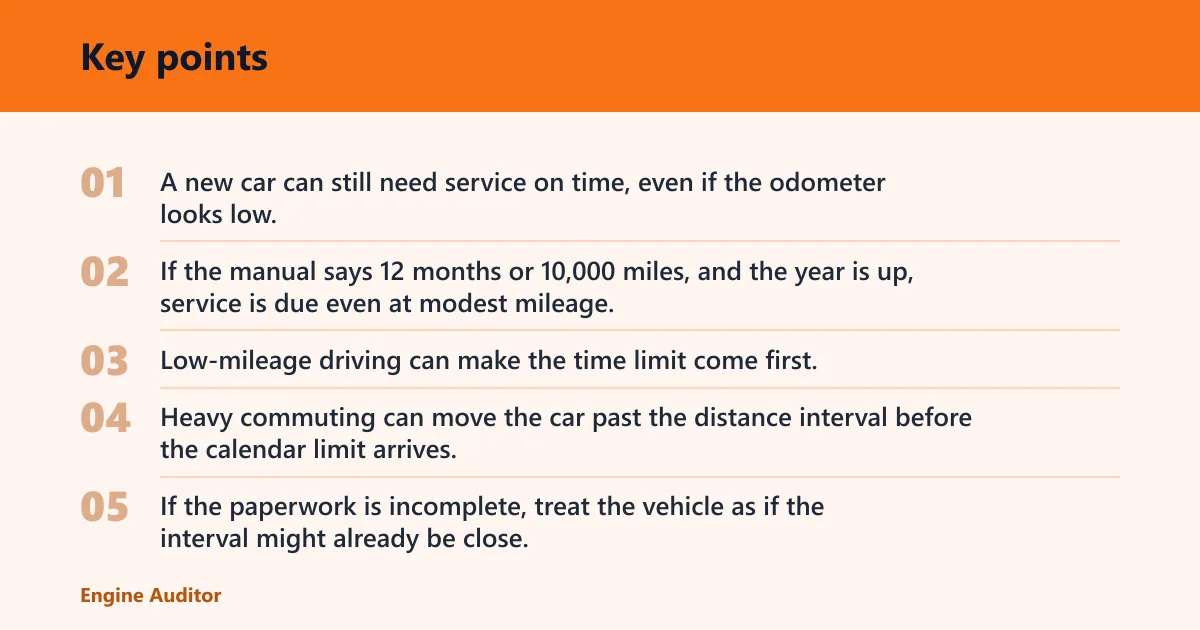
A new car can still need service on time, even if the odometer looks low. If the manual says 12 months or 10,000 miles, and the year is up, service is due even at modest mileage. Low-mileage driving can make the time limit come first.
High-mileage commuter
Heavy commuting can move the car past the distance interval before the calendar limit arrives. If the last service was at about 88,000 miles and the manual interval is about 10,000 miles, the next service is due at about 98,000 miles, even if only about four months have passed.
Car with missing records
If the paperwork is incomplete, treat the vehicle as if the interval might already be close. Start with the manual, then inspect oil level, tires, brakes, and filters. A car can be mechanically fine and still have poor maintenance proof, which matters when buying or evaluating it.
How do you know if your car has been maintained regularly? Look for a service booklet, invoices, dates, mileage entries, and a pattern of work that matches the manual. A single reset reminder is not proof. A stack of records that shows what was done, when, at what mileage, and what is next is far better evidence.
Car with one urgent symptom
If one symptom points to a safety issue, the maintenance decision changes. Grinding brakes, a red pressure light, overheating, or a tire-pressure warning with one visibly soft tire can mean the car needs immediate attention, even if the routine service interval is not yet due.
Say your compact SUV shows a maintenance reminder at 9 months, but the oil dipstick is full, the tires are even, and the only symptom is a message after the last reset. That is usually a service reminder, not an emergency. Now change one thing: the same SUV develops grinding at the front brakes. The brake inspection becomes due now.
Frequently asked questions
How to check maintenance on a vehicle
Start with the owner’s manual schedule, then check the last invoice or service booklet, then inspect oil, tires, brakes, and filters. The manual tells you the interval, the records tell you when the last service happened, and the car tells you whether a problem is already showing.
When is the next car maintenance due?
The next service is due at the earlier of the mileage limit or the time limit in the manual. If you have the last service date and mileage, add the interval to both and use whichever comes first. If records are missing, inspect the car and schedule service sooner rather than later.
Why does my car say maintenance required?
That message usually means a scheduled service interval has been reached or the reminder system has not been reset. It does not tell you which items need work, and it does not replace the manual or records. Check the schedule, then decide whether the reminder is due now or only a prompt.
Should I follow time or mileage for car service?
Follow both. The manual sets the distance interval and the time interval, and whichever comes first controls the service due date. That matters most for low-mileage drivers, because the time limit can arrive before the odometer does. Do not wait for mileage alone if the calendar limit has passed.
What is considered car maintenance?
Car maintenance includes inspections, servicing, and replacement done at manufacturer-recommended intervals. That usually covers oil service, brake checks, tire rotation when specified, tire pressure checks, filters, wipers, and fluid inspections. The exact list varies by vehicle, engine, oil, and sometimes country, so the manual is the source.
Products related to this article
Sponsored / affiliate links. As an Amazon Associate I earn from qualifying purchases. I may earn additional commission from eligible campaigns.