How to Read a Car Service Invoice Without Getting Lost
Match every invoice line to the approved estimate. If a charge lacks your authorization or a clear maintenance need, question it before paying. Miss that check, and you can pay for duplicate labor, unauthorized parts, or fees that should never appear. This guide shows how to verify the vehicle, read labor codes, audit parts and shop fees, and compare every charge against the estimate.
What is on a service invoice?
A service invoice should identify the correct vehicle, show what was approved, and list the charges that make up the final balance. Start with the customer name, VIN, mileage, date of service, and shop details, then compare the labor, parts, fees, taxes, and warranty terms against the estimate and the work order.
Customer and vehicle details
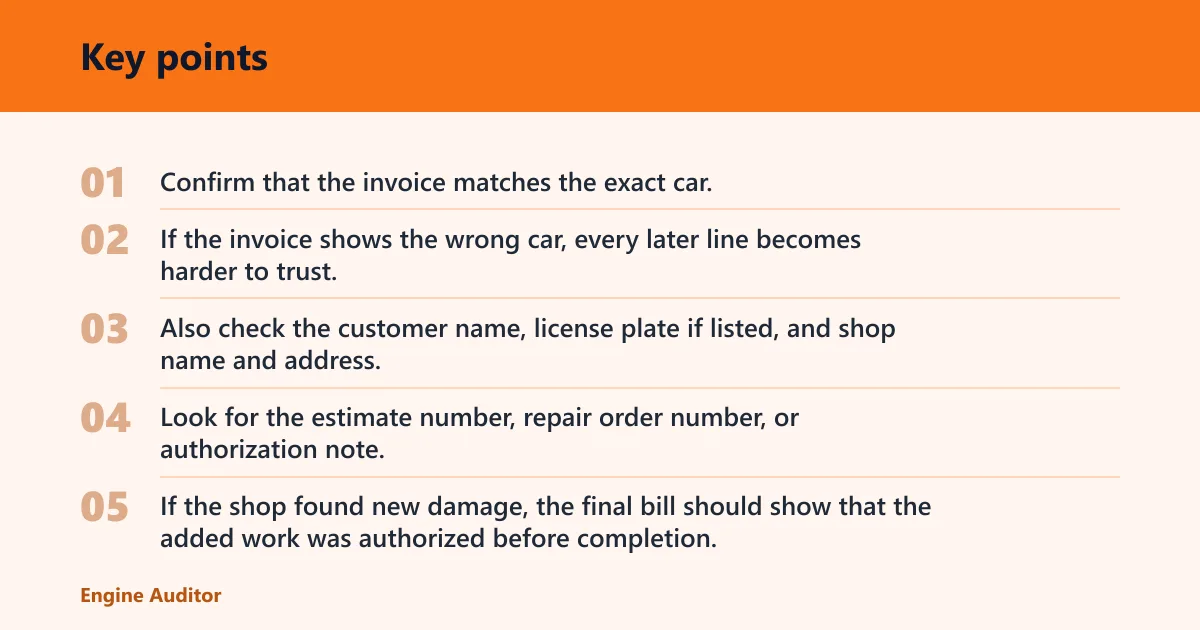
Confirm that the invoice matches the exact car. The VIN should be the 17-character vehicle number, the mileage should be close to the odometer reading at drop-off or pickup, and the date should match the actual service window. If the invoice shows the wrong car, every later line becomes harder to trust. (Nhtsa)
Also check the customer name, license plate if listed, and shop name and address. These details help tie the bill to the right repair history and warranty record.
Service authorization and estimate reference
Look for the estimate number, repair order number, or authorization note. The invoice should show what you approved, whether by signature, text, email, or phone approval, and any dollar limit for extra work. If the shop found new damage, the final bill should show that the added work was authorized before completion.
Totals, taxes, and final balance
The final page should separate subtotal, tax, fees, and grand total. A clean invoice makes it possible to see whether the shop charged for labor, parts, shop supplies, disposal, and government fees as separate lines. If the bill is only one lump sum, ask for an itemized version before you pay.
Invoice audit checklist
Use this table as a line-by-line filter. A line item is acceptable when it matches the estimate, the repair need, and the local billing rules; it is a red flag when the description is vague, duplicated, or outside the work you approved.
| Invoice field | What it means | Acceptable ranges or red flags | Questions to ask the shop |
|---|---|---|---|
| VIN, mileage, date | Identifies the vehicle and service visit | Should match the car and visit; wrong VIN or mileage is a red flag | “Can you correct the vehicle details before I pay?” |
| Labor rate | Shop’s hourly charge or flat-rate basis | Should be listed clearly; dealer rates are often higher than independent shop rates | “Is this billed at an hourly rate or flat-rate time?” |
| Labor hours | Time billed for the job, not always clock time spent | Should match the estimate or explained change order; duplicate labor is a red flag | “Why are these hours different from the estimate?” |
| Parts line | Parts used on the repair | Should show part number, quantity, and unit price; missing details are a red flag | “Is this OEM or aftermarket, and what part number was used?” |
| Diagnostic fee | Scan or inspection charge to find the problem | May be separate from repair labor; sometimes waived if the repair is completed | “Was the diagnostic fee separate from repair labor, and was any part waived?” |
| Shop supplies | Small consumables such as rags, cleaner, or fasteners | May appear as a flat fee or a percentage; ask whether it is taxable in your area | “Is this a flat fee or percentage, and how was it calculated?” |
| Disposal fee | Charge for handling oil, batteries, tires, coolant, or similar waste | Often jurisdiction-specific; should be itemized if required by local rule | “What was disposed of, and is this fee required here?” |
| Tax | Sales tax or other government charge | Should apply only where local law allows; tire or battery fees may be separate | “Which items are taxed, and which fees are government charges?” |
| Warranty note | Coverage on parts and labor after the repair | Should list period, mileage limit, and exclusions; missing terms are a red flag | “What exactly is covered, for how long, and what is excluded?” |
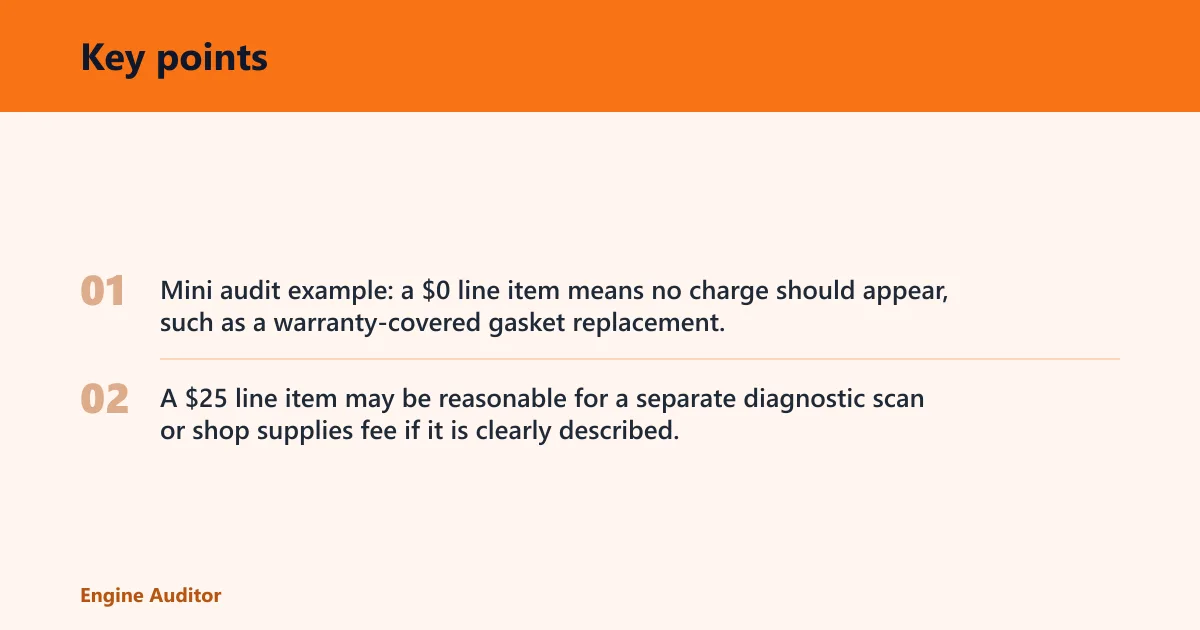
Mini audit example: a $0 line item means no charge should appear, such as a warranty-covered gasket replacement. A $25 line item may be reasonable for a separate diagnostic scan or shop supplies fee if it is clearly described. A $150 line item should carry enough detail to explain the charge, such as a quoted labor operation or a priced part with a part number.
How do labor charges work?
Labor charges usually come from an hourly shop rate, flat-rate labor, or a mix of both. The invoice should show how many hours were billed and at what rate, because billed time is not always the same as time spent on the car. Dealer labor rates are often higher than independent shop rates, so a higher number is not automatic overcharging.
Hourly shop rate vs flat-rate labor
An hourly rate multiplies the shop’s posted labor rate by billed hours. Flat-rate labor uses a published time guide for the job, which may be different from actual clock time. A brake service billed at about 1.5 hours can be normal even if the technician finished faster, because the charge typically follows the book time rather than the stopwatch.
Billed hours versus actual time
The key check is whether the billed hours match the approved work. If the estimate said about 2.0 hours for a thermostat replacement and the invoice shows about 3.5 hours with no explanation, ask for the reason. Extra time may be valid when corrosion, broken fasteners, or added diagnosis changes the job.
Say your invoice shows about 2.2 billed hours for an alternator at a $145 labor rate. That labor total would be $319. That is the number to compare with the estimate, not the actual time the bay was occupied.
Dealer and independent shop differences
Dealer shops often bill at a higher rate because they may use factory procedures, brand-specific scan tools, and higher facility overhead. Independent shops may charge less, but they can still bill flat-rate labor and diagnostic time. Price alone does not tell you whether the bill is correct; the repair detail does.
How do you read parts and fees?
Parts should be itemized with enough detail to confirm what was installed. Fees can be legitimate, but they should still be clear enough to check. The main issue is whether each charge matches the approved repair and local billing rules.
OEM versus aftermarket parts
Look for original equipment manufacturer parts or aftermarket parts on the invoice. OEM parts usually carry a part number that matches the vehicle maker’s catalog, while aftermarket parts may have a supplier number instead. Unit price and quantity matter; two spark plugs at $18 each should not appear as one vague “ignition parts” charge unless you approved a bundled quote.
Diagnostic fees and repair labor
A diagnostic fee covers finding the problem. Repair labor covers fixing it. Those charges can appear separately, and in some shops the diagnostic fee is waived or credited if you approve the repair. If the invoice shows both a scan charge and full labor, ask whether any diagnosis was already included in the repair time.
Shop supplies and disposal charges
Shop supplies are usually a small fee for consumables such as cleaner, gloves, clips, or bulk hardware. Shops may bill them as a flat fee or as a percentage of labor, and some states treat them as taxable while others do not. Disposal fees for oil, batteries, tires, or coolant may also appear, but their presence depends on local rules.
Check whether the fee is itemized. A percentage-based shop supplies charge is common, but it should still be stated clearly. A vague line like “miscellaneous fees” is a reason to ask for a breakdown.
Why is the final bill higher than the estimate?
The final bill can be higher when the shop found added work, used different parts, or adjusted the job after inspection. That change is normal only if you approved it. If the repair shop crossed your authorization limit or added items you did not approve, ask for a revised explanation before payment.
Approved add-ons and authorization limits
Many estimates may include a written limit for extra work, such as “call before exceeding $100.” If the invoice exceeds that threshold, the shop should show the added approval. Approved add-ons can include a battery, belt, or gasket discovered during tear-down, but they should not appear as surprise charges.
Price changes after inspection
Price changes are common when the mechanic sees more damage after disassembly. Parts may cost more than first quoted, or labor may increase if rusted fasteners slow the repair. The correct response is a new approval record, not a silent price jump.
When to ask for a revised estimate
Ask for a revised estimate when the invoice includes a new operation, a different part brand, or a larger labor total than the approval note. A revised estimate should name the new work, show the new total, and indicate that you approved it before the shop continued.
Which service line items should you question?
Question any line that is duplicated, bundled too broadly, or not tied to the maintenance need. The strongest red flags are vague descriptions, missing part numbers, and charges for work you did not approve. Not every extra line is wrong, but every extra line should be explainable.
Duplicate or bundled charges
Watch for duplicate labor, such as a “diagnostic” charge followed by the same diagnosis folded into repair labor without explanation. Also watch for bundled service names like “front-end service” or “maintenance package” when the invoice does not break out what was actually done. Bundles can hide price comparisons.
Maintenance you did not approve
If the invoice includes an air filter, fluid exchange, or brake service you never approved, ask why it was added. Some shops recommend related maintenance during a visit, but recommendation is not authorization. The invoice should show your approval, not only the shop’s suggestion.
Suppose a customer approved an oil change and tire rotation, but the bill also lists a coolant flush and cabin filter. Those added lines deserve a direct question: were they requested, approved, or just recommended during inspection?
Missing part numbers or vague descriptions
Missing part numbers make it hard to verify whether the shop installed the correct item. Vague wording such as “hardware,” “fluids,” or “miscellaneous parts” should be tightened into itemized lines. You should be able to see the part name, quantity, unit price, and, when relevant, the part number.
How do warranties, taxes, and maintenance records fit together?
Warranty terms, tax lines, and maintenance records all help you judge whether the bill is complete and accurate. The warranty shows what the shop stands behind, the tax lines show what the jurisdiction allows, and the maintenance record shows whether the service was actually due.
Parts and labor warranty terms
Look for the coverage period, mileage limit, and exclusions. Some invoices cover parts longer than labor, and some exclude wear items, misuse, or unrelated failures. If the shop promises a warranty verbally, ask for the written term on the invoice or repair order.
Sales tax and government fees
Sales tax should appear where your state or local law requires it, and tire or battery fees may be separate government charges. The invoice should show which items are taxable and which fees are statutory. If the tax line looks too high, compare it with the taxable subtotal rather than the full balance.
Matching invoice items to the maintenance schedule
Compare each maintenance item to the recommended schedule and to prior records. Oil change, air filter, brake service, and fluid exchange should line up with mileage, time, or condition-based intervals in the owner’s manual or service history. A listed service that is far ahead of schedule deserves a question.
- Check the vehicle identity. Confirm the VIN, mileage, date, and customer name before reviewing charges. If any of those fields are wrong, the rest of the invoice may also be mismatched.
- Compare labor first. Match the labor rate, billed hours, and labor description to the estimate. If the labor hours changed, ask what inspection result or extra step caused the change.
- Audit every parts line. Confirm the part number, quantity, and unit price, and note whether the part is OEM or aftermarket. A vague parts line is not enough to verify the charge.
- Review fees and taxes. Separate shop supplies, disposal fees, sales tax, and any tire or battery charges. Check whether each fee is itemized and whether it is allowed in your area.
- Match the final total. Compare the invoice total to the approved estimate and any added authorization. If the final bill is higher, ask for the approval record before paying.
Frequently asked questions
How do I read a car service invoice?
Start with the vehicle details, then move to labor, parts, fees, taxes, and warranty terms. The invoice should match the estimate and any approval record. If a line is vague or not tied to the service you approved, ask for a clearer breakdown before paying.
What charges on a car repair bill are normal?
Normal charges usually include labor, parts, shop supplies, disposal fees where allowed, and sales tax or similar government charges. Normal does not mean automatic; each charge should be itemized and tied to the approved work. A line that cannot be explained should be questioned.
What do labor time and shop hours mean on an invoice?
Labor time is the billed time used to calculate the charge, while shop hours can refer to the labor rate or the time the vehicle was in the bay. The two are not the same. A short visit can still carry several billed hours under flat-rate pricing.
How can I tell if a mechanic is overcharging me?
Look for charges above the approved estimate, duplicate labor, missing part details, or fees that were never explained. Compare the labor rate and hours with the estimate, and check whether parts were priced as OEM or aftermarket. A higher bill is not overcharging unless it lacks support or approval.
How do I compare an invoice to the recommended maintenance schedule?
Match each maintenance line to the mileage or time interval in the owner’s manual and to prior service records. If the invoice shows a brake flush, air filter, or fluid exchange earlier than expected, ask why it was needed now. The repair should fit the schedule or the car’s condition.
Products related to this article
Sponsored / affiliate links. As an Amazon Associate I earn from qualifying purchases. I may earn additional commission from eligible campaigns.