How to Keep Car Ownership Costs Low Without Skipping Service
Keep the services that protect the engine, transmission, brakes, tires, and cooling system on schedule. Push cosmetic and comfort work back unless there is a symptom or the maintenance schedule calls for it. Budget extra if you drive in severe service or beyond the maker’s normal interval. Skipping the first group can turn a cheap service into a repair bill that costs far more than a year of maintenance. This guide shows how to sort maintenance into must-do, can-wait, and budget-for-it buckets without gambling on reliability.
What makes car ownership expensive?


Car ownership costs stack up in six places: fuel, insurance, maintenance, repairs, fees, and depreciation. The monthly payment is only one part of the bill, and replacing a car also adds sales tax, registration, and insurance changes. The cheapest car to own is the one you already have.
Depreciation matters because a newer replacement starts losing value the moment you buy it. For many owners, keeping a current vehicle running is usually cheaper than replacing it, especially when the needed repair costs less than the hidden costs of another purchase.
Why the monthly payment is only one piece
A low payment can hide high running costs. Fuel, insurance, routine service, and surprise repairs still show up every month, even after the financing deal looks manageable.
If you are comparing keep-versus-replace, include taxes, title and registration, insurance changes, and the value lost to depreciation. A car with a payment can still cost less than a replacement if the current one needs only modest repairs.
How depreciation changes the repair-versus-replace decision
Depreciation changes the math on older cars. A paid-off car with a few age-related repairs can still be the lower-cost option if the next repair costs less than switching vehicles.
That does not mean every repair gets approved. It means you compare the repair bill against the car’s age, condition, and replacement costs, not against the next monthly payment alone.
Which service items should never slip?
Protect the service items that prevent engine, transmission, cooling, and brake problems. Oil changes, coolant service, transmission fluid service, and brake inspections belong on schedule because skipped maintenance can lead to expensive failures that cost more than the service itself. Safety repairs should not wait.
Safety repairs: brakes, tires, steering, and suspension
Brakes, tires, steering, and suspension are not optional. If they are worn or making the car harder to control, put them near the top of the list.
These items affect stopping distance, tire grip, and steering response. A delay here can raise both repair cost and crash risk, which is the wrong place to save money.
Reliability repairs: alternators and water pumps
Alternators and water pumps matter because they can strand the driver. They are not cosmetic, and they are not comfort work. If a charging or cooling failure is starting, it can turn a normal trip into a tow and a bigger repair.
Look for warning lights, overheating, battery problems, or coolant loss. Those symptoms move a reliability repair up the list fast.
When can maintenance wait?
Comfort and cosmetic work can usually wait unless the car has a symptom or the maintenance schedule calls for it. Interior trim, paint touch-ups, and convenience features do not get the same priority as engine, drivetrain, brake, tire, steering, or cooling work.
Unnecessary flushes and upsells deserve a pause. If the manufacturer’s maintenance schedule does not call for a service, or if the recommendation is vague, ask for the reason, the interval, and the failure it prevents.
Red-flag symptoms that move a repair back to the top
Move a repair up when you see fluid leaks, warning lights, overheating, grinding brakes, vibration, a pull while braking, hard shifting, or a dead battery that keeps returning. A symptom changes the job from “someday” to “protect the car now.”
Say your 8-year-old sedan needs a stained seat repaired, but the brake pedal is pulsing at highway speed. The seat can wait. The brake issue cannot.
Service priority matrix
| Task | Cost range | Failure prevented | Can-wait window | Red-flag symptoms |
|---|---|---|---|---|
| Oil change | Low to moderate | Engine wear, sludge buildup | Short for normal use, shorter for severe use | Low oil level, oil pressure light, noisy valvetrain |
| Coolant service | Moderate | Overheating, corrosion, hose and radiator damage | Follow schedule, do not stretch beyond symptoms | Overheating, sweet smell, coolant loss, temp gauge climbing |
| Transmission fluid service | Moderate to higher | Shift problems, accelerated transmission wear | Follow schedule closely on high-mileage and severe-use cars | Slipping, delayed engagement, harsh shifts, fluid leaks |
| Brake inspection | Low | Rotor damage, pad failure, longer stopping distance | At every service interval or sooner with symptoms | Squeal, grinding, vibration, soft pedal, pulling |
| Brake pads and rotors | Moderate | Loss of stopping power | Little to none if wear is near limit | Grinding, metal-on-metal noise, low pad thickness |
| Tires | Moderate to higher | Blowout, poor wet grip, longer braking distance | Only if tread and age are still safe | Uneven wear, cords showing, vibration, frequent air loss |
| Steering and suspension | Moderate to higher | Poor control, tire wear, instability | Short if play or clunking appears | Pulling, wandering, clunks, bouncing, uneven tire wear |
| Alternator | Moderate to higher | Battery drain, sudden shutdown, no-start | Very short once charging faults appear | Battery light, dim lights, repeated dead battery |
| Water pump | Moderate to higher | Overheating, engine damage, roadside failure | Very short if coolant loss or noise appears | Coolant leak, squeal, wobble, temp gauge rise |
| Interior trim, cosmetic fixes | Low to moderate | Comfort only | Can wait | Only if the damage affects use or safety |
For low-mileage commuters, protect the time-based items first: oil, coolant, brake inspections, battery checks, and tire age. For severe-use drivers, the same services arrive sooner. For older high-mileage cars, prioritize anything that prevents a tow or a bigger failure.
How do you follow the maintenance schedule cheaply?
The owner’s manual is the source of truth. The manufacturer’s maintenance schedule, not the dealer upsell menu, is the baseline. Use the normal interval if your driving is ordinary, and move to the severe interval when your use fits that category.
Severe driving includes short trips, extreme temperatures, dusty roads, and heavy towing. Those conditions shorten service life because fluids, filters, brakes, and batteries work harder than they do in easy commuting.
Normal versus severe intervals
Normal intervals fit steady driving with warm engine runs and little extra load. Severe intervals fit repeated short runs, cold starts, heat, dust, towing, or other heavy demands. The schedule often changes oil, fluid, and inspection timing when use is severe.
Do not treat severe service as rare or optional. If your pattern fits it, use the severe column from the manual and plan around it.
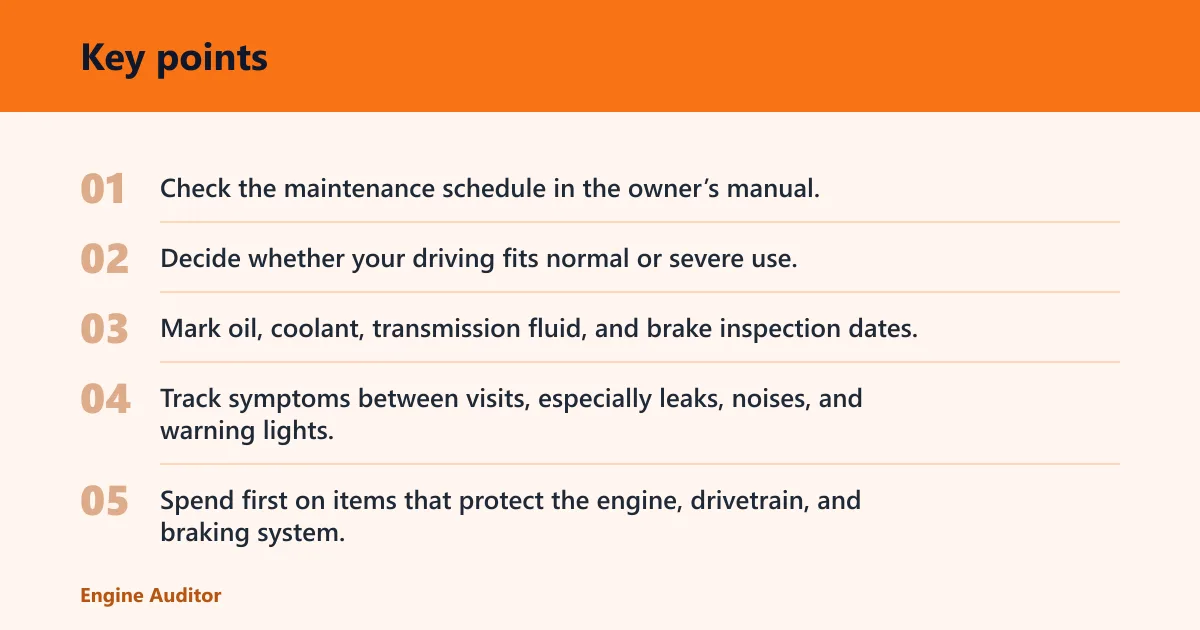
- Check the maintenance schedule in the owner’s manual.
- Decide whether your driving fits normal or severe use.
- Mark oil, coolant, transmission fluid, and brake inspection dates.
- Track symptoms between visits, especially leaks, noises, and warning lights.
- Spend first on items that protect the engine, drivetrain, and braking system.
Picture a commuter who drives a short distance each way in winter, with the engine barely warming up before shutdown. That is severe use for many schedules, even if the mileage looks low. A longer service interval can save money only if it still matches the way the car is used.
How much should you budget for repairs?
A repair fund of $100 to $200 per month gives many owners a workable start, and a $1,500 to $3,000 target buffer can cover most single repairs. That fund can help cover a brake job, battery, alternator, water pump, or similar repair before it becomes a crisis.
If the car is older, higher mileage, or used in severe service, lean toward the upper end. If the car is low-mileage and recent, the lower end may be enough for a while, but the fund should still exist.
How to decide whether a repair fits the budget
Start with three questions: Does the repair protect the engine, drivetrain, or safety? Does it stop a tow or a bigger failure? Can the repair be covered without wiping out the buffer? If the answer to the first two is yes, the repair gets priority.
A common first-timer mistake is approving a comfort repair before funding the next oil change, brake inspection, or coolant service. That order works backward.
How should you work with a mechanic?
An independent mechanic can help with budget repairs because they often set priorities, give clearer estimates, and may offer used parts when they make sense. Ask for line-item pricing so you can see labor, parts, and any shop fees separately.
Clear estimates make it easier to compare repairs against the car’s value and your repair fund. If a shop cannot explain why a service is needed now, ask what symptom, wear item, or schedule interval drives the recommendation.
When used parts make sense and when they do not
Used parts can make sense for some non-safety repairs, trim pieces, mirrors, or older vehicles where a new part would push the repair beyond reason. They are a weaker choice for items that affect stopping, steering, or long-term reliability.
Used parts should be judged by fit, condition, and risk. A low-price part that fails quickly can cost more than a better part installed once.
How a pre-purchase inspection helps with used cars
A pre-purchase inspection is worth it when buying a used car, especially if the listing looks clean but the service history is thin. An example cost is $150, and the inspection checks brakes, leaks, and codes.
That small cost can prevent buying a car that needs tires, brakes, cooling work, or electrical repair right away. It is a cheap filter before the bigger purchase closes.
Frequently asked questions
How can I save money on car maintenance without skipping service?
Follow the manufacturer’s maintenance schedule, use the severe interval when your driving fits it, and spend first on oil changes, coolant service, transmission service, and brake inspections. Skip upsells that do not match the manual, and use an independent mechanic for clear estimates and priority setting.
What maintenance should I never skip if I want to keep car costs low?
Do not skip oil changes, coolant service, transmission fluid service, or brake inspections. Those items protect the engine, drivetrain, and braking system from damage that costs far more than the scheduled service. Safety items such as brakes, tires, steering, and suspension also stay at the top of the list.
How often should I service my car to avoid expensive repairs?
Use the owner’s manual first, then choose normal or severe intervals based on your driving. Short trips, extreme temperatures, dusty roads, and heavy towing shorten service life, so they usually require more frequent oil, fluid, and inspection work than ordinary commuting.
What car maintenance is actually worth paying for?
Pay for maintenance that prevents a larger failure or protects safety. Oil changes, coolant service, transmission fluid service, brake inspections, and worn brake, tire, steering, or suspension parts are worth more than cosmetic work or flushes that are not called for in the schedule.
How much should I budget each month for car repairs?
That range helps cover most single repairs without forcing a rushed decision. Older cars and severe-use cars should lean toward the higher end.
Is it cheaper to keep my current car running or buy another one?
In many cases, keeping the current car running is cheaper than replacing it. Buying another vehicle adds sales tax, registration, insurance changes, and new depreciation. The current car wins unless the needed repairs are larger than the long-term cost of staying put.
What are the main costs that make car ownership expensive?
The main cost buckets are fuel, insurance, maintenance, repairs, fees, and depreciation. The monthly payment is only one part of ownership. A cheap loan can still sit beside high running costs, and a replacement car adds taxes, registration, insurance changes, and value loss.
Products related to this article
Sponsored / affiliate links. As an Amazon Associate I earn from qualifying purchases. I may earn additional commission from eligible campaigns.