What Car Maintenance Can You Do Yourself?
On many cars, a handful of routine jobs can be handled DIY, such as washer fluid, cabin air filter, wiper blades, tire pressure checks, and engine air filter replacement; brake work, coolant service, transmission service, and anything electrical or under the car are often better left to a mechanic. Done wrong, cheap maintenance can create leaks, brake failure, poor fuel economy, and repair bills far larger than the original service. This guide sorts car maintenance into safe DIY, conditional DIY, and mechanic-only work by risk, tools, and vehicle type.
What counts as safe DIY maintenance?
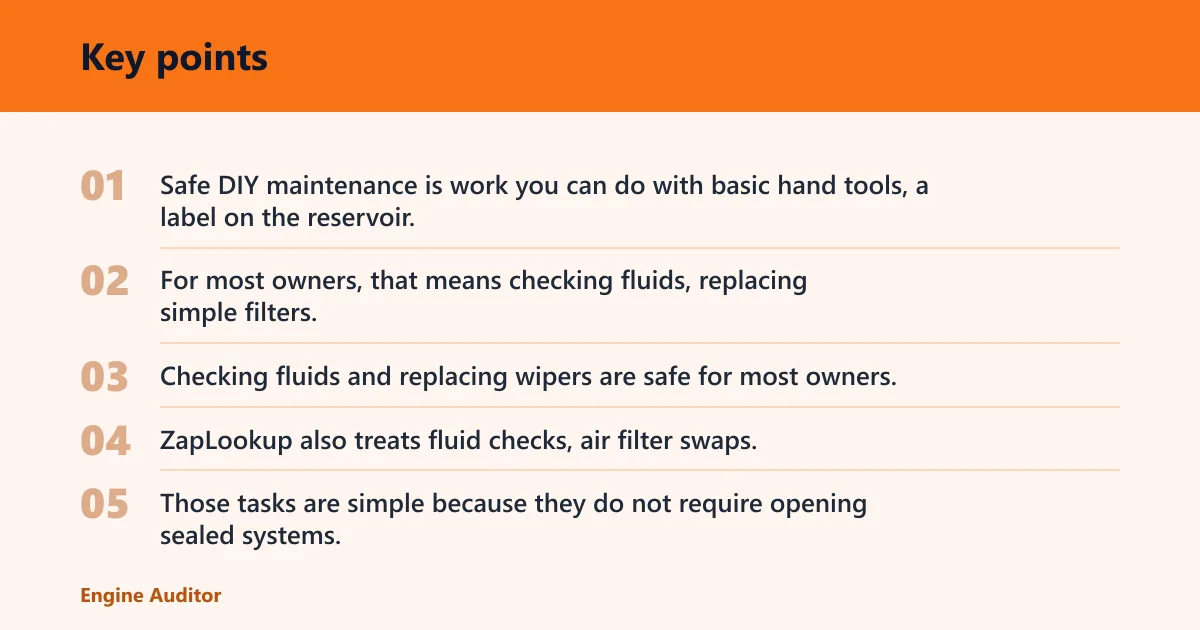


Safe DIY maintenance is work you can do with basic hand tools, a label on the reservoir, and a clear stop point if something looks wrong. For most owners, that means checking fluids, replacing simple filters, swapping wiper blades, checking tire pressure, and changing a flat tire if you have practiced the steps first.
Low-risk jobs you can usually do at home
Checking fluids and replacing wipers are safe for most owners. ZapLookup also treats fluid checks, air filter swaps, and wiper replacements as low-risk DIY jobs. Those tasks are simple because they do not require opening sealed systems, bleeding lines, or touching high-voltage parts.
Regular car maintenance keeps small faults from turning into bigger repairs. Low oil, weak battery voltage, underinflated tires, and a clogged filter can all snowball if you ignore them.
Jobs that look simple but need caution
Some jobs are still DIY-friendly, but only if you follow the manual exactly. Tire pressure is a good example: you need the placard PSI from the door jamb or owner’s manual, not a guess. A 12-volt battery replacement can also be manageable on many gas cars, but newer vehicles may need memory resets or scan-tool steps afterward.
Suppose your sedan has a cabin air filter behind the glove box and the old filter is packed with leaves. That is usually a straightforward replacement. Suppose the same car has a battery tucked under the rear seat with a vent tube and a battery management system. That is still possible for a capable owner, but the risk and reset steps are higher.
When a task is no longer beginner-safe
Stop the job if it involves pressurized fuel, brake hydraulics, suspension parts, airbag wiring, or high-voltage EV components. Those systems can fail in ways that affect safety immediately, and they often need special tools or calibration after the repair.
The owner’s manual first
Your owner’s manual is the first source for intervals, procedures, filter type, and torque specs. CarVertical says maintenance schedules are in the owner’s manual, and it is the place to check before any DIY task because service intervals and parts vary by model, engine, and drivetrain.
Find intervals, fluids, filters, and torque specs
Use the manual to confirm the correct engine oil specification, the right filter part or equivalent spec, and the lug-nut torque value for wheel changes. Many manuals also note service reminders around every 5,000 miles, but the actual schedule depends on the vehicle.
- Oil specification and capacity
- Cabin and engine air filter type
- Tire pressure placard values
- Lug-nut torque spec
- Battery replacement notes and reset steps
Use the manual for model-specific exceptions
Do not assume one car follows another car’s schedule. Some vehicles use cartridge oil filters, some hide the cabin filter behind trim, and some require a scan tool after battery disconnect. The manual is also where you confirm whether a hybrid uses a conventional 12-volt battery or a separate service procedure.
Check service notes for hybrids and EVs
Full EVs do not need oil changes. AAA says EV traction batteries are much larger and power the motor(s), and AAA advises inspecting EV battery cable connections at every service interval the manufacturer specifies for the vehicle. High-voltage parts stay off-limits unless you are trained and equipped for that work.

Car maintenance decision table
| Task | Safe for beginners | Tools required | Stop signs that mean call a mechanic |
|---|---|---|---|
| Engine oil level check | Yes, on most gas cars with a dipstick or marked reservoir | Owner’s manual, clean rag or paper towel | Oil pressure warning light, milky oil, metal glitter, no dipstick reading, or confusion about the correct specification |
| Windshield washer fluid refill | Yes | Washer fluid matched to climate, funnel if needed | Fluid leaks under the car, cracked reservoir, washer pump noise with no spray |
| Wiper blade replacement | Yes, on many clip or hook-style arms | Replacement blades, owner’s manual | Bent arm, damaged adapter, blade frame does not lock in place, streaking after correct installation |
| Cabin air filter replacement | Yes on many vehicles | Correct filter type, sometimes a trim tool or screwdriver | Access blocked by trim you cannot remove cleanly, water intrusion, broken housing tabs |
| Engine air filter replacement | Yes on many vehicles | Correct filter, screwdriver or clip release on some cars | Cracked airbox, torn intake boot, oil contamination, warning light after service |
| Tire pressure check | Yes | Tire gauge, placard PSI from door jamb or manual | Repeated pressure loss, sidewall bulge, tread separation, TPMS warning that returns after inflation |
| Spare tire and jack change | Yes if practiced before an emergency | Spare tire, jack, lug wrench, wheel chocks if available | Jack point is unclear, wheel is stuck, vehicle is unstable, lug nuts will not loosen, roadside surface is unsafe |
| 12-volt battery replacement | Yes on many gas vehicles | Gloves, eye protection, wrench, memory saver if needed | Corroded terminals fused in place, battery under seat or cargo trim you cannot access safely, newer car needs reset or coding you do not have |
| Brake repair | No for pads, rotors, calipers, lines, and fluid service | Professional equipment only | Squeal with grinding, soft pedal, brake warning light, leaks, pulling to one side |
| Fuel system work | No | Professional equipment only | Fuel smell, leaks, hard starting after repairs, pressurized lines, or any work near injectors, pumps, or rails |
| Suspension and alignment | No for alignment and major suspension repairs | Alignment rack, lift, specialty measuring tools | Steering wheel off-center, clunks, uneven tire wear, vehicle pulling |
| EV or hybrid high-voltage service | No for orange-cable, traction-battery, inverter, or high-voltage work | Trained high-voltage equipment only | Any orange cable exposure, HV warnings, battery isolation faults, or service requirements beyond the manual’s owner-level checks |
Which fluid checks can you do yourself?
Engine oil and washer fluid are the easiest fluid jobs for most owners. Brake fluid, coolant, and transmission fluid are different because mistakes can cause overheating, brake loss, or transmission damage, so those belong with the manual first and a mechanic if access or procedure is unclear.
Engine oil level and top-off
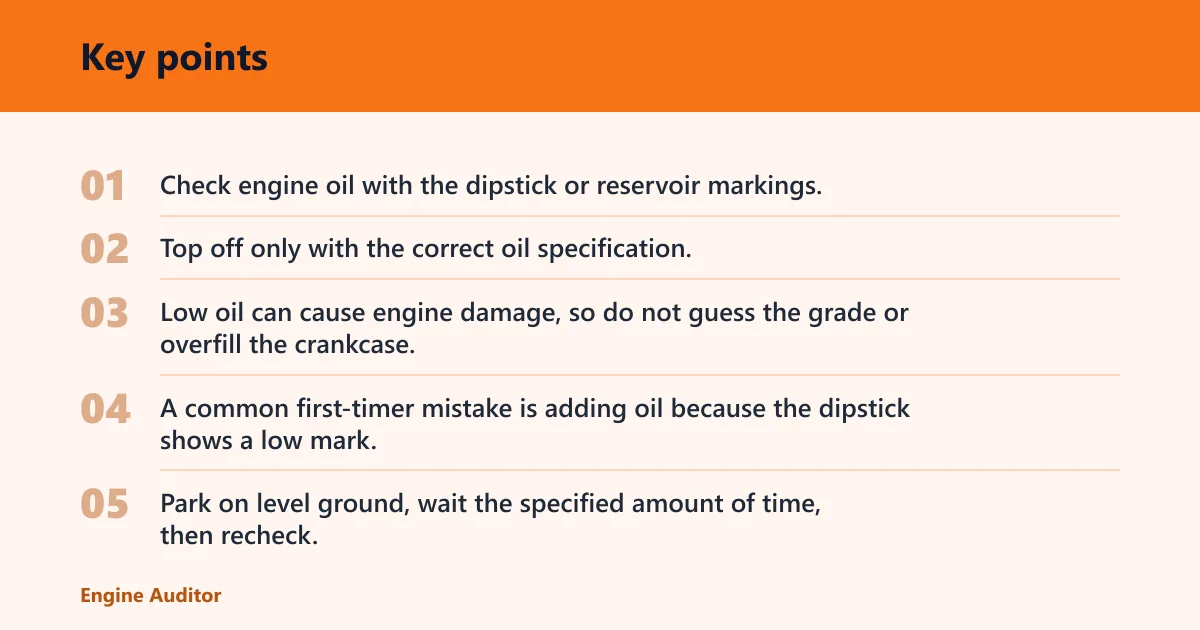
Check engine oil with the dipstick or reservoir markings, following the manual’s instructions for a cold or warm reading. Top off only with the correct oil specification. Low oil can cause engine damage, so do not guess the grade or overfill the crankcase.
A common first-timer mistake is adding oil because the dipstick shows a low mark, then adding too much because the vehicle was parked on a slope. Park on level ground, wait the specified amount of time, then recheck. If the reading stays far below the safe range or the oil looks foamy or milky, stop.
Windshield washer fluid
Washer fluid is refillable at home and usually goes into a clearly marked reservoir. Use a fluid suited to your climate: de-icer for freezing weather, bug-heavy formulations where bugs are a problem, and normal washer fluid where temperatures stay mild.
Coolant, brake fluid, and transmission fluid cautions
Do not open a hot coolant system. Do not top off brake fluid unless you know why the level dropped, because worn pads are not the only cause. Transmission fluid checks vary so much by vehicle that the manual matters more than any generic rule. If the level is wrong or the fluid is burnt, let a mechanic diagnose the cause.
Can you replace filters and wipers at home?
Yes. Cabin air filters, engine air filters, and windshield wiper blades are among the simplest DIY jobs on most cars. They are low-risk, easy to inspect, and often obvious when they need attention because airflow drops, dust builds up, or the blades streak and chatter.
Cabin air filter
The cabin air filter usually sits behind the glove box or under a cowl panel, and replacement interval varies by vehicle and environment. Dusty roads, smoke, and heavy pollen shorten its life. A clogged filter can reduce HVAC airflow and cabin air quality.
Engine air filter
The engine air filter is often straightforward to swap and helps the engine breathe. Check the manual for the replacement schedule and filter type. If the airbox is cracked or the intake boot is torn, replacing only the filter will not fix the problem.
Windshield wiper blades
Many vehicles use simple clip or hook-style blade mounts, so this is a common DIY task. Replace the blades when streaking, skipping, or chattering starts. If the metal arm is bent or the blade does not sit squarely on the glass, stop and inspect the mount before driving in rain.
Tires, pressure, and flat changes
Tire pressure checks are safe for most owners, and changing a flat tire is a manageable roadside task if you have practiced it. Use a gauge, compare the result against the placard PSI, and torque the lug nuts to the exact spec in the owner’s manual after the wheel is on the ground.
Check PSI with a gauge and match the placard
Underinflation affects handling, tire wear, and fuel economy. Check cold tires when possible, then adjust to the number on the driver-door placard or in the manual. Do not use the sidewall number; that is the tire’s maximum, not the car’s target pressure.
Use the spare tire and jack safely
Know where the spare, jack, and lug wrench are before you need them. The correct lifting point matters. If the car is on a hill, the jack sinks, or the wheel is badly damaged, stop and call for help instead of forcing the change.
Torque lug nuts to the spec in the manual
The manual should list the lug-nut torque value for your vehicle. Tighten in a star pattern, lower the car, then torque again to the listed spec. That step matters because over-tightening can damage studs and under-tightening can let the wheel loosen.
Battery changes on gas cars
A 12-volt battery replacement is a common DIY job on many gas vehicles. AAA says a new battery generally lasts three to five years, and AAA recommends battery testing as batteries age to avoid being stranded. Wear eye protection and gloves when servicing a battery. (AAA)
Terminal disconnect order and memory resets
Disconnect the negative terminal first, then the positive. Reconnect in the reverse order. That order reduces the chance of an accidental short. Some newer cars lose radio presets, clock settings, idle learn values, or window calibration after power loss, so check the manual before you start.
Why newer cars may need system steps
Some vehicles with battery management systems need a registration or reset after replacement. Others place the battery in the trunk or under a seat, which adds trim removal and venting concerns. If the battery is hard to access, or if the car throws charging warnings after the swap, stop and let a shop verify the installation.
What should you leave to a mechanic?
Brake repair, fuel system work, suspension and alignment, and high-voltage EV or hybrid work are generally better left to a mechanic. ZapLookup says brake, airbag, fuel, and suspension work should go to a mechanic. These systems are safety-critical, and the downside of a bad repair is larger than the labor you might save.
Brakes
Brake pads, rotors, calipers, brake lines, and brake fluid service need precision. You can inspect visible pad thickness through some wheel designs, but inspection is not repair. If you hear grinding, feel a soft pedal, or see a brake warning light, do not keep driving until the system is checked.
Fuel system
Fuel injectors, lines, rails, and pumps are flammable and pressurized. A small leak can become a fire risk. This is not a beginner DIY area, even if the part looks easy to reach.
Suspension and alignment
Alignment requires specialized equipment. Suspension faults also affect steering, tire wear, and braking stability. A home driveway cannot duplicate the measuring setup a shop uses to set toe, camber, and caster correctly.
High-voltage EV and hybrid work
Do not touch orange-cabled or high-voltage components unless you are trained for that system. Full EVs do not have oil changes, so any service schedule tied to oil changes does not apply to them. For hybrids, the 12-volt battery may be DIY-friendly, but the traction system is not.
Frequently asked questions
What car maintenance can you do yourself?
Many drivers can usually handle washer fluid, wiper blades, cabin air filters, engine air filters, tire pressure checks, flat tire changes, and some 12-volt battery replacements. Those jobs are low-risk when you follow the owner’s manual and stop if you find leaks, broken parts, or warning lights.
What car maintenance should you do yourself?
You should start with maintenance that is simple, visible, and low-risk: fluid checks, tire pressure, filters, and wiper blades. Those jobs can save shop labor and help prevent breakdowns, but only if the correct spec and procedure come from the owner’s manual.
What parts of car maintenance can you do by yourself?
Most owners can handle consumable parts like filters, blades, battery terminals, and a spare tire swap. Parts tied to brakes, fuel, suspension, airbags, or high-voltage systems should stay out of DIY territory because a wrong step can affect safety and create a larger repair.
How do you do your own car maintenance?
Start with the manual, collect the correct tools, and do one task at a time. Check the reservoir or placard, confirm the part number or spec, and stop if a fastener strips, a warning light appears, or the job reaches a system you cannot safely open.
Should I do my own car maintenance?
Yes, if the task is low-risk and you can verify the procedure first. DIY makes sense for routine items like fluids, filters, wipers, and tire checks, but it is a poor choice for brake, fuel, suspension, airbag, or high-voltage work.
What basic maintenance is required for my car?
Basic maintenance usually includes oil checks, tire pressure, fluid top-offs, filter replacement, wiper replacement, battery checks, and scheduled inspections from the owner’s manual. The same source notes that reminders commonly appear every 5,000 miles, but the exact schedule still depends on the vehicle.
Products related to this article
Sponsored / affiliate links. As an Amazon Associate I earn from qualifying purchases. I may earn additional commission from eligible campaigns.