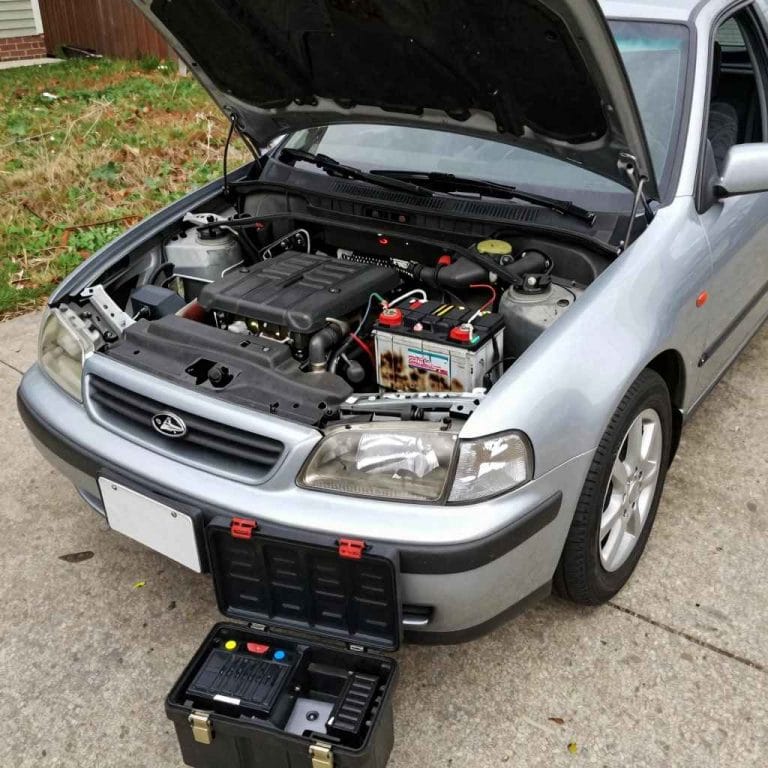
How to Tell If an Alternator Is Charging Properly
With the engine running, a healthy charging system usually reads about 13.8 to 14.7 volts at the battery. Below about 13.5 volts, or above about 15 volts, points to a charging fault you should check. Ignore it and you can strand the car, damage the battery, or miss a belt, wiring, or regulator problem. This article gives a quick voltage flowchart for alternator, battery, belt, ground, and smart-charging checks.
Alternator charging decision table

- Accurate frequency measurements on adjustable speed drives
- Captures intermittents as fast as 250 µS
- Switchable high display resolution
Start at the battery terminals. The table below sorts the most likely cause in order, then points you to the next check. Do not treat one number as final proof until you also look at battery state, belt condition, and connections.
| Test state | Likely cause | Next best check | Status |
|---|---|---|---|
| Engine off | Battery state of charge may be low | Read resting voltage before blaming the alternator | Suspicious if below 12.0 volts; otherwise baseline only |
| Idle | Normal charging, weak battery, belt slip, or regulator issue | Compare to resting voltage and inspect belt and terminals | Good if higher than resting and in range; suspicious if near 12 volts |
| 1,500–2,000 rpm | Alternator output response, belt slip, or control issue | Watch for a steady rise from idle and retest under load | Good if stable and higher than resting; suspicious if unchanged |
| Loads on | Weak alternator, poor connections, or slip under demand | Turn on headlights, rear defogger, blower motor, and seat heaters where fitted | Good if voltage stays clearly above battery voltage; bad if it drops near 12 volts |
| Voltage above 15 volts | Overcharging or regulator fault | Check the alternator voltage regulator and vehicle-specific charging strategy | Bad if repeatable |
| Voltage near 12 volts running | The battery is not receiving meaningful charge | Inspect belt, terminals, grounds, and charging wiring right away | Bad or highly suspicious |
What you need before testing
You need a digital multimeter set to DC volts and access to the battery terminals. Measure across the battery posts, not on painted metal or a random bracket, and compare engine-off voltage with engine-running voltage.
Digital multimeter set to DC volts
Use the meter on DC volts and place the probes directly on the battery terminals. A healthy 12-volt system should read higher running than off, so compare the number before start-up with the number after the engine starts.
Access to the battery terminals
Check both the positive and negative connections. Corrosion, looseness, or a damaged cable can mimic alternator failure and make a good charging system look weak.
Basic safety checks before cranking
Keep hands, tools, and loose clothing away from belts and pulleys. Do not remove a battery cable with the engine running. That old shortcut can create damage and does not give a reliable diagnosis.
How do you check if an alternator is charging?
Measure battery voltage with the engine off, start the engine, then read voltage again at idle and at 1,500–2,000 rpm. Turn on electrical loads and retest. If the running voltage stays above the resting voltage and holds steady under load, the alternator is probably charging.
Measure engine-off battery voltage first
A fully charged conventional battery commonly reads about 12.6 volts resting. Around 12.4 volts indicates a partially charged battery. Below 12.0 volts, diagnosis may be misleading until the battery is charged, because a weak battery can make the system look worse than it is.
Start the engine and read voltage at idle
Many conventional charging systems produce roughly 13.7 to 14.7 volts at idle. Normal charging voltage is typically about 13.5 to 14.8 volts in most passenger vehicles. If the reading stays near 12 volts, the battery is not receiving meaningful charge.
Raise rpm to 1,500–2,000 and watch for change
At about 1,500–2,000 rpm, voltage should usually hold steady or rise slightly, depending on the vehicle. If it barely changes from engine-off voltage, the alternator, belt drive, or regulator needs attention. A flat reading matters more than a noisy dash gauge.
Turn on electrical loads and retest
Switch on headlights, rear defogger, blower motor, and seat heaters where fitted. A healthy system should keep voltage above the battery’s resting level. If voltage falls near 12 volts with loads on, suspect output loss, slipping belt, poor ground, or corroded terminals.
Suppose a car shows 12.5 volts with the engine off and 14.1 volts at idle, then drops to 13.7 volts with headlights and blower on. That pattern usually points away from the alternator and toward normal regulation or a mild load response. A battery at 12.5 volts is not fully charged, though, so it can still skew the picture.
What voltage readings mean
Voltage interpretation starts with the battery at rest, then shifts to running voltage. Do not jump straight from a dim-light complaint to an alternator replacement. The same number can mean different things depending on whether the engine is off, idling, or carrying electrical load.
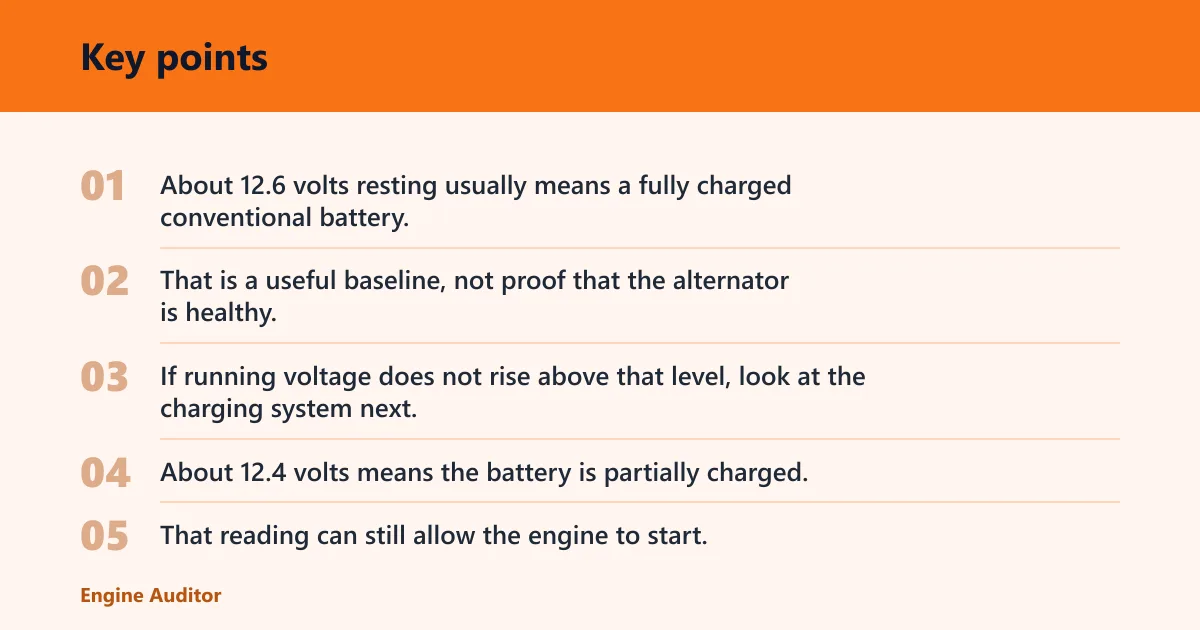
12.6 volts and what it means
About 12.6 volts resting usually means a fully charged conventional battery. That is a useful baseline, not proof that the alternator is healthy. If running voltage does not rise above that level, look at the charging system next.
12.4 volts and what it means
About 12.4 volts means the battery is partially charged. That reading can still allow the engine to start, but it makes the alternator test harder to interpret. Charge the battery first if the numbers are borderline and the diagnosis is unclear.
Below 12.0 volts and why it can mislead
Below roughly 12.0 volts, the battery is so low that testing may be misleading. A weak battery can pull the system down, hide normal alternator behavior, and trigger the battery light or dim lights without the alternator being the original problem.
Higher running voltage and when it is normal
Running voltage should normally exceed resting battery voltage. Modern smart-charging systems may intentionally vary voltage near battery voltage or near 15 volts, especially when the battery is charged or electrical demand changes. That is why one fixed number does not fit every vehicle.
A common first-timer mistake is seeing 12.2 volts with the engine running and calling the alternator dead. If the battery was already low, that reading may reflect a weak battery, a poor connection, or a system that has not yet recovered from a heavy start.
How do you know if the battery is the problem?
A weak battery can fake a charging fault because the alternator may be trying to recover a low state of charge instead of cruising at a steady number. If resting voltage is low, or the battery has been deeply discharged, the alternator may look weak even when it is working.
Why a weak battery can fake a charging fault
The alternator is an electrical generator, but it does not erase battery problems. A bad battery, loose belt, corroded terminals, bad grounds, or wiring issues cause many charging complaints. That is why the battery must be checked first and not treated as an afterthought.
When resting voltage makes the alternator look bad
If engine-off voltage is below 12.0 volts, the battery state can distort the result. A charged battery may let the alternator settle into the expected range, while a discharged one may keep voltage low enough to suggest a fault that is not actually there.
When a professional load test is the next step
If voltage readings stay borderline, a professional charging-system test can identify faults a basic voltage check cannot. That is the right next step when the numbers bounce between 12.8 and 13.4 volts, the battery is old, or the vehicle uses a control strategy that changes output often.
Check belt, terminals, and grounds
Do this before replacing parts. Belt slip, corroded posts, and weak grounds often sit ahead of alternator failure in the fault order. If the mechanical and connection checks are wrong, the voltage test can point you at the wrong part.
Serpentine belt fit, routing, and slip checks
The serpentine belt must be present and properly routed. Look for cracks, glazing, looseness, missing ribs, or a belt that slips under load. If the belt cannot turn the alternator at speed, output drops even when the alternator itself is fine.
Battery terminals and cable condition
Inspect both battery terminals and cable connections. Clean and tight beats shiny and loose. Corrosion can mimic alternator failure by adding resistance between the alternator, battery, and vehicle electrical loads.
Ground paths that can limit charging
Check the negative cable, engine ground strap, and body ground points. A bad ground can keep the battery from accepting charge and can make the dash light behave strangely. Look for looseness, rust, frayed cable ends, or heat damage.
How does the alternator know when to charge?
The alternator voltage regulator controls charging output. It watches system voltage and adjusts field current so the alternator raises voltage when needed and backs off when the battery is full. On many vehicles, that control is not a simple fixed target.
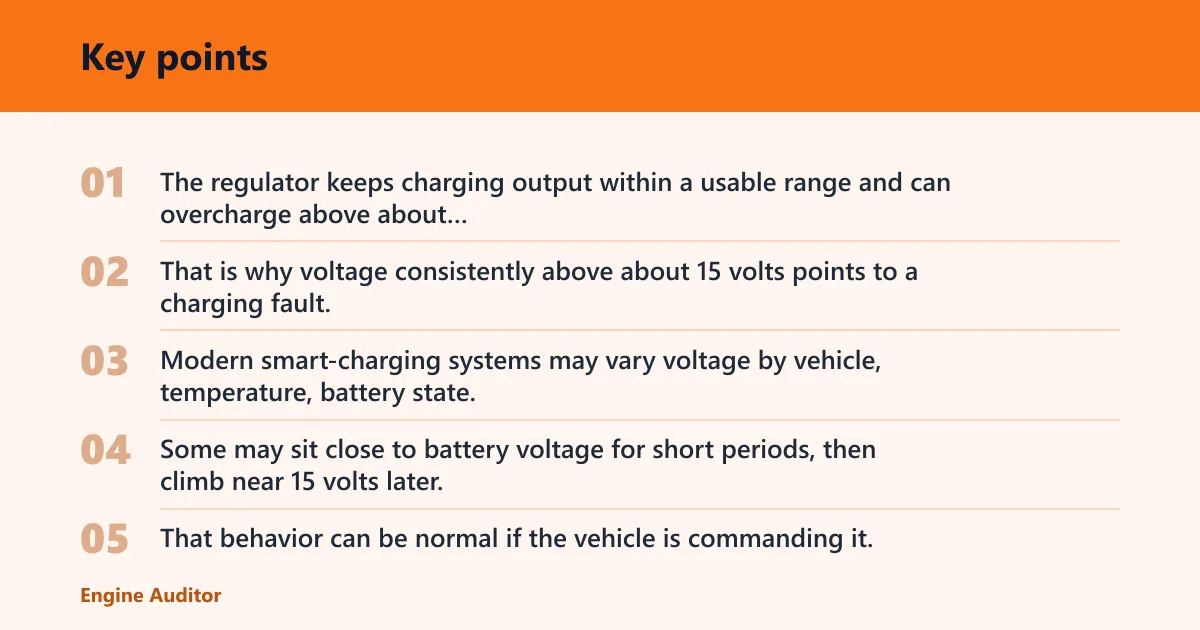
Voltage regulator basics
The regulator keeps charging output within a usable range and can overcharge above about 15 volts if it fails. That is why voltage consistently above about 15 volts points to a charging fault, not a healthy charging spike.
Smart-charging and variable voltage behavior
Modern smart-charging systems may vary voltage by vehicle, temperature, battery state, or electrical load. Some may sit close to battery voltage for short periods, then climb near 15 volts later. That behavior can be normal if the vehicle is commanding it.
Why some vehicles do not hold one fixed charging number
Do not expect every car to sit at one steady number. Conventional systems often stay in the 13.7 to 14.7 volt zone, while smart-charging systems may move around that range or outside it briefly. The key is whether the pattern fits the vehicle and the battery is actually being charged.
Frequently asked questions
How to tell if a alternator is not charging properly
If running voltage stays around battery voltage, especially 12.1 to 12.6 volts, the alternator likely is not charging. A battery warning light helps confirm a charging-system problem, but it does not prove the battery itself failed. Check belt, terminals, and grounds next.
How do I know if my alternator is charging properly?
You know by comparing resting and running voltage at the battery terminals. A healthy 12-volt battery should rest around 12.6 volts when fully charged, then rise above that with the engine running. If the rise is absent, the charging system needs further diagnosis.
How do you check an alternator to see if it’s charging?
Use a digital multimeter set to DC volts across the battery terminals. Read engine-off voltage first, then start the engine and retest at idle and with electrical loads on. If the reading rises and stays stable, the alternator is likely charging.
How does an alternator know when to stop charging?
The alternator stops or reduces output when the voltage regulator sees the system voltage has reached target. In smart-charging vehicles, that target can change with battery state, temperature, and demand. That is why one vehicle may show a steady number while another moves around.
How do I know if my alternator is not charging?
A running voltage that remains near 12 volts usually means the battery is not receiving meaningful charge. If the belt is intact and the terminals are clean and tight, the alternator, regulator, or wiring is the next place to look. Over 15 volts is the opposite problem.
Products related to this article
Sponsored / affiliate links. As an Amazon Associate I earn from qualifying purchases. I may earn additional commission from eligible campaigns.