
Bad Car Ground Symptoms: What Drivers Usually Notice
Bad car ground symptoms usually show up as one circuit acting erratically, dim or flickering lights, slow cranking, or gauge glitches; if several unrelated loads fail together, suspect the ground path first. Ignore it, and you can chase the wrong part, replace good components, or strand the car. This guide shows the symptom patterns and failure locations that point to a bad ground.
This guide is part of our Car electrical troubleshooting guide series.
What a bad ground does in a car

- Measures AC/DC voltage, current, resistance and continuity
- Backlit LCD with data hold for easier readings
- Dual ceramic fuse protection for overload safety
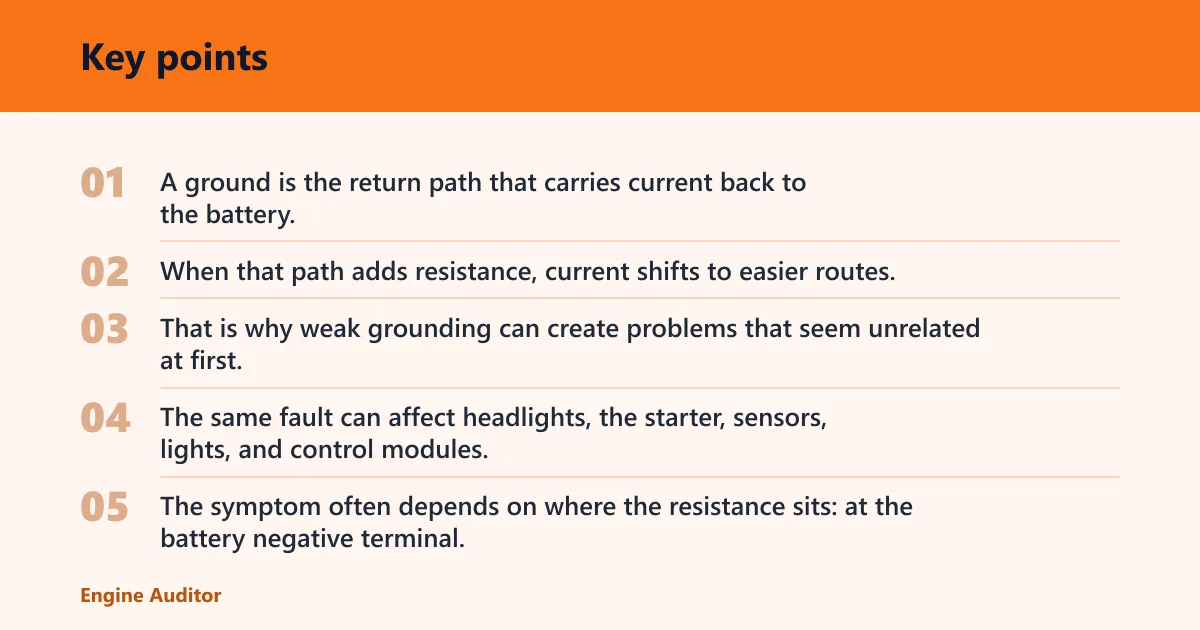
A ground is the return path that carries current back to the battery. When that path adds resistance, current shifts to easier routes, and the result can be voltage loss, module resets, or one system failing while another still works. That is why weak grounding can create problems that seem unrelated at first.
The same fault can affect headlights, the starter, sensors, lights, and control modules. The symptom often depends on where the resistance sits: at the battery negative terminal, on the engine strap, on a chassis bolt, or at a local component ground. Load matters because a weak connection can seem fine with the key on and fail under demand.
A 12-volt battery may seem healthy while the headlights dim when the blower motor comes on. That pattern points away from a dead battery and toward a return path that cannot carry current cleanly under load.
Why ground faults look random
A bad ground can affect only one system, not the entire vehicle. That is why one scan tool may report ABS or airbag faults while the engine starts and the radio still works. In vehicles with advanced driver assistance systems and CAN bus communication, that mix of symptoms can be especially hard to sort out.
Movement also matters. A loose ground can change if you wiggle a cable or reposition a strap. Rain, vibration, road salt, or a recent repair can turn a marginal connection into a real failure.
Which symptoms point to a bad ground?
Bad grounds usually show up as voltage loss or resistance, not as one single signature. The clearest clues are dim or flickering lights, slow cranking or no-start, erratic gauges, warning lights with no obvious cause, and intermittent accessories that reset or quit. The pattern matters more than the label on the dash.
Dim or flickering lights
Dim or flickering lights often point to a weak ground. If the headlamps, interior lights, or dash illumination pulse at idle or change when another load turns on, check the return path first. That is often a body or chassis ground issue, but a poor engine strap can also show up through charging and lighting complaints.
Slow cranking, clicking, or no-start
Slow cranking or no-start can happen even with a good battery. The starter motor draws heavy current, which can expose weak engine grounds quickly. If the starter clicks once, turns slowly, or behaves differently after a cable is moved, the engine-to-chassis return path is a prime suspect.
Can a bad ground make a car click but not start? Yes. A click with no crank often suggests the starter solenoid is trying to work, but the current path may not be able to support the motor. That can mimic a weak battery or a failing starter, which is why the ground path needs a direct test.
Erratic gauges and warning lights
Dashboard warning lights can come on without an obvious cause. ABS, airbag, check engine, traction control, and battery lights can all appear when the control module sees unstable voltage or a missing reference. A bad ground can trigger one of these warnings or several at once.
That is common when the body ground or a component-local ground is poor, because one module may still communicate while another loses its reference. The car can run, yet one warning lamp will not clear until the return path is corrected.
Intermittent accessories and module resets
One system can fail while the rest of the car acts normal. Power windows may work on one side but not the other. A radio may reboot over bumps. A sensor may drop out after rain. Those partial failures often point to a chassis ground point or a local ground shared by one module or accessory.
Ground symptoms map
This table maps common symptoms to the most likely ground location and the first test to confirm it. Start with the battery negative terminal, because it is the reference point for voltage-drop checks and the first inspection point for tightness and corrosion. Then move to the engine strap, the chassis bolt, or the local component ground based on the symptom pattern.
| Observed symptom | Most likely ground location | First test to confirm | Quick triage |
|---|---|---|---|
| Dim or flickering headlights, dash lights, or interior lights | Battery negative terminal or chassis ground point | Voltage drop test between battery negative and the suspect ground with lights and blower on | Drive if steady; repair soon if it flickers; tow if it cuts out with other faults |
| Slow cranking or single click with a known good battery | Engine ground strap | Voltage drop test between battery negative and engine block while cranking | Repair before extended driving; tow if it will not crank reliably |
| ABS, airbag, traction control, check engine, or battery light appears together | Chassis ground point or component ground | Voltage drop test under load at the module or body ground | Drive only if the vehicle behaves normally; repair soon |
| One accessory or module fails while others still work | Component ground | Check the local ground with the circuit operating, then verify continuity after load testing | Usually repairable before a tow unless safety systems are affected |
| Battery drains overnight or goes flat after sitting | Battery negative terminal, chassis ground point, or a hidden component ground issue | Inspect for loose or corroded grounds, then test for parasitic draw with the circuit awake and asleep | Repair soon; tow if the car becomes unreliable or will not restart |
What ground points should you check first?
Start with the battery negative terminal, then the engine ground strap, then the chassis ground point. Those three cover the main return paths for starting, charging, and body electronics. A bad connection at any of them can create symptoms that look like a battery, alternator, starter, or module failure.
Battery negative terminal
The battery negative terminal is the first inspection point because every voltage-drop test uses it as the reference. Check for tightness, corrosion, cracked clamps, and damaged cable ends. A loose or dirty terminal can create several symptoms at once, especially if the fault changes when the cable is touched.
Engine ground strap
The engine ground strap connects the engine block to the chassis, and it is critical for starter current. If that strap is corroded, broken, or loose, the starter motor may crank slowly or not at all even when the battery tests well. Sensor stability can also suffer because the engine and body no longer share a clean reference.
Chassis ground point
Chassis ground points are body or frame bolt locations. They can fail when rust, paint, moisture, or road salt create resistance under the eyelet or bolt head. That often leaves one circuit unhappy while others keep working, which is why a bad body ground can look selective rather than total.
Component-local ground
Some faults live at the component itself. A headlamp, module, fan, or sensor may have a short ground lead bolted nearby, and only that circuit will misbehave when the contact goes bad. If one system acts up and the rest of the car stays normal, the local ground deserves a close look.
How do you test a bad ground with a multimeter?
Use a multimeter for voltage-drop testing under load, not just for key-off continuity checks. Testing should measure voltage between battery negative and the suspect ground point while the circuit is operating. That is the preferred diagnostic method because a connection can look fine with no current flowing and fail when current rises.
- Set the multimeter to DC volts.
- Place the black lead on battery negative.
- Place the red lead on the suspect ground point, such as an engine block, chassis bolt, or component ground.
- Turn on the circuit that uses that ground.
- Read the meter while the load is active.
Load testing can reveal resistance that appears only under load. That is the key point many quick checks miss. If a ground passes continuity with the vehicle off but fails voltage-drop testing with the circuit on, the fault is real even if the wire looks intact.
A simple pass-fail rule helps. Near-zero voltage drop is the goal; any meaningful reading under load points to resistance that should be cleaned, tightened, or repaired. Check the service information for the exact target on a specific vehicle, because the acceptable reading can vary with circuit load and design.
Check continuity or resistance only after the load test. A continuity beep does not prove that the connection can carry starter current, fuel pump current, or module load without trouble.
Suppose a sedan starts normally after a jump, but the dash lights flicker when the rear defogger turns on. A voltage-drop test from battery negative to the body ground near the tail lamp area can often separate a bad chassis ground from a weak battery in a few minutes.
Can a bad ground mimic battery, alternator, or starter failure?
Yes. A ground issue can be confused with battery failure, alternator trouble, starter issues, or a bad control module. The overlap is real because all of those parts depend on stable voltage and a clean return path. The trick is to match the symptom to the load and the location before replacing parts.
Battery symptoms that overlap
A weak battery and a bad ground can both cause slow cranking, dim lights, and low-voltage warnings. The difference is that a ground fault may affect only one system, or the symptom may change when a cable is wiggled or a strap is repositioned. If the battery is good but the connection is bad, the symptoms can still look dead.
Alternator symptoms that overlap
Flickering lights and warning lamps can point to charging trouble, but they can also come from a poor return path between the alternator case, engine block, and chassis. If charging voltage seems inconsistent only at certain speeds, a ground test under load is more useful than guessing at the alternator first.
Starter motor symptoms that overlap
The starter motor is where bad engine grounds show up fast. Slow cranking or a click with no crank may be the starter, but it may also be the engine strap or the battery negative cable. Test the voltage drop while cranking before condemning the starter itself.
How to separate the likely cause
Start with location and load. If one module or accessory fails while the rest work, think component ground. If the car cranks poorly, think engine strap. If many body-related loads flicker or reset, think battery negative or chassis ground. That pattern is more useful than replacing parts in the order they failed.
Can a bad ground drain a car battery overnight?
Yes. Parasitic draw and grounding issues can overlap. A weak ground may not be the original drain, but it can hide another fault, keep a module awake, or make a normal draw look worse because the system voltage is unstable. Overnight battery drain is worth checking when the complaint follows a recent repair or intermittent electrical fault.
When drain and ground faults overlap
If a module does not sleep properly because its reference is poor, the battery may drain overnight. A chassis ground point with rust or moisture can also cause a module to behave erratically after shutdown. In that case, the battery is the victim, not the source.
What to inspect after a drain complaint
Check battery terminals and cable ends first, then inspect the ground points near the affected circuit. Look for loose bolts, corrosion, paint under the lug, and damaged cable ends. If the vehicle has repeated drain complaints after rain or road spray, pay special attention to low-mounted chassis grounds.
Can a bad ground drain a car battery overnight? It can, especially when a module stays awake or a poor connection hides another electrical fault. That is why a drain complaint should not stop at the battery itself.
Frequently asked questions
What are the symptoms of a bad car ground?
The most common symptoms are dim or flickering lights, slow cranking, clicking, erratic gauges, and warning lights that appear without an obvious cause. A bad ground can also affect one circuit while others still work, which makes the failure pattern look random until you trace the return path.
Can a bad ground make a car click but not start?
Yes. A click with no crank often means the starter solenoid is engaging but the starter motor cannot draw enough current through the return path. That points strongly to the battery negative cable, engine ground strap, or a high-resistance connection at the starter ground path.
Why do my lights flicker when the car is idling?
Flicker at idle often means the system is sensitive to load changes, which is common when a ground has extra resistance. As engine speed and electrical demand change, the voltage drop across a weak connection also changes, so the lights pulse or dim even though the bulbs are fine.
Can bad grounds cause dashboard warning lights?
Yes. A bad ground can trigger ABS, airbag, check engine, traction control, or battery lights. Those warnings may appear alone or in groups because the control modules are seeing unstable voltage or a poor reference rather than a direct part failure.
What ground points should I check first on a car?
Check the battery negative terminal first, then the engine ground strap, then chassis ground points. Those are the main return paths for starting, charging, and body electronics. If one system alone is acting up, inspect the component-local ground tied to that circuit as well.
How do I tell a bad ground from a bad battery or alternator?
Match the symptom to the load and location. A bad battery tends to affect the whole car at rest, while a bad alternator shows up as charging problems under operation. A bad ground often acts more selectively, changes with movement, and shows a clear voltage drop at one specific point under load.
Products related to this article
Sponsored / affiliate links. As an Amazon Associate I earn from qualifying purchases. I may earn additional commission from eligible campaigns.