How to Compare Fuel Economy Across Different Cars
Convert all fuel ratings to one unit, compare the same test cycle, then rank cars by the metric that matches your driving; for mixed use, start with combined MPG or L/100 km. Skip that step, and you can overpay for a car that looks efficient on paper but costs more at the pump. This guide shows how to normalize units, read test-cycle labels, and choose the right ranking for city, highway, or EV-heavy driving.
What fuel economy numbers actually mean
US MPG, L/100 km, and UK MPG
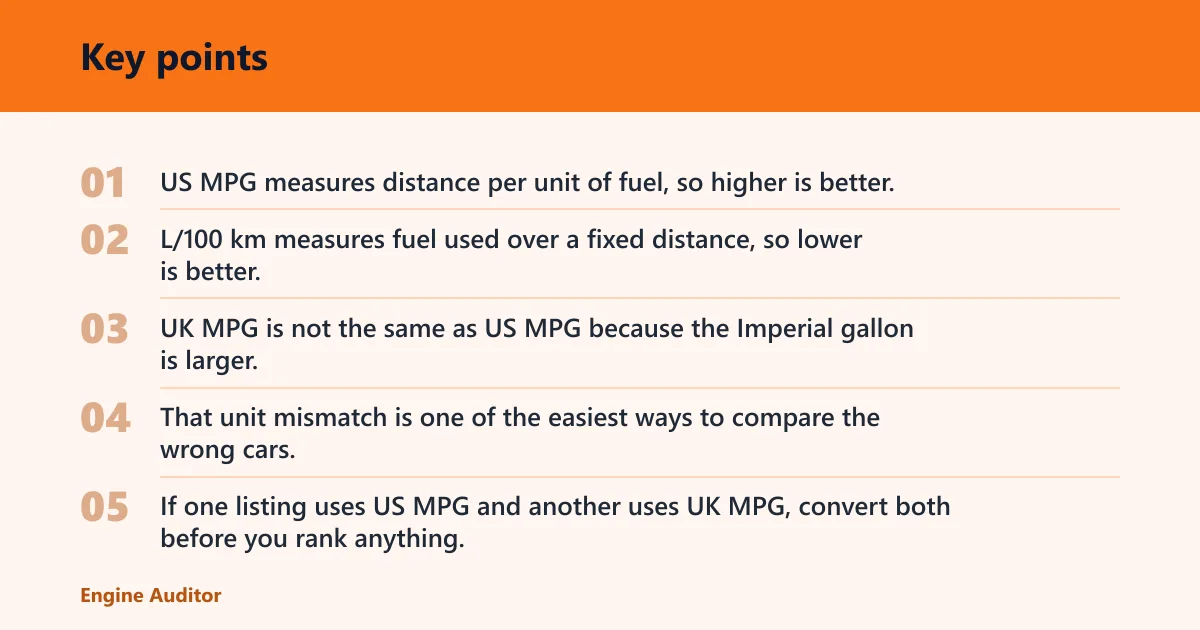
US MPG measures distance per unit of fuel, so higher is better. L/100 km measures fuel used over a fixed distance, so lower is better. UK MPG is not the same as US MPG because the Imperial gallon is larger, so you should not treat those numbers as interchangeable.
That unit mismatch is one of the easiest ways to compare the wrong cars. If one listing uses US MPG and another uses UK MPG, convert both before you rank anything.
City, highway, and combined ratings
New-car window stickers often list city MPG, highway MPG, and combined MPG. City matters most for stop-and-go traffic, highway matters most for steady long-distance driving, and combined is the best starting point for mixed use.
Combined ratings help because they fold both kinds of driving into one label. They are not a substitute for your own pattern. A commuter who spends most miles in traffic should not rank cars the same way as a driver who spends most miles on open roads.
Why higher MPG and lower L/100 km both mean better efficiency
The direction changes with the unit. Higher MPG means the car goes farther on a gallon. Lower L/100 km means the car burns less fuel over the same distance. FuelEconomy.gov states both rules plainly: higher mpg is better, and lower L/100 km is better.
Why do two cars with similar ratings cost different amounts to run?
Driving pattern changes the result, even when two cars look close on a label. A vehicle with slightly weaker city numbers can cost more in traffic than another model with a stronger city rating, while a highway runner can look better only if your trips are mostly steady-speed miles.
City-heavy vs highway-heavy use
Stop-and-go driving puts more weight on the city figure. Long freeway trips put more weight on the highway figure. Mixed commuting sits between those two, which is why combined MPG is often the best first filter, then city or highway can break the tie.
Say your commute is 10 miles each way with slow traffic on both ends and only a short freeway section in the middle. In that case, a car with stronger city MPG can save more fuel than a car with a slightly better highway number.
Why annual fuel cost matters more than the label alone
A fuel label tells you efficiency. It does not tell you the yearly bill unless you combine the rating with your mileage and fuel price. That step matters because a small difference in MPG can turn into real money over a full year.
Fuel economy worksheet
Use this worksheet to compare cars in one pass. It keeps the same order for every vehicle: record the label, convert to one unit, verify the test standard, weight the rating to match your driving, then estimate annual fuel cost.
| Step | What to enter | What to compare | Why it matters |
|---|---|---|---|
| 1 | City, highway, and combined ratings for each car | The label numbers as published | Gives you the full set, not one cherry-picked value |
| 2 | Convert every rating into one unit | US MPG, L/100 km, or another single unit | Prevents a mismatch between MPG, L/100 km, and UK MPG |
| 3 | EPA, WLTP, or NEDC | The same test standard across all cars | Stops cross-market numbers from being treated as equal |
| 4 | City-heavy, mixed, or highway-heavy weight | The rating that matches your driving pattern | Ranks cars by the miles that matter to you |
| 5 | Annual miles or kilometres plus local fuel price | Estimated yearly fuel cost | Turns the label into a budget number |
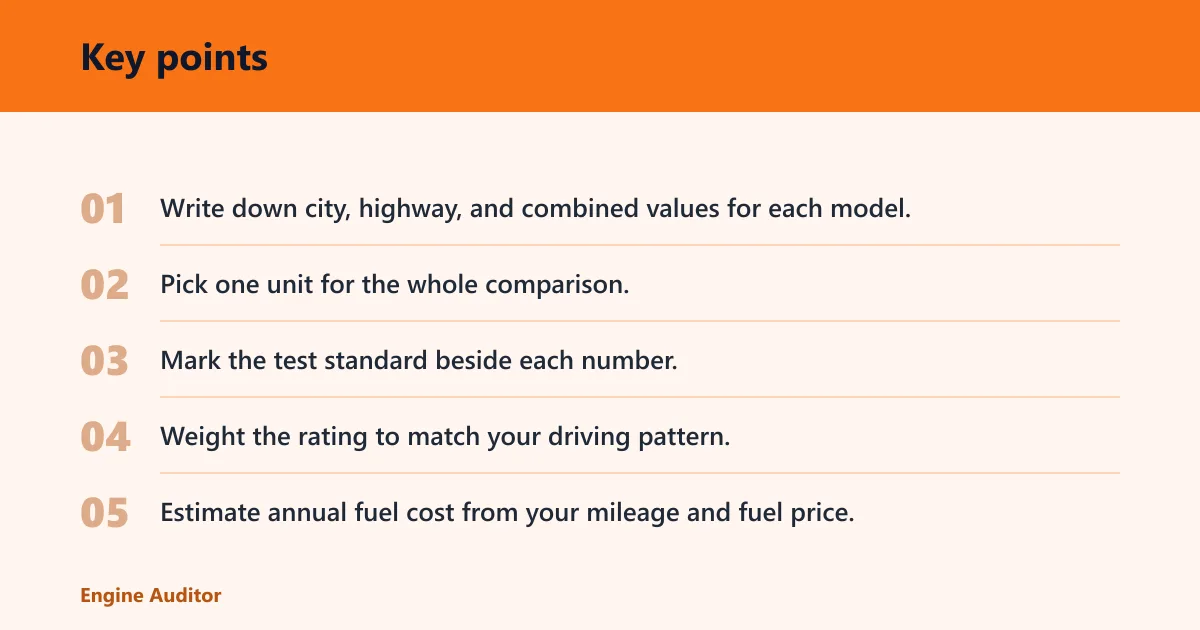
- Write down city, highway, and combined values for each model.
- Pick one unit for the whole comparison.
- Mark the test standard beside each number.
- Weight the rating to match your driving pattern.
- Estimate annual fuel cost from your mileage and fuel price.
Example: if a model gets 28 MPG combined and you drive 12,000 miles a year at $3.50 per gallon, a rough annual fuel use estimate is 12,000 divided by 28, or about 429 gallons. At that fuel price, that is about $1,500 a year. The same method works with litres and kilometres if you keep the unit consistent.
How do you compare MPG with L/100 km?
Convert both to one unit before ranking the cars. MPG rises as efficiency improves, while L/100 km falls as efficiency improves, so a raw side-by-side view can mislead you if you do not normalize first. If a calculator supports both, use it. If not, convert by hand and keep the market label beside the number.
Conversion basics
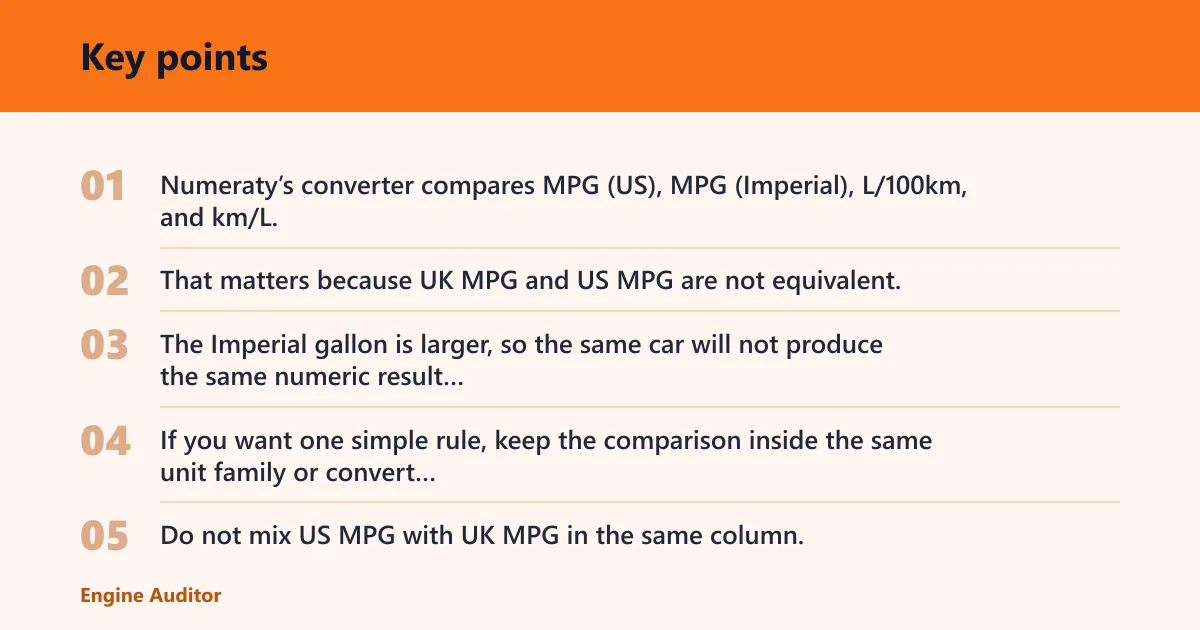
Numeraty’s converter compares MPG (US), MPG (Imperial), L/100km, and km/L. That matters because UK MPG and US MPG are not equivalent. The Imperial gallon is larger, so the same car will not produce the same numeric result in both systems.
If you want one simple rule, keep the comparison inside the same unit family or convert everything to a single unit before you rank the cars. Do not mix US MPG with UK MPG in the same column.
Why lower L/100 km is better
Lower L/100 km means less fuel used to cover the same distance. That is the inverse of MPG, where a larger number is better. If you are shopping in Canada or Australia, L/100 km may be the clearer number to use because it matches the local label format.
When to use km/L or UK MPG instead
Use km/L only if that is the standard on the listing you are reading and you can convert it cleanly. Use UK MPG only for listings and reviews that are written in that market system. The point is not to favor one unit; it is to avoid comparing non-equivalent values as if they were the same thing.
Why do EPA, WLTP, and NEDC numbers differ?
EPA, WLTP, and NEDC are not direct matches, so a car rated under one system should not be ranked against a car rated under another as if the figures came from the same test. EPA-style comparison data is based on laboratory testing in controlled conditions, but the test cycles and scoring rules still differ by market.
EPA fuel economy ratings and window sticker context
EPA ratings are the figures most US shoppers see on the window sticker. GreenCars notes that city MPG, highway MPG, and combined MPG appear there. FuelEconomy.gov also states that its data is used for comparisons and that lower L/100 km is better while higher mpg is better.
That makes the sticker a good starting point, not a final verdict. The same model can still behave differently once you put it into your commute, your climate, and your fuel price.
WLTP as a European test standard
WLTP is a European test standard used for cross-market labels and reviews. It is often lower than NEDC, so a WLTP number may look weaker than an older European figure for the same vehicle. That does not mean the vehicle changed. The measuring rule changed.
NEDC as an older cycle
NEDC is an older European cycle and should not be treated as directly comparable to WLTP. If one car is listed with NEDC and another with WLTP, treat the comparison as a warning sign. Re-check both cars in the same market source before you rank them. (Wikipedia)
Why cross-market comparisons need a caution flag
Two sites can show different numbers for the same car because they may be using different standards, different markets, or a different unit system. That is why the safest workflow is: same segment, same standard, same unit, then rank by your own driving pattern.
Which rating should you trust for your commute?
Pick the rating that matches how you drive most of the time. Use city for heavy traffic, highway for long steady trips, and combined for a mixed commute. If your drive pattern is unusual, weight the ratings rather than relying on a single label.
Hybrids, plug-in hybrids, diesel, and EVs
Hybrids can look stronger in city driving because stop-and-go traffic gives the system more chances to recover energy or shut the engine off. Plug-in hybrids need extra care because short trips may rely on battery driving, while longer trips can fall back to fuel use. Diesel and EVs need their own comparison logic, so do not judge them only against a gasoline car’s single MPG number.
A common first-timer mistake is comparing a plug-in hybrid’s headline figure to a regular sedan’s combined MPG without checking the assumed electric share. Another is comparing an EV’s range and a gasoline car’s MPG as if they were the same metric. They are not.
Segment-normalized comparison
Compare like with like first. A midsize SUV should be measured against other midsize SUVs, not compact crossovers or full-size trucks. Segment context keeps you from picking a “better” number on paper that belongs to a different class of vehicle and a different use case.
So, what midsize SUV has the best fuel economy? The best answer depends on the market, the test standard, and whether you care most about city, highway, or combined driving. Use the same class, the same unit, and the same cycle before naming a winner.
Which comparison tools should you use?
Use official tools first, then add your own mileage and fuel price. FuelEconomy.gov can compare up to four vehicles side by side, and its data is built for EPA comparisons. Canada’s fuel consumption tool compares up to five models at a time, lets you choose L/100 km, mpg (imperial), or mpg (U.S.), and personalizes annual fuel cost using your mileage and fuel prices. It also includes city driving percentage as an input. (Fueleconomy)
FuelEconomy.gov compare-side-by-side tool
This is the cleanest US tool for shortlists. It compares up to four vehicles side by side, and it keeps the EPA data in one place. Use it when your shopping list is already narrowed and you want a direct city, highway, and combined comparison.
Green Vehicle Guide compare tool
The Australia Green Vehicle Guide provides downloadable and shareable summaries. Its comparison output includes emissions, fuel consumption, electric range, cost, and noise data. That broader view helps when fuel use is only one part of the decision.
Canada fuel consumption ratings search tool
Canada’s tool works well when you want to compare more than one unit system at once. It can compare up to five models, show L/100 km and mpg in both imperial and US forms, and estimate annual fuel cost from your own driving and fuel price. That makes it useful for budget planning, not just label reading.
Frequently asked questions
How do I compare gas mileage in vehicles fairly?
Start by matching the same test standard, then convert every figure into one unit, then compare cars inside the same segment. After that, rank by the metric that fits your driving pattern. If your commute is mixed, begin with combined MPG or L/100 km and use city or highway only as a tie-breaker.
Is higher fuel economy better?
Yes, if you are using MPG, higher is better. If you are using L/100 km, lower is better. The direction flips because the units measure efficiency in opposite ways. Keep that rule in mind before you sort any comparison table.
What midsize SUV has the best fuel economy?
There is no single answer that stays true across every market and test cycle. You should compare midsize SUVs within the same standard, then separate city, highway, and combined figures, then estimate annual fuel cost using your own mileage. That gives a result that fits your use, not just the label.
Should I compare city, highway, or combined MPG?
Use city MPG for traffic-heavy driving, highway MPG for long steady trips, and combined MPG for mixed use. Most shoppers should start with combined, then switch to city or highway if their driving is clearly tilted one way. Do not use highway only if your week is mostly urban miles.
How do I compare MPG vs L/100 km when cars use different units?
Convert them into one unit before you rank anything. MPG is better when the number is higher, while L/100 km is better when the number is lower. If a listing uses UK MPG, keep in mind that it is not the same as US MPG, so convert that too.
Why do two sites show different fuel economy numbers for the same car?
They may be using different standards, different markets, or a different unit system. EPA, WLTP, and NEDC are not directly interchangeable, and UK MPG is not the same as US MPG. If the numbers do not line up, check the market and the test cycle before you compare them.
How much fuel money do I actually save with a better MPG rating?
Estimate it from your annual miles and local fuel price. Divide your yearly distance by MPG to estimate gallons used, then multiply by fuel price. If you use L/100 km, estimate litres from your annual distance instead. A small MPG gain can matter a lot over high mileage.
Products related to this article
Sponsored / affiliate links. As an Amazon Associate I earn from qualifying purchases. I may earn additional commission from eligible campaigns.