How to Compare Used Electric Cars vs New Gas Cars
Compare a used electric car with a new gas car on five-year total cost, not sticker price: include purchase price, energy or fuel, insurance, maintenance, taxes, and expected depreciation, then rule out any EV without dependable home or workplace charging. Skip that split, and a cheap-looking EV can turn expensive to charge, or a new gas car can shed value fast. This guide shows the numbers, charging checks, and depreciation factors you need.
| Decision factor | used electric cars | new gas cars | Winner |
|---|---|---|---|
| Purchase price | $21,000 example sticker; $17,000 after a $4,000 used EV credit if eligible | $30,000 example sticker; no EV credit | used electric cars |
| Financing impact | Lower loan balance can mean a smaller monthly payment on the same term | Higher loan balance usually means a larger monthly payment | used electric cars |
| Annual miles | 12,000 example miles; higher mileage improves EV economics | 12,000 example miles; fuel cost rises with every extra mile | used electric cars |
| Charging access | 80% home charging, 20% public charging in this worksheet | No charging needed | new gas cars |
| Fuel cost per mile | About 7 cents per mile in the worksheet mix | About $0.14 per mile at 25 MPG and $3.50 per gallon | used electric cars |
| Maintenance | Fewer drivetrain wear items, no oil changes, less routine service | Oil changes, more fluid service, and more routine engine wear items | used electric cars |
| Insurance | Can be higher in some cases because repair costs and parts prices may differ | Often lower, though this varies by model and region | new gas cars |
| Depreciation | Battery age can pressure resale, but the first owner already absorbed the steepest drop | New cars also lose value quickly in the first years | used electric cars |
| 5-year total cost | About $27,700 in the worksheet example | About $34,400 in the worksheet example | used electric cars |
| Best-fit use case | Home charger, moderate to high mileage, longer ownership horizon | Apartment living, heavy public-charging dependence, short ownership horizon | depends on buyer |
Used EV comparison worksheet
Purchase price and incentives
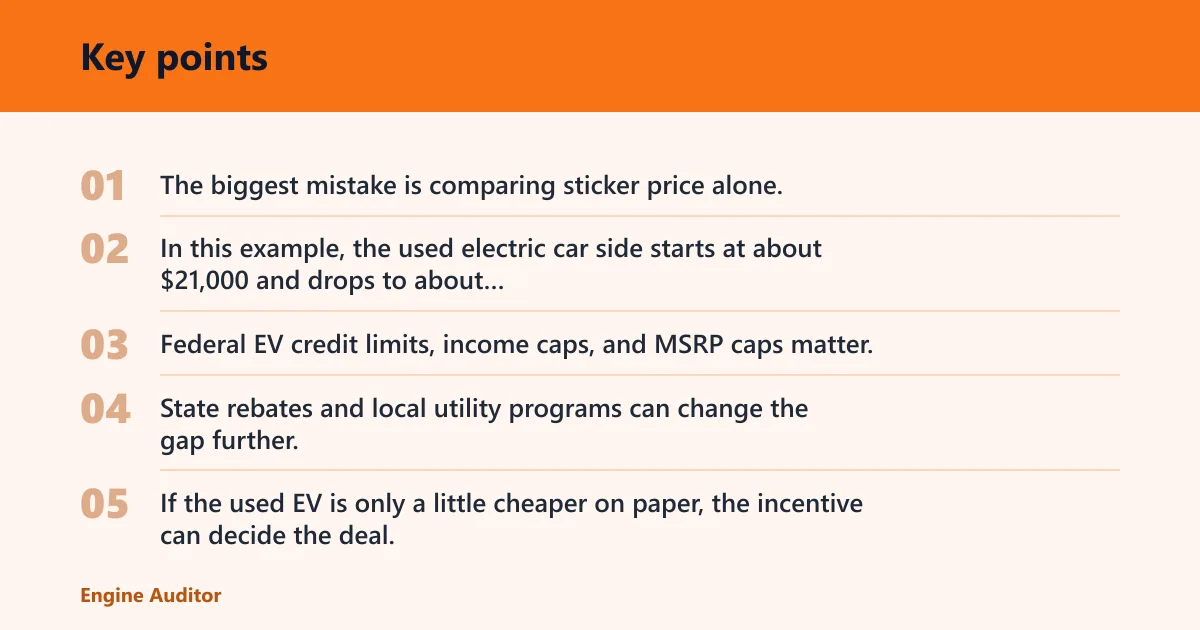
The biggest mistake is comparing sticker price alone. In this example, the used electric car side starts at about $21,000 and drops to about $17,000 after a $4,000 used EV credit if the vehicle and buyer qualify, while the new gas car side is about $30,000 with no EV credit offset. Federal EV credit limits, income caps, and MSRP caps matter, so the credit is not automatic.
State rebates and local utility programs can change the gap further. If the used EV is only a little cheaper on paper, the incentive can decide the deal; if it is not eligible, the numbers change fast.
Charging access and energy cost
Charging access changes the math as much as price. At the cited averages, electricity is about 15 cents per kWh and gasoline is around $3.50 per gallon, so an EV at 3.5 miles/kWh costs about $0.046 per mile on paper, while a gas car getting 25 mpg costs about $0.14 per mile in fuel.
That gap is widest when you can charge at home. Off-peak charging can cut costs by 30–40% in many urban grids, while regular public fast charging usually costs more and can erase part of the savings.
Maintenance, insurance, and depreciation
Routine maintenance usually favors used electric cars. EVs are said to have about 20 moving parts in the drivetrain, while traditional ICE vehicles are described as having over 2,000 moving parts, which is why EVs avoid oil changes and some fluid service, though tires and brakes still wear.
Insurance is less predictable. EV premiums can run higher in some cases because repair costs and parts prices may differ, and battery-age risk matters more on a used EV than on a new gas car. Battery replacement can cost anywhere from $5,000 to $20,000, so a buyer should ask for battery health data when it is available.
Five-year total cost and break-even point
Five-year total cost should combine purchase price, financing, energy, maintenance, insurance, and resale value. In the worksheet above, the used electric cars example wins because the lower fuel and maintenance burden offsets the purchase price gap and the weaker depreciation hit after the first owner has already taken the steepest value drop.
Break-even often arrives sooner when annual mileage is higher. If the buyer drives only a little each year, the fuel savings grow too slowly to offset a higher purchase price or costly public charging.
What costs matter besides sticker price?
Sticker price is only the first line item. You need to compare payment size, charging access, fuel or electricity cost per mile, maintenance, insurance, taxes, and resale value, because those items can change the five-year total by thousands of dollars. A lower sticker price does not guarantee the lower-cost choice.
Upfront price versus monthly payment
Used electric cars often win the upfront-price comparison because the market has already taken the first depreciation hit. That lower balance can also trim the monthly payment, even before fuel savings enter the picture.
Fuel, maintenance, insurance, and resale value
Fuel cost is where electric cars can pull ahead, but only if charging is cheap and accessible. Maintenance usually favors the EV, while insurance and resale value can move either way depending on model, region, repair costs, and battery condition.
How do you compare fuel cost per mile?
Compare fuel cost per mile by combining local energy prices with efficiency ratings and your annual miles. At the cited averages, a gas car getting 25 mpg at $3.50 per gallon costs about $0.14 per mile in fuel, while an EV at 3.5 miles/kWh costs about $0.046 per mile at 15 cents per kWh.
Gas price, mpg, and annual miles
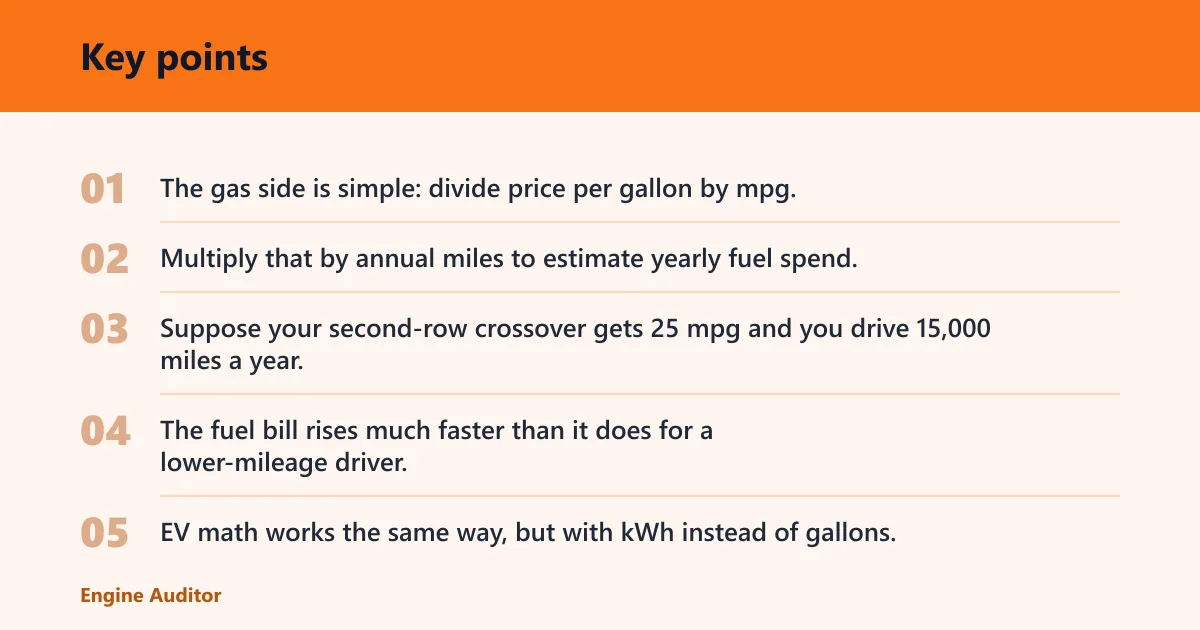
The gas side is simple: divide price per gallon by mpg. Multiply that by annual miles to estimate yearly fuel spend, and then check whether your commute is long enough for the savings to matter.
Suppose your second-row crossover gets 25 mpg and you drive 15,000 miles a year. The fuel bill rises much faster than it does for a lower-mileage driver, so the EV’s operating-cost edge grows with use.
Electricity rate, MPGe, and miles per kWh
EV math works the same way, but with kWh instead of gallons. A 2024 Tesla Model 3 is listed at 132 MPGe, which shows how efficient an EV can be relative to the average gas vehicle, and many calculators also use miles per kWh directly for easier comparison.
Home charging versus public charging
Home charging is usually the cheapest path. Public fast charging can be convenient, but it changes the cost per mile enough that a buyer who depends on it should run the numbers separately rather than use home-charging assumptions.
Picture a driver who relies on public charging three times a week because street parking blocks home charging. The EV can still work, but the cost edge narrows, and the convenience penalty may matter more than the fuel savings.
Does charging access change the answer?
Yes. Charging access can flip the result even when the purchase price favors used electric cars. A buyer with a garage outlet or workplace charging can usually model a much lower operating cost than a buyer who must queue at public fast chargers.
Home charging availability
If you can charge at home most nights, the EV side gets much stronger. Time-of-use pricing can also help if overnight electricity is cheaper than daytime power, especially in urban grids where off-peak rates cut cost meaningfully.
Public fast-charging dependence
Heavy dependence on public charging weakens the EV case because the per-kWh price is often higher and the time cost is larger. That does not make the EV wrong, but it means the decision should be based on convenience and total cost together.
Charging speed and time-of-use pricing
Fast charging is about time, not just price. If you need quick top-ups, compare charging speed alongside cost, because a slower but cheaper setup can be the better fit for a long-term owner, while a short-horizon buyer may care more about speed than savings.
How should you weigh maintenance and insurance?
Maintenance usually favors used electric cars, while insurance is less predictable and can tilt either way. EVs skip oil changes and some engine-service items, but tires, suspension, cabin filters, and brake components still need attention, and EV repair bills can be higher after a collision.
Routine service differences
New gas cars bring more routine service items: oil changes, more fluid changes, and more engine-related wear points. EVs reduce that list, which is one reason their ownership cost can fall below a gas car’s over a five-year horizon.
Battery age and repair risk
Used EV buyers need to think about battery age, not just mileage. A healthy battery can keep the vehicle attractive, but a degraded pack changes resale value and may make a high-mileage or fast-charging-heavy car a weaker buy.
Insurance premiums and repair costs
Insurance can favor new gas cars when EV parts and labor are pricier. The exact result depends on the model, local repair network, and insurer, so two vehicles with similar sticker prices can still have very different annual premiums.
When do incentives and depreciation matter most?
Incentives matter most when the buyer is close to a decision threshold. The federal EV tax credit is up to $7,500 for new EVs and up to $4,000 for used EVs, but eligibility rules, income caps, and MSRP caps control whether the credit applies at all.
Used EV tax credit rules
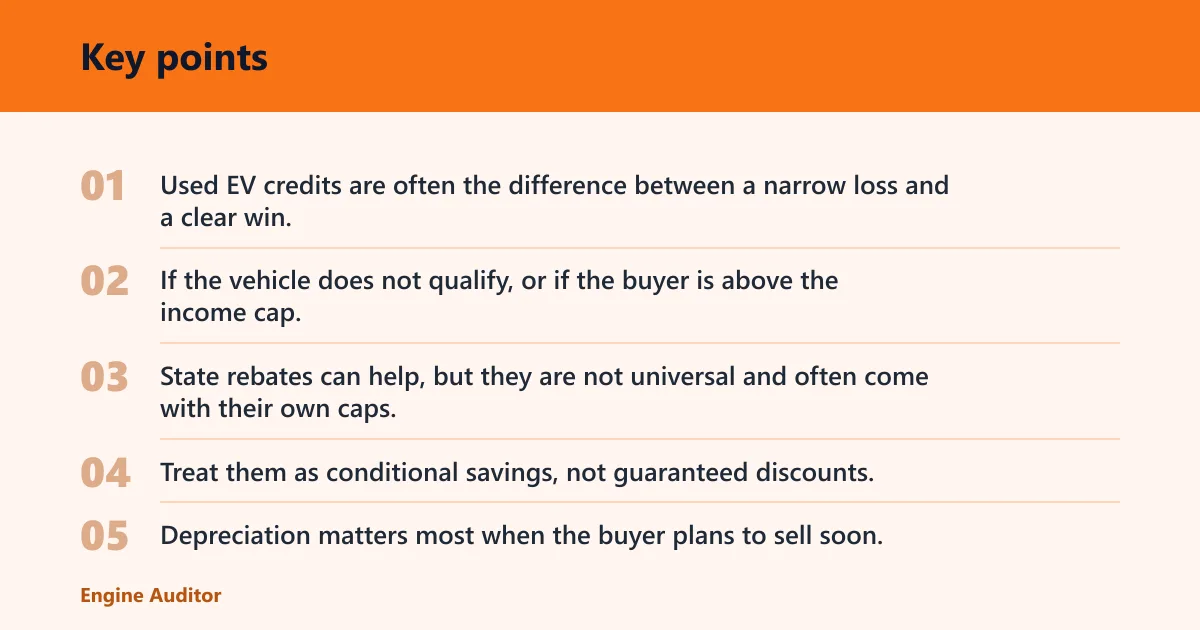
Used EV credits are often the difference between a narrow loss and a clear win. If the vehicle does not qualify, or if the buyer is above the income cap, the comparison should be recalculated without the credit.
State rebates and eligibility limits
State rebates can help, but they are not universal and often come with their own caps. Treat them as conditional savings, not guaranteed discounts.
Resale value and ownership horizon
Depreciation matters most when the buyer plans to sell soon. A short ownership horizon can favor new gas cars if the EV’s resale is uncertain, but a longer horizon gives the lower operating cost more time to work.
A common first-timer mistake is to buy the cheaper monthly payment and ignore the exit price. If the plan is to sell in two years, the wrong depreciation assumption can make the “cheaper” car the more expensive one.
How do you decide between these two purchases?
Choose used electric cars if you have reliable home or workplace charging, drive enough miles for energy savings to matter, and plan to keep the car long enough for lower operating costs to offset depreciation and insurance. Choose new gas cars if you depend on public charging, expect a short ownership horizon, or need a simpler refueling setup with fewer charging constraints.
Low-mileage buyers
Low-mileage buyers often see the smallest fuel savings from an EV. If annual miles are modest, the price gap and insurance gap may matter more than the energy savings, which can push the decision toward new gas cars.
Apartment living and public charging
If you live in an apartment and cannot charge at home, the EV case gets harder. Public fast charging can still work, but it is the first thing to check because it can narrow or erase the cost advantage.
Short ownership horizon
Short-horizon buyers should pay close attention to depreciation and incentives. A used EV can still be the better buy, but only if the lower purchase price and operating cost beat the resale risk within the time you plan to own it.
Verdict: used electric cars or new gas cars?
Choose used electric cars if you have home or workplace charging, drive moderate to high mileage like the worksheet’s 12,000-mile example, and want the lower five-year total cost shown in the article’s $27,700 EV example versus $34,400 for the gas car.
Choose new gas cars if you live in an apartment or otherwise rely on public charging, want a choice with no charging needed, or have a short ownership horizon where avoiding charging hassle matters more than the EV’s fuel and maintenance savings.
Frequently asked questions
Are electric cars cheaper than gas cars?
They can be, but only on the right ownership profile. Used electric cars usually have lower fuel and maintenance costs, while new gas cars can be cheaper to insure or easier to own when charging is inconvenient. The winning side depends on mileage, charging access, and resale value.
What is the cost comparison for gas vs electric car ownership?
Start with total cost of ownership over five years: purchase price, incentives, financing, fuel or electricity, maintenance, insurance, and depreciation. Gas cars often look cheaper at the lot, but electric cars can win over time if charging is cheap and usage is high enough.
How much do you save with an electric car vs a gas car?
The savings depend on how you charge and how far you drive. At the cited averages, a 25 mpg gas car at $3.50 per gallon costs about $0.14 per mile, while an EV at 3.5 miles/kWh costs about $0.046 per mile on paper. Public charging can reduce that gap.
Do used electric cars make more sense than new gas cars?
Often yes, if you can charge at home and plan to keep the car for several years. The used EV can win on upfront price, operating cost, and maintenance, but the case weakens if you rely on public charging or want out quickly because depreciation and battery age matter more.
What costs should I compare besides sticker price?
Compare monthly payment, incentives, electricity or gas cost, maintenance, insurance, taxes, and resale value. Also separate home charging from public fast charging, because the same EV can have very different cost-per-mile numbers depending on where you plug in.
How do incentives change the used EV versus new gas comparison?
They can move the result quickly. The federal EV tax credit is up to $4,000 for used EVs and up to $7,500 for new EVs, but eligibility rules, income caps, and MSRP caps apply. If the credit does not apply, recalculate the deal without it.
Products related to this article
Sponsored / affiliate links. As an Amazon Associate I earn from qualifying purchases. I may earn additional commission from eligible campaigns.