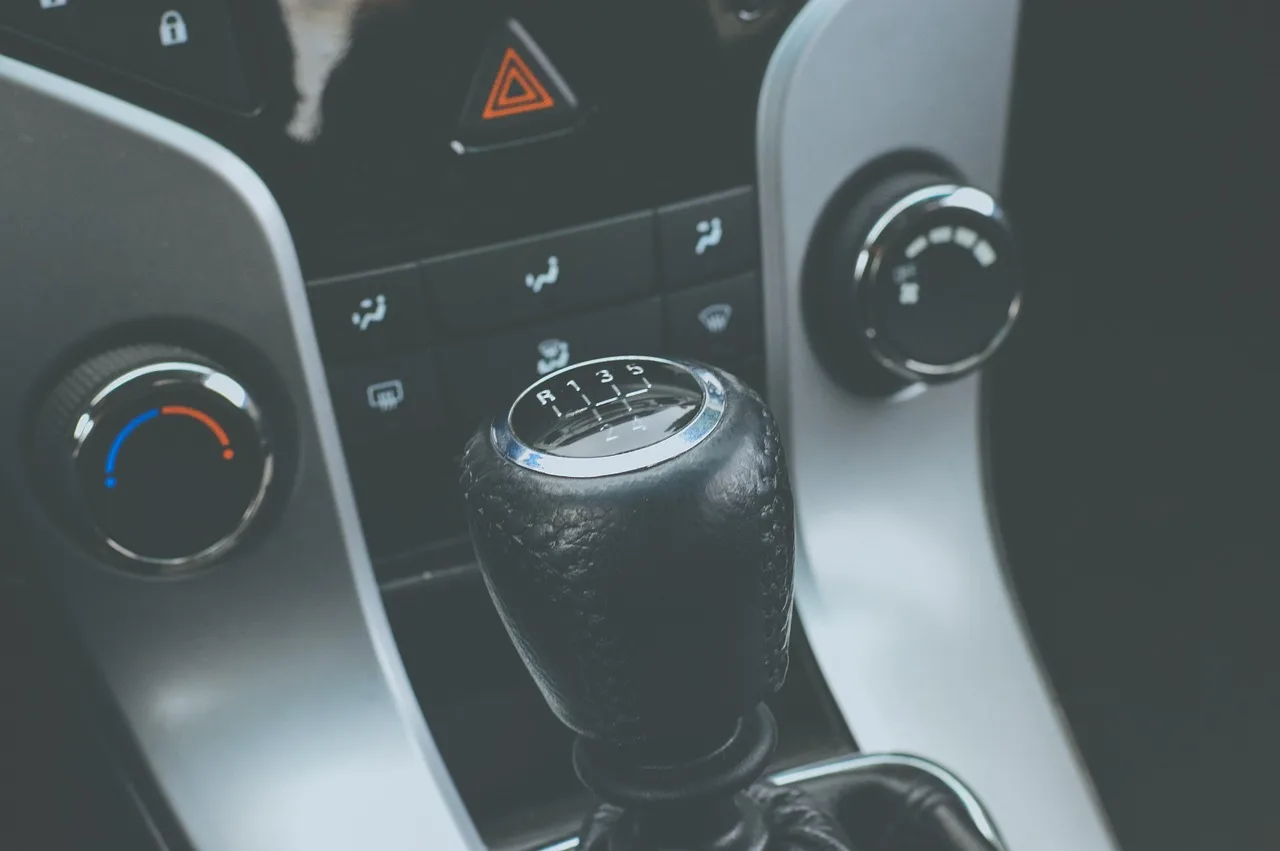
How to Compare Automatic vs Manual Cars for Beginners
For beginners, compare automatic and manual cars by a few practical checks such as learning difficulty, commute fit, and licensing concerns; if one factor matters most, choose the transmission that fits it best. Pick wrong, and the test gets harder, learning slows, or daily driving feels draining. This guide gives a simple decision matrix for first-time buyers and learner drivers.
This guide is part of our Car comparison guide series.
| Decision factor | How to compare automatic | manual cars for beginners | Winner |
|---|---|---|---|
| Learning difficulty | An automatic shifts gears for the driver and usually tends to stall less often. | A manual uses a clutch pedal and a gear lever, so the driver shifts gears and manages the bite point. | How to compare automatic |
| City commuting | Less tiring in stop-and-go traffic and dense city traffic. | Can feel busy in traffic because repeated clutch work and gear changes add effort. | How to compare automatic |
| Hill starts | Usually simpler for a beginner because the car does the shifting. | Gives more control in hills and snow, but hill starts raise stall risk for new drivers. | How to compare automatic |
| Licensing risk | Safer if your region has automatic-only restrictions after the test. | Better if you want full manual access after passing in a manual car. | tie |
| Ownership cost risk | Can bring higher repair costs in some cases. | Manual repairs are simpler and cheaper in some cases, but clutch wear can bite beginners who stall often. | manual cars for beginners |
Automatic vs manual: what changes for a beginner
Automatic and manual cars change the driving task in different ways. A manual asks the driver to handle the clutch pedal, gear lever, and timing of each shift. An automatic shifts gears for the driver, so the beginner can focus more on steering, speed control, and road position.
How a manual car changes the driving task
Manual transmission means the driver shifts gears, works the clutch pedal, and learns the bite point. That adds coordination with the throttle and makes smooth starts a learned skill, not a habit that appears on its own. New drivers often stall at first, especially on hills or when pulling away in traffic.
How an automatic car changes the driving task
Automatic transmission removes the clutch pedal and handles gear changes on its own. Most beginners find that easier to learn and less tiring in traffic. Drive, neutral, and park are generally simpler to manage than coordinating the clutch, throttle, and gear lever at the same time.
What beginners usually feel in the first week
In the first week, manual learners often spend time on getting moving, stopping cleanly, and avoiding stalls. Automatic learners often spend more time building road awareness and parking confidence. That difference matters because a beginner’s energy is limited; the easier car can make the first lessons more productive.
Which is easier to learn first?

Automatic is easier for most beginners because it removes clutch timing and cuts stall risk. Manual takes longer to feel natural, especially when the learner is still building steering control, mirror habits, and road scanning. The better first choice is the one that cuts the number of new actions at once.
Week 1: getting moving, stopping, and parking
Automatic usually wins this stage. Learners can start in a quiet parking lot and practice basic control without worrying about the clutch bite point. Manual beginners are often told to practice the clutch bite point first, because smooth pull-offs are the gatekeeper skill.
Week 3: hill starts, traffic flow, and confidence
By week 3, automatic learners often have more confidence in traffic flow because the car does the shifting. Manual learners may be getting smoother, but hill starts and repeated stops can still drain attention. That is where stop-and-go commuting starts to split the two choices quickly.
Signs you may need a simpler first choice
If a learner is anxious in traffic, has a left-foot injury, has short legs that make clutch reach awkward, or shares a car with family members who only know one type, automatic is often the safer first step. A first car should lower stress, not feel like a second training job every time the engine starts.
Which transmission fits your commute?
Automatic fits most city commuters better, while manual can still make sense for drivers who face hills, rural roads, or fewer stops. The best match depends on how often the driver faces traffic lights, uphill starts, parking, and slow queues. Daily route matters more than transmission pride.
Heavy city traffic and stop-and-go driving
Automatic is usually the better city choice because stop-and-go traffic can make manual driving tiring. Repeated clutch work in dense traffic can turn every commute into a practice session. For beginners, that fatigue often leads to sloppy stalls, jerky starts, and faster frustration.
Hills, rural roads, and mixed routes
Manual can offer better control in hills and snow, which is why some drivers prefer it outside flat cities. That advantage matters more to an experienced driver than to a first-timer. A beginner on hilly routes has to weigh control against stall risk, especially during starts on an incline.
Short trips, long trips, and parking frequency
Short trips with many stops favor automatic because there is less shifting and less leg work. Long trips can feel easier in either transmission once the driver settles in, but parking frequency still matters. If every day includes tight parking and repeated exits, the simpler drivetrain usually reduces fatigue.
Use this beginner transmission decision matrix
This one-page matrix helps separate learning difficulty, commute fit, and licensing risk. Use the row that matches the driver’s real day, not the transmission they imagine they should want. A beginner may be able to decide quickly with this format.
| Traffic level | Hill starts | Test and license rules | Budget and repair risk | Confidence level | Likely ownership tradeoffs | Best pick |
|---|---|---|---|---|---|---|
| Dense city, frequent stop-and-go | Rare hills | Any rule set | Can accept higher repair risk for convenience | Low or medium | Less fatigue, fewer stalls, easier daily use | How to compare automatic |
| Mixed city and rural routes | Some hills | Manual license allowed and desired | Wants lower repair complexity | Medium | More control, more learning time, possible clutch wear if starts are rough | manual cars for beginners |
| Mostly hills | Frequent hill starts | Automatic-only restriction applies after the test | Needs predictable beginner costs | Low | Better test fit, easier starts, fewer stalls | How to compare automatic |
| Mostly rural, light traffic | Few or no hills | No transmission restriction concern | Very tight budget | High | Possible lower purchase or repair cost in some markets, but learning takes longer | manual cars for beginners |
What do driving test and licensing rules mean for your choice?
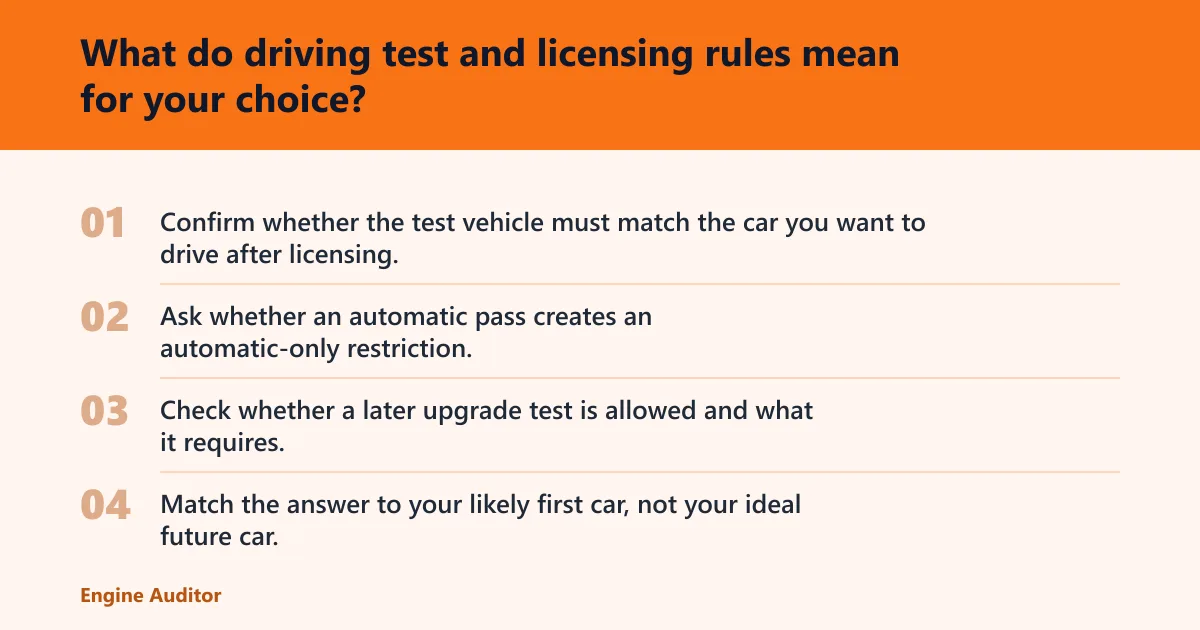
Test and licensing rules can decide the transmission before price or preference does. Some regions restrict drivers who passed an automatic test to automatic-only licenses. That means the test vehicle transmission matters as much as the first car you plan to buy.
Automatic-only restrictions in some regions
Some regions limit the license if the test was passed in an automatic. That is a real beginner risk because the short-term convenience of automatic can create a longer-term restriction. Anyone who may want manual later should check local rules before booking the test or signing a purchase order.
Taking the test in one transmission and driving the other later
Rules differ by region, and the test vehicle often decides what a new driver can legally drive afterward. In some places, passing in manual keeps both options open; in others, passing in automatic closes the manual door. The safe assumption is simple: the test car and the license outcome are linked.
How to check local rules before you buy
- Confirm whether the test vehicle must match the car you want to drive after licensing.
- Ask whether an automatic pass creates an automatic-only restriction.
- Check whether a later upgrade test is allowed and what it requires.
- Match the answer to your likely first car, not your ideal future car.
What should beginners know about cost, fuel use, and resale?
Cost is wider than purchase price. Beginners should factor in likely repair exposure, fuel use in real traffic, and resale demand in their market. A cheap car that is hard to insure, hard to service, or hard to resell can become the more expensive choice.
Purchase price and local market demand
Manuals can be cheaper to buy in some markets, and automatics can cost more up front. That pattern is not fixed everywhere. Local demand matters, and the right first car is the one the local market wants if resale or quick sale matters later.
Real-world fuel economy differences
Some manuals can get slightly better fuel economy in real use. Modern automatics can sometimes match fuel economy thanks to newer gearbox designs, and in some markets they may do a little better than manuals. Beginners should treat fuel economy as a market-dependent tie unless a specific car proves otherwise.
Maintenance, repairs, and resale value
Manual repairs are described as simpler and cheaper in some cases, but repeated poor starts can wear a clutch and drive up replacement cost. Automatics can be more expensive to repair if something goes wrong, though the beginner may avoid clutch wear altogether. Resale value depends on regional demand and transmission preference by market, not on a universal rule.
How do automatic and manual cars differ to drive?
Automatic cars differ by removing clutch work and handling gear changes for the driver. Manual cars differ by asking the driver to coordinate clutch pedal, throttle, and gear lever. That difference changes fatigue, learning speed, and the number of mistakes a beginner can make while moving.
Clutch pedal, bite point, and common beginner mistakes
The clutch pedal is the main manual-specific skill. Beginners have to find the bite point and coordinate it with throttle input, and the common mistake is releasing too quickly or adding too much throttle too soon. Repeated rough starts can increase wear and eventually lead to replacement cost.
Drive, neutral, and park in an automatic
Automatic driving is simpler in operation because the driver selects drive, neutral, or park and lets the car manage the shifting. That makes low-speed traffic easier and reduces stall risk. The beginner still needs braking judgment and parking skill, but the transmission adds less cognitive load.
Is manual harder to drive on hills and in traffic?
Yes, manual is usually harder on hills and in traffic for beginners because it adds more moving parts to each start and stop. Hills raise stall risk, and stop-and-go traffic makes the clutch work constant. Experienced drivers often value the extra control, but new drivers usually feel the extra workload first.
Hill starts and stall risk
Hill starts expose weak clutch-throttle timing very quickly. A beginner can roll back, stall, or over-rev while trying to move off cleanly. That is why hill practice should come after basic flat-ground starts feel automatic.
Traffic fatigue and attention span
Traffic fatigue matters because beginners lose precision when they are tired. In stop-and-go conditions, manual driving can keep one hand, one foot, and part of the mind busy just managing the car. Automatic removes that load and leaves more attention for mirrors, spacing, and hazard spotting.
Which transmission is safer for a new driver?
Automatic is often safer for a new driver in heavy traffic because it reduces stalls and lets the beginner focus on observation and space control. Manual can be safe too, but only after the learner can start, stop, and shift without dividing attention. Safety here depends on workload, not status.
When automatic improves safety
Automatic usually helps when the driver is anxious, inexperienced, or driving in dense city traffic. Fewer stalls mean fewer surprise situations in intersections and on hills. That simplicity can cut distraction during the period when the driver still has weak habits.
When manual can be safe enough
Manual can be safe enough when the learner has time to practice and the route is calm. It may also suit drivers who want direct control in hills or snow. The key is whether the driver can handle the extra task without missing road cues.
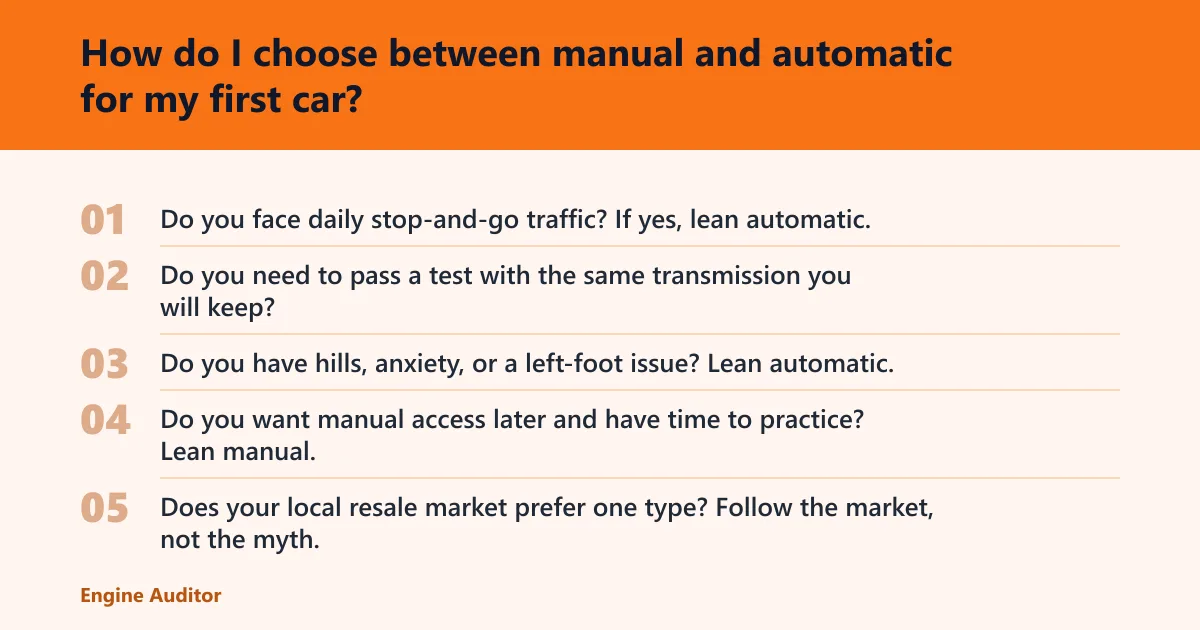
How do I choose between manual and automatic for my first car?
Choose automatic if your commute is heavy, your confidence is low, or your local licensing rules favor automatic-only restrictions you can live with. Choose manual if your region rewards manual licensing, your routes are calm, and lower repair complexity matters more than learning speed. The right answer is the one that fits the next twelve months, not a fantasy road trip.
When automatic is the safer first pick
Automatic is the safer first pick for city commuters, anxious learners, and anyone with frequent stop-and-go traffic. It is also the better choice for drivers with left-foot injury concerns or mixed-family-car households where multiple people may need to drive the same vehicle. That combination keeps the first months simpler.
When manual still makes sense
Manual still makes sense when the learner wants full transmission access after the test, has time to practice, and drives in a market where manual resale stays strong. It can also fit budget-conscious buyers in places where manuals are common and repairs are straightforward. A patient learner can get there.
A two-minute decision checklist
- Do you face daily stop-and-go traffic? If yes, lean automatic.
- Do you need to pass a test with the same transmission you will keep? Match the test car to the final plan.
- Do you have hills, anxiety, or a left-foot issue? Lean automatic.
- Do you want manual access later and have time to practice? Lean manual.
- Does your local resale market prefer one type? Follow the market, not the myth.
Frequently asked questions
Is it easier for beginners to learn automatic or manual?
Automatic is easier for most beginners because the car shifts gears on its own and there is no clutch pedal to coordinate. Manual adds the bite point, throttle timing, and stall risk, so the first week usually feels harder. That difference is biggest in traffic and on hills.
Which is better for city driving, manual or automatic?
Automatic is usually better for city driving because stop-and-go traffic can make manual driving tiring. Repeated clutch work in dense traffic increases fatigue and the chance of jerky starts. For a beginner, reducing workload in city traffic often matters more than any theory about manual control.
Is manual cheaper to buy and maintain than automatic?
Manual can be cheaper to buy and repair in some markets, and manual mechanics are often simpler. But beginner mistakes can wear the clutch and create replacement costs that erase part of the savings. The better answer depends on local prices, local demand, and how much practice the driver needs.
Will learning manual make me a better driver?
Learning manual can build coordination and awareness, but it does not automatically make someone a better road driver. Safe driving still depends on observation, judgment, and patience. For a beginner, the more important question is whether the extra workload helps learning or distracts from the road.
Can I take my driving test in an automatic and drive manual later?
Sometimes yes, sometimes no. Some regions restrict drivers who passed an automatic test to automatic-only licenses, while others allow later manual driving under different rules. The test vehicle transmission can shape the license, so local rules should be checked before booking the exam or buying the car.
Products related to this article
Sponsored / affiliate links. As an Amazon Associate I earn from qualifying purchases. I may earn additional commission from eligible campaigns.