How to compare turbo vs naturally aspirated engines
Choose turbo if you need strong low-rpm torque, high-altitude performance, or towing with a smaller engine; choose naturally aspirated if you want simpler service, predictable throttle response, and fewer long-term variables. Pick the wrong one and you can buy extra fuel use, higher repair bills, or drivability that does not fit your commute. This guide compares both by commuting, towing, altitude, short trips, used-car risk, and operating costs, then shows how to verify the exact engine family before you buy.
This guide is part of our Car comparison guide series.
| Factor | How to compare turbo | naturally aspirated engines | Winner |
|---|---|---|---|
| Commuting and passing | Stronger mid-range pull with less downshifting; can feel easier in traffic because boost fills in the torque curve early. | Cleaner, more linear throttle feel and more immediate off the pedal, but often less shove at low rpm. | How to compare turbo |
| Towing and hauling | Better low-rpm torque and hill climbing at smaller displacement; works best with adequate cooling, oil control, and transmission calibration. | Can tow well when paired with large displacement and correct gearing, but usually needs more rpm to make the same pulling force. | How to compare turbo |
| Short trips and cold starts | More heat-management concerns and more sensitivity to neglected oil; turbo hardware faces repeated heat cycles. | Simpler airflow hardware and fewer turbo-specific parts, with fewer places for heat-related wear to build up. | naturally aspirated engines |
| High-altitude driving | Retains more power as air thins because turbocharging compresses intake air and helps offset elevation loss. | Loses power more quickly with elevation because it is limited by atmospheric intake pressure. | How to compare turbo |
| Used-car risk | More inspection points: boost plumbing, oiling, intercooler, and heat history. | Fewer forced-induction failure modes and a lower-risk used-car purchase. | naturally aspirated engines |
| Fuel cost potential | Can be efficient if downsized and lightly loaded, but boost usage changes results. | Often steadier in mixed ownership because there is no boost demand. | Tie |
| Performance and usable power | Often makes stronger low-rpm torque and a broader mid-range, so useful power arrives sooner. | Usually climbs more linearly toward peak power rpm and may need more revs for the same shove. | How to compare turbo |
| Throttle response and drivability | Can feel less immediate because of turbo lag, though modern systems spool quickly. | Usually feels more linear and direct, which can make it easier to modulate. | naturally aspirated engines |
| Maintenance and service simplicity | Includes turbo-specific hardware and heat/oil management, so service discipline matters more. | Has simpler hardware because it does not need a compressor, boost control, or intercooler piping. | naturally aspirated engines |
| Best-fit use | Best for strong low-rpm torque, frequent hill climbing, towing, and better pull at elevation. | Best for simpler service, predictable response, and fewer long-term variables. | Tie |
Turbo vs naturally aspirated: which fits your use case?
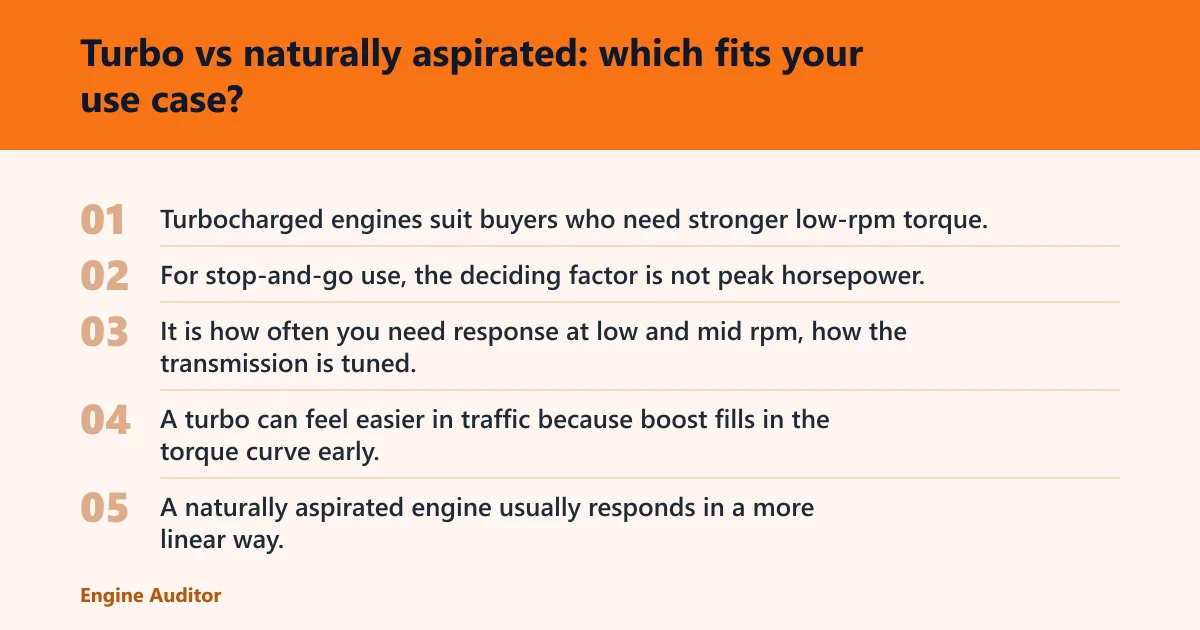
Pick the engine for the job first. Turbocharged engines suit buyers who need stronger low-rpm torque, frequent hill climbing, or better pull at elevation; naturally aspirated engines fit buyers who want simpler hardware, predictable response, and a lower-risk used-car purchase.
Commuting and city driving
For stop-and-go use, the deciding factor is not peak horsepower. It is how often you need response at low and mid rpm, how the transmission is tuned, and whether the engine feels calm without repeated deep throttle inputs.
A turbo can feel easier in traffic because boost fills in the torque curve early. A naturally aspirated engine usually responds in a more linear way, which some drivers prefer for smooth throttle control.
Towing and hauling
For towing, torque at usable rpm matters more than headline output. A turbocharged engine can deliver stronger pull from a smaller displacement, but it also needs adequate cooling, proper oil control, and transmission calibration that avoids constant hunting.
A larger naturally aspirated engine can tow well when the gearing matches the load. The trade-off is that it usually needs more rpm to make the same pulling force.
Mountain and high-altitude driving
At elevation, a naturally aspirated engine loses more power because it is limited by atmospheric intake pressure. Turbocharging helps offset that loss by compressing intake air, which is why turbo models often feel more consistent in the mountains.
That advantage does not make every turbo better. The engine family still has to manage heat, fuel, and calibration correctly.
Short trips and cold starts
Short-trip duty is harder on engines with turbo hardware because the oil and cooling systems see repeated heat cycles without much steady-state driving. A naturally aspirated engine has fewer turbo-specific parts, so there are fewer places for heat-related wear to build up.
Suppose a small turbo SUV spends most of its life on very short errands. The turbo may spend much of its service life heat-soaking and never fully drying out moisture and fuel dilution in the oil, which makes service discipline more important than the badge on the tailgate.
📊 Turbo-normalized systems aim to maintain about 29.5 inHg manifold pressure. Source: Forced induction.
How each engine type makes power
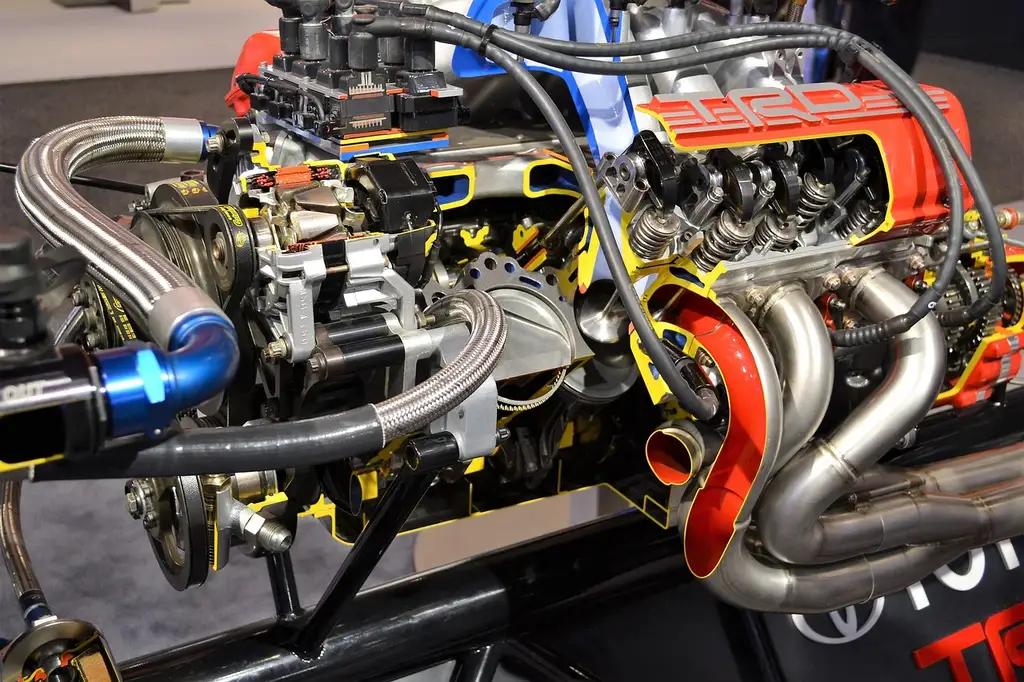
A turbocharged engine uses exhaust flow to spin a turbine connected to a compressor, which increases the density of the intake air. Engines without forced induction are naturally aspirated and pull air at atmospheric pressure.
Turbocharged engine basics
In practical terms, the turbo makes more air available to the cylinders. That raises low- and mid-range torque when the calibration, fuel system, and intercooler can support the extra airflow.
Turbo-specific hardware includes boost plumbing, charge-air cooling, and oil and heat management around the turbine. Intercooling is often used to reduce intake-air temperature after compression.
Naturally aspirated engine basics
A naturally aspirated engine has simpler airflow hardware because it does not need a compressor, boost control, or intercooler piping. It is limited to atmospheric intake pressure, so power falls more as elevation increases.
That simplicity helps explain why many shoppers value it for predictable service and fewer forced-induction failure points.
Why boost changes the torque curve
Turbo boost can shift where the engine makes more of its torque. A turbo engine often builds stronger low-rpm torque and a broader mid-range, while a naturally aspirated engine usually climbs more linearly toward peak power rpm.
That affects drivability. Around-town passing often feels easier in a turbo because the useful torque arrives sooner, but a naturally aspirated engine can feel more immediate when you first press the pedal.
What the intercooler does
The intercooler lowers charge-air temperature after compression, which helps density and knock control. Hotter air is less dense, so charge-air cooling matters when the turbo is working hard, climbing grades, or pulling a trailer.
If the intercooler is undersized or heat-soaked, the turbo advantage shrinks. That is one reason platform integration matters as much as the engine label.

Which engine type feels stronger on the road?

Turbocharged engines can feel stronger in normal driving because they may make more low-rpm torque and keep that pull into the mid-range. Naturally aspirated engines often feel cleaner and more immediate off the pedal, but they usually need more rpm to deliver the same shove.
Low-rpm torque and passing power
Low-rpm torque changes how often you need to downshift. A turbo can make passing easier at partial throttle, especially in heavier vehicles where the engine would otherwise need a downshift.
That is why many shoppers describe turbo engines as easier to live with on grades or when merging at highway speed.
Turbo lag and spool behavior
Turbo lag is the delay between pressing the throttle and the boost arriving. Some modern systems spool quickly, but the effect never disappears completely because the turbo depends on exhaust energy.
Lag matters most in quick tip-in driving and when you want instant response from very low rpm. It is less of a problem when the transmission keeps the engine in its useful range.
Throttle response and drivability
Naturally aspirated engines usually feel more linear because throttle opening tracks airflow more directly. That can make them easier to modulate in parking lots, on slick roads, or during gentle city driving.
If you value a direct pedal feel over extra pull, the naturally aspirated setup often wins that comparison.
Peak power versus usable power
Peak horsepower gets attention, but usable power is what you feel most of the time. A turbo engine can make strong usable power at lower rpm, while a naturally aspirated engine may need more revs to reach its best output.
Picture a 4,000-pound crossover climbing a hill with four people aboard. The turbo may hold speed with fewer downshifts, while the naturally aspirated version may need more rpm and more noise to do the same work.
Does a turbo engine use more fuel than a naturally aspirated engine?
Not automatically. Fuel economy depends on the whole vehicle, not engine type alone. EPA ratings are only part of the story; real-world MPG changes with driving cycle, vehicle weight, gearing, calibration, and how often the turbo is kept in boost.
EPA ratings versus real-world MPG
EPA numbers help with comparison, but they do not capture every commute. A light vehicle with a turbo may post competitive ratings, while a heavier one with the same engine type may not.
Real-world MPG also shifts with traffic, terrain, and temperature. Two similar engines can produce very different ownership costs once driver behavior enters the picture.
How vehicle weight and gearing change results
Weight and gearing shape how hard the engine has to work. A turbo that allows taller gearing can reduce revs on the highway, but a poor match can erase much of the benefit.
A naturally aspirated engine in a lighter vehicle may match or beat a turbo setup in mixed driving if it spends less time under load.
Driving style and boost usage
The more often you ask for boost, the more fuel the engine needs. Hard acceleration, steep grades, and loaded towing can pull a turbo well away from its test-cycle efficiency.
Gentle throttle use keeps a turbo closer to its efficiency sweet spot. Aggressive driving does the opposite.
Downsized turbo engines versus larger NA engines
Fuel economy claims often come from engine downsizing. FuelEconomy.gov cites turbocharging and engine downsizing, and the February 2026 Automotive Trends Report notes that turbocharged engines accounted for more than 44% of U.S. light-duty vehicle production in model year 2024.
That does not mean every turbo uses less fuel. It means manufacturers use forced induction to let a smaller engine match the output of a larger one. The result depends on calibration, vehicle mass, and how the engine is driven.
How do they compare at altitude and in heat?
Turbocharged engines usually lose less power as air gets thinner because forced induction can compensate for lower air density. Naturally aspirated engines cannot recover that lost density the same way, so their output falls more noticeably at elevation.
Air density and power loss
Air pressure at 18,000 feet is about half of sea level. A naturally aspirated engine is limited to that thinner atmospheric intake, so output drops as altitude rises. (en.wikipedia.org)
That is the basic reason mountain performance often favors forced induction.
Why turbos can offset thin air
Forced induction increases the density of the intake air. That helps the engine move more oxygen into the cylinders even when ambient air is thin.
Turbo-normalized systems aim to maintain about 29.5 inHg manifold pressure, which is one reason turbocharged aircraft and some road vehicles perform better at altitude than naturally aspirated ones.
Heat soak and charge-air temperature
Heat soak is a real turbo issue. After repeated pulls, the compressor outlet, intercooler, and surrounding bay can heat up, which reduces charge-air density and can soften performance.
That is why an intercooler is not an accessory. It is a core support component for consistent turbo operation.
Cooling system load
Turbo engines ask more of the cooling and lubrication systems because the turbine runs hot and the oil sees more thermal stress. That does not make them fragile by default, but it does make maintenance and service history more important.
Naturally aspirated engines generally place less thermal demand on the system, which can simplify ownership in hot weather or severe duty.
Which is better for towing, turbo or naturally aspirated?
For most buyers, turbo wins towing if the full vehicle is designed for the load and the cooling system is sized correctly. Naturally aspirated can still be the better tow choice when you want simple thermal behavior, a larger displacement engine, and fewer boost-related concerns.
Torque curve under load
Towing rewards engines that make usable torque at lower rpm. A turbo engine often delivers that sooner, which helps on grades and during highway merges with a trailer attached.
A naturally aspirated engine can still tow effectively, but it usually relies more on displacement and revs to stay in the power band.
Transmission gearing and thermal load
Gearing matters as much as the engine. If the transmission keeps hunting between ratios, any engine will feel strained and build heat faster.
The best tow setup is the one with enough cooling margin, sensible gearing, and a calibration that avoids excessive boost or high-rpm cycling.
Engine braking and downshifts
During descents, transmission strategy often matters more than aspiration type. A turbo may downshift less often in steady climbs, but both engine types should be judged by how the drivetrain handles sustained grade work.
If the vehicle is underspecified for the trailer, neither engine type will feel relaxed.
Trailer duty and cooling margin
For frequent towing, ask how the engine handles heat over time. Turbo systems need clean oil, an intact intercooler path, and a cooling package that can handle repeated load without heat soak.
A naturally aspirated engine may look less exciting on paper, but its simpler setup can be a virtue for long-term service under moderate towing loads.
Reliability and maintenance: what actually changes?
Reliability depends on the exact engine family, maintenance schedule, cooling and lubrication design, warranty history, and service records. A turbo badge does not automatically mean trouble, and a naturally aspirated badge does not guarantee durability.
Engine family history versus engine type
Look at the specific engine family, not just whether it is turbocharged. Two turbo engines can have very different records because one may have stronger oiling, better cooling, or a cleaner service history than the other.
The same is true for naturally aspirated engines. Family history matters more than category labels.
Turbo-specific wear points
Turbocharged engines add wear points such as the turbocharger bearings, wastegate or variable-geometry control, boost plumbing, intercooler connections, and pressure sensors. A failure in any of those can affect performance long before the engine itself is worn out.
Heat management is part of reliability here. Oil quality and interval discipline matter more because the turbo lives in a hotter environment.
Oil changes, cooling, and heat management
Turbo engines are usually more sensitive to oil specification, oil level, and change timing. They also place more demand on coolant routing and under-hood heat control.
Naturally aspirated engines still need proper maintenance, but they are less exposed to turbo heat and boost-system wear.
Warranty and service records
Before buying used, verify warranty coverage history and service documentation. If the engine family has known turbo issues, a complete record becomes far more important than a generic reliability score.
That is the right way to separate a well-kept turbo from a neglected one.
Buyer decision matrix and used-turbo inspection checklist
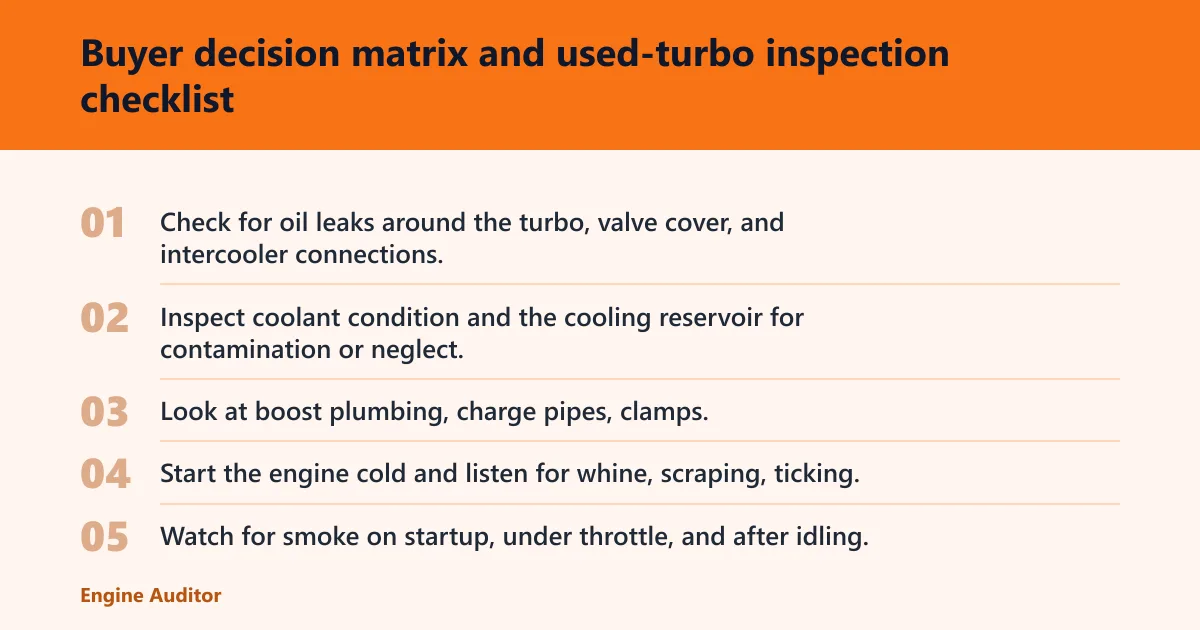
Use a scorecard before you compare badges. The right answer changes by job: a commuter, a mountain driver, and a trailer hauler do not need the same torque curve, maintenance burden, or risk tolerance.
| Use case | Turbocharged engine score | Naturally aspirated engine score | Why |
|---|---|---|---|
| Commuting | 4/5 | 4/5 | Tie if you value different traits: turbo for mid-range pull, NA for linear response |
| Towing | 5/5 | 3/5 | Turbo torque helps under load when cooling and gearing are right |
| Mountain driving | 5/5 | 2/5 | Turbo compensates better for thin air |
| Short trips | 2/5 | 4/5 | NA has fewer heat- and boost-related concerns |
| Used-car risk | 2/5 | 4/5 | Turbo systems add more inspection points |
| Fuel costs | 3/5 | 3/5 | Results depend on weight, gearing, and driving cycle |
- Check for oil leaks around the turbo, valve cover, and intercooler connections.
- Inspect coolant condition and the cooling reservoir for contamination or neglect.
- Look at boost plumbing, charge pipes, clamps, and intercooler piping for splits or oil mist.
- Start the engine cold and listen for whine, scraping, ticking, or hissing that rises with boost.
- Watch for smoke on startup, under throttle, and after idling.
- Review service records for oil type, oil-change intervals, spark plugs, filters, and cooling service.
- Verify whether the engine has a stock calibration or a tune, especially on a used turbo car.
- Walk away if there is boost leakage, unexplained coolant loss, or missing maintenance history.
Common first-timer mistake: buying the turbo version because the brochure says “efficient,” then discovering the car spends most of its life in short trips, sees poor service records, and carries a higher repair risk than the naturally aspirated trim beside it.
Paperwork to verify before buying
Ask for oil-change receipts, coolant service history, spark plug intervals, and any warranty repair history tied to the engine family. If the seller cannot show records, assume you are taking on the maintenance debt yourself.
That matters even more with turbo engines because lubrication and heat history are part of the system, not side issues.
Choose turbocharged engines if…
Choose a turbocharged engine if your priority is stronger low-rpm torque, mountain driving, towing, or a smaller engine that can match the output of a larger one when properly calibrated. It is also the better fit if you live at elevation and the specific engine family has a clean service record and strong cooling design.
Choose naturally aspirated engines if…
Choose a naturally aspirated engine if you want simpler airflow hardware, predictable throttle response, and fewer turbo-specific inspection points on a used vehicle. It is the safer default for short-trip duty and for buyers who value lower complexity over extra torque.
Frequently asked questions
turbo vs naturally aspirated engines
The core difference is forced induction versus atmospheric intake. Turbocharged engines make more low- and mid-range torque and often perform better at altitude, while naturally aspirated engines usually feel more linear and have fewer turbo-specific parts to inspect or maintain.
turbo vs naturally aspirated engine mileage
Mileage depends on the full vehicle, not aspiration alone. A downsized turbo can return strong MPG when lightly loaded, but real-world results shift with weight, gearing, terrain, and how often the driver asks for boost. EPA numbers are only a starting point.
which engine is better naturally aspirated or turbo
Neither wins everywhere. Turbo is usually better for towing, altitude, and passing power; naturally aspirated is usually better for simple service, linear response, and used-car peace of mind. The right answer is the one that matches the vehicle’s job.
turbo vs naturally aspirated reliability
Reliability depends more on engine family and maintenance history than on the label. Turbo engines add wear points such as the turbocharger, intercooler plumbing, and hotter oil demands, while naturally aspirated engines usually have fewer forced-induction parts to fail.
Do turbo engines use more fuel than naturally aspirated engines?
Not by default. A turbo engine can be efficient when it is downsized and driven lightly, but fuel use rises with boost, vehicle weight, aggressive driving, and poor gearing. Compare the exact model, not the engine type alone.
Which engine is better for towing, turbo or naturally aspirated?
Turbo is usually better for towing because it delivers stronger low-rpm torque and can hold speed with fewer downshifts, especially at altitude. Naturally aspirated can still tow well if the displacement, gearing, and cooling package are right, but it usually needs more rpm to do the work.
Products related to this article
Sponsored / affiliate links. As an Amazon Associate I earn from qualifying purchases. I may earn additional commission from eligible campaigns.