How to Compare Lease vs Buy for Your Next Car Costs
Compare totals at around 36 months and 60 months. If you keep the car past the lease term, buying usually comes out ahead because the loan is closer to paid off, while leasing only wins when payments, fees, mileage charges, and end costs stay below depreciation and resale value loss. Leave out mileage caps, acquisition fees, disposition charges, or resale value, and the lower monthly payment can turn into the pricier deal by thousands. This guide gives a worksheet that plugs in lease quotes, loan terms, taxes, maintenance, insurance, and resale value so you can compare both paths side by side.
This guide is part of our Car comparison guide series.
| Decision factor | How to compare lease | buy for your next car | Winner |
|---|---|---|---|
| Monthly cash flow | Usually lower monthly payment, but due-at-signing cash, acquisition fee, and mileage limits can add hidden cost. | Higher monthly payment, but every payment builds equity instead of ending at turn-in. | Lease for cash flow |
| Total 36-month cost | Includes payments, upfront fees, insurance, excess mileage, disposition fee, and wear charges. | Includes payments, down payment, tax, interest, insurance, maintenance, and depreciation net of resale value. | Depends on mileage and resale value |
| Total 60-month cost | Often weak unless the lessee can roll into a very favorable second lease and avoid penalties. | Usually stronger because the loan may be finished or close to finished while the car still has resale value. | Buy |
| Mileage flexibility | Annual-mile cap creates excess-mileage risk and can erase the payment advantage. | No mileage cap, so long commutes and road trips do not add per-mile penalties. | Buy |
| End-of-term risk | Disposition fee, wear-and-tear charges, and turn-in inspection can add cost at the end. | Resale value is a market risk, but there is no lease-end return process. | Buy |
Why monthly payment alone gives the wrong answer
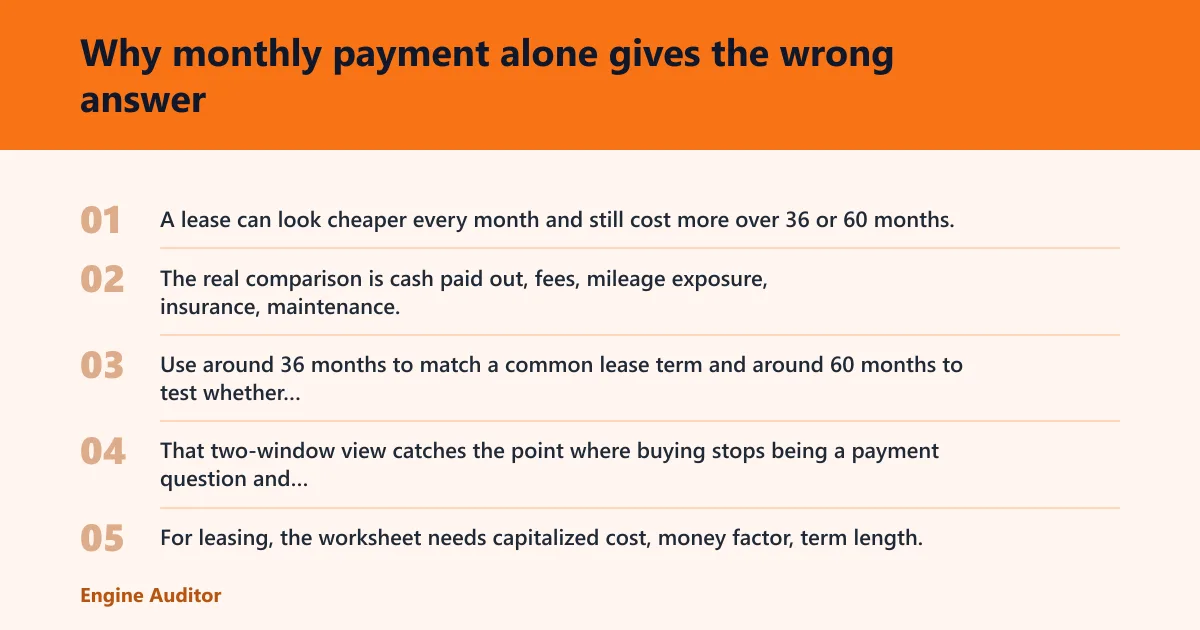
A lease can look cheaper every month and still cost more over 36 or 60 months. The real comparison is cash paid out, fees, mileage exposure, insurance, maintenance, and the value left at the end.
Set the comparison window at 36 and 60 months
Use around 36 months to match a common lease term and around 60 months to test whether ownership holds up over a longer period. That two-window view catches the point where buying stops being a payment question and turns into a resale question.
Define the inputs before signing
For leasing, the worksheet needs capitalized cost, money factor, term length, due-at-signing amount, residual value, acquisition fee, disposition fee, mileage allowance, excess-mileage charge, and wear-and-tear risk. For buying, it needs loan APR, term, down payment, sales tax, total interest paid, insurance, maintenance, depreciation, and resale value.
📊 Beyond Compare lists version 5.2.6 released Sept. 24, 2026. Source: Download Beyond Compare.
How leasing costs are built
Lease cost starts with the gap between the car’s adjusted price and its predicted value at lease end. The lower the residual value, the more of the vehicle you are paying to use over the term.
Lease monthly payment: capitalized cost, money factor, term, and due at signing
Capitalized cost is the lease’s starting price after incentives and dealer adjustments. Money factor is the finance charge; weaker credit usually raises it, which pushes the payment up even if the sticker price stays the same.
Residual value, acquisition fee, and disposition fee
Residual value is the predicted end-of-lease value, usually stated as a percentage of MSRP. It changes by model and term, and it directly shapes the payment because the lessee is covering the loss between the starting value and the residual estimate.
Acquisition fees are paid to start the lease. Disposition fees are paid when the car is returned, unless the lessee buys it out or the contract waives the charge.
Mileage allowance, excess-mileage charges, and lease-end wear costs
Leases usually include an annual mileage allowance. Go past it and every excess mile adds a penalty, which is why a long commute or regular road trips can wreck the math.
Wear-and-tear charges matter too. A car returned with tire wear, curb rash, dents, or stained upholstery can lead to extra charges that do not show up in the monthly payment quote.
How buying costs are built
Buying trades lease-end fees for financing cost and depreciation risk. The monthly payment is often higher, but the owner keeps the residual value instead of returning it to the lender.
Loan APR, loan term, and down payment
Purchase payments are shaped by loan APR, term length, and down payment. A lower APR or a larger down payment reduces the payment and the total interest paid, but it also increases the cash needed on day one.
Sales tax, registration, and total interest paid
Sales tax and registration can be rolled into the purchase cost, depending on state rules and lender structure. Over 36 or 60 months, interest is a real line item and should be counted, not treated as noise.
Depreciation and expected trade-in or resale value
Depreciation is the main ownership cost driver. The first few years of value loss are often the largest expense, though some of that cost may be offset by trade-in or resale value at the end of the hold period.
How do residual value and depreciation change the result?
Residual value lowers lease payments because the lessee is only financing the car’s expected loss in value. Depreciation works the same direction for buyers, but instead of a forecast used by the lender, it becomes the owner’s actual economic loss after resale.
Why residual value lowers lease payments
A high residual value means the vehicle is expected to be worth more at lease end, so less value must be paid for during the term. That is why the same model can lease better on a 36-month term than on a longer term, where the predicted ending value drops.
Why depreciation is the main ownership cost
For buyers, depreciation usually exceeds fuel, routine service, and finance charges combined. The car’s value loss matters more than the payment itself because the owner eventually absorbs the difference between purchase price and resale value.
Which vehicle types lose value faster or slower
Luxury sedans, heavily discounted models, and vehicles with weaker used-market demand often lose value faster. Popular trims, efficient crossovers, and models with strong reputations for durability often hold value better, which can help buying more than leasing.
How many miles per year make leasing a bad deal?
Leasing becomes shaky when annual mileage regularly exceeds the contract cap or when the driver’s use pattern is unpredictable. A low-mileage driver can make leasing work; a high-mileage driver often pays for convenience with excess-mileage fees.
Low-mileage, average-mileage, and high-mileage use cases
Low-mileage drivers who mostly commute short distances and keep long trips rare can fit within a lease allowance. Average-mileage drivers need to compare the cap carefully. High-mileage drivers usually do better buying because the per-mile penalty in a lease can erase the payment advantage.
How commute miles and road trips change the math
Count all commute miles first, then add weekend travel and vacation road trips. Many shoppers undercount the miles they will actually drive, then discover the excess charge only after the lease is signed.
When excess-mileage fees erase the lease advantage
Once the projected excess-mileage bill plus disposition fee approaches the gap between lease and loan payments, the lease loses its edge. That break point arrives faster on shorter leases with tight mileage caps.
What costs should you include in a lease-vs-buy worksheet?
The worksheet should include every cash outflow tied to getting the car, using it, and exiting it. If a cost appears only at the end of the term, it still belongs in the comparison.
Payment, fees, taxes, and insurance
Include the monthly payment, due-at-signing cash, acquisition fee, sales tax, registration, and lender or lease charges. Insurance should also be listed, because leased cars often require comprehensive and collision coverage at limits the lender sets.
Maintenance, repairs, and wear items
Maintenance is lower during the warranty window, but wear items still cost money. Tires, brakes, wiper blades, alignments, and out-of-warranty repairs should be counted for both options.
Resale value, buyout value, and lease-end charges
Buying needs an expected resale or trade-in value at month 36 and month 60. Leasing needs the buyout option, disposition fee, excess-mileage charge, and likely wear-and-tear exposure.
Use the 36-month and 60-month worksheet
| Line item | Lease, 36 months | Buy, 36 months | Lease, 60 months | Buy, 60 months |
|---|---|---|---|---|
| Monthly payment | Lower monthly outflow | Higher monthly outflow | Lower monthly outflow, but two-term risk grows | Often finishes near payoff |
| Down payment / due at signing | Due at signing cash plus first payment and acquisition fee | Down payment plus sales tax and registration | Same lease start costs, spread over a longer horizon | Down payment spread across the loan term |
| Fees | Acquisition fee, disposition fee, possible wear charges | Sales tax, title, registration, document fees | Higher chance of repeat lease fees if the driver rolls again | Usually fewer recurring contract fees |
| Mileage penalties | Excess-mileage charges if the cap is missed | No mileage penalty | Higher risk over a longer period if driving patterns expand | No mileage penalty |
| Insurance | Often higher required coverage level | Coverage can be set by the owner, lender, and risk tolerance | Coverage cost compounds over time | Coverage cost compounds over time |
| Maintenance and repairs | Often inside warranty for much of the term | Warranty window may cover part of the term, then repair risk rises | Warranty may end before the lease path ends | More out-of-warranty exposure by year five |
| End value | No equity unless buyout is exercised | Trade-in or resale value offsets depreciation | Buyout decision becomes central if the car is worth more than residual | Resale value often decides the true cost |
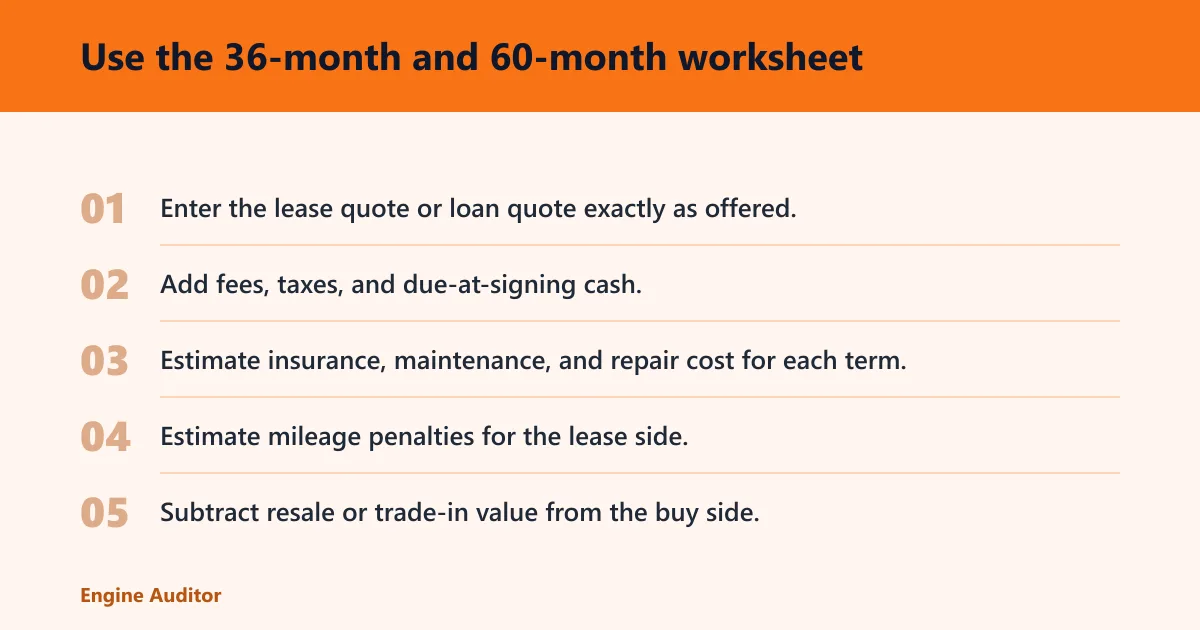
- Enter the lease quote or loan quote exactly as offered.
- Add fees, taxes, and due-at-signing cash.
- Estimate insurance, maintenance, and repair cost for each term.
- Estimate mileage penalties for the lease side.
- Subtract resale or trade-in value from the buy side.
- Compare the 36-month totals, then the 60-month totals.
- Choose the option with the lower all-in cost at the horizon you actually plan to keep the car.
Break-even mileage and break-even ownership horizon
Break-even mileage is the annual distance at which lease penalties and fee exposure wipe out the lower payment. Break-even ownership horizon is the month where buying’s higher early cost is overtaken by retained resale value and lower long-run friction.
When does buying make more sense than leasing?
Buying often makes more sense when the car will stay in service beyond the loan term, when mileage is high or hard to predict, or when the driver wants to avoid lease-end charges. It also tends to win when a vehicle has strong resale value and the owner can hold it long enough to use that value.
Drivers who keep cars beyond the loan term
Once the loan is paid off, the payment disappears but the car can still provide years of use. That is the point where buying usually pulls ahead, because the owner keeps driving without a monthly finance charge.
Drivers with higher annual mileage
High-mileage drivers may face excess-mileage charges under a lease. Buying removes that penalty entirely, so the comparison becomes depreciation plus maintenance instead of depreciation plus mileage fines.
Drivers who want fewer lease-end restrictions
Buying gives the owner control over wear, modifications, and exit timing. Leasing puts strict limits on return condition and forces a decision at term end.
Choose How to compare lease if…
Choose the lease path if the driver values lower monthly cash flow, drives within the mileage cap, and is unlikely to keep the car past the term. Lease math can win on 36 months when residual value is strong, fees are low, and the lessee avoids mileage penalties and wear charges.
Choose buy for your next car if…
Choose buying if the car will be kept past 36 months, the mileage is high, or the goal is to capture resale value instead of returning the car. Buying also makes more sense when the owner wants to avoid disposition fees, turn-in inspections, and lease restrictions.
Frequently asked questions
compare car lease vs buy calculator
A good calculator should compare the full 36-month and 60-month totals, not just payments. It needs lease payment, due-at-signing cash, fees, mileage charges, insurance, maintenance, depreciation, and resale value so the result reflects real ownership cost.
How to compare lease vs buy car
Start with two worksheets. One tracks lease cash flow, residual value, mileage caps, and lease-end fees. The other tracks loan APR, taxes, interest, insurance, maintenance, depreciation, and expected resale value, then compare the final totals at the same month.
Is it cheaper to lease or buy a car over 3 to 5 years?
Over about 3 years, leasing can be cheaper when residual value is strong and mileage stays within the contract. Over about 5 years, buying often wins because the loan is closer to paid off or already paid off, and the car may still have resale value.
How many miles per year make leasing a bad deal?
Leasing starts to lose its edge when yearly driving is close to or above the allowance, especially after commuting and road trips are counted honestly. If excess-mileage charges are likely, buying often becomes the cleaner financial choice.
What costs should I include when comparing lease vs buy?
Include monthly payment, down payment, due-at-signing cash, taxes, acquisition or loan fees, insurance, maintenance, repairs, mileage penalties, disposition fees, wear-and-tear charges, and the vehicle’s expected resale or buyout value.
How do residual value and depreciation affect lease vs buy?
Residual value lowers a lease payment because it estimates what the car will still be worth at return. Depreciation hurts buying because it is the owner’s value loss, but that loss is partly offset by trade-in or resale value at the end.
What lease-end costs should I watch for before signing?
Watch disposition fees, excess-mileage charges, wear-and-tear bills, and the buyout option price. Those items can turn a low monthly lease into a much more expensive contract if the car is driven hard or returned in rough condition.
How do taxes, fees, and insurance change lease vs buy math?
Taxes and fees raise both sides, but they show up differently. Lease costs often arrive upfront or at turn-in, while purchase costs get folded into financing and resale. Insurance can also run higher on a lease because the contract often requires more coverage.
How can comparison tools help with this worksheet?
Tools like Diffchecker can compare two worksheet versions side by side with original on the left and changed version on the right, or in a unified view. It supports custom ignore rules for timestamps, build numbers, session IDs, or any string, and it can compare without sign-up.
Can I share or export the finished worksheet safely?
Diffchecker lets users save and share a comparison as a link and export a comparison as a PDF. Text Compare highlights additions, deletions, and modifications, and it notes that sensitive information should ideally use an offline tool.
What if I want an offline comparison tool?
Beyond Compare offers downloads for Windows, macOS, and Linux. For buyers who keep private budget details offline, that can be the better fit than a web tool, especially when the worksheet includes pay stubs, insurance quotes, or lender terms.
Products related to this article
Sponsored / affiliate links. As an Amazon Associate I earn from qualifying purchases. I may earn additional commission from eligible campaigns.