Ford models to avoid for low repair costs: worst years
If low repair costs matter, it may be worth steering clear of some 2011–2019 Fiesta, 2012–2016 Focus, 2013–2016 Escape with the 1.6L EcoBoost, and 2011–2014 Explorer models, since these years are often associated with transmission, steering, and recall expenses. A low sticker price can hide repeat fixes, lost time, and weaker resale. This guide flags the worst years, explains the failure patterns, and gives safer Ford alternatives.
This guide is part of our Ford cars guide series.
How to judge Ford repair risk before you buy
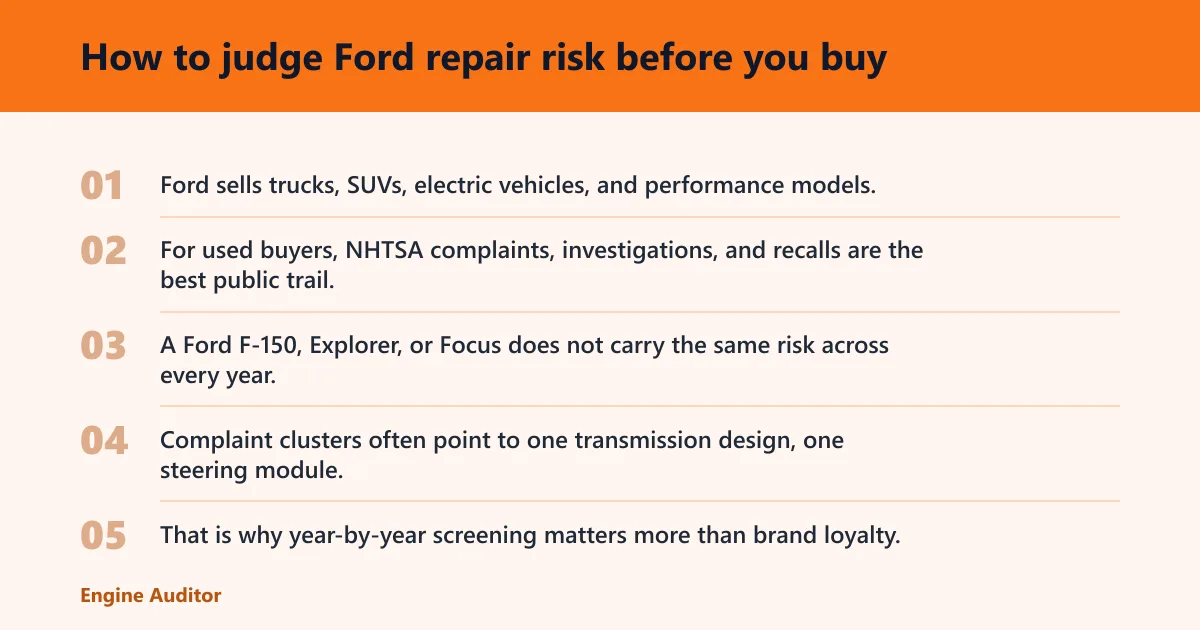
Model year matters more than the badge. Ford sells trucks, SUVs, electric vehicles, and performance models, and the same nameplate can swing from a solid buy to a problem year depending on the exact generation and build window. For used buyers, NHTSA complaints, investigations, and recalls are the best public trail.
Why model year matters more than the badge
A Ford F-150, Explorer, or Focus does not carry the same risk across every year. Complaint clusters often point to one transmission design, one steering module, or one defect family that was not fully corrected until later years. That is why year-by-year screening matters more than brand loyalty.
How NHTSA complaints, investigations, and recalls fit together
NHTSA tracks owner complaints, opens investigations, and publishes recall actions. Complaints do not prove every vehicle will fail, but they can reveal repeat patterns such as hard shifting, brake problems, or steering loss. Investigations show regulators saw enough signal to look deeper, and recalls show Ford later acknowledged a defect in affected vehicles.
Why recall repairs may not fully solve used-car risk
Recall work matters, but it is not a clean reset. Some vehicles never received the fix, some received incomplete repairs, and some defects affect parts outside the recall scope. A completed recall can lower risk, but it does not erase age, wear, or a model-year pattern that still points to expensive ownership.
📊 Ford sold over two million vehicles in the U.S. in 2024. Source: 12 Used Ford Models You Should Steer Clear Of At All Costs.
Which Ford models have the highest repair costs?
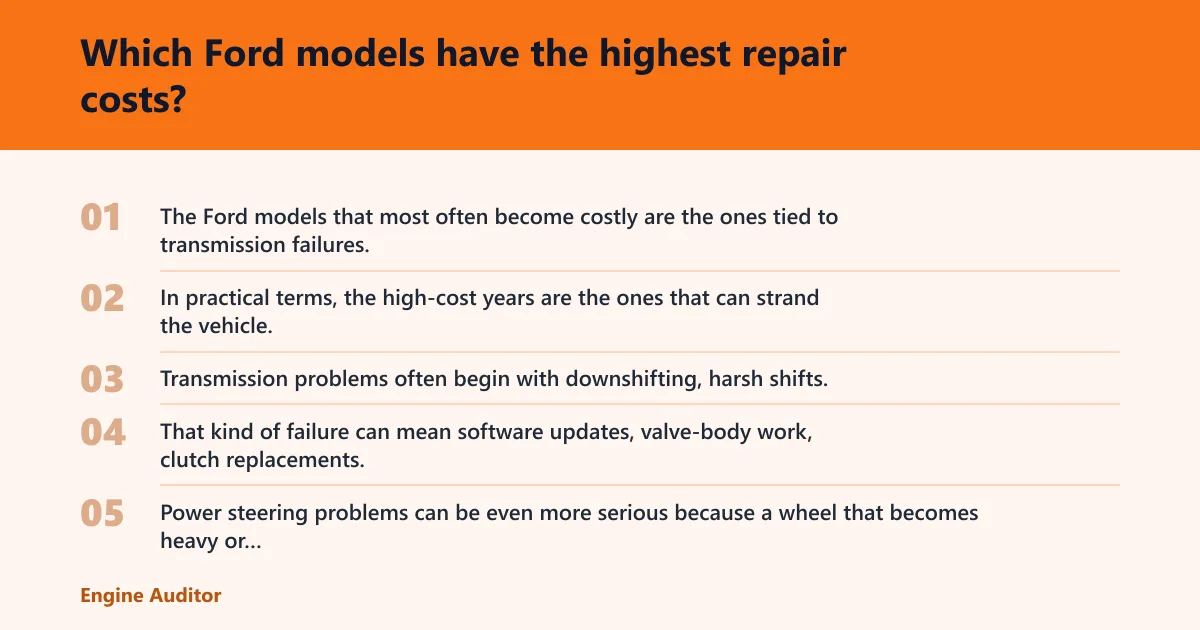
The Ford models that most often become costly are the ones tied to transmission failures, power steering faults, and safety recalls with repeat complaint volume. In practical terms, the high-cost years are the ones that can strand the vehicle, trigger towing, or create repeated shop visits even after a repair.
The failure patterns that usually get expensive
Transmission problems often begin with downshifting, harsh shifts, or an unexpected first-gear shift at speed. That kind of failure can mean software updates, valve-body work, clutch replacements, or a rebuilt unit. Power steering problems can be even more serious because a wheel that becomes heavy or unresponsive while driving is both a safety issue and a repair bill.
Safety defects versus nuisance repairs
A broken cup holder is a nuisance. A brake defect, fuel-tank issue, or steering failure is different. Safety defects can trigger recalls, investigations, and repeated visits, and they can also make a used vehicle harder to insure, finance, or resell. That is why complaint type matters as much as complaint count.
How transmission and steering problems change ownership cost
When a transmission starts downshifting without warning, repair costs can rise fast because the fault may involve electronics, hydraulics, and internal wear at once. Steering faults can be worse. If a steering system seizes or goes unresponsive while driving, the buyer is no longer comparing routine maintenance costs. The issue becomes a safety and towing problem too.
Ford model-year risk matrix: the years to watch
This matrix ranks commonly avoided Ford years by likely ownership cost. It separates major-safety risk, powertrain risk, and electrical risk, then gives a buyer action. The goal is not to ban entire nameplates. It is to avoid the worst years and keep the better ones on the table.
| Ford model-year | Major-safety risk | Powertrain risk | Electrical risk | Why it shows up on used-car short lists | Buyer action |
|---|---|---|---|---|---|
| 2013 F-150 | High | High | Medium | Braking investigations, later recalls, and reports of an unexpected shift into first gear at high speeds | Budget for inspection and possible repair |
| 1997 F-150 | High | Medium | High | Reports of vehicles catching fire while parked and a later recall for fuel tank strap failure | Walk away unless records are exceptionally strong |
| 2002 Explorer | High | High | Medium | More than 1,500 NHTSA complaints about the powertrain alone, plus airbag, steering, suspension, and structure concerns | Walk away unless the price reflects major risk |
| 2012 Focus | Medium | High | High | Part of the 2012-to-2016 automatic-transmission problem range, with power steering reports too | Budget for inspection and possible repair |
Ford F-150 years that deserve extra caution
The F-150 is not a bad truck line overall, and Ford positions it as a number-one full-size truck for new-vehicle quality. The caution is about certain years, not the whole nameplate. Two standouts for used buyers are 2013 and 1997, both of which carry repair and recall baggage that can turn a cheap truck into an expensive one.
2013 transmission and brake complaint history
The 2013 Ford F-150 had braking investigations and later recalls for affected vehicles. It also could unexpectedly shift into first gear at high speeds. That is not a nuisance fault. A sudden shift can create a jolt, increase wear, and leave the owner facing diagnosis costs that start with electronics and can end in major transmission work.
1997 fire and fuel tank strap recall history
The 1997 Ford F-150 had reports of vehicles catching fire while parked. A 2011 recall addressed the fuel tank strap failure. That history matters because a safety recall is evidence of a real defect, not proof that every truck is bad. It also shows why a prior repair record should be verified, not assumed.
What to check before you sign
Look for proof of recall completion, especially on older trucks with long ownership histories. Check for transmission service records, brake work, and any wiring repairs. A common first-timer mistake is to trust a seller who says, “the recall was done,” without paperwork. For a truck with this history, paperwork is the point.
Ford Explorer years that can turn cheap into costly
The 2002 Explorer is a strong example of model-year risk beating badge reputation. It has more than 1,500 NHTSA complaints about its powertrain alone, plus an airbag investigation in December 2001. Reports also mention suspension, structure, steering, and rear window glass cracking or shattering while parked.
2002 powertrain complaint volume
More than 1,500 complaints about the powertrain alone is a warning sign for used buyers. That level of reporting does not prove every 2002 Explorer will fail, but it does mean the ownership curve can be steep. Transmission and drivetrain repairs on a heavy SUV can erase any savings from a low purchase price.
Airbag, suspension, structure, and steering reports
When an SUV year shows airbag, suspension, structure, and steering issues together, the repair story is broader than a single bad part. These are the kinds of defects that can bring multiple visits, multiple systems, and a harder resale conversation. A buyer chasing budget transportation should treat that as a serious warning.
Rear window glass cracking and shattering reports
Reports of rear window glass cracking or shattering while parked point to another ownership headache. Glass failures are often less expensive than driveline failures, but they still mean inconvenience, possible leaks, and added cost. When they appear alongside powertrain and steering complaints, the total risk picture gets worse.
Is the Ford Focus a bad buy because of transmission problems?
Yes, the 2012 Ford Focus is a risky used buy if repair costs matter, mainly because it sits inside the 2012-to-2016 automatic-transmission problem range. Owners also reported power steering seizing or becoming unresponsive while driving. That combination raises both cost and safety concerns, especially in city traffic.
2012 automatic transmission issues
The 2012 Focus is one of the years buyers should scrutinize first. Transmission complaints often center on hesitation, shuddering, downshifting, and abrupt engagement. Those are the kinds of symptoms that can lead to repeat visits, uncertain diagnoses, and expensive repairs that may not fully restore confidence in the car.
The 2012-2016 transmission problem range
This matters because the risk is not limited to one model year. The 2012-to-2016 automatic-transmission range means the defect pattern can carry across several years, so a buyer should not assume a later model automatically solves the problem. One bad design window can affect multiple used-car listings.
Power steering and electric steering complaints
Owners of 2012 Ford Focuses reported power steering seizing or becoming unresponsive while driving. That is a high-severity failure mode because it can make the vehicle hard to control at low speed and alarming at highway speed. If a seller downplays this history, treat that as a reason for a harder inspection or a different car.
Which Ford models are safer bets for budget buyers?
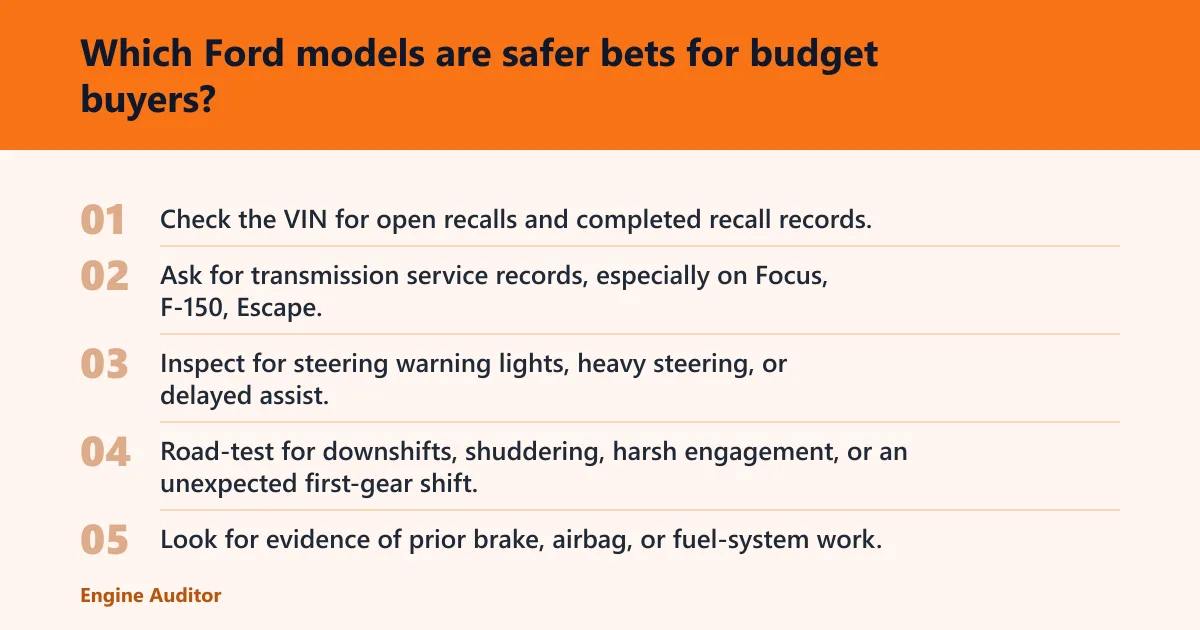
Budget buyers should focus on later, cleaner model years within a nameplate rather than assuming every older Ford is a bargain. Newer does not always mean safer, but a model-year run without major complaint clusters, major recalls, or repeat transmission issues is a better starting point than a discounted problem year.
How to separate safer years from risky ones
Start with the exact model year, then check complaint patterns for the common failure modes: transmission, steering, brakes, airbags, and fire risk. Ford’s current or recent inventory includes the Bronco Sport, Explorer, Mustang Mach-E, Escape, Maverick, Ranger, Expedition, and Mustang. That range is broad, so model-year screening still matters.
Why newer does not always mean safer
A newer vehicle can still inherit an early-production defect. A lower-mileage vehicle can still have a recall open. Age and mileage matter, but they do not cancel a model-year flaw. For budget buying, the goal is not the newest Ford available. It is the year least likely to create repeat repair bills.
What to verify on any used Ford
- Check the VIN for open recalls and completed recall records.
- Ask for transmission service records, especially on Focus, F-150, Escape, and Explorer listings.
- Inspect for steering warning lights, heavy steering, or delayed assist.
- Road-test for downshifts, shuddering, harsh engagement, or an unexpected first-gear shift.
- Look for evidence of prior brake, airbag, or fuel-system work.
Picture a buyer comparing two used F-150s with the same price. One is a 2013 truck with vague recall history and a hard downshift on the test drive. The other is a later year with service records and no open recalls. The second truck may cost a little more up front, but the first one is more likely to turn into shop time.
Which Ford models are safest from expensive transmission repairs?
The safest Ford models from expensive transmission repairs are the used years without a known complaint cluster, especially those that do not sit inside a documented problem range like the 2012-to-2016 Focus automatic-transmission years. The best buy is usually the specific year with clear records, not the cheapest car on the lot.
For buyers on a budget, a clean title and good service history are not enough by themselves. Match those documents with a calm road test, no warning lights, and no sign of harsh shifting or delayed engagement. If the seller cannot explain the exact model year and its recall status, keep shopping.
Frequently asked questions
Which Ford models have the highest repair costs?
The highest repair costs usually show up in Ford years with repeat transmission, steering, or safety-defect complaints. The 2013 F-150, 2002 Explorer, 2012 Focus, and 1997 F-150 are the clearest examples here. They combine expensive failure modes with recall or investigation history, which raises ownership risk.
Which used Ford years should I avoid?
Start by avoiding the years with known defect clusters: 2013 F-150, 1997 F-150, 2002 Explorer, and 2012 Focus. Also avoid any used Ford with open recalls, missing service history, or a test-drive symptom such as hard shifting, steering heaviness, or brake warning lights.
Is the Ford Focus a bad buy because of transmission problems?
Yes, the 2012 Focus is a risky buy if you want low repair costs. It sits in the 2012-to-2016 automatic-transmission problem range, and owners also reported power steering seizing or becoming unresponsive while driving. That combination makes the car more likely to need costly diagnosis and repair.
What Ford Explorer years are the most unreliable?
The 2002 Explorer stands out because it has more than 1,500 NHTSA complaints about its powertrain alone, plus airbag, steering, suspension, structure, and rear window glass reports. That does not make every Explorer bad, but it makes the 2002 model year a poor budget buy.
How do I tell if a used Ford has had recall work done?
Ask for repair invoices, not a verbal promise. Then check the VIN against recall records and look for paperwork that names the exact recall and the completed remedy. If the seller cannot produce proof, assume the work may be incomplete and price the car as if the defect still matters.
Are newer Ford trucks more reliable than older ones?
Often yes, but not always. Newer trucks can still have early-production defects or unresolved recalls, while older trucks can be either solid or costly depending on the exact year. The right question is not “new or old?” It is “which model year had the fewest complaint patterns and the cleanest recall history?”
Which Ford models are better for budget-conscious buyers?
Budget-conscious buyers should focus on Ford years outside the known problem windows and verify recall completion before purchase. A safer pick is one with documented service history, no open recalls, and a road test that does not reveal harsh shifting or steering trouble. That approach beats chasing the lowest sticker price.
Products related to this article
Sponsored / affiliate links. As an Amazon Associate I earn from qualifying purchases. I may earn additional commission from eligible campaigns.