Gear Ratio Calculator: Pick the Right Ratio
Use a gear ratio calculator to match engine RPM to tire size and transmission overdrive. A taller ratio lowers cruising RPM, while a numerically higher ratio raises torque and crawl control. Pick the wrong ratio and you can lose highway comfort, towing pull, or off-road control while wasting fuel. This guide shows how to calculate RPM and speed, then compare highway, towing, off-road, and larger-tire setups side by side.
How is this calculated?
Press Calculate to see the math with your numbers.
What gear ratio means

Gear ratio is the output gear teeth divided by the input gear teeth. It can be written as a fraction, a decimal, or a colon format such as 2:5. It is dimensionless, and ratios below 1.00:1 are overdrive.
Higher numerical ratios multiply torque more and raise engine speed at the same road speed. Lower numerical ratios do the opposite. That is why a 4.10 axle feels stronger off the line than a 3.73, while a 0.70 top gear can calm highway RPM.
Axle ratio versus transmission ratio
Axle ratio is the rear-end ratio in the ring and pinion set. It works with tire diameter, road speed, and engine RPM. Common truck ratios include 3.21, 3.42, 3.55, 3.73, and 4.10.
Transmission ratio matters too. A truck in top-gear overdrive, such as 0.70 or 0.63, will cruise at a different RPM than the same truck in direct drive. If you leave transmission ratio out, the result will be wrong.
How to calculate RPM and speed
For truck gearing calculators, the common relationship is RPM = MPH × tire diameter × transmission ratio × 336 ÷ axle ratio. Rearranged for axle ratio, the formula is RPM × tire diameter ÷ (MPH × transmission ratio × 336). Speed can also be solved from the same parts.
The constant 336 appears in many calculators because it folds unit conversion into one number. TREMEC notes that its calculator can determine vehicle speed in any gear and any engine RPM, and Spicer Parts includes transmission gear ratio, tire height, MPH, and ring gear and pinion ratio in its calculator inputs.
Solving for RPM versus solving for mph
Use RPM when you want to know highway cruise speed or whether a gear choice keeps the engine in a target band. Use mph when you want to know how fast a given engine speed will move the vehicle in a chosen gear. Tire diameter should be entered in inches for these examples.
- Choose tire diameter in inches.
- Pick the axle ratio and transmission ratio you will actually use.
- Enter road speed or engine RPM.
- Apply the formula and compare the result with your target.
What gear ratio do you need for your use case?

The right ratio depends on the job. Highway use favors lower engine speed and relaxed cruising. Towing, drag racing, and off-road use usually need more torque multiplication, higher RPM at speed, or both.
If you choose from nearby ratios, think in terms of use case first and math second. The closest available axle ratio is often the best answer, but the right choice is the one that fits your tire size, overdrive, and driving pattern.
Highway cruising targets
For highway use, a common aim is to keep cruise RPM in a comfortable band in top gear, especially with overdrive. A numerically lower axle ratio, such as 3.21 or 3.42, often fits this role when tire diameter is moderate and the engine does not need extra load support.
Towing and load-carrying targets
For towing, a 3.73 or 4.10 axle usually makes more sense than a taller ratio because it reduces the strain of holding speed on grades. The engine can stay in a more useful part of its power range, and the transmission does not need to downshift as often.
Off-road and low-speed control
For off-road use, a numerically higher axle ratio helps slow vehicle speed while keeping engine output in a usable range. That gives better throttle control in loose terrain, steep climbs, and tight obstacles. The same setup can feel busy on pavement, so the tradeoff is clear.
Drag strip and acceleration bias
For drag racing, the goal is usually quick acceleration and strong launch behavior, not low cruise RPM. A shorter ratio helps the engine get into its power band sooner. Tire diameter still matters, because a larger tire softens the effective gearing and can dull the launch.
Axle ratio and tire size decision table
This table gives a practical starting point. Use it to narrow the choice before you run a calculator with your exact vehicle, transmission, and tire measurements.
| Tire diameter | Overdrive ratio | Axle ratio | Typical use case | What it feels like |
|---|---|---|---|---|
| 31 inches | 0.70 | 3.21 | Mostly highway, light load | Low cruise RPM, least pull in top gear |
| 33 inches | 0.70 | 3.42 | Mixed use with modest towing | Balanced cruise and pull |
| 33 inches | 0.70 | 3.73 | Towing, mixed highway, larger cargo | Stronger response, higher RPM than 3.42 |
| 35 inches | 0.70 | 3.73 | Daily driving with mild off-road use | Acceptable cruise, but feels taller than stock |
| 35 inches | 0.63 | 4.10 | Towing, heavy vehicle, off-road bias | Best pull of the examples shown here |
| 37 inches | 0.63 | 4.10 | Heavy build, low-speed control, steep terrain | Still taller than many factory setups |
At 65-70 mph, the difference between 3.73 and 4.10 is easy to feel. Using a 33-inch tire and a 0.70 overdrive, 3.73 works out to about 1,730 RPM at 65 mph and about 1,860 RPM at 70 mph. With 4.10 gears, that setup is about 1,900 RPM at 65 mph and about 2,045 RPM at 70 mph.
That spread is small enough to keep both ratios in the same conversation, but large enough to change drivability. If you want quieter highway behavior, 3.73 leans that way. If you want more pull on grades or with a trailer, 4.10 is the stronger choice.
How bigger tires change effective gearing
Larger tires reduce effective gearing if the axle gears stay the same. The vehicle acts as if the axle ratio were numerically lower, because the engine must turn farther to move the same distance. This is why a tire swap can make a truck feel lazy even when the axle ratio has not changed.
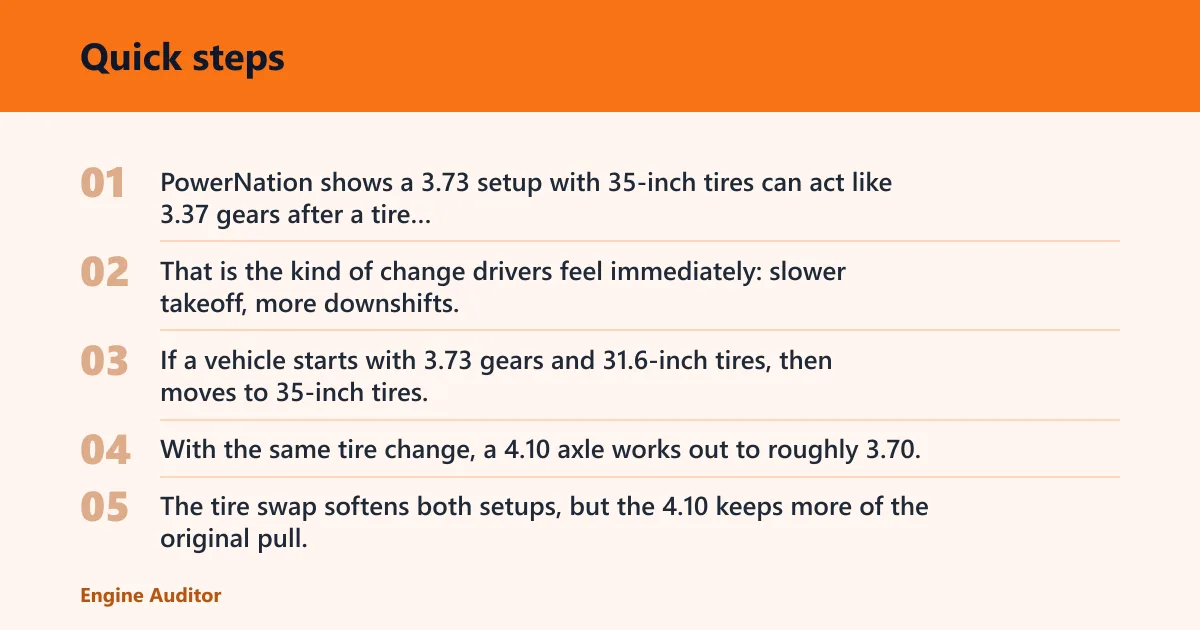
PowerNation shows a 3.73 setup with 35-inch tires can act like 3.37 gears after a tire swap. That is the kind of change drivers feel immediately: slower takeoff, more downshifts, and less reserve at highway speed.
31.6 inch to 35 inch comparison
If a vehicle starts with 3.73 gears and 31.6-inch tires, then moves to 35-inch tires, the effective ratio works out to about 3.37. With the same tire change, a 4.10 axle works out to roughly 3.70. The tire swap softens both setups, but the 4.10 keeps more of the original pull.
That is the practical meaning of effective gear ratio. The number does not change inside the axle, but the road feel does.
How to estimate the new effective ratio
Use this quick estimate: new effective ratio = old axle ratio × old tire diameter ÷ new tire diameter. A move from 31.6 to 35 inches is about a 10 percent increase in tire size, so the gearing feels about 10 percent taller.
Say your truck had 3.73 gears and felt fine on 31.6-inch tires. After a change to 35s, the same truck may hunt between gears on hills. That is a sign the axle ratio is now too tall for the new tire size and driving load.
When a re-gear makes sense
A re-gear makes sense when the tire swap pushes cruise RPM too low, increases downshifts, or weakens launch feel more than you want. The ring and pinion are the rear differential gear set, so a ratio change there is the usual fix when the tires get larger.
Use the calculator before buying parts. It is often cheaper to confirm the needed axle ratio once than to correct a guess after the truck feels wrong.
What goes wrong in gear calculations?
Most bad results come from three mistakes: leaving out overdrive, using the wrong tire diameter, or flipping the tooth-count order in the gear ratio formula. Any one of those errors can send the answer far from the real driving result.
Ignoring overdrive
If you calculate RPM with axle ratio and tire diameter only, the answer will be too high for highway use. The transmission ratio must be included. A 0.70 or 0.63 top gear can cut cruise RPM enough to change which axle ratio is the better choice.
Using the wrong tire diameter
Do not use the sidewall label as if it were the true tire diameter. A 35-inch tire is often a size label, not the exact measured diameter under load. For calculator work, use the actual diameter in inches whenever you can.
Mixing up driven and driver teeth
Another common error is swapping the gear teeth order. Omni Calculator defines gear ratio as output gear teeth divided by input gear teeth. If you reverse that order, the result will be inverted, and a numeric ratio like 4.10 may look like 0.24 instead.
Frequently asked questions
How do I calculate gear ratio?
Use output gear teeth divided by input gear teeth, then express the result as a fraction, decimal, or colon format. For vehicle use, fold that into axle ratio, tire diameter, and transmission ratio so you can see what happens at road speed rather than only at the gear set.
What RPM will I have with this gear ratio and tire size?
Multiply MPH by tire diameter and transmission ratio, then by 336, and divide by axle ratio. If you are checking highway behavior, use the top-gear overdrive ratio, not just the axle ratio, or the RPM estimate will be too high.
What is the difference between 3.73 and 4.10 gear ratio?
4.10 is numerically higher, so it gives more torque multiplication and higher RPM at the same speed. At 65-70 mph, the difference is noticeable but not huge. For highway comfort, 3.73 is calmer; for towing and load carry, 4.10 gives more reserve.
What is a good diff ratio for highway use?
A good highway diff ratio is the one that keeps cruise RPM where your engine is comfortable in top gear. For many trucks with overdrive, 3.21, 3.42, or 3.55 suits light-duty highway use, while 3.73 is often the better choice once tire size or load rises.
How does tire diameter change effective gear ratio?
When tire diameter increases, effective gearing gets numerically lower. The formula is old axle ratio × old tire diameter ÷ new tire diameter. That means a 3.73 setup on 35-inch tires can feel closer to 3.37, which is why bigger tires often call for a re-gear.
Does transmission ratio matter when picking axle gears?
Yes. Transmission ratio changes engine RPM at a given road speed, and top-gear overdrive can shift the best axle choice by a full step. A setup that seems tall on paper may drive fine with a 0.63 or 0.70 overdrive, while the same axle ratio in direct drive may feel too short.
Products related to this article
Sponsored / affiliate links. As an Amazon Associate I earn from qualifying purchases. I may earn additional commission from eligible campaigns.