What Is a Hybrid Vehicle Type? How It Compares to Gas Cars
A hybrid vehicle type is a car that pairs a gasoline engine with one or more electric motors. The closest match to a gas car is usually a mild hybrid, while full and plug-in hybrids change fuel use and ownership costs more. Miss those differences and you can pay extra for mpg you will not use, or pick a hybrid that does not fit your driving habits. This guide compares hybrid types with conventional gas cars and shows which is closest to the driving feel and cost structure you want.
How hybrid power sources work together on the road
A hybrid vehicle uses two power sources: an internal-combustion engine and an electric motor. It stores electricity in a traction battery and can use the engine, the motor, or both depending on speed, load, and battery state. Most hybrids typically do not need a plug. (Caranddriver)
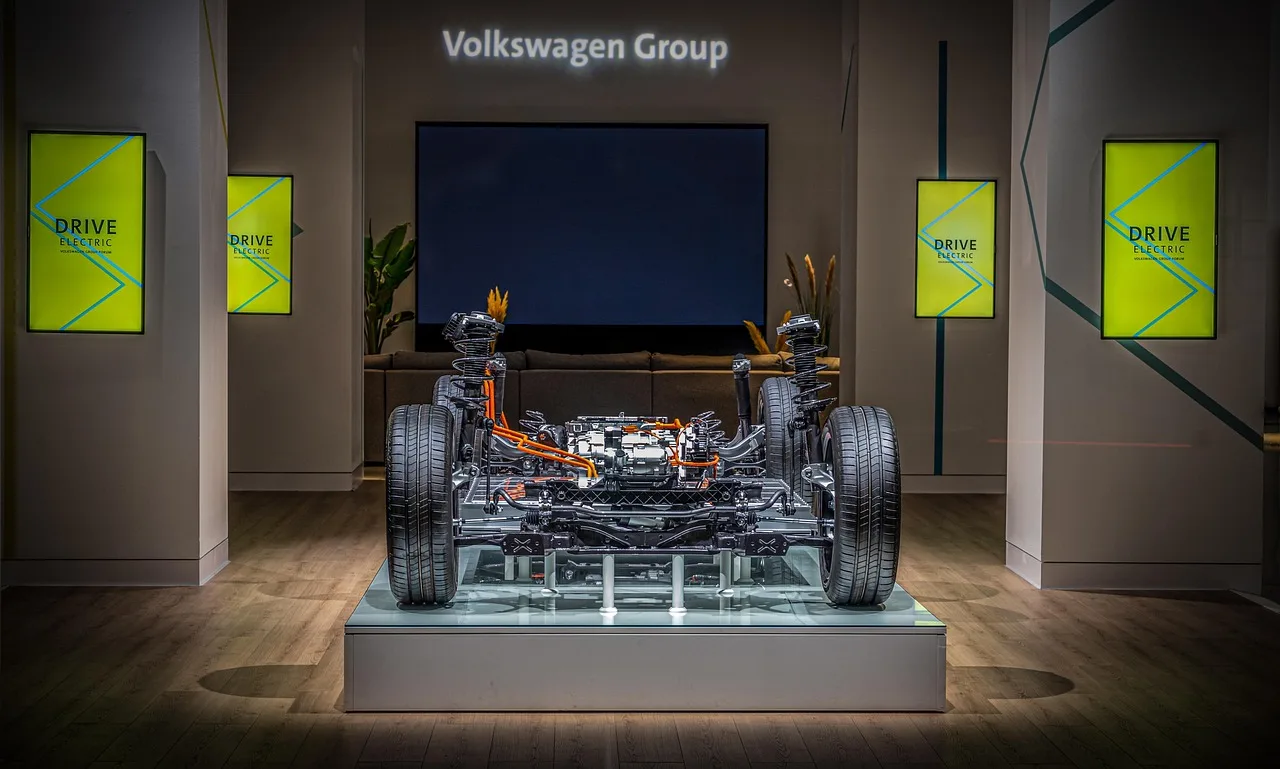
How the parts work together
The electric motor helps at low speeds, during launch, and in stop-and-go traffic. The internal-combustion engine usually takes over more often at higher speeds or when more power is needed. The traction battery holds the energy that the motor uses, and most hybrids refill it through regenerative braking and engine operation.
That setup matters because hybrid is not one fixed behavior. A full hybrid can move on electric power for short stretches, while a mild hybrid mainly smooths the engine’s work. A PHEV goes further and can run for a limited distance on electricity alone before acting like a normal hybrid.
Why most hybrids do not need charging
Most hybrids recharge themselves while you drive. Regenerative braking and engine-driven charging keep the battery in range, so you usually do not plug in. Most hybrids cannot be charged from an external source unless they are designed to do so.
📊 Hybrid batteries vary in size, and many are larger than 1 kWh. Source: Caranddriver.
How is a hybrid car different from a gas car?
A gasoline car depends entirely on gasoline for propulsion and uses one power source. A hybrid car adds an electric motor and a traction battery, so the drivetrain can share the load. That difference changes fuel use, low-speed behavior, and some maintenance items, especially over long ownership.
Single-power versus dual-power driving
A gas car sends all motive work through the engine. A hybrid can let the motor handle brief, low-speed work, then bring in the engine when the car needs more power. In U.S. usage, hybrids use both an internal-combustion engine and an electric motor.
That is why many hybrids feel familiar in normal traffic. They still have a fuel tank and still use gasoline, but they can shut the engine off more often, restart it smoothly, and recover energy during slowing. The result is usually better city fuel economy than a comparable gas car.
Maintenance differences that matter
A gas car still has the traditional maintenance list: oil changes, spark plugs, and other engine-related service. A hybrid keeps many of those items, but brake wear can be lower because regenerative braking does part of the slowing work. The trade-off is that hybrid-specific repair risk can be higher if battery or power electronics fail out of warranty.
Do not assume a hybrid always has lower maintenance. It can reduce brake wear, but it also adds battery aging and more complex components. For a short ownership period, that extra complexity may not pay back before you sell the vehicle.
How regenerative braking works
Regenerative braking captures energy when the vehicle slows down and sends that electricity back to the traction battery. The electric motor acts as a generator during deceleration, then the friction brakes take over for harder stops or when stronger braking is needed. Most hybrids use this system.
What changes behind the pedal
When you lift off the accelerator, the car can slow with the motor helping to recharge the battery. That is why city driving often favors hybrids. Frequent stops give the system repeated chances to recapture energy that a gas car would normally waste as heat.
Picture a 12-mile commute with six stoplights and a few parking-lot starts. A hybrid can recover a small amount of energy each time it slows. On a steady highway commute, there are fewer braking events, so the advantage shrinks.
Main hybrid types
Hybrid types differ in how they route power. Some behave very much like a gas car with extra help. Others lean on electric drive more often and change the ownership math more noticeably. The main types are parallel, series, power-split, mild hybrid, and PHEV.
| Type | How it drives | Closest feel to a gas car? | Typical trade-off |
|---|---|---|---|
| Parallel hybrid | Engine and motor can drive the wheels together or independently; often uses a conventional automatic or CVT. | Yes, usually | Strong everyday familiarity, good fuel savings in traffic. |
| Series hybrid | Wheels are driven by an electric motor; the engine acts as a generator. | Less so | Electric-drive feel, but the engine may run mainly as a generator. |
| Power-split hybrid | Blends engine and motor power through a planetary gearset and an electronically controlled CVT-like system. | Moderately | Very efficient around town, less conventional engine behavior. |
| Mild hybrid | Uses a smaller battery and motor, usually a 48-volt generator; cannot propel the vehicle on electric power alone. | Most like a gas car | Small fuel savings, low learning curve. |
| PHEV | Can be charged externally and offers electric-only range before operating like a regular hybrid. | Least like a gas car when charged | Best if you can plug in and use the electric range. |
Parallel hybrid
Parallel hybrids are one common type. They let the engine and motor work together, or separately, so the car can behave very much like a conventional automatic in daily use. This is the category most shoppers are thinking of when they say “hybrid car.”
High-volume examples often cited include the Toyota RAV4 and Ford Maverick. In this layout, the driving feel stays close to a gas car, but the system can shut the engine off sooner and use the motor for short assist.
Series hybrid
Series hybrids use a primary drive motor and an engine-driven generator. The engine does not directly drive the wheels in the usual sense; it makes electricity for the motor. Some are described as extended-range EVs in certain contexts.
Some mainstream hybrids, including the Honda Accord, Civic, and CR-V, are discussed in this family, though their systems can also include direct mechanical drive. The feel can be less like a standard gas car because the engine’s role is more indirect, especially when the car is using the motor to move the wheels.
Power-split hybrid
Power-split hybrids use a planetary gearset to blend power from the engine and motor. The system behaves like an electronically controlled CVT-like setup, which lets the drivetrain move between electric help, engine power, and both together with little driver input.
This type can deliver strong city fuel economy because the system can keep the engine in a useful range and lean on the motor when traffic slows. The driving feel is still familiar, but the transmission behavior is less conventional than a standard automatic.
Mild hybrid
Mild hybrids use a smaller battery and electric motor, usually a 48-volt generator. They cannot supply enough power to propel the vehicle on their own, so they still drive like gas cars for almost every mile. The motor mainly smooths starts, adds small assist, and supports stop-start operation.
If you want the closest thing to a gas car with a little efficiency gain, this is often the easiest transition. The fuel savings are usually smaller than a full hybrid, but the ownership experience stays simple.
Plug-in hybrid electric vehicle
A PHEV can be charged from an external power source and offers electric-only range before it behaves like a regular hybrid. Depending on the model, that electric-only range can be between 20 and 60 miles. Once the battery is used up, the vehicle runs like a hybrid. (Motortrend)
This is one of the least gas-car-like hybrid options when you can charge at home or work and keep trips inside the electric range. Without regular charging, though, a PHEV can become a heavier, more expensive hybrid with less payoff.
What kind of battery does a hybrid use?
A hybrid uses a traction battery for propulsion support, not the small starter battery found in a conventional car. Hybrid batteries vary in size, and many are larger than 1 kWh. Most hybrids recharge through driving, not plugging in.
Battery size and charging behavior
Because the battery is small compared with an EV pack, it is meant to move energy in short bursts rather than store a long electric range. Regenerative braking and engine operation keep it charged in normal use. PHEVs are the exception because they can also charge from an external power source.
- Use a gas car if you drive very little, keep the car only a few years, or mostly rack up highway miles with few stops.
- Choose a mild hybrid if you want the closest driving feel to a gas car and only want a modest fuel-economy bump.
- Choose a full hybrid if your driving includes regular city traffic, stoplights, and repeated braking.
- Choose a PHEV if you can charge regularly and many trips fit inside its electric-only range.
Hybrid and gas car decision table
This table turns driving patterns into a practical starting point. Annual mileage and commute type can help frame the choice, but they are only part of the picture. Stop-and-go driving gives hybrids more chances to recover energy, while highway-heavy driving reduces the gap.
| Driving profile | Annual mileage band | Commute type | Best powertrain choice | One-line reason | Likely fuel or cost trade-off |
|---|---|---|---|---|---|
| Low-mileage owner, short commute | Under 8,000 miles | Mixed, with some city driving | Gas car | Fuel savings are often too small to repay a higher purchase price soon. | Lower upfront cost; weaker fuel savings over 5 to 10 years. |
| City commuter, frequent stops | 8,000 to 15,000 miles | Mostly city | Full hybrid | Regenerative braking and low-speed motor assist matter most here. | Higher purchase price, better fuel economy, often lower brake wear. |
| Highway-heavy commuter | 12,000 to 18,000 miles | Mostly highway | Mild hybrid | The car still feels conventional, and the smaller efficiency gain may be enough. | Small mpg gain without the bigger premium of a full hybrid. |
| Long-distance driver who can plug in | 12,000 to 20,000 miles | Short daily trips plus overnight charging | PHEV | Electric-only miles can cover the commute before the engine is needed. | Lowest fuel use if you charge often; higher purchase price and more complexity. |
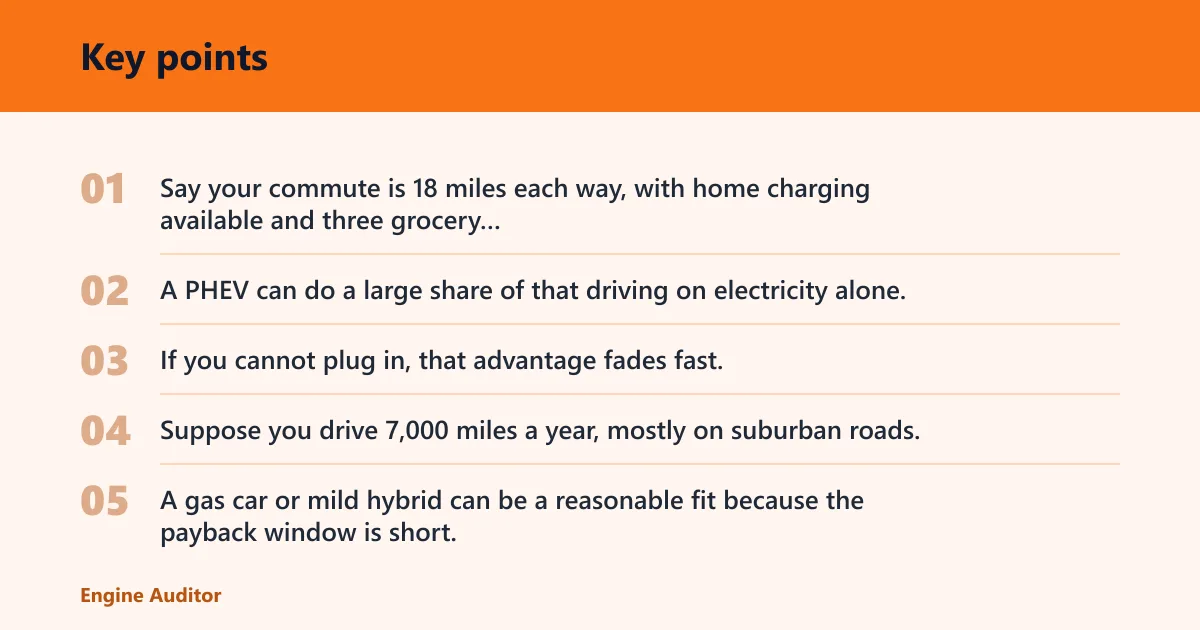
Say your commute is 18 miles each way, with home charging available and three grocery trips a week inside that same range. A PHEV can do a large share of that driving on electricity alone, which can cut gasoline use sharply. If you cannot plug in, that advantage fades fast.
Suppose you drive 7,000 miles a year, mostly on suburban roads, and plan to keep the car for three years. A gas car or mild hybrid can be a reasonable fit because the payback window is short. A full hybrid may still be fine, but the premium may be harder to recover before you sell.
Frequently asked questions
What is a hybrid vehicle type?
A hybrid vehicle type is a car that uses both an internal-combustion engine and an electric motor. The car stores electricity in a traction battery and usually recharges it through driving, not a plug. Different hybrid types change how much the car feels like a conventional gas car.
Do hybrid cars need to be plugged in?
Most hybrids do not need to be plugged in because they recharge themselves through regenerative braking and engine operation. Only plug-in hybrids need external charging to use their electric-only range. If you never plug in a PHEV, you give up much of its advantage.
What are the main types of hybrid vehicles?
The main types are parallel hybrids, series hybrids, power-split hybrids, mild hybrids, and plug-in hybrid electric vehicles. They differ in how the engine and motor share propulsion. Mild hybrids are the closest to gas cars, while PHEVs change the driving and charging pattern the most.
Is a hybrid better than a gas car for city driving?
Usually yes, because city driving gives the hybrid more stop-and-go braking events and more chances to recover energy. That is where regenerative braking and low-speed motor assist pay off most. Highway-heavy drivers usually see a smaller gap, so the extra cost is harder to justify.
What is the difference between a hybrid and a plug-in hybrid?
A regular hybrid uses its battery without external charging and typically runs like a gas car with electric assistance. A plug-in hybrid has a larger battery, can charge from an external power source, and can drive 20 to 60 miles on electricity alone before acting like a regular hybrid.
Products related to this article
Sponsored / affiliate links. As an Amazon Associate I earn from qualifying purchases. I may earn additional commission from eligible campaigns.