Car Overheats in Traffic: Why It Happens
If your car overheats in traffic but not on the highway, check the cooling fans, fan relays or fuses, condenser or radiator blockage, and coolant level first. If the temperature rises only at idle and drops once moving, airflow is the first suspect. Ignore it, and you can warp the head, blow the gasket, or end up stranded in stop-and-go traffic. This guide gives a quick decision tree for fan control, pressure cap, thermostat, water pump, radiator flow, and air trapped in the system.
Traffic overheat decision table

This table is the fastest way to sort a traffic-only overheat. Match the symptom pattern first, then decide whether you can limp to a shop or should stop driving now.
| Symptom pattern | Most likely subsystem | Quick driveway check | What changes at highway speed | Drive, limp, or tow |
|---|---|---|---|---|
| Temperature climbs at stoplights, then drops as soon as the car moves | Fan failure | With the engine at operating temperature, turn the A/C on and listen for the electric fan; confirm airflow at the radiator | Outside air at road speed cools the radiator better than still air | Limp only if the gauge stays in the safe range; tow if it keeps climbing in traffic |
| Fan never runs, or runs only after a bump or after cycling the A/C | Relay or wiring fault | Swap the fan relay in the underhood fuse box with an identical relay if available; check fuse and connector condition | More air through the grille can hide a control-side failure while moving | Limp if temperature stays controlled; tow if the fan still will not come on |
| Heater output turns weak, reservoir is low, or gauge jumps after a service | Low coolant or air pocket | Check the reservoir when cold, not hot; look for obvious leaks and fill only to the marked line | Road speed can mask a small air pocket until idle heat soak builds | Tow if the level keeps dropping or the gauge surges sharply |
| Overflow, coolant smell, or boil-over after shutdown | Radiator cap failure | Inspect the cap seal, spring, and neck for damage; replace the cap before expensive diagnosis if it is old or suspect | A weak cap can still seem fine at speed, then boil over when heat soak peaks in traffic | Limp only after cooldown and only if the level remains stable; otherwise tow |
| Temperature climbs most on hot days, with A/C on, or in bumper-to-bumper traffic | Blocked radiator or condenser | Check fin condition, bugs, leaves, bent fins, and packed debris between the condenser and radiator | Highway airflow can force enough air through a partly blocked core to hide the fault | Limp if the gauge stays controlled; tow if the gauge rises quickly |
| Gauge rises slowly, then spikes under load at idle | Thermostat issue | Watch for a late-opening or stuck-closed thermostat pattern; upper hose may stay cooler longer than expected | Higher road speed may delay the spike but does not fix restricted coolant flow | Tow if it overheats fast or repeatedly; do not keep pushing it |
| Idle heat gets worse over time, especially with a steady coolant level | Water-pump wear | Look for belt issues, seepage, bearing noise, and weak circulation; impeller erosion can reduce flow | At speed, extra airflow and rpm can partially cover reduced pump output | Tow if the gauge continues to rise after cooldown or coolant circulates poorly |
Why it overheats in traffic
If your car overheats in traffic but not on the highway, the pattern points first to low-speed airflow. At highway speed, outside air passes through the grille and radiator, so the cooling system gets help it does not get at a stoplight. At idle, the fan must provide most of the radiator airflow.
A properly functioning cooling system should hold safe temperature during normal street driving. When the gauge rises only at stoplights, the weak point is often the fan, the radiator, or the path that air uses to reach them.
The radiator is a heat exchanger, so it depends on air moving across its fins. If the cooling system works fine with a strong breeze through the grille and falls behind without one, the fault usually appears first in traffic and only later in harder driving.
What highway speed changes
Road speed pushes more air through the grille, across the condenser, and through the radiator core. That extra flow can hide a weak fan, a partly blocked core, or a missing shroud because the engine gets enough cooling once the vehicle is moving.
That is why traffic-only overheating is not a random complaint. It is a clue.
What to do right away if the temperature gauge climbs in traffic
If the gauge climbs in traffic, turn off the A/C, set the heater to full hot, and pull over as soon as it is safe. Shut the engine off before the gauge reaches the red zone. Never open a hot radiator cap or reservoir cap.
- Turn off the A/C load.
- Set the heater to full hot and the fan high.
- Move out of traffic and pull over safely.
- Shut the engine off.
- Wait for the engine to cool before touching any cap or hose.
Suppose the gauge climbs at a long red light, then drops once the car starts moving again. That does not prove the problem is harmless. It means the system can cool better with airflow than without it, and the next stop could push it back over the edge.
A common mistake is to open the reservoir cap because the level looks low. Do not do that while hot. A pressurized cooling system can spray scalding coolant and steam.
Can a bad cooling fan cause this?
Yes. A bad cooling fan can cause overheating only in traffic because the fan has to do most of the work at idle. If the fan does not move enough air when the engine is hot, the gauge climbs at stoplights and falls again once road speed restores airflow through the radiator.
Electric fan versus mechanical fan
An electric cooling fan should run when the engine reaches operating temperature or when the A/C demands extra cooling. A mechanical fan should still pull air at idle, usually with help from a clutch if the design uses one. In either case, the fan must move air in traffic.
If your vehicle has an electric fan, the fault can be in the fan motor itself or in the control side that tells it to run. Those are different repairs. A dead motor, a blown fuse, a bad relay, a wiring fault, or a failed command signal do not lead to the same parts list.
A/C on test at operating temperature
The A/C on test is useful because it loads the cooling system and on many vehicles can help trigger fan operation. With the engine at operating temperature, turn the A/C on and watch for fan operation. If the fan still does not run immediately, suspect a motor, relay, fuse, wiring, or control fault, but note that some vehicles use a different fan strategy and may not respond the same way.
The fan relay swap test uses the underhood fuse box. If an identical relay is available, swapping it can separate a failed relay from a fan-motor problem. Relay replacement is estimated at $10–$25, while fan motor replacement is estimated at $150–$400; prices can vary widely by vehicle and region.
Could low coolant be the cause?
Yes. Low coolant can make a car overheat only when stopped because it can create air pockets, and air does not carry heat like liquid coolant does. Check the reservoir when cold. If the level is low, top-off alone is not enough unless you also find the leak or the source of the loss.
Cold reservoir check
Check the reservoir only when the engine is cold. A hot system can give a false read and can be dangerous to open. If the reservoir is low, inspect hoses, the radiator, the water pump area, and the underside of the vehicle for fresh wetness or dried coolant residue.
Wrong mix can also reduce cooling efficiency. Coolant that is too weak can lower boiling protection and make traffic heat soak worse. If the system has been serviced recently, an air pocket after the refill is a common suspect.
Air pockets after a leak or service
An air pocket can sometimes show up after a hose replacement, thermostat job, radiator repair, or simple top-off. The engine may run normal at speed, then surge hot at idle because the pump is moving a mix of coolant and trapped air instead of a full liquid column.
What else blocks cooling at low speed?
Low-speed overheating is often an airflow-path problem, not just a bad radiator. The radiator, condenser, shroud, grille openings, seals, and baffles all matter. If air bypasses the core, the fan can spin and still fail to cool the engine.
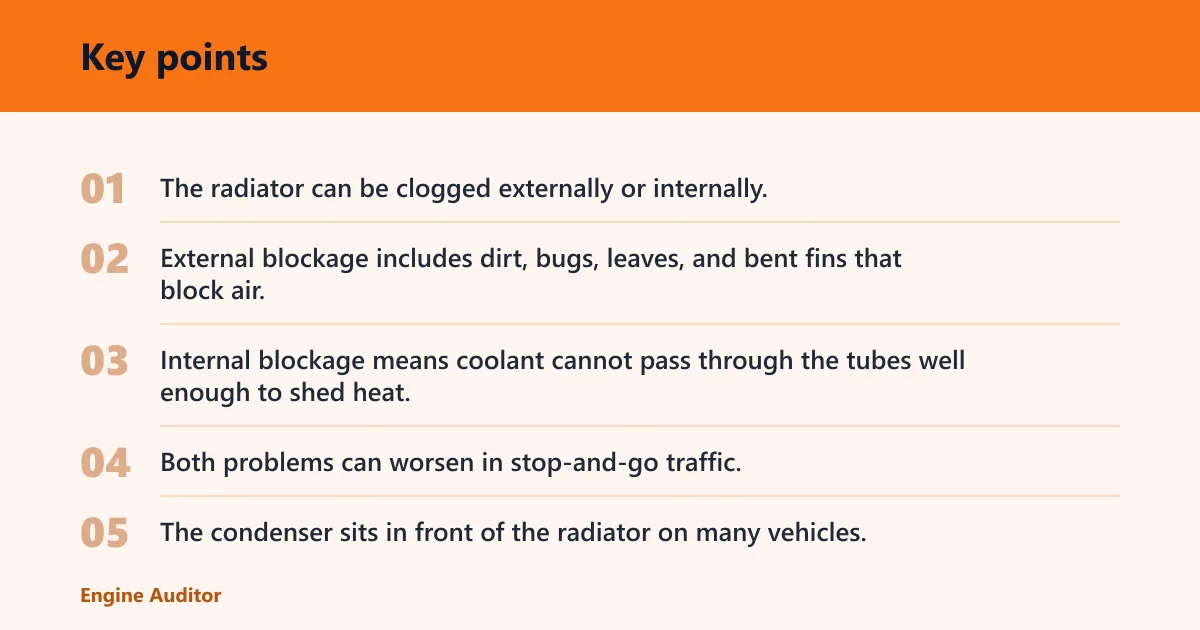
Radiator fin blockage
The radiator can be clogged externally or internally. External blockage includes dirt, bugs, leaves, and bent fins that block air. Internal blockage means coolant cannot pass through the tubes well enough to shed heat. Both problems can worsen in stop-and-go traffic.
The condenser sits in front of the radiator on many vehicles, so heat soak from the A/C system can load the cooling stack on hot days. That is why idle overheating may be worse with the A/C on, even if the vehicle feels fine once it reaches road speed. (Firestonecompleteautocare)
Shroud, seal, and air-dam gaps
Missing shrouds, torn seals, damaged baffles, or a missing air dam can let air bypass the radiator instead of passing through it. That matters most at idle, when the fan has to pull air through the full stack. A bad fan shroud can make a good fan act weak.
Picture a sedan that idles cool for ten minutes in cool weather but climbs fast on a 95°F day with the A/C on. If the radiator face is partly blocked with debris and the lower shroud is missing, the fan may be working but losing the fight to bypass air and heat soak.
What the thermostat, water pump, and cap do
The thermostat, water pump, and radiator cap each fail in a different way. A stuck-closed or opening-late thermostat blocks coolant flow to the radiator. A worn water pump reduces circulation. A weak radiator cap lowers system pressure and can cause boil-over or overflow.
Stuck-closed or late-opening thermostat
A thermostat that opens late can contribute to rapid overheating, especially after a cold start or during slow traffic. Because it affects coolant flow to the radiator, the engine may rise hot faster than the fan can compensate. Thermostat replacement is estimated at $15–$40 for the part; prices can vary widely by vehicle and region.
Water-pump wear and impeller erosion
The water pump circulates coolant. Wear, bearing play, or impeller erosion can reduce flow, and the symptoms can be worse at idle. At highway speed, extra airflow and engine rpm can partly cover the problem. Water pump replacement is estimated at $200–$600; prices can vary widely by vehicle and region.
Radiator cap pressure loss
The radiator cap is a pressure-control component. A healthy cap raises boiling point to approximately 250°F–265°F, and it maintains 13–16 PSI above atmospheric pressure. A failed cap can reduce pressure control, which makes boil-over more likely in traffic.
This is why cap condition matters more than many drivers expect. The cap costs $10–$25 and is recommended before expensive diagnosis when the symptom set points to overflow, coolant smell, or boil-over; prices can vary widely by vehicle and region.
Is it normal for a car to overheat in traffic?
No. A properly functioning cooling system should maintain safe temperature during ordinary street driving. Some vehicles run hotter in slow traffic than they do at speed, but they should not overheat at stoplights as a normal condition. That pattern points to a fault in airflow, coolant level, pressure, or circulation.
AAA says a normal engine temperature is about 195 to 220 degrees Fahrenheit. If the gauge rises beyond its normal range only in traffic, treat it as a warning, not a quirk.
What to do after the engine cools
After cooldown, inspect the reservoir level, radiator neck if equipped and safe to check cold, visible hoses, fan operation, and the front of the radiator and condenser. Look for dried coolant, bent fins, missing shrouds, or debris. Then decide whether the car needs a short limp, a shop visit, or a tow.
- Check the reservoir when cold.
- Inspect the fan blades, shroud, and wiring.
- Look through the grille for blocked fins or debris.
- Check for wet spots, crusty residue, or hose leaks.
- Recheck the symptom only after the cause is addressed.
Do not assume the problem is solved just because the gauge fell once the car started moving again. A temperature drop at speed only shows that road airflow is helping. It does not rule out a failing fan, weak cap, clogged core, low coolant, or a pump that cannot keep up in traffic.
What to do if your car overheats on the highway
If the car overheats on the highway, move to the shoulder safely, turn off the A/C, turn the heater to full hot, and shut the engine off if the temperature continues climbing. Highway overheating is more serious because the cooling system should have more airflow there, so the fault may be larger or more sudden.
Once the engine cools, do not assume a quick restart is safe. Repeated overheating can damage the engine, hoses, radiator, or head gasket. If the gauge spikes again soon after restart, tow it.
Frequently asked questions
Why does my car overheat in traffic?
Traffic overheating usually points to a low-speed airflow problem first. At idle, the fan has to move most of the air through the radiator, condenser, and shroud. If coolant is low, the fan is weak, the radiator is blocked, or the cap is failing, the gauge rises where airflow is weakest.
What should I do right away if the temperature gauge climbs in traffic?
Turn off the A/C, set the heater to full hot, and pull over as soon as it is safe. Shut the engine off before the gauge reaches the red zone. Wait for full cooldown before opening any cap. That sequence limits heat damage and reduces the risk of scalding coolant.
Can a bad cooling fan cause overheating only in traffic?
Yes. A bad cooling fan is a classic cause of traffic-only overheating because idle depends on fan airflow, while highway speed adds outside air through the grille. If the fan does not run with the engine hot and A/C on, suspect the motor, relay, fuse, wiring, or control side.
Can low coolant make a car overheat only when stopped?
Yes. Low coolant can leave the system with air pockets, which reduce heat transfer and circulation. The car may seem fine once moving, then overheat at idle or stoplights. Check the reservoir only when cold, and do not stop at topping off if you have not found the leak.
Is it safe to keep driving if the car cools down once moving again?
Not automatically. Cooling down at speed only means airflow improved, not that the fault is gone. If the gauge rises again in traffic, the issue can still damage the engine, gasket, hoses, or radiator. Limp only if the temperature stays controlled; otherwise stop and tow it.
Products related to this article
Sponsored / affiliate links. As an Amazon Associate I earn from qualifying purchases. I may earn additional commission from eligible campaigns.