Ford Automatic Transmission Slipping: Warning Signs to Watch
A Ford automatic transmission may be slipping when engine rpm rises without a matching increase in road speed, especially if there is flare between shifts, delayed engagement, or repeated gear changes; if it gets worse or the transmission warning light flashes, stop driving. Ignoring it can turn a fluid or sensor fault into clutch damage, overheating, or a full rebuild. This guide shows how to tell slip from low fluid, bad shift solenoids, misfires, torque-converter shudder, and what to check next.
What transmission slipping feels like

- Wide range of brass adapters for import and domestic engines
- High-pressure hose kit with a maximum pressure of 500psi
- Blow molded case included with 6 brass fittings and extension
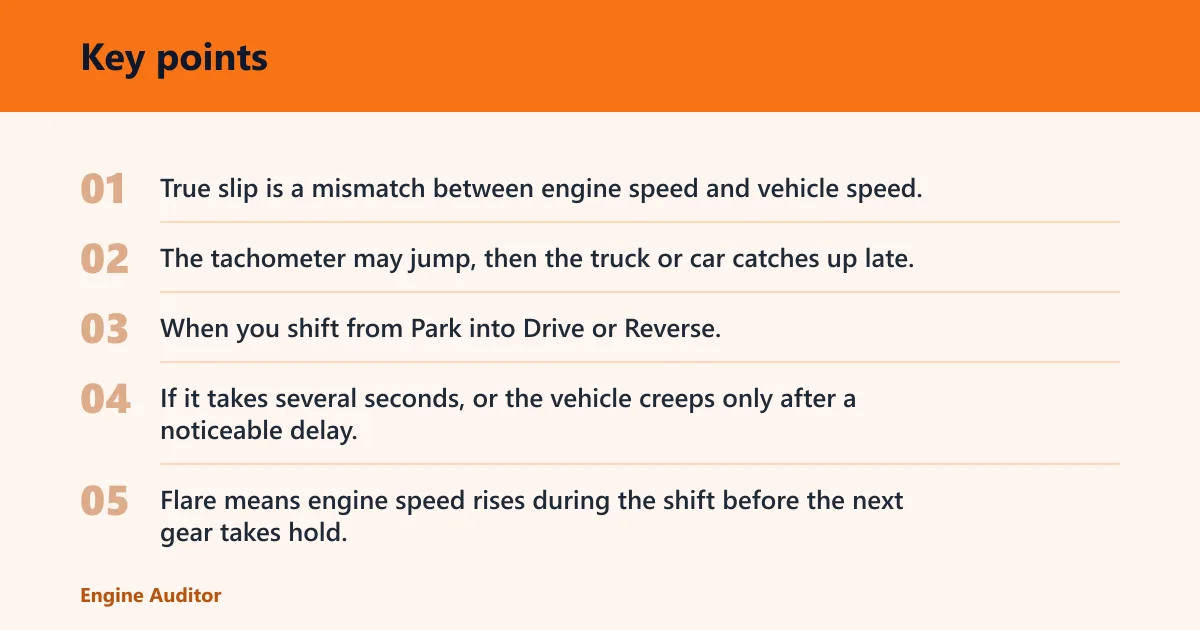
True slip is a mismatch between engine speed and vehicle speed. The tachometer may jump, then the truck or car catches up late, or you may feel a shift pause and then land hard.
Delayed engagement from park or reverse
When you shift from Park into Drive or Reverse, a healthy Ford transmission should engage after a short pause. If it takes several seconds, or the vehicle creeps only after a noticeable delay, that can point to pressure loss, low fluid, a restricted filter, or an internal seal issue.
Flare shifts and rpm jump between gears
Flare means engine speed rises during the shift before the next gear takes hold. That is one of the clearest signs of slip, because the transmission is briefly letting go instead of holding the ratio it was commanded to use.
Loss of drive under load or uphill
If the problem shows up during acceleration, towing, merging, or climbing a grade, the transmission may be slipping under load. That pattern often points to a pressure problem, a failing clutch pack, a torque-converter issue, or heat-related fluid breakdown.
Ford transmission warning signs to watch
Ford warning signs often include a check engine light, a wrench light on some models, PRNDL flashing, or a gear indicator that blanks, jumps, or shows the wrong position. Repeated odd shift timing matters too, especially if the symptom becomes more obvious when hot.
Check engine light, wrench light, and PRNDL flashing
A check engine light can come on for transmission-related faults, but some Ford models also use a wrench light for powertrain issues. PRNDL flashing or a missing gear display can mean the control system has lost confidence in the gear selection, wiring, or sensor input.
Gear-indicator problems and odd shift timing
If the display says one gear while the vehicle feels like another is engaged, scan data becomes important. That mismatch can come from a bad speed sensor, shift solenoid fault, or TCM logic problem rather than worn clutch packs.
Heat-related symptoms and repeated slip
Slip that appears after stop-and-go traffic, a long highway climb, or towing often tracks with high transmission temperature. Heat thins the fluid, raises internal leakage, and can turn a marginal problem into repeated flare or shudder.
How do you tell slip from a lookalike fault?
True transmission slip is not the same as torque-converter shudder, engine misfire, or normal cold-shift behavior. Timing is the fastest clue: torque-converter problems often show up during steady cruise, while misfire feels rough across the whole powertrain and may flash the check engine light.
Torque-converter shudder versus true slip
Shudder feels like a light rumble or vibration, often near lockup at steady speed. True slip usually shows as rpm flare, delayed engagement, or a loss of drive under load. If the problem changes when lockup applies, the torque converter deserves attention before deeper internal work.
Engine misfire or fuel delivery problems
An engine misfire can mimic a slipping transmission because the rpm moves without clean acceleration. The difference is that misfire often comes with rough idle, shaking, or misfire codes, and it affects engine speed even in Park, not only during gear changes.
Cold-start behavior versus hot stop-and-go failure
A Ford that shifts firmly when cold but slips after heat soak or traffic is pointing toward fluid condition, pressure loss, or a control issue that appears when components expand. A cold-only hesitation can be normal strategy on some models, but repeated flare is not.
Say your Ford pulls away from a stoplight in second gear, then the tach jumps from 2,100 rpm to 3,200 rpm on the 2-3 shift while road speed barely changes. That pattern fits true slip better than a rough idle or a one-time flare.
Transmission slip triage table
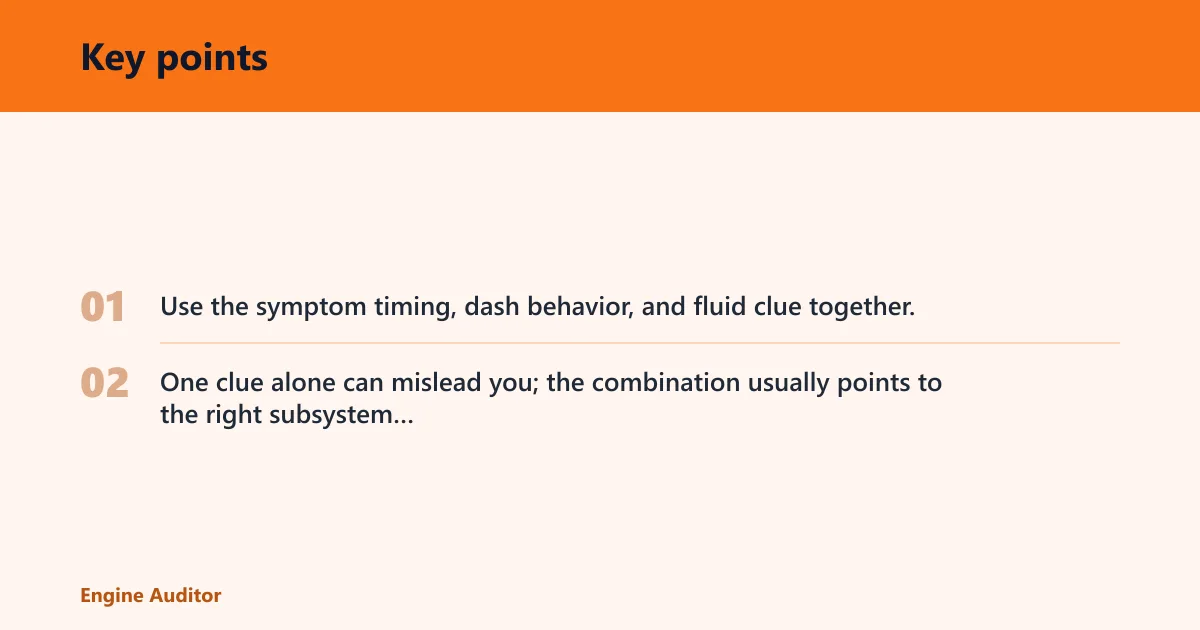
Use the symptom timing, dash behavior, and fluid clue together. One clue alone can mislead you; the combination usually points to the right subsystem and the right urgency.
| Symptom timing | Dash lights | Fluid clues | Likely subsystem | Drive-or-no-drive advice | First diagnostic step |
|---|---|---|---|---|---|
| Cold start, first move from Park | No light or check engine light | Level slightly low, no burnt smell | Fluid level or delayed line pressure | Drive to a shop only if it engages cleanly after the first delay | Check fluid level and for leaks |
| Hot stop-and-go after 20-30 minutes | Wrench light or check engine light | Dark fluid, burnt odor | Overheating, worn clutches, restricted filter | Limit driving; tow if slip repeats | Scan codes and inspect fluid condition |
| During uphill load or towing | Possible PRNDL flash | May be normal color, may foam if overfilled | Torque converter, pressure loss, or clutch wear | Reduce load immediately; tow if drive fades | Read live slip data and temperature |
| Between 2-3 or 3-4 shifts | Check engine light | Fluid may look normal | Valve body or shift solenoid control | Drive lightly only if the problem is brief and rare | Pull transmission codes |
| At steady highway cruise | Check engine light or no light | Fluid usually not the main clue | Torque-converter clutch shudder | Can often drive short distance, but avoid long trips | Check lockup command and shudder data |
| After a recent service | Possible warning light | Wrong ATF type, aerated, or overfilled | Fluid specification or fill issue | Stop if the symptom is severe or getting worse | Verify the exact Ford ATF spec used |
| Intermittent, no clear pattern | PRNDL flashing, gear display faults | May be normal | Wiring, sensor, or TCM fault | Usually driveable only if shifts stay normal; avoid hard use | Check for stored and pending codes |
| Loss of drive in Reverse or Forward | Warning light likely on | Burnt, contaminated, or very low fluid possible | Major internal pressure or clutch failure | Do not keep driving; tow | Stop and inspect fluid, then scan for codes |
Can low fluid cause slipping?
Yes. Low transmission fluid can cause pressure loss, delayed engagement, flare shifts, and slip on a Ford. The first thing to check is whether fluid is present at the correct level and whether there is a leak under the vehicle.
Fluid level checks and leak locations
Look for wet spots under the transmission pan, cooler lines, axle seals, or bellhousing area. A small leak can become a pressure problem once the fluid level drops enough to uncover the pickup during acceleration, braking, or cornering.
Burnt fluid, dark fluid, and contamination
Dark fluid with a burnt smell usually means heat and wear have already started to damage the fluid. Metal debris, clutch material, or a milky look can point to internal wear or contamination, and those clues raise the urgency quickly.
Wrong ATF type and pressure loss
Ford automatics are sensitive to fluid specification. Using the wrong ATF can change friction behavior, shift timing, and lockup feel, and a wrong fill can create symptoms that look like mechanical slip even when the hard parts are still intact.
Suppose a crossover starts slipping after a fluid top-off, and the dipstick or service record shows a generic ATF instead of the Ford-specified fluid. That detail matters, because the wrong fluid can change apply pressure and clutch behavior without any other major fault.
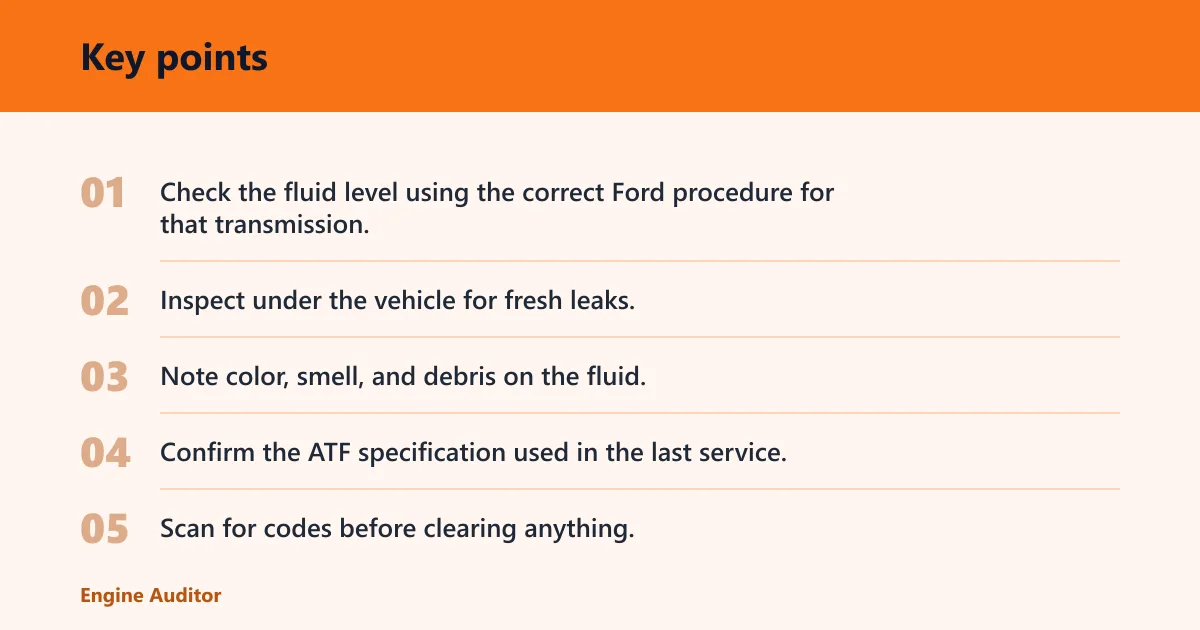
- Check the fluid level using the correct Ford procedure for that transmission.
- Inspect under the vehicle for fresh leaks.
- Note color, smell, and debris on the fluid.
- Confirm the ATF specification used in the last service.
- Scan for codes before clearing anything.
Which parts can cause Ford slip?
Not every slipping complaint comes from worn clutches. A restricted filter, sticky valve body, failing shift solenoid, or TCM issue can all create the same delayed or flare-type symptom by reducing pressure or commanding the wrong gear change.
Transmission filter restriction
A restricted filter limits fluid flow to the pump and valve body. That can lower line pressure, especially when the fluid is hot and thin, and it often shows up as delayed engagement, soft shifts, or slip after a missed service interval.
Valve body and shift solenoids
Sticky valves can block pressure routing, while shift solenoids control which circuits apply. Electrical faults, loose connectors, damaged wiring, or intermittent solenoid failure can produce hesitation and flare that feel mechanical but are actually control related.
Transmission control module and wiring faults
The TCM uses adaptive shift logic, temperature input, and speed sensors to decide how and when to shift. Software faults, corrupted learned values, or wiring problems can cause harsh, delayed, or incorrect shifts, and that is why scan data matters before parts are replaced.
What scan data should you read?
An OBD-II scan tool can pull transmission-related DTCs, freeze-frame data, and live data that may show commanded gear, actual gear, slip, and temperature. That information helps separate a mechanical failure from an electrical or calibration fault.
OBD-II codes and freeze-frame data
Look for transmission-specific codes, not just engine codes. Freeze-frame data tells you what was happening when the fault set, including speed, temperature, and load, which can point to hot stop-and-go slip or a highway lockup complaint.
Live gear-command, slip, and temperature data
Live data can show whether the TCM asked for a gear change that never completed, or whether the transmission temperature climbed into a range that matches the symptom. Gear-command mismatch is one of the most useful clues when the shift problem is intermittent.
Adaptive shift logic and relearn clues
After battery disconnect, repairs, or a software update, some Ford transmissions need relearn time. If the symptom is mild and only appears right after service, a relearn or calibration issue is possible; if it is severe, do not assume relearn will fix it.
Frequently asked questions
Why is my Ford automatic transmission slipping between gears?
Slip between gears usually means the transmission cannot hold pressure long enough to complete the shift cleanly. Common causes include low fluid, a restricted filter, a valve body fault, bad shift solenoids, or worn clutch packs. The timing of the slip and the dash lights help narrow it down.
What are the warning signs of transmission slipping in a Ford?
The main warning signs are flare shifts, delayed engagement, rpm rising without matching acceleration, PRNDL flashing, a wrench light on some models, and a check engine light. Slip that gets worse when hot, under load, or during repeated stop-and-go driving deserves prompt attention.
Is it safe to drive a Ford if the transmission is slipping?
Short, light driving may be possible if the symptom is mild and the vehicle still shifts normally most of the time. It is not safe to keep driving if it loses drive, shudders badly, flashes warning lights, or slips under load. Those symptoms can lead to overheating fast.
Can low transmission fluid cause slipping on a Ford?
Yes. Low fluid can lower hydraulic pressure enough to cause delayed engagement, flare shifts, or a loss of drive. Check for leaks under the vehicle, inspect the fluid level correctly, and look for burnt odor or dark color. Low fluid is common, but it is not the only cause.
What does it mean when my Ford revs but won’t accelerate?
That usually means the drivetrain is losing its grip somewhere between the engine and the wheels. On a Ford, the cause may be true transmission slip, torque-converter failure, or a severe pressure problem. If it happens in gear and gets worse with throttle, stop driving and scan it.
How much does it cost to repair a slipping Ford transmission?
Cost depends on the fault path. Fluid and filter service is the lowest tier, valve body or solenoid work sits in the middle, and internal repair or replacement is the highest. The key is to diagnose the subsystem first, because the wrong guess can waste money and delay the real fix.
Products related to this article
Sponsored / affiliate links. As an Amazon Associate I earn from qualifying purchases. I may earn additional commission from eligible campaigns.