Ford Transmission Slipping? Symptoms and Repair Steps
A Ford that slips usually shows RPM flare without a matching speed increase; if the revs rise only during shifts or in one gear, check ATF level, scan transmission and powertrain codes, and confirm the fluid spec before you replace the transmission. Ignoring it can turn a fluid, control, or sensor fault into clutch damage and a far larger repair bill. This guide separates true slip from misfire and torque-converter shudder, then maps the next diagnostic step.
What transmission slipping feels like
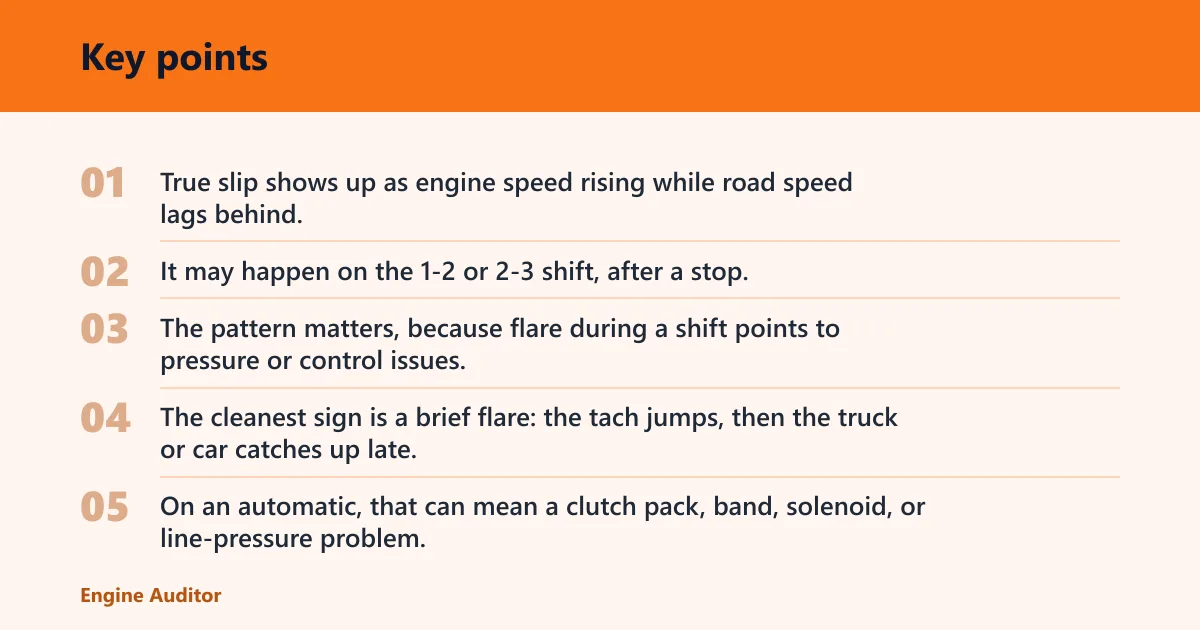


True slip shows up as engine speed rising while road speed lags behind. It may happen on the 1-2 or 2-3 shift, after a stop, or under light throttle in higher gears. The pattern matters, because flare during a shift points to pressure or control issues, while steady high-speed shudder often points elsewhere.
RPM flare without acceleration
The cleanest sign is a brief flare: the tach jumps, then the truck or car catches up late. On an automatic, that can mean a clutch pack, band, solenoid, or line-pressure problem. If it happens only once and never repeats, a low-fluid condition or adaptive shift issue is more likely than hard internal damage.
Delayed engagement and gear hunting
Delayed engagement feels like a pause after shifting into Drive or Reverse before the vehicle moves. Gear hunting means repeated upshifts and downshifts on a steady road. Both can come from low ATF, a pressure-control problem, or a TCM that is struggling with shift timing.
Shuddering under light throttle
Light-throttle shudder can feel like a washboard vibration rather than a clean slip. That pattern often appears during torque-converter lockup, especially at highway speed. It is easy to confuse with engine misfire, so the location, speed, and throttle opening matter.
Is it really the transmission?
Not every rev flare is a transmission fault. Engine misfire, wheel slip, and torque-converter shudder can mimic slipping, but they leave different clues. A fast symptom check first keeps you from buying the wrong parts or ordering a rebuild for a problem outside the gearbox.
How misfire can mimic slip
An engine misfire can make RPM surge and the vehicle feel flat, especially under load. The key difference is that misfire usually comes with rough running, shaking, or a flashing check-engine light. Transmission slip feels smoother but less effective, with the engine spinning higher than expected for the road speed.
How wheel slip differs from gear slip
Wheel slip is usually tied to wet pavement, gravel, snow, or traction-control intervention. You may see the traction light flash and hear tire spin. Transmission slip does not need low grip; it can happen on dry pavement, on one gear change, or at a steady cruise.
How torque converter shudder feels at highway speed
Torque-converter shudder usually shows up around steady highway speed during lockup. It feels like a tremor or surge, not a hard free-rev. If the complaint starts at about 45 to 70 mph and changes with lockup, the converter, fluid condition, or pressure control should be checked before internal teardown.
Slip diagnostic table
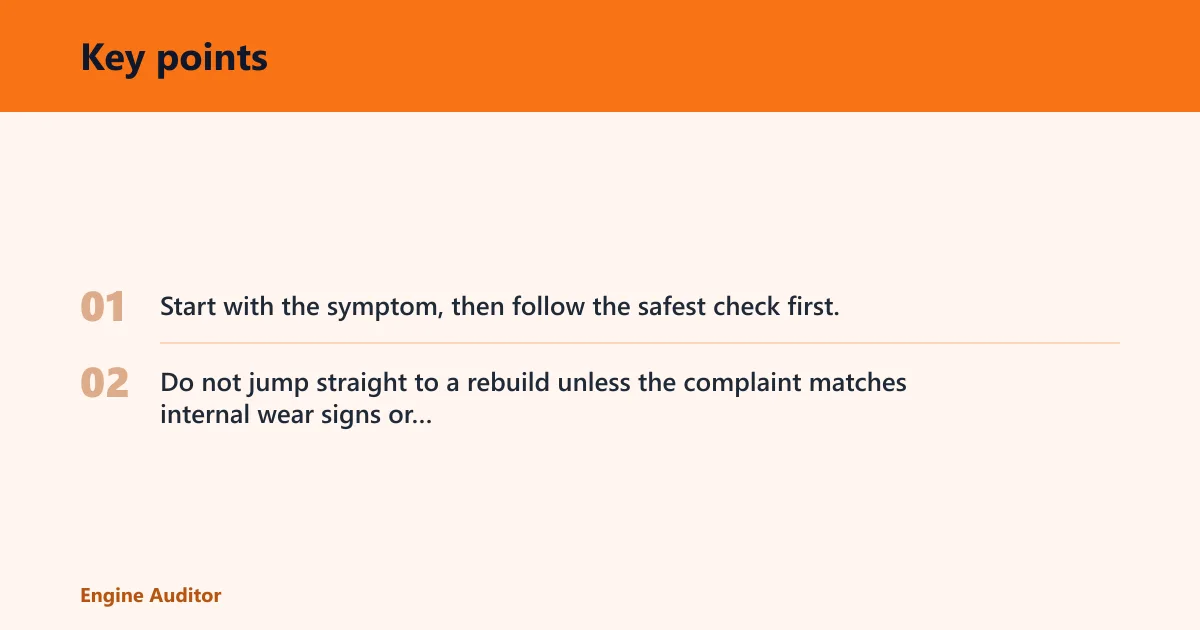
This table gives a first-pass fault tree. Start with the symptom, then follow the safest check first. Do not jump straight to a rebuild unless the complaint matches internal wear signs or the transmission loses engagement.
| Complaint | Likely cause | Immediate safety action | First check | Likely repair tier |
|---|---|---|---|---|
| RPM rises on the 1-2 shift | Low ATF, solenoid issue, worn clutch pack | Drive gently only if engagement is normal | Check fluid level and scan for codes | Fluid service, solenoid or valve body, rebuild if repeated |
| Delayed engagement into Drive | Low fluid, pressure loss, worn seals | Avoid hill starts and towing | Inspect for leaks and ATF condition | Leak repair, filter service, valve body work |
| Gear hunting on level road | TCM adaptation, speed sensor, pressure control | Keep speed low and avoid heavy throttle | Read codes and live data | Software update, relearn, sensor or solenoid repair |
| Shudder at 45 to 70 mph | Torque-converter lockup fault, worn fluid | Ease off throttle; avoid long highway runs | Check ATF condition and converter slip data | Fluid service, converter replacement |
| Burnt smell after towing | Overheating, clutch wear, fluid breakdown | Stop towing and let the unit cool | Check transmission temperature and ATF color | Service, cooler check, possible rebuild |
| Slip only when hot | Heat-related pressure loss, worn seals | Shorten the drive and avoid traffic | Scan temp data and inspect cooling | Cooling-system repair, valve body, rebuild if severe |
| Limp mode with harsh shifts | TCM fault, pressure fault, failed solenoid | Stop if power is limited or warning lights flash | Scan codes and freeze-frame data | Electrical diagnosis, valve body, software update |
| Slip plus metal debris in pan | Internal wear, clutch damage, bearing damage | Tow the vehicle | Inspect pan and filter | Rebuild or replacement |
Check fluid before parts
ATF comes first because low, wrong, or burnt fluid can create real slip. A Ford transmission also depends on the correct Ford-approved specification, not just any fluid that fits the dipstick tube or fill plug. If the fluid is dark, smells burnt, or shows debris, the transmission has already been stressed.
Ford-approved ATF spec matters
Use the exact fluid spec called for by the transmission family. Ford units are picky about friction behavior, and the wrong ATF can change shift feel, converter lockup, and line pressure. If the service history is unknown, verify the spec by transmission code rather than guessing from model alone.
Level, color, smell, and debris
A proper check looks at four things: level, color, smell, and debris. Low level can aerate the fluid and cause delayed shifts or flare. Dark ATF with a burnt smell points to overheating and clutch wear. Metal flakes or clutch material in the pan means the fault is moving beyond a simple service item.
Leaks and overheating clues
External leaks at cooler lines, pan gaskets, axle seals, or case connectors can lower fluid enough to cause slipping. Heat makes the fault worse. If the transmission runs hot, the fluid thins out, clutch apply pressure drops, and limp mode can appear to protect the unit.
Say your Escape only shudders after 20 minutes on the freeway, then shifts normally again after a stop. That pattern points more toward lockup or heat-related pressure behavior than a permanent gear failure. One short highway run with no warning light is different from repeated flare on every shift.
What does the scan tool show?
An OBD-II scan tool belongs early in the process because it can separate a fluid problem from an electrical or control fault. Read codes, live data, transmission temperature, and shift-solenoid commands before any major repair. That order avoids replacing hard parts when the TCM, wiring, or adaptive values are the real issue.
Codes worth reading first
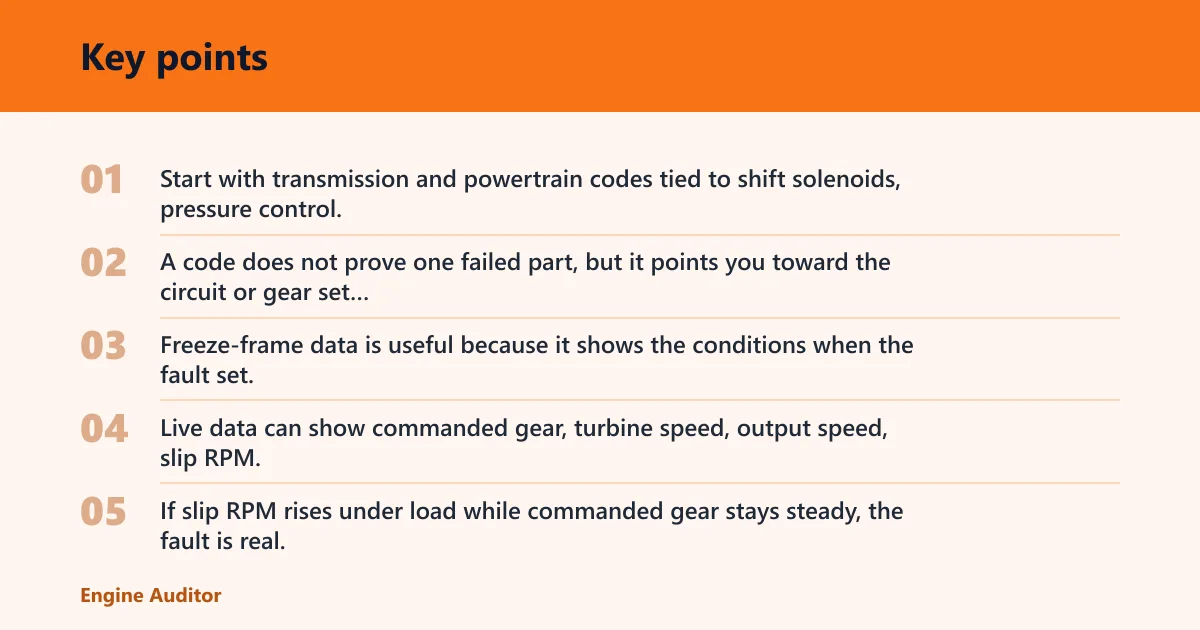
Start with transmission and powertrain codes tied to shift solenoids, pressure control, gear ratio errors, slip, or temperature. A code does not prove one failed part, but it points you toward the circuit or gear set that the TCM is seeing. Freeze-frame data is useful because it shows the conditions when the fault set.
Live data for slip RPM and temperature
Live data can show commanded gear, turbine speed, output speed, slip RPM, and transmission temperature. If slip RPM rises under load while commanded gear stays steady, the fault is real. If the temperature is high, that reading matters because heat can create or worsen a borderline slip complaint.
TCM adaptive learning and relearn flags
The TCM controls shift timing and pressure modulation. After a service, battery disconnect, or component replacement, adaptive learning may need to be reset or relearned. A bad adaptive state can create harsh, late, or confusing shifts, but it should not be guessed at until fluid and codes have been checked.
Which parts usually fail?
Most Ford slip complaints fall into three buckets: control, converter, or internal wear. The right repair tier depends on whether the unit still engages cleanly, whether the symptom is speed-specific, and whether the fluid shows damage. That is why the order matters: fluid, scan, then deeper mechanical checks.
Solenoids and valve body faults
Shift solenoids and the valve body manage pressure and gear changes. A failed solenoid can cause delayed shifts, flare, harsh shifts, or the wrong gear ratio. These faults often set codes and can sometimes be handled without opening the entire transmission, depending on wear inside the unit.
Torque converter lockup problems
The torque converter handles power transfer at low speed and locks up at cruise to reduce slip. When lockup shudders or fails, the complaint often appears at highway speed, not from a stop. Converter problems can also mimic a misfire because the vehicle feels as if it is surging or tugging under steady throttle.
Clutch packs, bands, and internal wear
Clutch packs and bands wear when the unit has been slipping, overheated, or starved of proper pressure. Burnt friction material in the pan, repeat slip in the same gear, and no improvement after service all point toward internal damage. At that stage, repair often moves from a service job to rebuild or replacement.
Suppose a 10-speed Ford starts flaring on the 3-4 shift only after towing a trailer uphill. If the fluid is dark and the pan shows clutch material, a drain-and-fill will not cure worn friction surfaces. The same symptom with clean fluid and stored codes points you back to control or pressure faults first.
Can you keep driving?
Maybe, but only if the slip is mild, the transmission still engages every time, and there is no limp mode, flashing warning light, or burnt smell. Severe slip, loss of reverse or drive, or rapid worsening under load is a tow decision. Heat turns a small fault into a larger one fast.
Short drive versus tow decision
A short, cautious drive to a shop can be reasonable when the symptom is light and stable. Keep speed down, avoid hills, and do not tow or haul cargo. Tow the vehicle if it revs freely without moving, bangs into gear, or slips more with each mile.
Limp mode and warning signs
Limp mode means the TCM has limited operation to protect the unit. That usually comes with harsh shifting, limited gear selection, or reduced power. If the transmission temperature is high or the dash shows a transmission warning, stop pushing it and arrange transport instead of testing it further.
When heat makes the fault worse
Heat lowers fluid quality and pushes worn clutches over the edge. A transmission that slips only when hot has already crossed into a risk zone, especially in traffic, on grades, or while towing. Letting it cool may bring temporary relief, but that does not remove the root cause.
Ford transmission service and repair cost ranges
Costs vary by transmission family, labor time, and whether the fault is external or internal. A drain-and-fill with filter replacement is the lowest tier. Solenoid or valve body work costs more. Converter replacement and rebuilds sit at the high end because they involve labor, parts, and often programming or relearn work.
| Repair tier | Typical scope | Common cost range |
|---|---|---|
| Fluid service | Drain-and-fill, filter, pan gasket, inspection | $150-$400 |
| Leak repair | Seals, gasket, cooler line, connector repair | $200-$700 |
| Solenoid or valve body | Electrical diagnosis, valve body service or replacement | $400-$1,500 |
| Torque converter | Converter replacement, fluid, labor, relearn | $800-$2,000 |
| Rebuild or replacement | Full internal overhaul or reman unit | $2,500-$6,000+ |
Drain-and-fill versus flush
A drain-and-fill is the safer first service on a slipping unit. A flush can move debris through an already worn transmission and make matters worse, especially if the friction material is breaking down. On a high-mileage or badly slipping Ford, filter replacement and inspection are more sensible than a power flush.
Model-family patterns that matter
Some Ford families have repeat patterns that help narrow the diagnosis. Six-speed units used in many F-150, Explorer, and Taurus applications often show solenoid, valve body, or adaptive issues before full failure. The 6R80 and 6R140 can show torque-converter concerns under load. Dual-clutch Ford units are more sensitive to software, adaptation, and launch shudder than a typical hydraulic automatic. That context helps, but the fluid and scan still come first.
Frequently asked questions
Why is my Ford transmission slipping?
Most slip complaints come from low or worn ATF, a leak, a solenoid or valve body fault, a torque-converter problem, or worn clutches. The quickest way to narrow it down is to check fluid condition first, then read transmission codes and live data before guessing at hard parts.
What does transmission slipping feel like in a Ford?
It usually feels like the engine revs climb faster than the vehicle speeds up. You may also notice delayed engagement, a flare between gears, repeated gear hunting, or a shudder at cruise. If the symptom is tied to highway speed only, torque-converter lockup moves up the list.
Can I still drive my Ford if the transmission is slipping?
Only if the slip is mild, the transmission still engages every time, and there is no limp mode, flashing light, or burnt smell. Keep the drive short and gentle. If the unit loses gear, slips harder when hot, or starts making noise, stop driving and tow it.
How do I check transmission fluid on a Ford?
Use the correct Ford procedure for that transmission family, because some units use a dipstick and others use a fill plug and temperature-based level check. Confirm the proper ATF spec, then inspect level, color, smell, and debris. Low, dark, or burnt fluid needs attention before more driving.
How much does it cost to fix a slipping Ford transmission?
Fluid service may be a few hundred dollars, leak repair can stay under $700, and solenoid or valve body work often falls around the midrange. A torque converter repair is more expensive, and a rebuild or replacement can move into the thousands. Severity and model family drive the final number.
Can a transmission flush make slipping worse?
Yes. On a worn or debris-filled unit, a flush can move material into places that are already marginal and can stir up a fault that was barely manageable. A drain-and-fill, filter change, and inspection are safer first steps when the transmission is already slipping.
Products related to this article
Sponsored / affiliate links. As an Amazon Associate I earn from qualifying purchases. I may earn additional commission from eligible campaigns.