Oil Light on but Oil Level Is Fine: What It Can Mean
An oil light with a normal dipstick usually points to a bad oil-pressure switch, wiring fault, or true low oil pressure; if the light is red and stays on, shut the engine off within seconds and do not keep driving. Ignoring it can turn a minor electrical fault into bearing damage or an engine seizure. This guide separates false alarms from pressure problems and shows the next checks to run.
Why the oil light can stay on with full oil

- Fixes false oil-pressure light directly
- OE form, fit, and function
- Withstands harsh engine environment
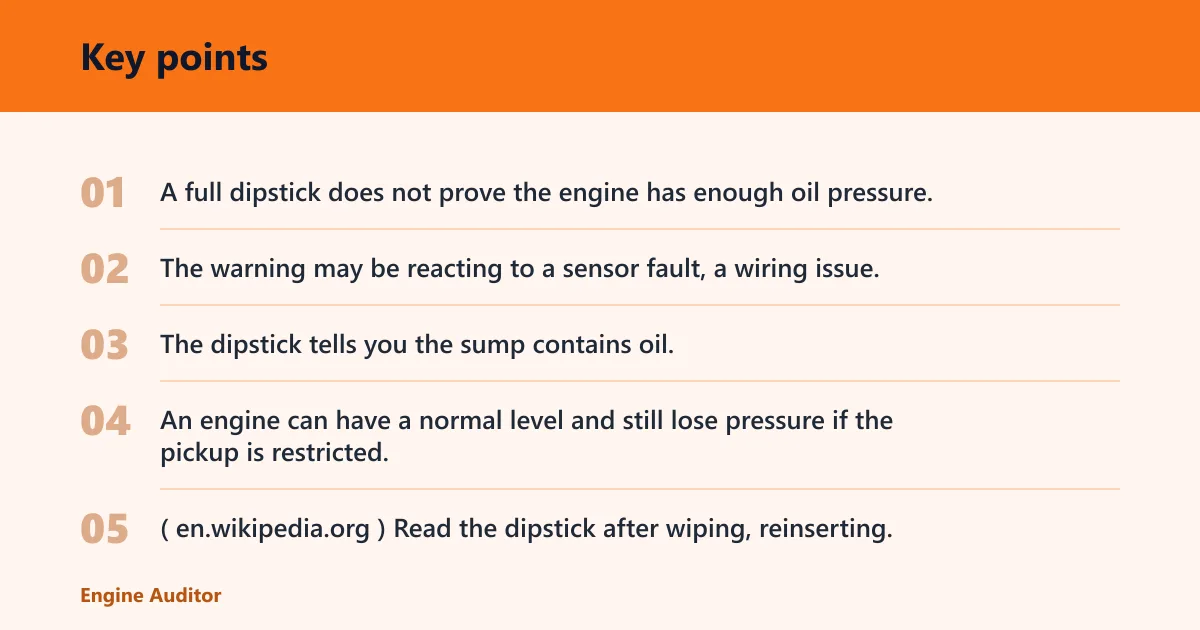
A full dipstick does not prove the engine has enough oil pressure. The warning may be reacting to a sensor fault, a wiring issue, or actual pressure loss from a pump, pickup screen, sludge, wrong viscosity, or worn bearings.
Why the dipstick can look normal anyway
The dipstick tells you the sump contains oil, not that the pump can move that oil at the pressure the engine needs. An engine can have a normal level and still lose pressure if the pickup is restricted, the pump is worn, or internal clearances are too large. (Wikipedia)
Read the dipstick after wiping, reinserting, and reading it on level ground. A normal reading is the first check, not the final answer.
What the warning light is actually reacting
On many vehicles, the oil warning light is driven by an oil pressure sensor or switch rather than by the dipstick. That means an electrical fault can turn the light on even when the oil level is fine. It also means a bad reading can hide a real pressure loss until the engine starts making noise.
The first split: level problem, sensor problem, or pressure problem
Use the symptom pattern to separate the three paths. If the level is low, that is the obvious path. If the level is full and the light acts erratically, the sensor or wiring is a strong suspect. If the light stays on and the engine sounds rough or noisy, treat it as a pressure problem until a gauge proves otherwise.
Yellow oil light vs red oil light
A yellow oil light usually points to an oil level warning or a sensor alert, and it may allow a short move to a safe stop. A red oil light usually signals dangerously low oil pressure and calls for immediate shutdown. The color changes the decision, not just the urgency.
What a yellow oil light usually means
Many vehicles use yellow for a lower-severity warning such as oil level, low level sensor logic, or a soft fault in the circuit. It still deserves attention, but it is often the warning that lets you drive a short distance to a safe place if the engine is otherwise quiet.
What a red oil light means
A red oil light may mean the engine does not have enough oil pressure to protect the bearings and camshaft. If it stays on, shut the engine off within a few seconds. Driving farther can turn a repairable fault into severe engine damage.
How the color changes your stop-driving decision
Yellow usually means diagnose soon and limit driving. Red means stop now. If a red light appears with tapping, knocking, or a harsh mechanical sound, do not restart the engine just to “see if it clears.”
Oil light decision table
This table separates common symptom patterns from the most likely cause and the right next check. The stop-driving threshold is the key column.
| Symptom pattern | Most likely cause | Safe next check | Stop-driving threshold |
|---|---|---|---|
| Startup-only warning that goes out after a few seconds | Sensor delay, wiring issue, or brief pressure delay at start | Read fault codes, inspect the sensor connector, and confirm pressure with a gauge before replacing parts | If it becomes red, stays on, or brings engine noise, shut down immediately |
| Warning at hot idle only | True low pressure from worn bearings, thin oil, sludge, or a weak pump | Stop driving, check oil type and level, then verify actual pressure with a mechanical gauge | Treat as stop-now if the light stays on at idle more than briefly |
| Warning during turns or braking | Oil slosh, low level, clogged pickup screen, or a pickup that uncovers under load | Check level on flat ground, inspect for leaks under the car, and gauge pressure if the warning repeats | Stop if the light turns red, stays lit, or any noise appears |
| Warning with engine noise | Actual pressure loss, often from pump failure, pickup restriction, or bearing wear | Do not continue driving; confirm with a gauge only if the engine can be shut down safely | Immediate shutdown; tow required |
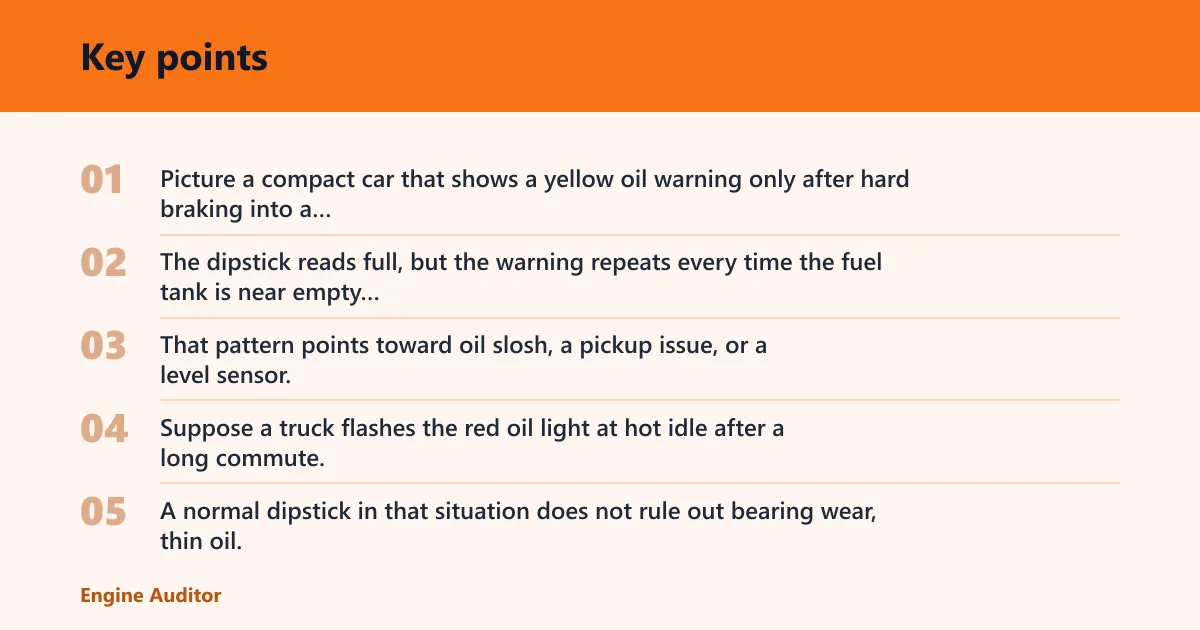
Picture a compact car that shows a yellow oil warning only after hard braking into a driveway. The dipstick reads full, but the warning repeats every time the fuel tank is near empty and the car corners sharply. That pattern points toward oil slosh, a pickup issue, or a level sensor, not proof that the pump is healthy.
Suppose a truck flashes the red oil light at hot idle after a long commute, then the tick from the top end starts. That combination is far more serious. A normal dipstick in that situation does not rule out bearing wear, thin oil, or a failing pump.
What should you check first?
Start with the dipstick, but do not stop there if the level is normal. Then look for leaks, confirm which warning color you have, and use the owner’s manual to confirm the warning light meaning on that exact vehicle or scan for oil-related fault codes. Those steps sort a level issue from a pressure issue fast.
Check the dipstick the right way
Park on level ground, let the oil settle, wipe the stick, reinsert it fully, then read it again. A low reading calls for the correct oil type and amount. A normal reading means the problem may be electrical or mechanical, so move to the next checks.
Look for leaks and obvious oil loss
Check under the car, around the filter, and at the drain plug for fresh oil. A leak can explain a level warning, but it does not explain every pressure warning. If the light is red, do not keep searching under the hood with the engine running.
Confirm the warning with the owner’s manual and scan tool
Use the owner’s manual to confirm what the light color means on that exact vehicle. Then scan for oil-related trouble codes. P0520 through P0524 often point to oil pressure circuit problems, which helps separate wiring and sensor faults from real pressure loss.
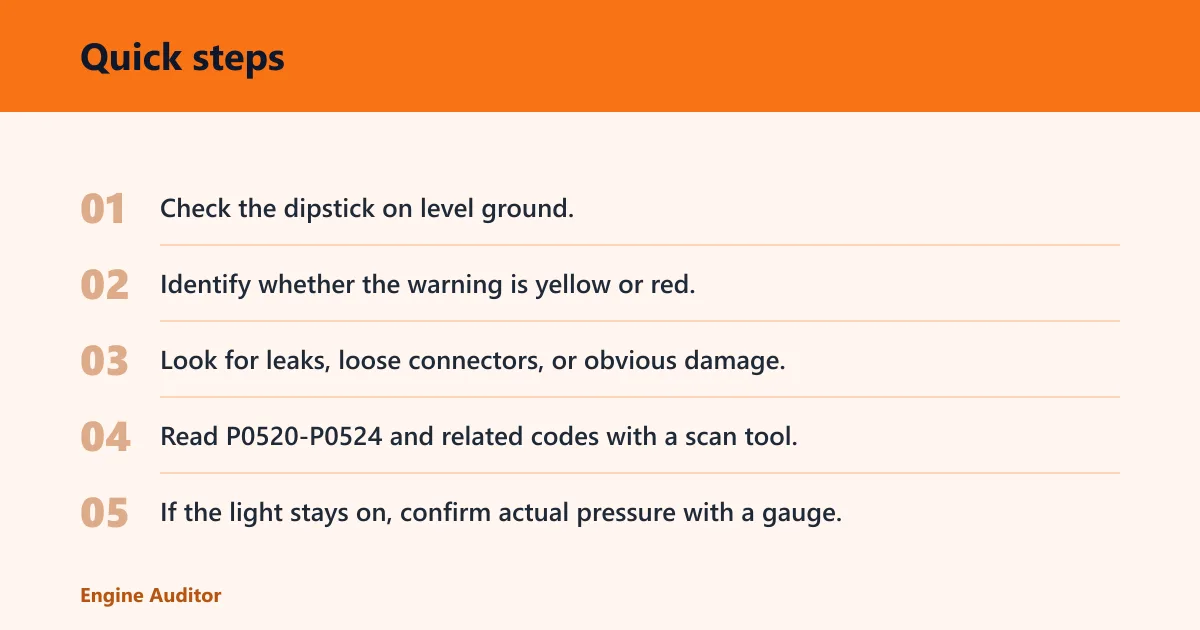
- Check the dipstick on level ground.
- Identify whether the warning is yellow or red.
- Look for leaks, loose connectors, or obvious damage.
- Read P0520-P0524 and related codes with a scan tool.
- If the light stays on, confirm actual pressure with a gauge.
Can a bad sensor or wiring fault trigger it?
Yes. A failed oil pressure sensor, corroded connector, broken wire, or poor ground can turn the warning light on even with normal oil level and normal actual pressure. That is why wiring checks and pressure testing come before parts replacement.
How the oil pressure sensor fails
An oil pressure sensor can drift, short internally, or send an erratic signal. The connector can also fill with oil or corrosion. Either problem can trigger a warning that looks serious on the dash but is false in the engine.
Why P0520-P0524 matter
Those codes are clues, not a verdict. They point to circuit or sensor range problems that deserve inspection, but they do not prove the sensor is bad. The code must be matched with wiring checks and an actual pressure reading.
What wiring and connector checks can reveal
Look for damaged insulation, oil intrusion, bent pins, and loose terminals at the sensor. A circuit fault can create a warning at startup, after a bump, or only when the engine heats up. If the scan tool shows inconsistent values, the next move is still a pressure test.
When low pressure is the real problem
If the gauge confirms low pressure, the issue is mechanical, not cosmetic. The likely causes are a failing oil pump, a clogged pickup screen, oil that is too thin for the engine, sludge that restricts flow, or bearing wear that opens clearances and drops pressure.
Oil pressure gauge test before parts replacement
A mechanical oil pressure gauge is a common confirmation step. It separates a faulty sensor from true pressure loss and should be used before replacing the pump, sensor, or timing cover parts. Without that reading, repairs can be misdirected.
Oil pump and pickup screen problems
An oil pump can fail even when the sump is full. A clogged pickup screen can starve the pump with sludge or debris. Both faults can create low pressure with a normal dipstick reading, which is why level alone never closes the case.
Wrong viscosity, sludge, and bearing wear
Use the oil viscosity listed in the engine spec. Oil that is too thin can contribute to low pressure, especially at hot idle. Sludge can block the pickup or galleries. Bearing wear raises internal clearances and lowers pressure, which usually makes the warning more serious if it persists after the engine warms up.
Is it safe to drive with the oil light on if oil level is fine?
Only in a narrow set of cases. A yellow warning that behaves like a level or sensor alert may allow a short move to a safe place, but a red oil light, a persistent warning, or any engine noise means stop now. Full oil level does not make low pressure safe.
If the light appears only for a few seconds after startup and then disappears, the car may still need diagnosis, but it is less urgent than a hot-idle or red-pressure warning. If it appears while cruising and stays on, do not assume the dipstick has cleared the risk.
Do I need a tow if the oil light stays on with full oil?
Yes, if the light is red, stays on, or comes with tapping, knocking, or a sudden change in engine sound. A tow is also the safer choice when the light stays on at hot idle or the gauge test has not been done yet. The risk is engine damage, not inconvenience.
If the warning is yellow, the engine is quiet, and the vehicle can be moved a short distance without loading it hard, a brief move to a safe spot may be reasonable. After that, diagnosis should happen before the car is driven again.
Frequently asked questions
Why is my oil light on when the oil level is full?
A full dipstick does not rule out low pressure, a failed oil pressure sensor, or a wiring fault. The warning may also reflect a clogged pickup, a weak pump, or bearing wear. The next step is to confirm whether the problem is electrical or mechanical, not to assume the level is the answer.
Can a bad oil pressure sensor turn the oil light on?
Yes. A bad sensor, a corroded connector, or damaged wiring can trigger the light with normal oil level and normal pressure. That is why P0520-P0524 codes and connector checks matter, but they still need a mechanical pressure test before any part is replaced.
What should I check first when the oil light comes on but the oil is full?
Check the dipstick again on level ground, note whether the light is yellow or red, and inspect for leaks. Then read any oil-related fault codes. If the warning remains, confirm actual pressure with a mechanical gauge before replacing the sensor or pump.
Could low oil pressure happen even when the dipstick looks normal?
Yes. The engine can hold a normal amount of oil and still lose pressure because of a worn pump, a clogged pickup screen, wrong viscosity, sludge, or bearing wear. The dipstick shows quantity in the sump, not the pressure inside the oil galleries.
Why does the oil light come on after startup and then go off?
That pattern can point to a sensor delay, wiring issue, or a brief pressure lag while the pump primes. It can also be the first sign of a mechanical problem that appears only when the engine is cold. A gauge test is the clean way to separate those paths.
How do mechanics diagnose an oil warning if the level is okay?
They start with the warning color, scan for P0520-P0524 and related codes, inspect the sensor and wiring, then verify pressure with a mechanical gauge. If pressure is low, they move to pump, pickup screen, oil viscosity, sludge, and bearing checks in that order.
Products related to this article
Sponsored / affiliate links. As an Amazon Associate I earn from qualifying purchases. I may earn additional commission from eligible campaigns.
 ACROPIX Engine Oil Level Indicator Dipstick for Ford Fusion 2010-2012 for Ford Escape 2010-2012 for Ford Fusion 2006-2007 No.6E5Z6750AC Car Parts
 DongJinK Engine Oil Level Gage Dipstick Compatible with Toyota 4Runner 1984-1995 for Toyota Celica 1984-1985 for Toyota Pickup 1984-1995 Replace# 15301-35020 1530135020