Should You Follow Time or Mileage for Car Service?
Follow the earlier of the two intervals in your owner’s manual: time or mileage, whichever comes first. If the date limit arrives first, do the service even when the odometer looks fine. Oil, fluids, filters, belts, and seals can age out before miles add up. This guide explains the rule, the cases where time matters more than miles, and how to handle split intervals.
Should you follow time or mileage for car service?
Use whichever limit comes first in the owner’s manual. That rule accounts for both driving wear and aging from sitting. For many cars, the schedule is framed as a yearly service or a mileage service, and the earlier trigger is the one to follow.
The manual matters because service schedules vary by make, model, engine, drivetrain, and driving pattern. A generic package can be useful as a shorthand, but it should not replace the carmaker’s schedule or the service history already on the car.
Why the owner’s manual sets the baseline
The manufacturer maintenance schedule is the baseline for your car. It may use time-based items, mileage-based items, or both, and it can override common assumptions such as 30,000, 60,000, or 90,000-mile milestones. If the manual gives two triggers, use the earlier one.
That matters because age affects parts even when the odometer moves slowly. Oil, brake fluid, coolant, belts, hoses, seals, batteries, and filters all age in service. Mileage tells part of the story. Time tells the rest.
When does time matter more than miles?
Time matters more than miles when the car ages faster than it travels. That is common with low-mileage older cars, stored or seasonal cars, short-trip use, and any vehicle whose fluids or rubber parts sit for long stretches. In those cases, a low odometer reading can hide real service need.
What is the difference between vehicle age and mileage?
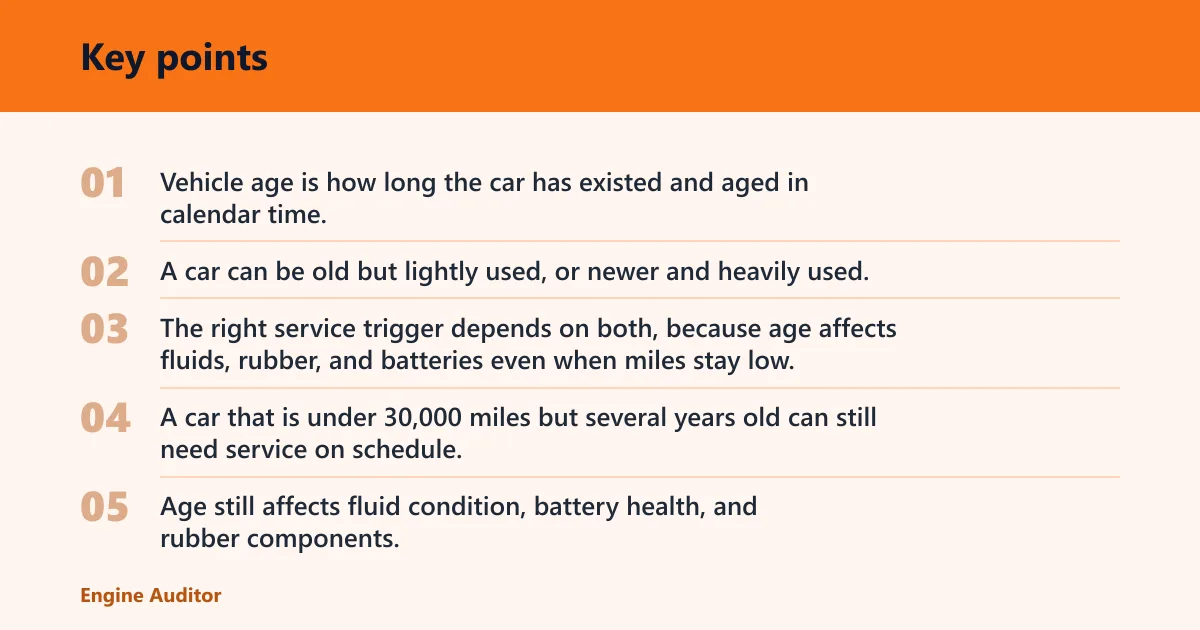
Vehicle age is how long the car has existed and aged in calendar time. Mileage is how far it has been driven. A car can be old but lightly used, or newer and heavily used. The right service trigger depends on both, because age affects fluids, rubber, and batteries even when miles stay low.
Low-mileage older cars
A car that is under 30,000 miles but several years old can still need service on schedule. Age still affects fluid condition, battery health, and rubber components. If the manual says 12 months, do not wait for 10,000 miles to catch up.
Stored or seasonal cars
Vehicles that sit for months at a time can need service before the mileage limit arrives. Fluids absorb moisture, seals dry out, and batteries weaken during storage. A car used only in summer or only on weekends still needs time-based checks.
Short-trip and stop-and-go use
Short trips, stop-and-go traffic, and heavy urban use can require service sooner than highway use. That is because the engine and exhaust may never stay hot long enough to burn off moisture and fuel contamination.
Say your car does four-mile school runs in winter. The mileage may stay low, but the oil, battery, and brake fluid can age faster because the car rarely reaches steady operating temperature.
How do parked cars affect mileage service timing?
Parked cars cannot ignore mileage simply because they are not being driven. They still age by time, and sitting can be harder on fluids, seals, tires, and the battery than steady use. If the calendar limit arrives first, the car still needs service even with very low miles.
EVs and age-based checks
Electric vehicles still need service. They usually need fewer engine-related items, but they still have tires, brakes, cabin filters, coolant on some models, brake fluid, suspension parts, and a 12-volt battery that ages with time. A low-mileage EV that sits often still needs age-based checks.
Manufacturer maintenance schedule
The manufacturer maintenance schedule tells you what to service and when. It is the primary source for the exact car, because it reflects the engine, drivetrain, and use case built into that model. It may also split the schedule by normal use and severe use, which is where short trips, towing, or repeated heavy traffic matter.
How schedules differ by engine, drivetrain, and use pattern
A petrol car, diesel, hybrid, and fully electric vehicle do not share the same wear pattern. One may need more frequent oil service, another may place more weight on brake fluid, transmission fluid, or coolant checks. That is why a garage package should never replace the manual.
Halfords says most drivers should service every 12 months or 10,000 miles, but it also recommends an Interim Service every 6 months or 6,000 miles, a Full Service every 12 months or 13,000 miles, and a Major Service every 24 months or 24,000 miles. Those are useful guideposts, not a universal substitute for the manual.
What is a severe-use or short-trip interval?
A severe-use or short-trip interval is the shorter schedule that applies when driving is harder on the car than average. That can include short trips, towing, heavy traffic, or repeated cold starts. In those cases, the calendar often matters more than the odometer because fluids and components age faster than miles suggest.
Time-based items versus mileage-based items
Some items age with time even if the car barely moves. Brake fluid can take on moisture, coolant can weaken, and rubber parts can harden or crack. Mileage-based items still matter, but they do not cover every failure mode.
- Oil and filter changes can be mileage-based, time-based, or both.
- Brake fluid is often time-sensitive because moisture accumulation matters.
- Cabin filters, air filters, belts, and hoses can age even on low-mileage cars.
- Tires still age by date, tread depth, and storage conditions.
Service trigger table

This table gives a practical way to choose between time and mileage when the two disagree. Use the owner’s manual first, then compare your driving pattern, age, and service history against the most likely trigger.
| Driving pattern | Age | Miles | What wins first | Likely service items |
|---|---|---|---|---|
| Low-mileage old car | Over several years old | Under 30,000 miles | Time | Oil, filters, brake fluid, battery check, belts, hoses, tire age inspection |
| High-mileage young car | Newer car | Over 70,000 miles | Mileage | Oil service, filters, tires, brakes, fluids, suspension checks, transmission service as scheduled |
| Short-trip commuter | Any age | Below average yearly miles | Time | Oil, battery, brake fluid, cabin filter, moisture-related checks |
| Highway commuter | Any age | Average to high yearly miles | Mileage | Oil service, tire rotation, filters, brakes, scheduled fluid changes |
| Stored or seasonal car | Any age | Low use | Time | Battery maintenance, fluid checks, tire condition, seal and hose inspection, fuel system checks |
| EV | Any age | Low to moderate | Time | Tires, brakes, cabin filter, coolant on applicable models, 12-volt battery, brake fluid |
CarBravo says average vehicles accrue around 12,000–15,000 miles every year. That helps separate low, average, and high use. CarBravo classifies low mileage as under 30,000 miles, average or mid mileage as 30,000–70,000 miles, and high mileage as over 70,000 miles.
Suppose one car is a 9-year-old hatchback with 18,000 miles and another is a 3-year-old crossover with 78,000 miles. The hatchback is a time-first case. The crossover is a mileage-first case. Same rule. Different trigger.
What should you ask your mechanic if the schedule is unclear?
Ask whether the car is on a normal or severe-use schedule, whether recent service records change the next due date, whether short trips or storage shorten the interval, and whether any brake fluid, coolant, or filter items are time-sensitive. If the history conflicts with the manual, use the earliest due item first.
-
Check the manual first.
Look for the schedule page that lists time and distance together. If the manual gives both, use the earlier date or mileage. -
Match your driving pattern.
Compare your use against short trips, highway miles, towing, storage, or heavy traffic. Freehome notes that short trips, towing, and heavy traffic may need service more often. -
Review service history.
Confirm when oil, filters, brake fluid, coolant, and other items were last changed. If records are incomplete, treat the schedule as due sooner rather than later. -
Choose the earliest trigger.
If the manual says 12 months or 10,000 miles, service the car at 12 months even if the miles are low, or at 10,000 miles even if the date has not arrived.
What service items usually age out first?
Oil and filters often age out first, especially on cars that do many short trips or sit unused. Brake fluid and coolant can also age before mileage looks high. That is why mileage-only service can miss moisture, chemical breakdown, and rubber deterioration.
Oil and filters
Oil service intervals often fall in an approximate 5,000 to 10,000 mile range, depending on oil type and driving conditions, and time can also be a trigger. If the car sees lots of cold starts or short runs, the calendar matters more.
Brake fluid and coolant
Brake fluid can pull in moisture over time. That can affect pedal feel and corrosion risk even when the car has not covered many miles. Coolant also ages chemically, so a low-mileage car can still need a fluid change on schedule.
Why is brake-fluid timing so sensitive?
Brake fluid is sensitive because it can absorb moisture over time, even if the car is driven very little. That moisture can reduce performance and increase corrosion risk. For that reason, brake fluid is often a calendar-based item rather than a mileage-only item.
Tires, belts, hoses, and battery checks
Tires age by both use and time. Belts and hoses can crack, harden, or swell with age. Batteries lose capacity with sitting, heat, and repeated short starts. A mileage-only plan can miss all three.
Which service interval fits your driving pattern?
Interim, full, and major service intervals are useful labels when the manual is clear or your shop uses package names. The right choice depends on how fast your time or mileage limit arrives. High-mileage drivers usually hit the mileage trigger first, while low-mileage drivers usually hit the time trigger first.
What is the best service choice for high-mileage drivers?
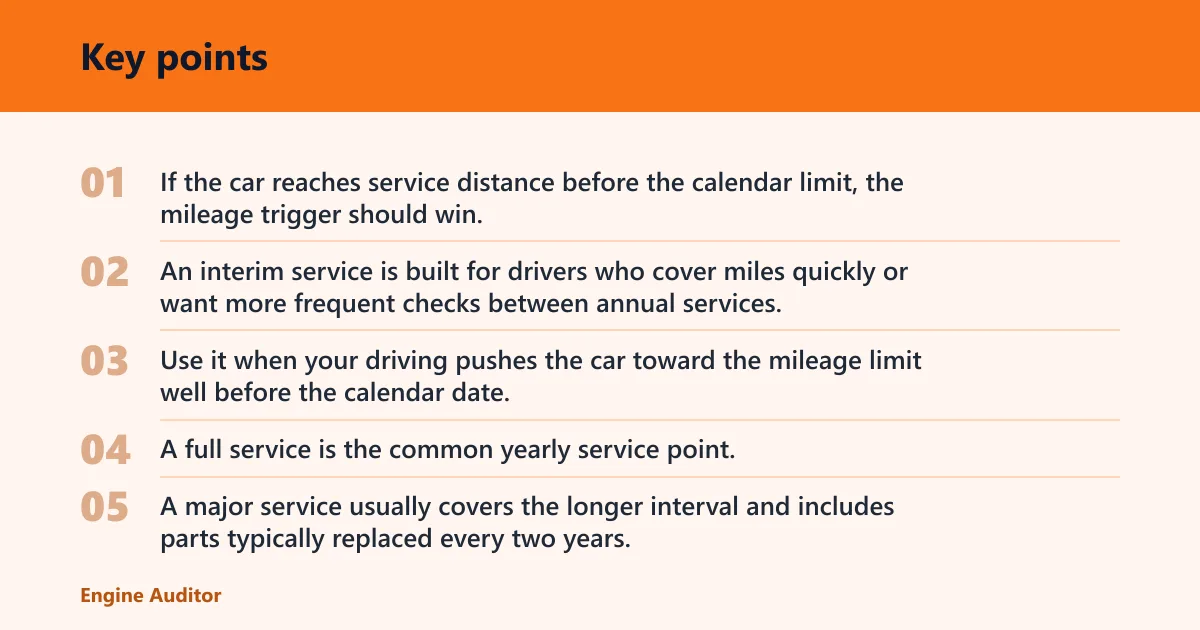
High-mileage drivers usually benefit from the shorter mileage-based package or the earliest scheduled service in the manual. If the car reaches service distance before the calendar limit, the mileage trigger should win. That keeps wear items, fluids, and inspections aligned with heavy use.
Interim service
An interim service is built for drivers who cover miles quickly or want more frequent checks between annual services. It is often used for high-mileage drivers and can suit petrol, diesel, hybrid, and electric vehicles. Use it when your driving pushes the car toward the mileage limit well before the calendar date.
Full service
A full service is the common yearly service point. If your car is average use and reaches the annual trigger first, this is often the right interval to follow unless the manual asks for something different.
Major service
A major service usually covers the longer interval and includes parts typically replaced every two years. That commonly means brake fluid and cabin filter work, along with the broader inspection set tied to the package.
Common mile-based milestones
30,000, 60,000, 90,000, and 100,000 miles are common planning points, but they are not universal package names. A 30,000-mile service may include oil, filters, tires, brakes, fluids, and suspension checks. A 60,000-mile service may add brake fluid flushes, transmission fluid service, spark plugs, and coolant exchange, depending on the vehicle.
Frequently asked questions
Should I service my car by time or by miles?
Use whichever limit comes first in your owner’s manual. That rule covers both wear from driving and aging from sitting. Mileage matters, but time matters too, especially for fluids, batteries, rubber parts, and cars that do short trips or spend long periods parked.
What comes first on car service, months or mileage?
The earlier trigger comes first. If the manual says 12 months or 10,000 miles, service the car at 12 months even if it has low mileage, or at 10,000 miles even if the calendar is younger. That is the cleanest way to avoid overdue maintenance.
Is 30,000 miles a major service?
Not always. 30,000 miles is a common planning milestone, but service needs vary by manufacturer and model. One car may need only inspection and routine fluids at that point, while another may call for filters, brakes, or other scheduled items. The manual decides, not the milestone alone.
Is 60,000 miles a major service?
Often it is a broader service point, but not universally. Many schedules add deeper checks or fluid changes around 60,000 miles, yet the exact list depends on the vehicle. Follow the manufacturer schedule first and use the mileage as a reminder, not a rule by itself.
Is it bad to go by mileage only for oil changes?
Yes, mileage-only oil changes can miss age-related oil breakdown and moisture build-up, especially on short-trip cars. Oil service often falls between 5,000 and 10,000 miles, but time can also be the trigger. If the car sees lots of cold starts, the date matters as much as the odometer.
How often should I service my car if I drive low miles?
Low-mileage cars still need time-based service, often at annual intervals or sooner if the manual says so. A car under 30,000 miles can still need oil, brake fluid, filters, and battery checks because age, storage, and short trips can wear parts without many miles showing.
Does short-trip driving mean I need service sooner?
Yes. Short trips, stop-and-go traffic, and heavy traffic can push service sooner because the engine may not heat fully and moisture can build in fluids. That is one reason the manual may call for severe-use timing or earlier time-based service even when mileage stays low.
Can a parked car ignore mileage service intervals?
No. A parked car still ages by time, and sitting can create its own maintenance needs. If the time limit arrives first, service is due even with very low miles. Parked cars should still follow the manual’s calendar-based items, especially for fluids, tires, seals, and batteries.
What does manufacturer service schedule mean?
It means the maintenance plan written for your exact car by the manufacturer. It is the primary source for service timing, and it can differ by make, model, engine, drivetrain, and use pattern. It may also use both time and mileage limits, so follow the earlier one.
Products related to this article
Sponsored / affiliate links. As an Amazon Associate I earn from qualifying purchases. I may earn additional commission from eligible campaigns.