What Voltage Is Too Low for a Car Battery?
A 12-volt car battery is too low for reliable starting at about 12.2 volts, and below 12.0 volts it needs charging; at 11.8 volts or less, treat it as deeply discharged or failing. Staying in that range can leave you stranded and can hide charging-system faults. This guide sets the voltage thresholds for recharge, load retest, charging-system inspection, and replacement.
Resting, cranking, and running voltage thresholds
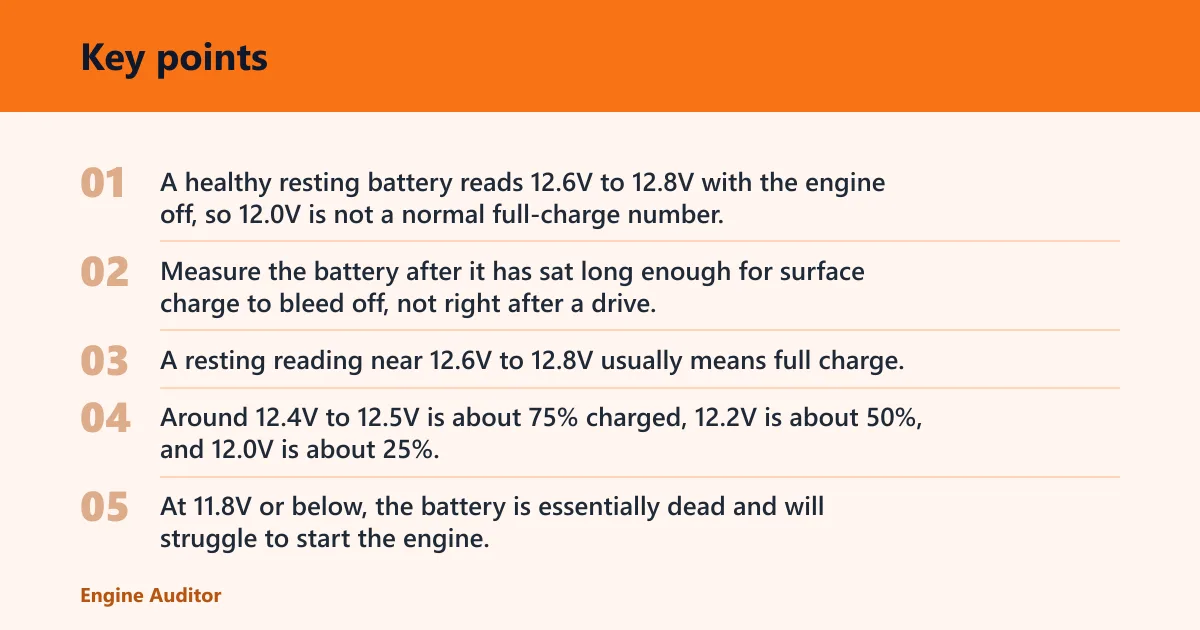


For a standard 12V lead-acid battery, anything below about 12.2V at rest is commonly treated as low enough to take seriously, and about 12.0V or lower is a charge-now reading. A healthy resting battery reads 12.6V to 12.8V with the engine off, so 12.0V is not a normal full-charge number.
Resting voltage thresholds for a 12V battery
The key word is resting. Measure the battery after it has sat long enough for surface charge to bleed off, not right after a drive. A resting reading near 12.6V to 12.8V usually means full charge. Around 12.4V to 12.5V is about 75% charged, 12.2V is about 50%, and 12.0V is about 25%.
At 11.8V or below, the battery is essentially dead and will struggle to start the engine. That is the point where a recharge is no longer optional. It becomes the first step before any other diagnosis.
Cranking voltage under starter load
Cranking voltage is different from resting voltage. During engine start, the battery should stay above 9.6V under starter load. If it drops below 9.6V, the battery may be weak under load, or resistance in the cables or grounds may be stealing current.
Running voltage with the engine
With the engine running, a normal charging-system reading is about 13.5V to 14.7V. That number is not a battery state-of-charge reading. It is a charging-system reading that tells you whether the alternator is feeding the battery and vehicle electrical loads properly.
Low-voltage action thresholds
This table separates resting voltage, cranking voltage, and running voltage so you can choose the next move without guessing. Use the row that matches the battery chemistry and the condition you are checking.
| Battery type | Resting voltage | Cranking voltage | Running voltage | Likely meaning | Next action |
|---|---|---|---|---|---|
| Standard flooded lead-acid | 12.6V to 12.8V is healthy; 12.2V is about 50%; 12.0V or below is low | Above 9.6V is normal under starter load | 13.5V to 14.7V is normal; below 13.5V undercharging; above 14.8V overcharging | Low resting voltage points to discharge; low cranking voltage points to weak battery or high resistance; abnormal running voltage points to a charging-system fault | Recharge, then retest at rest and under load; inspect cables, grounds, alternator, or regulator if running voltage is out of range; replace if it still fails load testing |
| AGM | 12.6V to 13.0V can be normal when fully charged | Above 9.6V is still the load target | 13.5V to 14.7V is normal unless the battery maker calls for a different profile | AGM batteries can sit a little higher at rest than flooded batteries, so a 12.8V reading may be healthy, not suspicious | Use the battery label and vehicle charging spec before replacing; recharge and retest if the battery is low, then check load performance |
| LiFePO4 | About 13.3V to 13.4V can be normal at rest | Should still hold up under starter load if the battery and vehicle are compatible | Charging profile differs by system and battery management setup | A lithium reading that looks “high” by lead-acid standards may be normal for that chemistry | Follow the battery and vehicle charging requirements; do not apply flooded lead-acid voltage rules to a lithium pack |
State of charge versus true condition
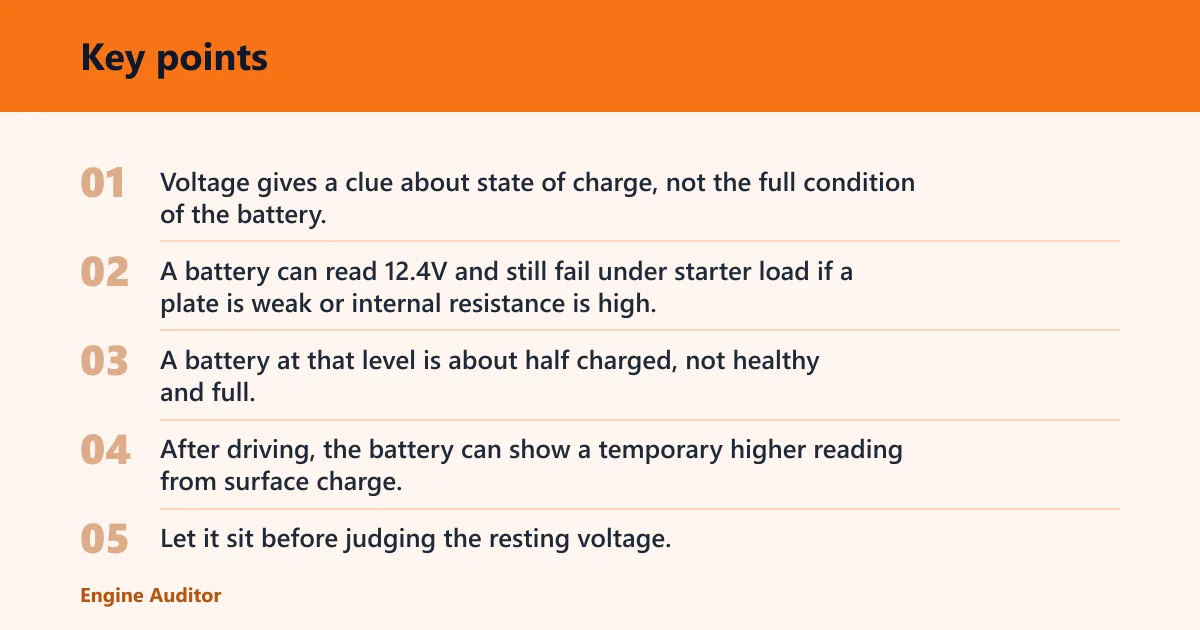
Voltage gives a clue about state of charge, not the full condition of the battery. A battery can read 12.4V and still fail under starter load if a plate is weak or internal resistance is high. That is why the resting number alone should not decide replacement.
A common mistake is to assume 12.2V is fine when the engine still cranks after a short drive, even though that voltage is already low for a healthy car battery. A battery at that level is about half charged, not healthy and full. It needs charging and a retest, not wishful thinking.
Surface charge after driving
After driving, the battery can show a temporary higher reading from surface charge. Let it sit before judging the resting voltage. Turning on the headlights for a short time can help dissipate surface charge faster, which makes the next reading more honest.
Cold weather and short-trip effects
Cold weather lowers available battery power and increases starting demand. Short trips can leave the battery undercharged even if the car starts fine, so a reading near 12.2V after repeated short drives may point to chronic low charge rather than a single bad start.
What voltage is too low to start a car?
For starting, the important number is cranking voltage, not the quiet resting number from the driveway. A battery should stay above 9.6V while the starter is turning the engine. Below that, the battery may be too weak under load, or the cables and grounds may be limiting current.
How to read cranking voltage
-
Set the meter first. Put a multimeter on DC volts and connect the probes to the battery posts, not the cable clamps. Good contact matters because a corroded clamp can hide the real battery voltage.
-
Watch the start event. Have someone crank the engine while you watch the meter, or use a meter with a min/max function. The reading during the first seconds of cranking is the number that matters here.
-
Compare to 9.6V. If the voltage stays above 9.6V, the battery is generally holding under load. If it falls below 9.6V, charge the battery first, then retest before blaming the battery or the starter.
When low cranking voltage points to cables or grounds
If the battery tests okay at rest but cranking voltage collapses, the problem may be outside the battery. High resistance in the positive cable, a loose terminal, or a poor engine ground can create the same no-start symptom. That is why a load result should trigger a cable and ground inspection, not an automatic battery swap.
When the battery is too weak to recover
If a charged battery still drops below 9.6V under starter load, replacement becomes likely. If it also sits at 11.8V or lower after resting, the battery is deeply discharged or failing, and repeated recharge cycles may not bring it back to reliable service.
What voltage is too low while driving?
While driving, the battery should not be left to carry the vehicle on its own. A normal charging-system reading is about 13.5V to 14.7V with the engine running. Below 13.5V suggests undercharging, and above about 14.8V points to overcharging.
Normal charging-system voltage
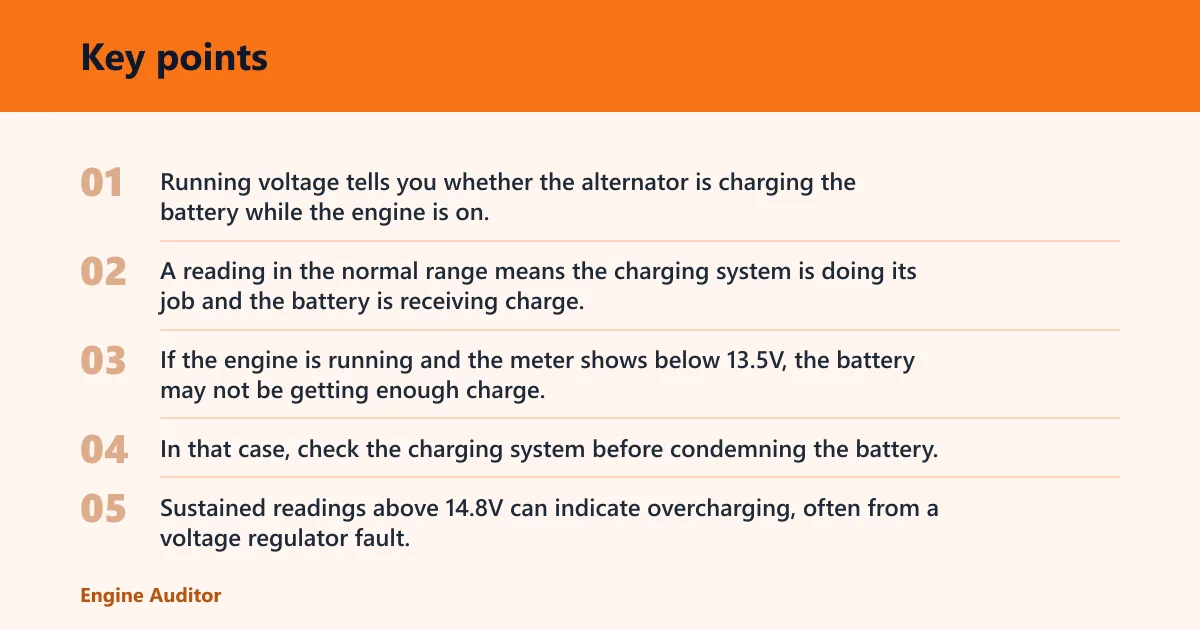
Running voltage tells you whether the alternator is charging the battery while the engine is on. A reading in the normal range means the charging system is doing its job and the battery is receiving charge. That does not prove the battery is good, but it does rule out a major charging fault.
Undercharging and alternator checks
If the engine is running and the meter shows below 13.5V, the battery may not be getting enough charge. That can come from a weak alternator, belt slip, wiring loss, or a poor connection. In that case, check the charging system before condemning the battery.
Overcharging and voltage regulator faults
Sustained readings above 14.8V can indicate overcharging, often from a voltage regulator fault. That condition can overheat the battery and boil electrolyte in flooded lead-acid designs. If you see high running voltage, do not ignore it because the car starts.
Suppose a sedan shows 12.5V at rest but 15.0V while driving. The battery may not be the main problem. That high running number points first to the charging system, especially the regulator, because the battery is being pushed above the normal charge range.
Battery chemistry changes the baseline
Not every battery should be judged by the same resting number. Flooded lead-acid, AGM, and LiFePO4 batteries can all behave differently at rest, and charging profiles differ too. Use the chemistry first, then the voltage threshold.
Flooded lead-acid batteries
A standard flooded 12V battery is the simplest case. A healthy resting reading is 12.6V to 12.8V, around 12.2V is about half charged, and 12.0V or below means the battery is low enough to recharge before further testing.
AGM batteries
AGM batteries can rest at 12.6V to 13.0V, so a slightly higher standing voltage can still be normal. Do not force a flooded-battery benchmark onto an AGM battery. Check the battery label and the vehicle charging spec if the numbers seem unusual.
LiFePO4 batteries
LiFePO4 batteries are different again. A resting reading around 13.3V to 13.4V can be normal for that chemistry. A lead-acid battery chart does not apply cleanly here, and the charging profile should match the battery and its management system.
Frequently asked questions
What voltage is too low for a car battery?
For a standard 12V lead-acid battery, 12.2V at rest is already low enough to justify charging, and 12.0V or below is deeply discharged. At 11.8V or lower, the battery is essentially dead and may struggle to start the engine, even if the lights still work.
What voltage is too low for a 12 volt car battery?
A 12 volt car battery is too low below about 12.2V at rest. Around 12.4V is only about 75% charged, and 12.2V is about 50%. A healthy resting battery is closer to 12.6V to 12.8V, so 12.0V is not a normal full-charge reading.
What battery voltage is too low to start a car?
Cranking voltage below 9.6V is too low for reliable starting. That reading matters only during engine start, not at rest. If the battery falls below that level while cranking, the battery may be weak under load, or the cables and grounds may be adding too much resistance.
What voltage is too low to charge a car battery?
There is no single voltage that means charging is impossible, but 11.8V or lower shows a deeply discharged battery that needs attention right away. If the battery will not hold above 9.6V during cranking after charging, replacement becomes more likely. Charging should come before any final verdict.
What car battery voltage is too low while driving?
While driving, anything below 13.5V suggests undercharging, not a healthy charge. The alternator should generally hold running voltage in the 13.5V to 14.7V range. If it stays low, check the alternator, belt, wiring, and grounds before blaming the battery alone.
What voltage is too high for a car battery?
Sustained running voltage above about 14.8V is too high and points to overcharging. That can come from a voltage regulator fault and can damage the battery over time. If the reading stays high with the engine running, treat the charging system as the first suspect.
Products related to this article
Sponsored / affiliate links. As an Amazon Associate I earn from qualifying purchases. I may earn additional commission from eligible campaigns.