How to Choose a Reliable Mechanic You Can Trust
Choose a mechanic who gives you a written estimate, explains repairs in plain language, posts required licenses or certifications, and has solid recent reviews on several sites. Skipping that check can lead to surprise charges, unnecessary work, and a car that still leaves you stranded. This guide shows how to verify trust with paperwork, review patterns, shop policies, and repair-process signals.
How do you find a reliable mechanic?
Start with your car’s repair history and match the shop to your vehicle type. A reliable auto repair shop leaves a paper trail: clear estimates, documented approvals, itemized invoices, and warranty terms you can compare. Shop fit matters too. A dealer is not always best, and a general independent shop is not always enough.
Start with your vehicle’s paper trail
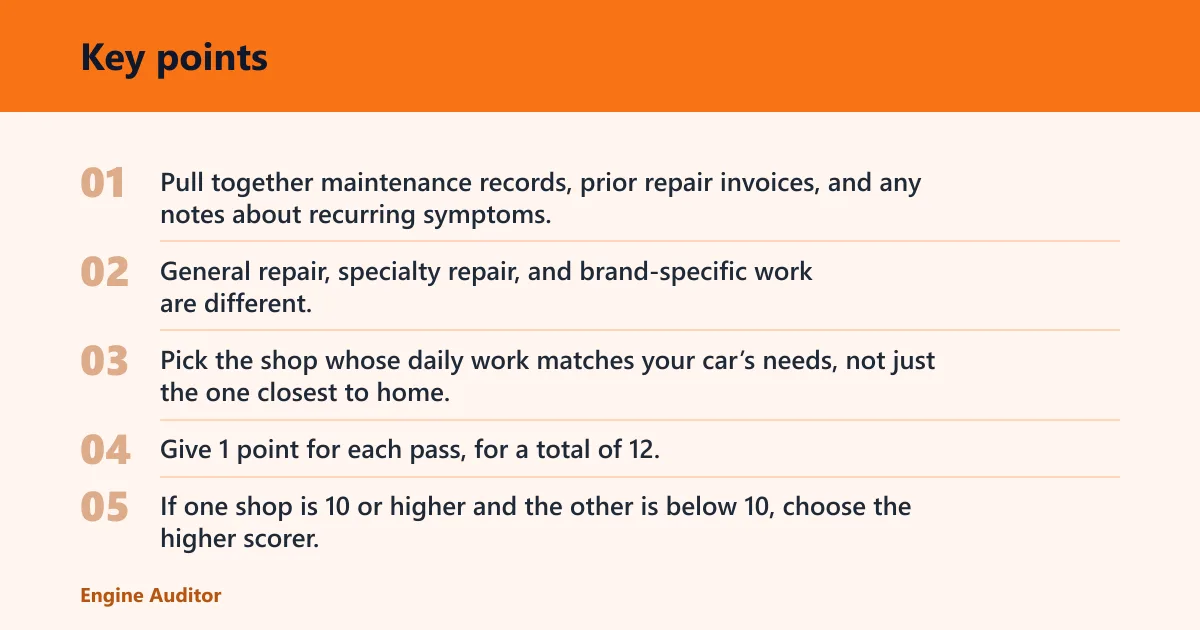
Pull together maintenance records, prior repair invoices, and any notes about recurring symptoms. That history helps you spot whether a shop is consistent with previous repairs and whether a new estimate fits the car’s actual needs. It also gives you a baseline if the same fault returns.
Match the shop to the job
General repair, specialty repair, and brand-specific work are different. A shop that handles routine brake, battery, and suspension work may not be the best fit for European diagnostics, hybrid battery issues, or a complicated drivability fault. Pick the shop whose daily work matches your car’s needs, not just the one closest to home.
| Category | Check | Pass criteria | Red flag |
|---|---|---|---|
| Credentials | ASE certification | Technician certification can be verified by area, such as brakes, engine repair, or electrical systems | No verifiable credential, or the shop uses certification talk with no names or areas listed |
| Credentials | Business licensing and insurance | Shop can show required state or local business paperwork and basic liability coverage | Won’t answer basic licensing questions or gets evasive about coverage |
| Communication | Plain-language explanation | Advisor can explain the failure, the test plan, and the repair in plain terms | Heavy jargon, no clear diagnosis path, or shifting explanations |
| Communication | Follow-up timing | Calls or texts arrive when promised, especially if diagnosis takes longer than expected | Silent delays or changes made before you hear from the shop |
| Estimate clarity | Written estimate | Estimate lists parts and labor separately before work starts | Only a single total, no line items |
| Estimate clarity | Diagnostic fee disclosure | Any diagnostic fee is stated upfront, including what it covers | Hidden fee added later or vague “shop charge” language |
| Authorization controls | Approval for extra work | No added work starts without new approval | Shop says it “had to” proceed without asking |
| Authorization controls | Estimate change notice | Any higher total is explained before the repair continues | Price changes appear only on pickup |
| Authorization controls | Parts return policy | Shop explains what happens to old parts if you ask to see them or take them back | Refuses to discuss removed parts |
| Warranty and invoice quality | Parts warranty | Duration is stated in months or miles | “Guaranteed” with no length |
| Warranty and invoice quality | Labor warranty | Labor coverage is separate from parts coverage | Only parts are covered, or the terms are unclear |
| Warranty and invoice quality | Itemized final invoice | Invoice shows labor, parts, part numbers or descriptions, and final price reconciliation | Receipts that do not match the estimate or no reconciliation at pickup |
Score two shops by this table. Give 1 point for each pass, for a total of 12. If one shop is 10 or higher and the other is below 10, choose the higher scorer. If both are 10 or higher, pick the one with clearer authorization controls and cleaner invoices. If both are below 10, keep shopping.
How do you check reviews the right way?
Use Google reviews, complaint patterns, and reply quality together, not star rating alone. A shop with fewer but recent reviews may be easier to judge than one with a high average built years ago. BBB records can add context, but they do not tell you whether a shop can diagnose or repair your car correctly.
Look for volume and recency
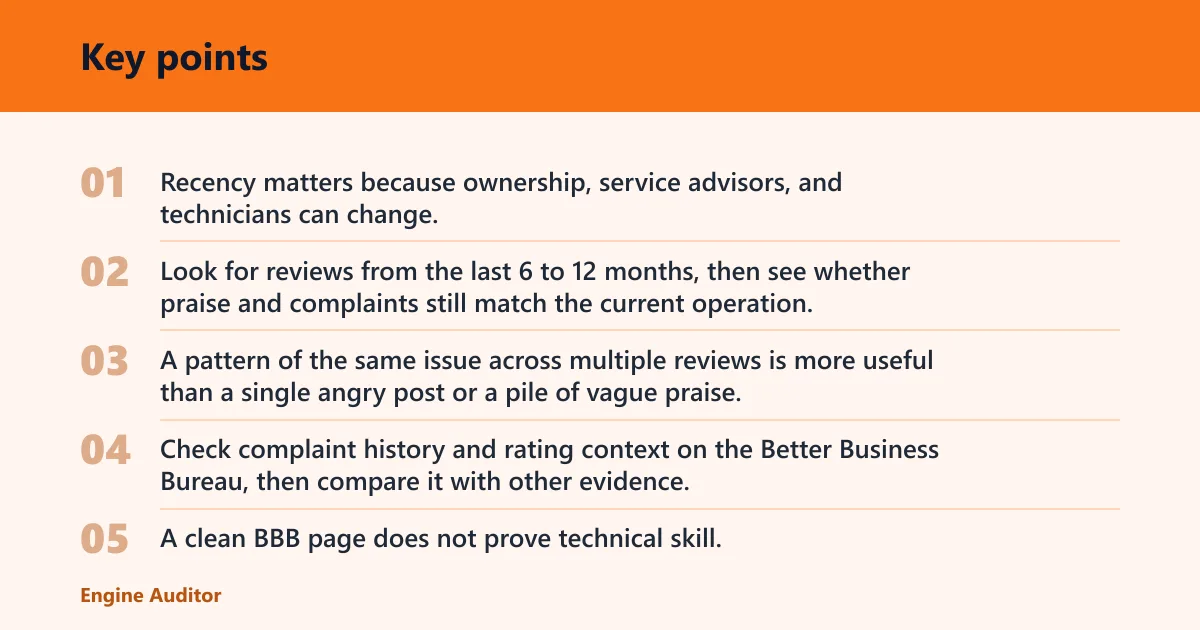
Review volume matters because five stars from ten people says less than a strong pattern across dozens of recent reviews. Recency matters because ownership, service advisors, and technicians can change. Look for reviews from the last 6 to 12 months, then see whether praise and complaints still match the current operation.
Read complaint patterns, not just stars
Focus on repeated themes: surprise charges, poor communication, failed fixes, repeated visits for the same fault, or pressure to approve extra work. A few complaints are normal. A pattern of the same issue across multiple reviews is more useful than a single angry post or a pile of vague praise.
Use BBB records as one signal
Check complaint history and rating context on the Better Business Bureau, then compare it with other evidence. A clean BBB page does not prove technical skill. A messy one does not automatically disqualify a shop if the complaint count is small and the response history is organized and specific.
Say your check engine light comes on and the shop points to an OBD-II code within five minutes. That code is only a starting point. A reliable mechanic still explains the diagnostic path, checks the fault conditions, and confirms whether the code matches the symptom before asking for expensive work.
What should a written estimate include?
A written estimate should show parts and labor separately, disclose any diagnostic fee up front, and say what changes require new approval. That document protects you from vague totals and gives you a baseline for comparing shops. If the estimate is vague, the repair process usually is too.
Check the line items
The estimate should identify the repair, list parts and labor separately, and show whether parts are new, remanufactured, or used. If the shop cannot separate those costs, you have less room to judge whether the price is fair. Ask for the estimate before any work begins.
- Ask for the diagnosis first. Before approving repairs, request the symptom, the test used, and the likely cause. If the shop has only an OBD-II code or a road-test note, that is not a full diagnosis.
- Request a written estimate. The estimate should list parts, labor, tax, and any shop fees. A single number hides where the money goes and makes later changes harder to challenge.
- Confirm the diagnostic fee. Ask whether the fee is due even if you decline the repair, and what it covers. That keeps the estimate honest and avoids a surprise at pickup.
Watch how changes are handled
If the shop finds extra work, it should stop and ask before moving ahead. You should get a new estimate or a clear revision, not a casual “we already fixed it.” A good shop also explains whether the old parts can be returned, especially for major repairs.
Suppose a brake estimate starts at $420, then grows because calipers are “stuck” after teardown. That may be valid, but the shop should call first, explain why the total changed, and let you approve the new amount before more labor is billed.
How should authorization and follow-up work?
Customer authorization should happen before extra work starts, not after the bay is already occupied. You should get clear notice of estimate changes, a chance to approve or decline them, and a final repair invoice that matches what was authorized. That is where trust becomes measurable.
Verify approval before more work
Ask who can authorize added work, how they will contact you, and what happens if they cannot reach you. Shops should have a consistent process for calls, texts, and written approval. If they cannot explain that process, they may not respect it either.
Use the invoice as your receipt of record
The repair invoice should itemize labor and parts, include part numbers or descriptions when available, and reconcile the final price against the estimate. Look for a clean match between what was approved and what was billed. If the final total differs, the invoice should show why.
Compare warranty terms carefully
Ask about both parts warranty and labor warranty, and compare duration in months or miles. Those terms should be written, not implied. A shop that repairs a part for about 12 months or 12,000 miles is making a different promise than one that covers labor for about 90 days only.
Which mechanic are you trusting?
You are trusting the person turning the wrench and the shop behind that person. Technician skill, shop policy, and paperwork quality are different things. A competent technician with weak authorization controls can still create a bad repair experience, while a well-run shop with average skills may still communicate clearly and bill accurately.
What certifications should a good mechanic have?
ASE certification is an automotive technician credential, and it can be checked by certification area. It signals baseline training in a specific system, such as brakes, engine performance, or electrical work. It is useful, but it is not a guarantee of perfection or honesty.
Should you use a dealership or an independent shop?
A dealership can make sense for brand-specific software issues, warranty work, or vehicles that need factory-level procedures. An independent shop often fits routine maintenance, brakes, suspension, and many common drivability repairs. Choose based on the job, the car, and the shop’s documented experience, not on the logo alone.
When does specialty repair matter?
For EVs, hybrids, European cars, or high-mileage vehicles, the right fit matters more. A shop may be excellent at general repair and still be the wrong choice for high-voltage systems, module coding, or difficult oil leaks on a specific platform. Ask what similar work they handle every week.
What questions should I ask a mechanic before repairs?
Ask for the cause, the test result, the price breakdown, and the approval process before any repair starts. Good questions force the shop to show its reasoning instead of hiding behind vague language. You are not looking for charm. You are looking for evidence.
Questions that get useful answers
- What failed, and what test confirmed it?
- Is the estimate written, with parts and labor separate?
- Is the diagnostic fee disclosed up front?
- What warranty applies to parts and labor?
- Will you call before any extra work starts?
What should a mechanic inspection include? At minimum, it should identify the symptom, verify stored codes if the check engine light is on, inspect the related system, and explain whether more testing is needed. A good inspection also notes what was checked and what was not, so you can judge the next step.
Frequently asked questions
How can I tell if a mechanic is honest?
Honesty shows up in specifics: they disclose the diagnostic fee, call before extra work, and give you an invoice that matches the estimate. Vague praise is weak evidence. Clear answers, itemized paperwork, and consistent follow-through are much better signs.
How do I avoid being overcharged for car repairs?
Get the repair in writing, ask for separate parts and labor, and approve any estimate change before work continues. Compare warranty terms and review whether the invoice matches the original quote. If the shop resists those basics, keep looking.
How do I check mechanic reviews the right way?
Read recent Google reviews, look for the number of reviews, and study complaint patterns. Focus on repeated issues like comebacks, surprise charges, or poor communication. Use BBB records only as context, not as proof of technical quality.
When should I get a second opinion on car repairs?
Get a second opinion when the repair is expensive, the diagnosis is uncertain, or the problem returns after work is done. That matters especially for intermittent symptoms and complex systems. A second estimate can confirm whether the first shop’s plan is reasonable.
Products related to this article
Sponsored / affiliate links. As an Amazon Associate I earn from qualifying purchases. I may earn additional commission from eligible campaigns.