Can an Electric Car Be Jump-Started?
Yes, but only for the 12V battery system; you cannot “jump-start” the high-voltage drive battery, and an EV should only be used as a donor if the owner’s manual allows it. OEM jump procedures typically direct you to the low-voltage battery or designated boost points, not the traction pack. A wrong connection can blow fuses, damage control modules, or leave both vehicles disabled. This guide gives a safety-first decision path for EV 12V rescues, EV-to-EV jumps, and when to stop and call roadside help. For related background, see EV 12V battery replacement, what the DC-DC converter does, roadside assistance for EVs, and hybrid jump-start guidance.
Why the traction battery isn’t jump-started like a gas car


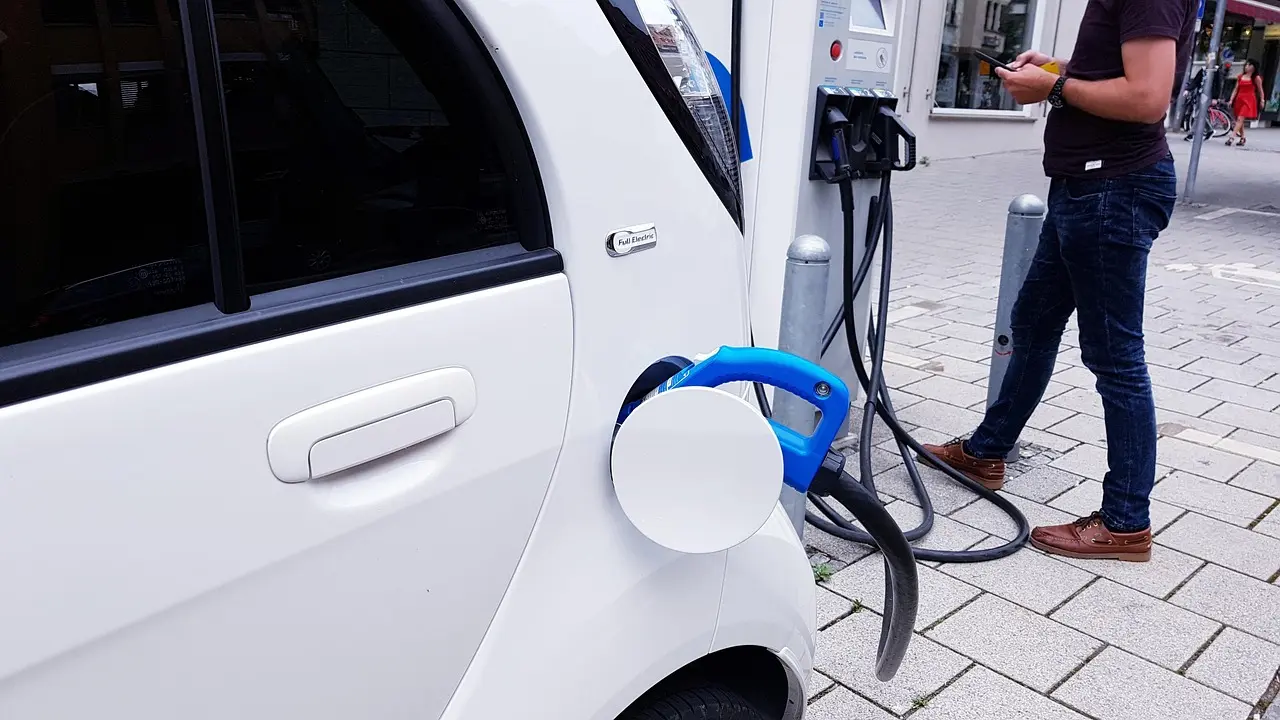
An electric car can often be jump-started through its 12V auxiliary battery system, rather than the high-voltage traction battery. That low-voltage battery commonly powers locks, control modules, and wake-up circuits. If it is flat, the car may not unlock, boot up, or enter accessory mode even when the main battery is charged. AAA and manufacturer guidance consistently treat the 12V system as the jump-start target, not the traction battery.
Why the traction battery is a different system
The traction battery is the propulsion battery. It is not the battery you connect jumper cables to in normal consumer guidance. The 12V auxiliary battery is the one that usually matters for starting the car’s computers and relays, while the DC-DC converter takes over once the vehicle is awake and running. OEM manuals and roadside guidance warn against treating the traction pack as a consumer jump point.
What changes from model to model
Jump points, battery access, and wake-up steps vary by model. Some vehicles place the 12V battery under a front hood, while others put it in the rear or hide it behind trim or service covers. Read the jump-start section in the owner’s manual first, because it lists approved points and the exact steps for that vehicle. Don’t rely on generic cable diagrams when the manual gives model-specific instructions.
Some newer EVs also support remote release or service-mode procedures, but those steps still depend on the specific model. An unknown battery location, a locked cabin, or a car that will not enter accessory mode changes the answer fast: stop and use roadside assistance. If the manual says donor use is allowed, it still only applies to the listed low-voltage setup and approved points.
What to check before you touch the cables
Before you connect anything, confirm the jump-start section in the owner’s manual, identify the approved 12V point, and check whether the car can enter accessory mode. If the manual is not available or the battery location is unclear, do not guess at the layout. Pause and verify first. AAA, RAC, and OEM instructions all emphasize correct polarity, approved terminals, and stopping when access or identification is uncertain.
Find the owner’s manual jump-start section
Look for the approved jump-start points, the correct sequence, and any notes about the EV’s power-up steps. Some manuals specify a positive terminal under a service cap and a separate ground point for the negative clamp. Others give model-specific warnings about what not to touch. The manual is the authority on whether a donor vehicle is permitted at all.
Confirm the 12V battery location or jump points
Do not assume the battery is in the front compartment. Location varies by model, and the wrong access panel can put you near electronics that are not meant for jump starting. If you cannot confirm the location, use roadside assistance instead of opening random trim panels. Hidden frunk or hood-release layouts are a stop condition when the release method is unknown.
Check whether the car can enter accessory mode
If the EV cannot wake up, accessory mode may be unavailable. That often points to a flat 12V battery, a lockout problem, or a fault that is larger than a simple boost. If the dash stays dark and the vehicle will not respond, do not keep retrying with repeated spark-producing connections. Repeated failures after wake-up are a clue that the underlying issue may be battery or charging-system related, not a one-time discharge.
A common first-timer mistake is treating a dead EV like a dead smartphone battery. Suppose the car is a hatchback with a charged traction battery but a flat 12V system. The doors may stay locked, the screen may stay black, and the car may need a proper 12V boost before anything else works.
EV jump-start decision matrix
| Scenario | Safe action | No-go condition |
|---|---|---|
| Dead 12V battery | Use the approved 12V jump points, a donor 12V source, or a portable jump starter that matches the vehicle’s low-voltage system requirements. | Do not connect to high-voltage components or guess at terminals. |
| Locked EV | Call roadside assistance if the car cannot be opened safely or the release procedure is unknown. | Do not force panels or try random access paths. |
| Unknown battery location | Read the owner’s manual first; if the location stays unclear, stop and get help. | Do not hunt for the battery under trim without confirmation. |
| Portable jump pack available | Use a 12V-only lithium pack with the correct polarity and the approved connection points. | Do not use a pack that does not match the vehicle’s low-voltage system. |
| EV as donor for another car | Use only if the manual allows donor use and the EV is awake, stable, and in the proper mode. | Do not assume every EV can power another vehicle. |
| DC-DC converter fault suspected | Try a single proper 12V boost only if the manual allows it, then plan service if the problem returns. | Do not keep repeating jump attempts as a repair strategy. |
| Car will not enter accessory mode | Stop and arrange roadside assistance or service. | Do not keep cycling connections or forcing the start sequence. |
| Polarity cannot be verified | Identify positive and negative before energizing the system. | Do not guess. Reverse connection can damage electronic control units. |
| Visible corrosion at the terminal | Clean the contact only if the manual and the site condition make it safe, then reconnect to the approved point. | Do not clamp onto loose, hot, or heavily corroded metal if the connection is unstable. |
| Battery access blocked by trim or covers | Follow the manual or use roadside assistance if access is not straightforward. | Do not pry at hidden components or work near unknown wiring. |
| Gas, diesel, or hybrid donor request | Check the donor car’s manual and the recipient vehicle’s requirements before attaching cables. | Do not treat the setup as universal across all drivetrains. |
| Repeated successful jump but car dies again | Arrange diagnosis of the 12V battery and DC-DC converter. | Do not assume the boost fixed the root cause. |
| Sparks or heat at the clamp | Disconnect and verify the setup before trying again. | Do not continue energizing a questionable connection. |
How to jump-start an EV safely
If the manual approves it, use the designated 12V jump points, connect the clamps with correct polarity, and keep clear of high-voltage components. A common sequence is positive to positive first, then the grounded negative connection at the approved point. Do not improvise by clamping onto random metal. OEM procedures and battery-safety guidance both prioritize approved terminals, not convenience.
Use the approved 12V jump points
The owner’s manual should tell you where to connect. Many EVs provide a dedicated positive post and a specific ground point. That matters because the wrong contact can damage electronics, cause sparks, or energize the wrong part of the system. If the manual shows a service cap or remote post, use that instead of the battery itself.
Connect the cables in the correct polarity order
- Confirm which terminal is positive and which is negative.
- Attach the positive clamp to the approved positive point.
- Attach the negative clamp to the approved ground point or donor negative terminal, as the manual specifies.
- Keep clamps from touching each other or any moving parts.
- Start the donor source or turn on the portable jump pack only after the clamps are set.
Keep clear of high-voltage components and sparks
Do not open orange high-voltage cabling, battery enclosures, or service hardware. Those parts are outside normal jump-start guidance. A spark at the wrong spot can damage control electronics, and reverse polarity can create a much larger repair problem than the flat battery. If the clamps get warm, smoke appears, or you see an immediate spark at hookup, stop and reassess before proceeding.
Can you use an electric car to jump-start another car?
Sometimes, but only if the EV’s owner’s manual allows donor use and the vehicle’s low-voltage system can support it. An EV can act as a 12V donor in some cases, but that does not mean every model should do it. A portable jump starter is often the safer first choice, especially when the donor policy is unclear.
When an EV can act as a 12V donor
An EV may be suitable as a donor if it has an approved 12V output path, is awake and stable, and the manual permits donor use. Use the same basic donor rules you would use with any 12V source: correct polarity, approved contact points, and no guesswork about grounding. If the donor vehicle needs to stay in a specific operating state, follow that instruction exactly.
When to use a portable jump starter instead
A portable jump starter is a 12V-only lithium pack made for emergency starts. It is often safer than improvising with another vehicle because it reduces the chance of mismatched systems, unstable donor voltage, or confusion about grounding. Use one only if it matches the vehicle’s low-voltage requirements and the vehicle’s manual does not prohibit that method.
Why donor-car rules still matter for EVs
Even though the EV is not running a gasoline starter motor, donor-car rules still matter because the jump is about the 12V system. Polarity, spark control, and approved connection points still apply. The donor source is only a tool. The manual decides whether that tool is appropriate. That caution becomes even more important if the EV has a sensitive control network or a service-mode wake procedure.
Can an EV jump-start a gas, diesel, or hybrid car?
It may be possible for a gas car, but only in limited, manual-approved cases. Diesel engines and some hybrid or start-stop systems place higher demand on the donor source. If the EV manual does not explicitly allow donor use, do not assume it can support the other vehicle’s starting load. The question is not just whether it can, but whether the manufacturer permits it.
Gas car donor scenarios
A small gasoline car with a modest 12V starting load is the most plausible donor target, but only if the EV manufacturer permits donor operation. Use approved clamps and correct polarity. If the target car has unusual electrical faults, a portable jump starter or roadside service is the better call. A normal gas-car load is still only acceptable when the manual says the EV can serve as a donor.
Diesel and higher-demand starting cases
Can an electric car jump start a diesel? Usually not something to assume. Diesel starting loads are often higher, and many EVs are not intended to supply that kind of demand. If the recipient vehicle is diesel, treat the situation as a roadside assistance case unless the manuals for both vehicles clearly say otherwise. A diesel load can exceed what a typical EV donor setup is intended to provide.
Start-stop and hybrid systems
Can an electric car jump start a petrol? Sometimes, but the same manual check applies. Can an electric car give a jump start to a hybrid? That is even more model-sensitive because hybrid systems may have their own wake-up requirements and protective electronics. Do not treat them as ordinary 12V recipients. If the hybrid guide says a specific sequence is required, follow that sequence or stop.
Why a jump may not solve the problem
A successful jump can wake the car temporarily, yet the root problem may still be a failing 12V battery or a faulty DC-DC converter. The DC-DC converter is the part that typically steps high-voltage energy down to 12V when the car is on. If it fails, the EV may keep acting dead or fall back to the same problem soon after. RAC and OEM troubleshooting guides commonly point to this distinction when the vehicle repeatedly loses low-voltage power.
Dead auxiliary battery versus failed DC-DC converter
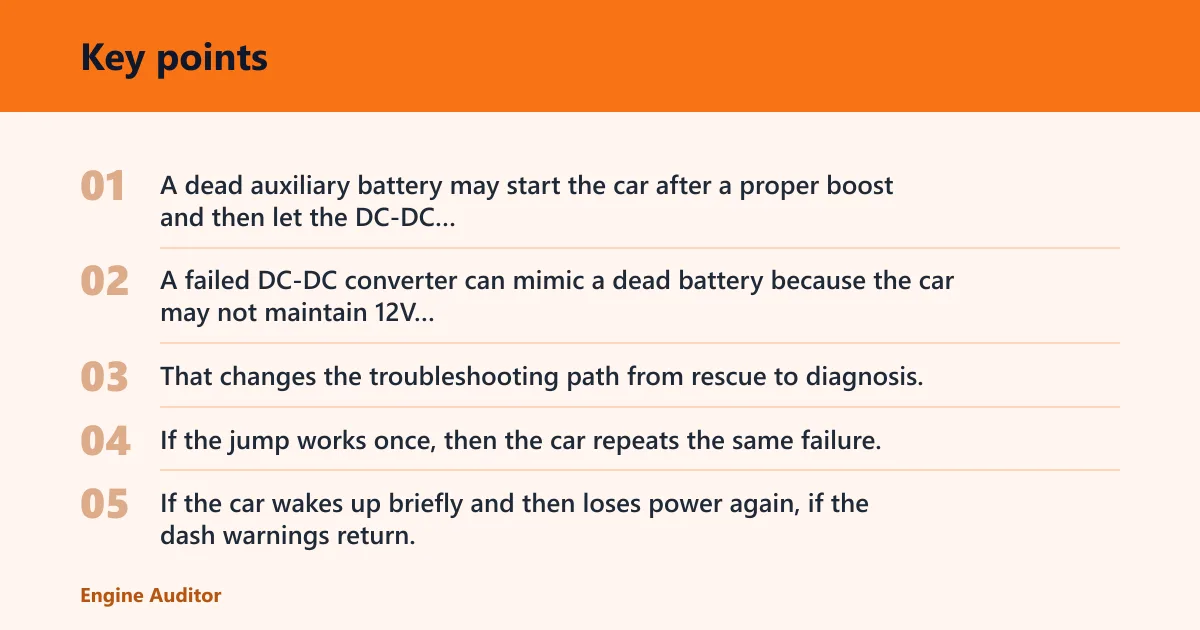
A dead auxiliary battery may start the car after a proper boost and then let the DC-DC converter recharge it once the vehicle is on. A failed DC-DC converter can mimic a dead battery because the car may not maintain 12V power after the boost. That changes the troubleshooting path from rescue to diagnosis. If the jump works once, then the car repeats the same failure, suspect a charging-system fault rather than a one-off discharge.
Signs the EV needs service, not another boost
If the car wakes up briefly and then loses power again, if the dash warnings return, or if the battery goes flat after a short drive, the problem is likely deeper than a one-time discharge. Repeated jump-starts can hide the fault for a day and still leave the car stranded later. Repeated wake-up failures, corrosion that keeps returning, or a battery that does not hold charge all point toward service diagnosis.
When roadside assistance is the safer next step
Call roadside assistance when the battery location is unknown, the EV is locked, access is blocked, the car cannot enter accessory mode, or polarity cannot be verified. Roadside help reduces the chance of damaging control units and is the right next move when the car is not ready for a standard 12V rescue. It is also the best answer when the frunk or hood release cannot be accessed safely.
Frequently asked questions
Can an electric car be jump started?
Yes, many electric cars can be jump started through the 12V auxiliary battery system. That does not mean the high-voltage traction battery is involved in the jump. Read the owner’s manual first, verify the approved jump points, and stop if the car will not wake up or the battery location is unclear.
Can an electric vehicle be jump started?
Yes, an electric vehicle can often be jump started in the same limited sense: the 12V system can be boosted. The traction battery is a separate system. If the EV is locked, unresponsive, or unable to enter accessory mode, roadside assistance is safer than guessing at terminals.
Can an electric car be used to jump start another car?
Sometimes, but only if the EV manual allows donor use and the donor setup matches the vehicle’s low-voltage system. Use correct polarity and approved grounding. If you are unsure whether the EV can supply another car safely, a portable jump starter is usually the better choice.
Can an EV be jump started?
Yes, if the issue is the 12V auxiliary battery and the manufacturer provides an approved procedure. A failed DC-DC converter can look like a dead battery, so a jump that works once may not solve the underlying fault. If the problem repeats, plan service instead of more boosts.
Can you jump an electric car?
You can often jump an electric car’s 12V system, but you should not connect to high-voltage components or assume the battery is easy to reach. Use the owner’s manual, correct polarity, and the approved jump points. If access is blocked or unknown, call roadside assistance.
Can an electric car jump start another?
Sometimes, but not automatically. An EV can act as a donor only when the manual allows it and the low-voltage system can support the task. That same caution applies whether the other vehicle is gasoline, diesel, or hybrid. If the manual is silent, do not improvise.
Products related to this article
Sponsored / affiliate links. As an Amazon Associate I earn from qualifying purchases. I may earn additional commission from eligible campaigns.