Can You Tow an Electric Car? What Owners Should Know
Yes, but the default answer for most EV recoveries is a flatbed, and the exact towing method must follow the owner’s manual for that make, model, and year. Tesla, Kia, Hyundai, and GM manuals all use model-specific limits for transport mode, wheel lift, dollies, and wheels-on-ground movement, so a generic tow rule is not enough.
EV recovery starts with the failure state, not with the truck. If the car rolls freely, the 12-volt system is awake, and the manual allows a specific transport method, loading may be straightforward. If the wheels are locked, the parking brake will not release, or the car has crash damage, the safest answer is still a flatbed.
Telling dispatch exactly what your EV can and cannot do
Because EV drivetrains can generate electrical current when the wheels turn, towing can create regenerative braking, inverter stress, or battery-related faults if the wrong axle is allowed to roll. Tesla’s towing instructions, Kia’s EV towing guidance, Hyundai’s emergency towing sections, and GM roadside guidance all make the same point in different ways: flatbed is the safest default, and any exception is model-specific.
What to say when you call for a tow
Tell dispatch the vehicle model, whether it rolls, whether the 12-volt battery is dead, whether any wheels are locked, whether the car has collision damage, and whether the manual allows Transport Mode or another exception. Ask for a flatbed unless the owner’s manual for that exact EV says a different setup is permitted.
- “EV, exact year/model, and the manual needs to be followed.”
- “Tell me whether you can send a flatbed with skates or dollies if needed.”
- “The 12-volt battery may be dead, so Tow/Transport Mode might not work.”
- “Please do not assume wheel-lift or dolly towing is allowed.”
EV towing decision table
Use this table to match the failure state to the safest recovery method before the truck arrives. The dispatch note column is the exact language to give the tow operator, and the new column explains why that setup is usually required or what manual check still matters.
| Scenario | Safest recovery method | What to tell dispatch | Why this method / Manual check needed | Red flags |
|---|---|---|---|---|
| Empty traction battery | Flatbed, with the car loaded rather than driven | “The high-voltage battery is empty. It may not power the car, but it still needs a flatbed for transport.” | An empty traction battery does not automatically make wheel-on-ground towing safe. The manual may still require Transport Mode, and EVs can still have parking-brake or drivetrain limits even when the pack is depleted. | Do not assume the car can be charged by towing. Do not ask for wheel-on-ground towing just because the pack is empty. |
| Dead 12V battery | Flatbed, or external 12-volt power first if the manual requires it | “The 12-volt battery is dead, so the parking brake may not release and tow mode may not work.” | A dead 12V battery can block Tow/Transport Mode on many EVs because the low-voltage system wakes the control modules. Manual check needed for the exact jump-point and release procedure. | The car may not roll, enter Tow Mode, or shift into a transport setting without outside power. |
| Locked wheels | Flatbed with skates, wheel dollies, or other loading aid if the operator uses them | “One or more wheels are locked. Bring skates or a loading method that does not require those wheels to roll.” | Locked wheels can make wheel-lift towing unsafe because dragging a tire or hub can damage suspension and driveline parts. Manual check needed for any approved loading aid and axle orientation. | Do not let the operator drag a locked wheel on pavement. |
| AWD EV | Flatbed unless the owner’s manual gives a narrow alternate procedure | “It is all-wheel drive. Please send a flatbed and follow the model manual, not a generic tow setup.” | AWD with one axle lifted can still spin the wrong motor or gearset unless the manual specifically allows that exact arrangement. Manual check needed for axle position and maximum distance. | AWD models are more likely to be flatbed-only; wheel-on-ground towing can drive the wrong axle. |
| Single-motor EV | Flatbed by default; only manual-approved loading exceptions | “It is a single-motor EV, but I still want flatbed transport unless the manual explicitly allows another method.” | Single-motor layout does not automatically permit wheel-lift towing. Manual check needed because some rear-drive or front-drive models still restrict wheel rotation or distance. | Do not assume rear-drive or front-drive layout makes wheel-lift towing safe. |
| Transport Mode available | Flatbed; transport mode only for loading or very short movement | “Transport Mode is available. Use it only to load the car; do not move it farther than the manual allows.” | Transport Mode exists to help load the vehicle, not to replace towing. Tesla’s owner guidance limits its use to very short, low-speed movement; the same principle appears in other EV manuals with different wording. | Transport Mode only allows tires to rotate slowly under the manual’s limit; it is not ordinary towing permission. |
| Transport Mode unavailable | Flatbed with external power or loading aids if needed | “Transport Mode is unavailable. The car may need 12-volt power or skates to get it on the truck.” | If Transport Mode cannot be enabled, the manual may require external 12-volt power or a specific release sequence before loading. Manual check needed because the wake-up method varies by model. | A dead 12V battery may prevent the EV from entering tow mode. |
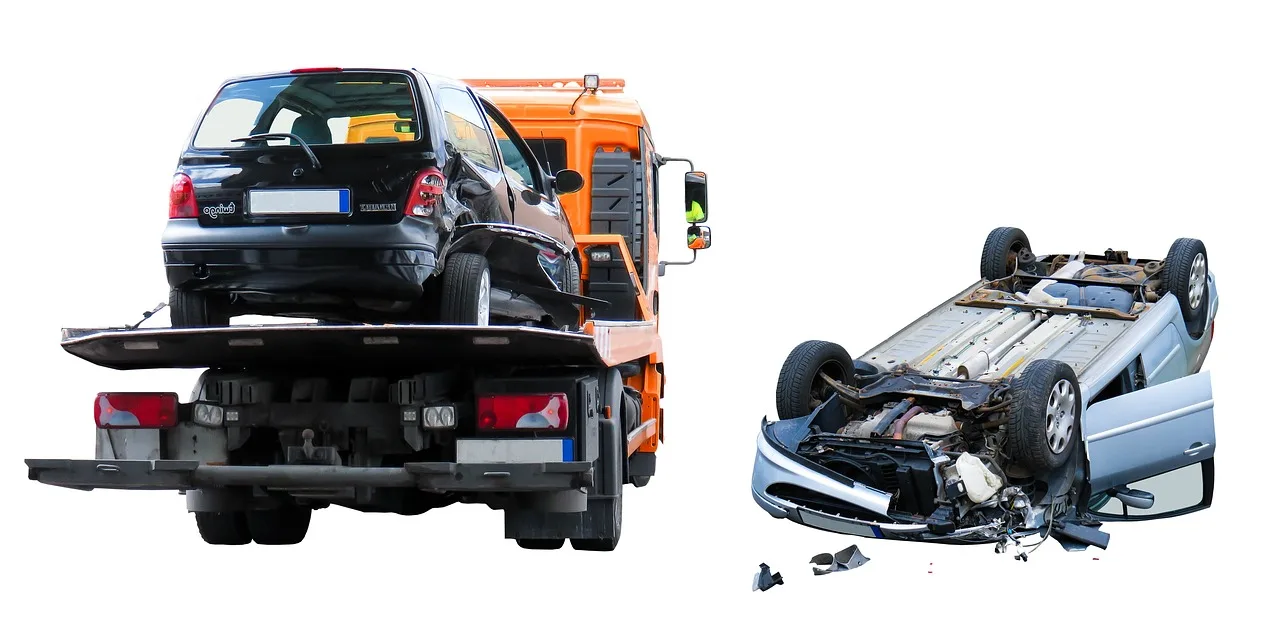
| Post-collision damage | Flatbed only | “The car has crash damage. Please treat it as a flatbed-only recovery with no wheel rotation until the suspension and driveline are checked.” | Crash damage can trigger high-voltage isolation faults, bent suspension, and wheel/brake binding. NHTSA and automaker emergency-response guidance treat collision-damaged EVs as higher-risk recoveries that should not be dragged or rolled casually. | Broken suspension, bent wheels, shifted bodywork, or deployed restraints can make wheel-lift or dolly loading unsafe. |
What to tell dispatch first
Give dispatch four facts in this order: whether the car rolls freely, whether the 12-volt battery is dead, whether any wheels are locked or the suspension is damaged, and whether Transport Mode is available. That lets the tow company choose a flatbed, skates, external power, or another loading aid before it arrives.
Keep the description short and specific. “EV, dead 12-volt battery, front wheels locked” is better than a vague “it won’t move.” If the car is in a garage, on a condo deck, or nose-in against a wall, say that too, because tight loading space can change which truck and recovery gear fit.
Do EVs need a flatbed tow truck?
A flatbed is the safest default because it keeps all wheels off the road. Tesla towing instructions, Kia EV guidance, and GM roadside guidance all point toward flatbed transport when there is any uncertainty. Even where a manual allows a limited exception, the flatbed remains the cleanest answer for drivetrain and battery protection.
When a flatbed is mandatory
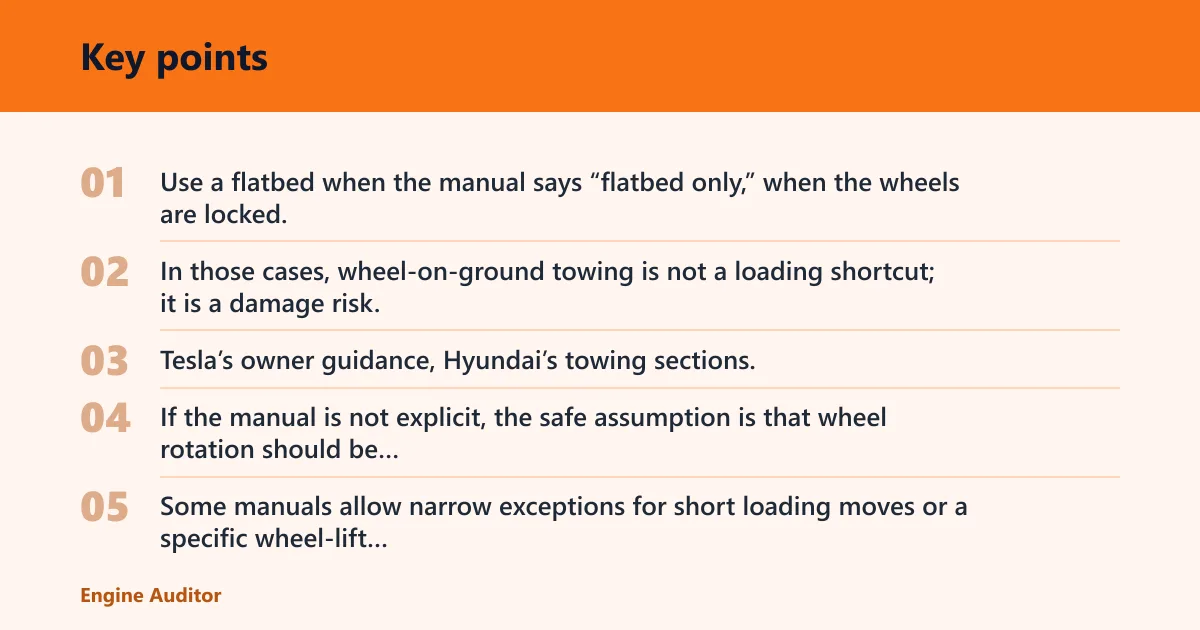
Use a flatbed when the manual says “flatbed only,” when the wheels are locked, when the parking brake will not release, when the car has crash damage, or when there is any doubt about which axle is driven. In those cases, wheel-on-ground towing is not a loading shortcut; it is a damage risk.
Tesla’s owner guidance, Hyundai’s towing sections, and GM emergency-response documents all treat the owner manual as the controlling source for recovery limits. If the manual is not explicit, the safe assumption is that wheel rotation should be avoided.
When limited wheel-lift or dollies may be allowed
Some manuals allow narrow exceptions for short loading moves or a specific wheel-lift and dolly setup. That is not the same as normal towing. The permission may depend on the exact model, drivetrain, and axle position, so a generic “EV tow” answer is not enough.
If the manual does not clearly allow that setup, do not treat it as permitted. A tow dolly lifts only two wheels, so the other two still roll. On an EV, that can mean unwanted drivetrain rotation and extra electrical load.
Why wheels on the ground are usually the wrong choice
Wheel-on-ground towing is usually the wrong choice because many EVs do not have a true neutral that fully disconnects the motor. Tesla and Kia both warn that the wheels should not be allowed to rotate freely unless the manual gives a narrow transport exception. That is because spinning wheels can still drive components during transport.
The main risks are the motor, inverter, parking brake, and high-voltage battery pack. Regenerative braking can appear when the wheels turn, and the resulting current can create heat or electrical stress. The safest habit is simple: if the manual does not clearly permit a limited wheel-on-ground move, ask for a flatbed.
What is tow Mode or Transport Mode?
Tow Mode, often called Transport Mode, is a software setting that helps load an EV by releasing the parking brake and letting the car roll under controlled conditions. It is not true neutral, and it usually applies only to very short, low-speed movement. It is for loading, not for ordinary towing across town.
What the setting does
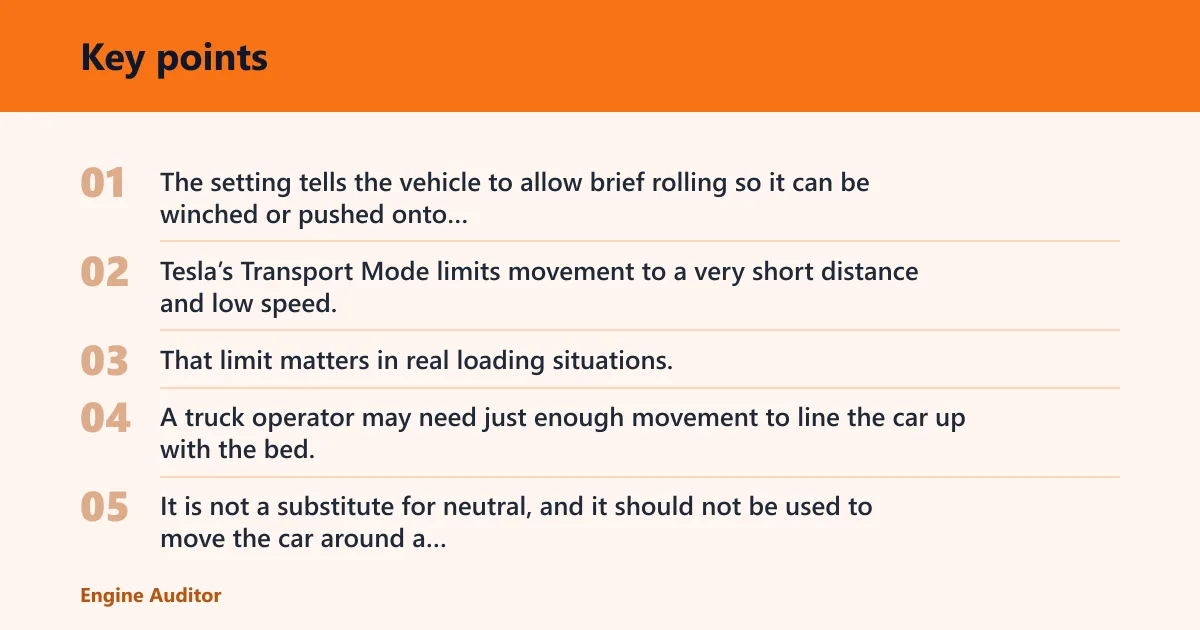
The setting tells the vehicle to allow brief rolling so it can be winched or pushed onto a truck. Tesla’s Transport Mode limits movement to a very short distance and low speed, while other automakers use different wording for the same basic idea: loading only, not road towing.
That limit matters in real loading situations. A truck operator may need just enough movement to line the car up with the bed, and then the transport mode is done. It is not a substitute for neutral, and it should not be used to move the car around a lot or down the road.
What to do when the setting is unavailable
If Transport Mode is unavailable, the recovery plan changes. The tow company may need external 12-volt power to wake the electronics, or skates and wheel dollies to get the car onto a flatbed without forcing the wheels to roll under load. A dead 12-volt battery can block the setting entirely.
A common first-timer mistake is assuming the car can “just be pushed” because the traction battery is empty. That misses the parking brake and control-module dependency. The safe answer is to load the vehicle, not to improvise a driveway-style push unless the operator says the model manual permits it.
Can you tow an EV if the 12-volt battery is dead?
Yes, but a dead 12-volt battery can make the job harder because that battery powers the electronics that release the parking brake and enter tow mode. Tesla, Hyundai, and Kia all use low-voltage wake-up procedures in their towing guidance, and a dead 12V system can block those steps entirely.
Why the 12-volt battery matters
The high-voltage battery pack powers propulsion, but the 12-volt battery runs the control systems that wake the car, shift it into Transport Mode, and release the parking brake. If that smaller battery is dead, the vehicle may look “off” but still resist loading. That is why roadside assistance often starts with external power before the tow truck moves in.
How a dead 12-volt battery blocks loading
If the 12-volt system cannot power the modules, the operator may not be able to put the car into the needed transport setting. The result is simple: no release, no roll, no easy loading. In that case, skates, dollies, or a powered jump to the 12-volt system may be needed before the flatbed can finish the job.
Suppose a compact EV is nose-in in a parking garage and the 12-volt battery is dead. The operator may be able to open the transport setting only after external 12-volt power is applied, then use a winch to load the car a few feet at a time. Without that power, the parking brake can stay locked and the wheels will refuse to turn.
What to do if an EV ran out of charge
If an EV ran out of charge, the first move is still a flatbed unless the owner’s manual gives a specific loading procedure. A depleted traction battery does not automatically mean the wheels can be rolled or towed normally. Some vehicles also need 12-volt power before they can release the parking brake or enter Transport Mode.
Do not assume a roadside charge is the right fix for every dead-EV call. If the car is unsafe to drive, in a bad location, or stuck because the low-voltage system is dead, recovery may be faster and safer than attempting to recharge on the spot.
What changes when the traction battery is empty
An empty traction battery usually means the car will not move under its own power, but it does not remove tow restrictions. The manual may still require a flatbed, a short loading roll only, or a specific Tow Mode sequence. The key check is whether the vehicle can be placed into the exact transport state the manual allows.
Why “empty” is not the same as “easy to tow”
Even with no propulsion available, the parking brake, steering lock, and control modules can still resist movement. That is why a “ran out of charge” call should be treated as a recovery job first and a charging job second. Flatbed loading avoids guessing about drivetrain rotation and transport limits.
What to tell a tow company before they pick up my EV?
Tell the tow company the failure state first, then the loading condition. Say whether the car rolls freely, whether the 12-volt battery is dead, whether any wheels are locked, whether the car has crash damage, and whether Transport Mode is available. Ask for a flatbed unless the owner’s manual clearly allows another method.
Use this call script
- State the vehicle type and whether it is AWD or single-motor.
- Say whether the traction battery is empty or the car simply will not start.
- Report any dead 12-volt battery, locked wheels, or parking-brake issue.
- Say whether Transport Mode is available and whether the owner’s manual allows any exception.
- Ask for a flatbed and mention any garage, curb, tight turn, or crash damage.
If the operator sounds unsure about EV loading, ask for an EV-capable tow company or roadside assistance provider. That is especially important for condo decks, narrow lanes, or post-collision recoveries where a bad setup can grind tires, drag suspension parts, or force a wheel rotation the car should not see.
What is safe for your EV?
The safest setup depends on the manual, the drive layout, and the failure mode. A flatbed is still the default answer, but wheel-lift or dolly recovery may be allowed only in narrow, model-specific cases. If the manual is unclear, the wheel is locked, or the car has body or suspension damage, choose the flatbed and stop there.
Tow dolly limits
A tow dolly is risky for EVs because it leaves two wheels rolling on the road. That can be acceptable only when the exact owner’s manual permits it for that model, distance, and axle combination. Otherwise, a dolly can spin the wrong components and create transport damage.
Wheel-lift risks
Wheel-lift towing can be acceptable only when the manual specifically allows the axle arrangement and distance. Even then, the car may need the remaining wheels lifted or supported so the drivetrain does not spin in a harmful way. Tesla, Kia, and Hyundai manuals all keep the model-specific rules front and center.
AWD versus single-motor layouts
AWD EVs are more likely to need flatbed transport because one axle can force the other components to rotate in ways the manual does not allow. Single-motor EVs are not automatically safe for wheel-on-ground towing. The model manual is the final word, not the number of motors.
Manual instructions override general advice
The owner’s manual is the primary source for model-specific towing instructions. Some brands require flatbed only, while some models allow limited wheel-lift plus dollies under strict conditions. If the manual says a specific method is allowed for loading or short-distance transport, that instruction overrides broad general advice.
Can an electric car be towed with the wheels on the ground? Sometimes, but only when the manual gives a narrow exception and the car can be loaded within those limits. For most EVs, the answer is no, because wheel-on-ground towing can create regenerative braking, unwanted current, and damage to the inverter or high-voltage battery pack.
Frequently asked questions
Can you tow an electric car safely?
Yes, if you use the correct method for that specific model. The safest default is a flatbed because it keeps all wheels off the road. If the wheels are locked, the parking brake will not release, or the car has crash damage, flatbed transport is the safest and most practical choice.
Can an electric car be towed with the wheels on the ground?
Usually not. Many EV manuals either forbid it or allow only very short loading movement under specific conditions. The reason is that wheel rotation can create regenerative braking and electrical stress. For the exact answer, check the owner’s manual for that make, model, and year.
What is tow Mode or Transport Mode on an EV?
It is a setting that releases the parking brake and lets the car roll briefly for loading. It is not true neutral. Tesla’s Transport Mode and similar EV instructions from other automakers are limited to short loading moves, not ordinary towing.
Is a tow dolly safe for an electric car?
Usually not. A tow dolly leaves two wheels turning on the road, and that can spin parts the car was not meant to spin during transport. Use it only if the owner’s manual explicitly allows that exact setup, and confirm the axle arrangement before loading.
Products related to this article
Sponsored / affiliate links. As an Amazon Associate I earn from qualifying purchases. I may earn additional commission from eligible campaigns.