How Long Do Electric Car Batteries Last?
Most EV batteries are commonly reported to last about 10 to 20 years, or about 100,000 to 200,000 miles. Replacement usually makes sense only when usable range drops below your daily need. Ignore battery loss, and a usable car can become a planning problem with a repair bill that exceeds the car’s remaining value. This guide explains lifespan, range loss, warranty terms, and when replacement makes financial sense.
How long do EV batteries last?
For most owners, the practical answer comes down to years, miles, and the range left on the dash. Most EVs use lithium-ion battery packs, and those packs usually lose capacity gradually rather than failing all at once. Age matters even if the odometer stays low, and high mileage matters even if the car is still under warranty.
Years, miles, and what drivers usually notice
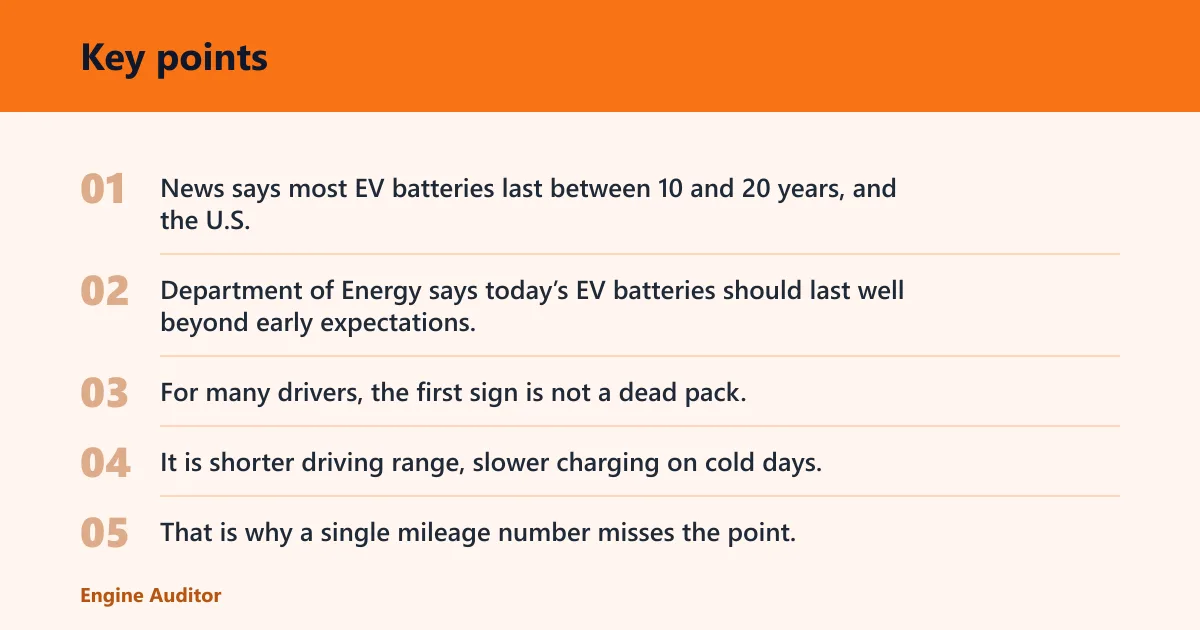
U.S. News says most EV batteries last between 10 and 20 years, and the U.S. Department of Energy says today’s EV batteries should last well beyond early expectations. For many drivers, the first sign is not a dead pack. It is shorter driving range, slower charging on cold days, or a need to charge more often than before.
That is why a single mileage number misses the point. A commuter who adds 8,000 miles a year may keep the same battery for many years, while a delivery driver can stack up cycle wear much faster. Calendar aging and cycle aging both matter.
Say your EV loses 12 percent of its usable range over several years. If it originally went 250 miles on a full charge, the pack may still deliver about 220 miles. That is degraded, but still useful if your daily drive is 40 miles and you charge at home.
What battery age means in real use
Battery age is not the same as battery failure. The battery management system controls charging and discharging, manages temperature, and protects the pack from overheating and deep discharge. That software and hardware protection is one reason modern EV packs often remain usable long after the first owner expects some decline.
When people ask how long EV batteries last before replacement, the better question is usually whether the remaining range still fits the owner’s routine. A battery can be worn enough to feel shorter, yet still be perfectly serviceable for local driving.
Battery degradation and warranty limits
Battery degradation means capacity loss over time. It comes from both calendar aging, which happens as the pack sits and ages, and cycle aging, which builds as the battery is charged and discharged. Heat, cold, driving style, and charging habits all affect the rate. Frequent DC fast charging, repeated full charges, and long periods at high state of charge can speed the process.
Why 70 percent capacity matters
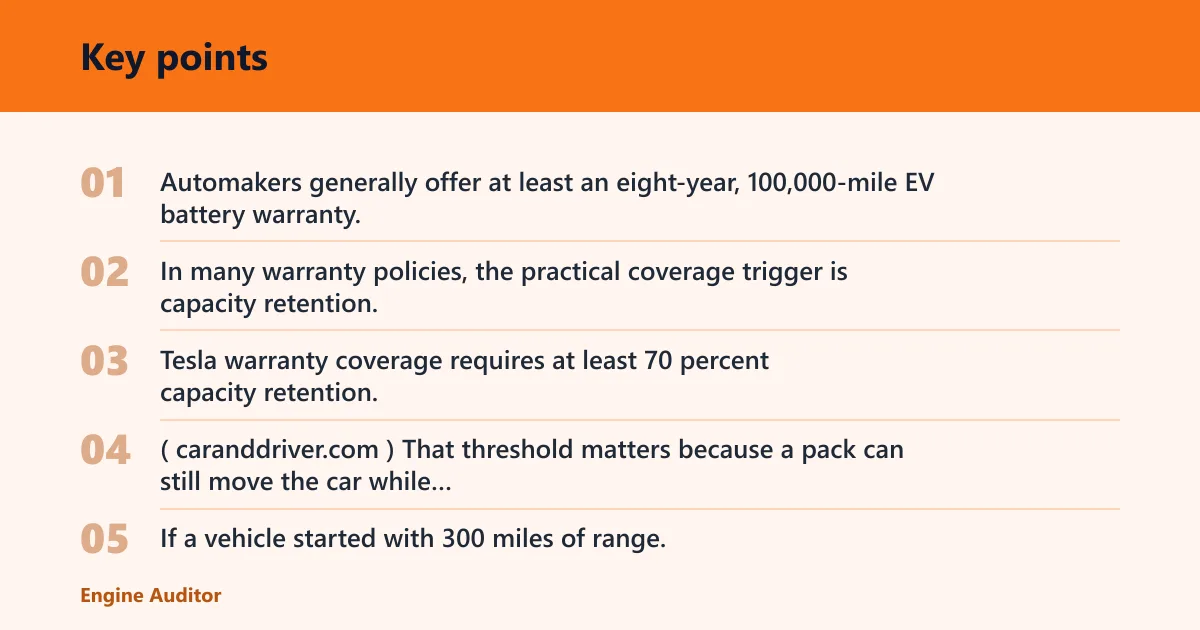
Automakers generally offer at least an eight-year, 100,000-mile EV battery warranty, and Tesla warranties can run from 100,000 to 150,000 miles depending on vehicle. In many warranty policies, the practical coverage trigger is capacity retention, not total failure. Tesla warranty coverage requires at least 70 percent capacity retention. (Caranddriver)
That threshold matters because a pack can still move the car while losing enough range to trigger concern. If a vehicle started with 300 miles of range, 70 percent capacity would imply about 210 miles of usable range under similar conditions. That is a meaningful drop, but not a dead battery.
What the warranty usually covers
EV battery warranties usually cover excessive capacity loss, not just a pack that stops working. They also do not replace every worn battery for free. Normal degradation is expected. Rare recalls, manufacturing defects, and accident damage are separate issues and are handled differently from ordinary wear.
Recurrent found that under 4 percent of EV batteries had been replaced across its community, and first-generation EV battery replacement rates were around 8.5 percent. Those figures support the same point: replacement is much less common than many shoppers fear.
Electric car battery life by driver type
Driver type changes the answer. Low-mileage owners often see calendar aging dominate. Commuters split wear between time and cycles. High-mileage drivers and fleets push more cycle aging into the same period, so useful life in miles can arrive sooner even if the pack still looks healthy on age alone.
Low-mileage and occasional drivers
If you drive a few thousand miles a year, the pack may age mostly by sitting, not by use. Lithium-ion batteries self-discharge at 1 to 2 percent per month, so a car left unused for long stretches still needs attention. Storage at a moderate state of charge is usually better than parking full for months.
Daily commuters and road-trip drivers
Commuters who charge at home often get long service life because they can use Level 2 charging and avoid constant rapid replenishment. U.S. The same source says Level 2 charging can refill an EV in hours, while DC fast charging can restore 80 percent in 30 minutes or less. Fast charging is useful on trips, but it adds more stress than routine home charging.
Rideshare, delivery, and fleet use
High-mileage use stacks cycle aging faster. A rideshare or delivery vehicle may still be covered by warranty on age, yet reach noticeable range loss sooner because it runs through more charge cycles. For these drivers, battery life is often measured by usable daily range, not by calendar years alone.
How long electric car decision table
This table turns battery-life risk into a quick ownership read. Use it to compare mileage, charging pattern, and climate before you assume a pack is near replacement.
| Driver type | Annual mileage | Charging pattern | Climate | Likely degradation risk | Maintenance habit that matters most |
|---|---|---|---|---|---|
| Occasional driver | Under 8,000 | Mostly home charging, long storage periods | Mild or garage-kept | Low | Keep the battery near mid-state of charge during long parking periods |
| Daily commuter | 8,000 to 15,000 | Level 2 at home, occasional 100 percent charge for trips | Mild to warm | Medium | Charge to 80 percent for daily use and schedule charging overnight |
| Road-trip driver | 15,000 to 20,000 | Mixed Level 2 and DC fast charging | Cold winters or hot summers | Medium | Limit DC fast charging to travel days and precondition the pack when possible |
| Rideshare or delivery driver | Over 20,000 | Frequent charging, often repeated top-ups | Any, especially hot weather | High | Reduce heat exposure and avoid leaving the pack at high charge for long periods |
| Fleet vehicle | High, with daily cycle use | Mixed charging, often scheduled around shifts | Varies by depot | High | Use thermal management and charging schedules that avoid constant full charges |
How should you charge daily?
For many EVs, charging to 80 percent daily is a common longevity target, while 100 percent is fine for road trips or other days when you need full range. The goal is not to ban full charges. It is to avoid leaving the pack at the top of its range when you do not need it.
Why 80 percent is common
U.S. The same source recommends charging to 80 percent daily for longevity in many EVs. That advice fits most lithium-ion packs because staying at very high state of charge can add stress over time. The battery management system helps, but it cannot erase chemistry limits.
Some batteries are different. Lithium iron phosphate, or LFP, is a lithium-ion subtype, and some Tesla models use LFP packs. LFP may be charged to 100 percent regularly, so owners should follow the automaker’s guidance instead of copying a rule meant for a different pack type.
When 100 percent makes sense
Charging to 100 percent is useful before a long trip, especially when you need the full buffer for highway driving, weather, or detours. A common first-timer mistake is treating 100 percent as harmful in every case. For many owners, it is simply the right setting on travel days.
Why DC fast charging is best saved for trips
DC fast charging is convenient, especially on the road, but it is harder on the battery than routine Level 2 charging. That does not mean it is forbidden. It means daily dependence on fast charging can add stress that home charging avoids.
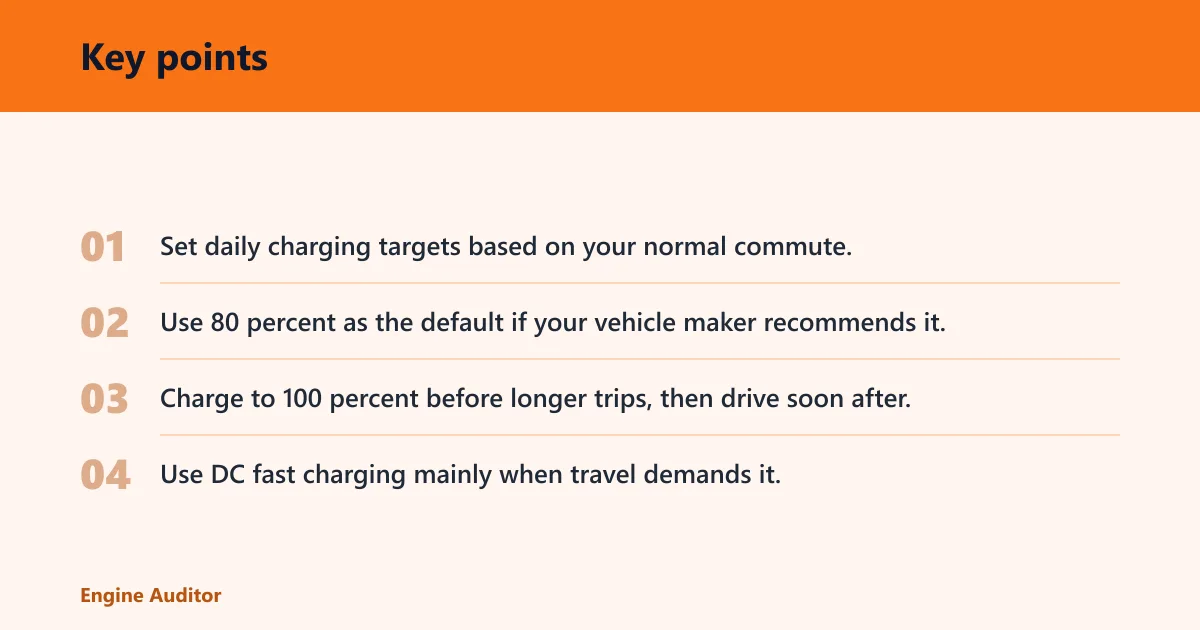
- Set daily charging targets based on your normal commute.
- Use 80 percent as the default if your vehicle maker recommends it.
- Charge to 100 percent before longer trips, then drive soon after.
- Use DC fast charging mainly when travel demands it.
What climate does to battery life?
Temperature affects both performance and long-term wear. U.S. The same source says ideal battery temperature is between 68 and 86 degrees Fahrenheit. Extreme heat and cold reduce performance, and heat is usually tougher on long-term battery health. Cold often cuts usable range first, even before it changes capacity much.
Heat, cold, and garage parking
Warm climates can shorten battery life because high temperatures accelerate degradation. Garage parking helps because it reduces exposure to temperature swings and direct sun. Cold weather usually brings a different problem: less immediate range, slower charging, and more energy spent on cabin and battery heating.
Picture a driver in a hot climate who parks outdoors every day and fast-charges after work. That pack faces both heat and repeated high-rate charging. A similar car parked in a garage and charged slowly at home will usually see a friendlier environment.
Weather and range before capacity
Many owners notice weather effects before they notice true battery aging. A winter commute may feel shorter because the pack is cold, not because the battery permanently lost that range. Once temperatures normalize, much of that lost distance comes back.
How much does battery replacement cost?
Battery replacement can be very expensive, and U.S. The same source says it can cost as much as $20,000. That number is one reason owners worry about every bit of degradation. In practice, a degraded battery is often still usable long before replacement becomes rational.
When replacement makes sense
Replacement usually makes sense only when the remaining usable range no longer fits your driving pattern, or when a defect leaves the car unreliable. If the pack still covers your daily needs with margin, keeping it is often the better financial move. Range loss alone does not automatically mean replacement.
When a degraded pack is still worth keeping
If your daily drive is 30 miles and the battery still delivers 180 miles, replacement is hard to justify. You may need more frequent charging, but the car still works. A worn pack becomes a bigger problem when winter range, highway use, or towing pushes the remaining buffer too low.
Recall, defect, and crash cases
Do not confuse normal wear with a recall, a manufacturing defect, or accident damage. Those cases can trigger repair or replacement even when the battery has not aged out naturally. That is separate from the normal degradation curve every owner should expect.
Frequently asked questions
How long do electric car batteries last on average?
Most EV batteries last 10 to 20 years, with real-world life depending on mileage, climate, and charging habits. Age and use both matter. A low-mileage driver may keep the pack longer on the odometer, while a high-mileage driver may see capacity loss sooner.
How many miles does an electric car battery last for?
A practical answer is about 100,000 to 200,000 miles for many drivers, but that is not a universal cutoff. City use, road trips, and fast-charging habits all change the number. Some packs last longer, especially when the vehicle is charged mostly at home and kept in moderate temperatures.
How long do electric car batteries last before replacement?
Replacement is usually considered only after the pack loses enough capacity that the remaining range no longer fits daily use. Many warranties use a 70 percent capacity threshold for coverage decisions, but that is not the same as a mandatory replacement point for the owner.
How much does it cost to replace an electric car battery?
Battery replacement can cost as much as $20,000, depending on vehicle, pack size, and labor. Because that cost is high, it often makes more sense to keep a mildly degraded battery than to replace it early. Warranty, recall, or defect coverage can change the equation.
How long do electric car batteries last when not in use?
EV batteries self-discharge at 1 to 2 percent per month, so a parked car still needs attention. Long storage is easier on the pack when it is left at a moderate charge, not full. Extreme heat or cold during storage can also increase stress.
How long should an electric car battery last?
It should last long enough to cover normal ownership without major range loss, which for many drivers means well beyond the first warranty period. A typical warranty is at least eight years and 100,000 miles, with some Tesla coverage running to 150,000 miles. Daily needs should guide replacement, not fear alone.
Products related to this article
Sponsored / affiliate links. As an Amazon Associate I earn from qualifying purchases. I may earn additional commission from eligible campaigns.
 4G GPS Tracker Car Anti-Theft Long Battery Life 20000mAh Real Time GPS Tracking Device Magnet No Geographic Restriction Car Tracker with Alerts, Geo Fence, History Playback TK905C
 EAGLEWING Compatible with Craftsman Vehicle/Car Charger for 20V Lithium Battery Fast Charger Black and Decker LBXR20 LBXR2020 LB2X4020 and Porter Cable 20V Lithium Battery PCC685L PCC680L PCC681L