What Does an Electric Car Inverter Do? Parts and Symptoms
An EV inverter converts battery DC into motor AC, then sends that flow back during regenerative braking. It also shapes throttle response, regen strength, and efficiency. If it misbehaves, you can lose power, regen, charging function, or get a no-start fault that turns a normal drive into a tow. This guide explains how the inverter differs from the battery, motor controller, and on-board charger, plus the symptoms that point to inverter trouble.
How Inverters Convert DC Battery Power to AC Motor Input


An electric car inverter takes high-voltage direct current from the traction battery and turns it into alternating current for the drive motor. It also adjusts voltage and frequency so the car can control speed, torque, and acceleration. In simple terms, it is the translator between battery storage and motor motion.
Why the battery and motor need different current types
The traction battery stores DC. Most EV drive motors use three-phase AC. The inverter sits between them because the battery cannot feed the motor directly in the form the motor needs. That is why the inverter is essential for propulsion, not optional hardware.
What the driver can notice from inverter action
When the inverter changes output, you feel it at the pedal. Light throttle, hard launch, cruising, and lift-off all depend on how the inverter meters power. Smooth response, quiet motion, and predictable regen all come from that control layer.
How does an EV inverter move power to the motor?
DC from the traction battery enters the inverter, where switching devices create alternating current for the motor. The inverter does not simply flip power on and off; it shapes timing, voltage, and phase so the motor can produce the right amount of torque at the right speed.
Switching devices inside the power electronics
Inverter assemblies usually include power electronics and motor control functions. The switching stage often uses IGBTs or MOSFETs, depending on the design. Those devices open and close very quickly, which is how the inverter builds the three-phase AC the motor expects.
Voltage and frequency control
Motor speed and torque depend on the inverter output. Higher frequency generally supports higher motor speed, while voltage and current control affect available torque. That is why the inverter is a control unit as much as a converter.
Why does an EV need an inverter at all?
An EV needs an inverter because the battery and the motor use different electrical output. The battery is a DC source. The drive motor wants AC, and it wants that AC in a controlled form. The inverter is the bridge that makes the two parts work together.
How inverter control shapes efficiency and range
Efficiency depends on how much energy is lost as heat inside the inverter and motor system. Cleaner switching, lower heat, and correct control cut waste. That matters for range because every avoided watt of loss is more energy left for the wheels.
Thermal limits matter in real driving
Heat is a major constraint. Under hard acceleration, long uphill pulls, or repeated launches, the inverter can reach protection thresholds. When that happens, the car may limit power to protect the electronics and cooling system.
How regenerative braking uses the inverter
Regenerative braking works by sending power back the other way. The motor acts as a generator, sending energy back through the inverter to the traction battery. That recovered energy slows the car and reduces wear on the friction brakes, but the amount recovered is not fixed.
What limits regen strength
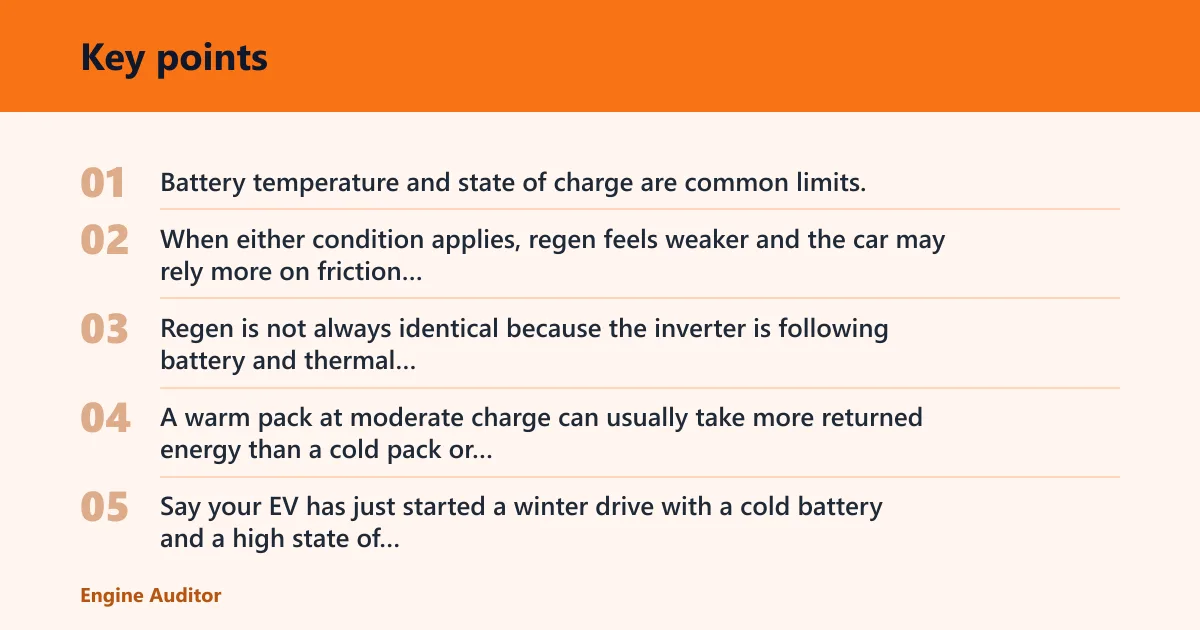
Battery temperature and state of charge are common limits. A cold battery may accept less power. A nearly full battery may also accept less. When either condition applies, regen feels weaker and the car may rely more on friction brakes.
Why regen feel changes from one drive to another
Regen is not always identical because the inverter is following battery and thermal limits in real time. A warm pack at moderate charge can usually take more returned energy than a cold pack or one near full.
Say your EV has just started a winter drive with a cold battery and a high state of charge. Lifting off the accelerator may produce only light slowing, even though the same car feels stronger regen later in the trip after the pack warms up.
What is the difference between the inverter, motor controller, and on-board charger?
The inverter and motor controller are often packaged together, and some manufacturers describe the same assembly with both terms. The on-board charger is different. It handles AC charging from a wall supply and converts that AC to DC for the battery. The traction inverter is not the charging unit for that path.
AC charging uses different hardware
Home and public AC charging go through the on-board charger. Wall power arrives as AC, then the on-board charger converts it to DC for the battery. The traction inverter is not doing that job.
DC fast charging bypasses the traction inverter
DC fast charging sends direct current to the battery through separate charging hardware, rather than through the traction inverter. The car still manages battery protection and communication, but the drive inverter does not perform the DC-to-DC charging conversion.
A common first-timer mistake is assuming the inverter “charges the battery” whenever the car is plugged in. It does not during normal AC charging. That task belongs to the on-board charger, while DC fast charging bypasses that path altogether.
What happens if an electric car inverter fails?
If the inverter fails, the car may warn you, limit power, lose regenerative braking, or refuse to drive. Some faults are partial, such as reduced acceleration or weaker regen. Others trigger a no-start condition because the traction system cannot safely deliver motor power.
Common warning signs
- Dashboard warning lights related to the drive system or power electronics
- Reduced power mode, especially under heavier throttle
- Loss of regen or unusually weak lift-off deceleration
- No-start, creep loss, or a sudden shutdown after a fault message
- Charging complaints if the vehicle detects a related high-voltage fault
Cooling faults and heat protection
Inverter cooling matters because excess heat can force protective limits even before full failure. A coolant pump issue, blocked cooling path, or high ambient heat can reduce available power. The car may still move, but not with normal response.
- Check whether the car shows a drive system warning or power limit message.
- Note whether acceleration is weaker than usual in every mode or only under load.
- Watch for regen loss, especially right after startup or after a fast charge.
- Look for charging faults that appear with inverter-related warnings.
- If the car enters reduced-power mode, arrange diagnosis before repeated driving.
What is an inverter in an electric car?
An inverter in an electric car is the high-voltage power unit that connects the DC battery to the AC drive motor. It is part converter, part controller, and part protector. Without it, the battery cannot run the motor in the way an EV needs.
How packaging differs by vehicle type
Low-cost EVs often use compact inverter designs tuned for efficiency and packaging space. Performance EVs may use higher-power-density hardware that supports stronger acceleration and sustained output. Hybrids can have different layouts again because the inverter must fit a mixed powertrain package.
Why design differences matter
Two vehicles can both have an inverter, yet feel very different. One may prioritize efficiency and compact size. Another may support repeated high-load driving. The inverter’s cooling, switching hardware, and packaging all affect that result.
Why does an EV need an inverter?
An EV needs an inverter because it lets one energy source feed another device with a different electrical requirement. The battery stores DC, the motor needs AC, and the inverter also makes propulsion controllable. It is the reason an EV can move smoothly instead of all at once.
Analogy for beginners
Think of the inverter as an electrical translator. The battery speaks one current type, while the motor prefers another. The inverter also edits the message by changing frequency and voltage, which is why the same pedal input can produce gentle creeping or strong acceleration.
What does an EV inverter do?
An EV inverter converts DC from the traction battery into AC for the motor, then reverses that flow during regenerative braking. It also controls voltage and frequency, which shapes torque, speed, and feel at the pedal. In practice, it is central to both motion and energy recovery.
Simple flow map
Driving: battery DC in, inverter converts, motor turns. Regen: motor generates AC, inverter routes energy back, battery receives DC. AC charging: wall AC goes to the on-board charger, which supplies DC to the battery without using the traction inverter as the charger.
| Mode | Component that handles the step | Energy direction and driver feel |
|---|---|---|
| Driving | Traction battery → inverter → motor | DC leaves the battery, becomes AC, and turns the wheels; the driver feels throttle response and acceleration. |
| Regenerative braking | Motor → inverter → traction battery | Motion becomes electrical energy again; the driver feels slowing when lifting off or pressing the brake lightly. |
| AC charging | Grid or wall power → on-board charger → battery | AC is converted to DC by the charger; the car gains range while parked, with no traction-motor driving involved. |
How does an EV inverter affect EV efficiency and range?
The inverter affects efficiency by controlling how much energy becomes useful motor output and how much becomes heat. Better thermal control, efficient switching, and stable voltage handling help the vehicle waste less energy. That can mean more range from the same battery capacity.
Cold weather and state of charge
Cold conditions can reduce battery acceptance and limit both drive output and regen. High state of charge can also restrict regenerative braking. In both cases, the inverter is still working, but system limits change how much power it can move.
Practical driver impact
Range can drop when the inverter and battery have to operate under less favorable conditions. Lower regen means more friction braking. Heat-related power limiting can also make repeated acceleration less efficient because the system is managing temperature rather than full output.
Is the inverter the same as the motor controller in an EV?
Not always. In many EVs, the inverter and motor controller are integrated into one high-voltage assembly or described together as power electronics. In plain terms, the inverter is the power conversion part, while the controller logic decides how to switch that power for motor control.
What the combined unit often includes
Depending on the vehicle, the assembly may include the inverter stage, control electronics, and the switching devices that drive the motor. Some manufacturers separate the names more clearly than others, but the functions are tightly linked.
Can regenerative braking work without the inverter?
No, not in a normal EV drive system. Regen depends on the motor generating AC during deceleration and the inverter converting that returned energy into DC for the battery. Without the inverter, the car would lose the controlled path needed to send energy back.
Why this matters
Regenerative braking is not a separate add-on. It depends on the same high-voltage bridge that drives the motor. If the inverter is offline or limited, regen may drop out or disappear entirely.
Frequently asked questions
Does the inverter charge the battery in an EV?
Not during normal AC charging. The on-board charger converts wall AC to DC for the battery. During regenerative braking, the inverter does route recovered energy back to the battery, but that is a drive-system function, not the same as plug-in charging.
How does the inverter affect EV efficiency and range?
The inverter affects efficiency by controlling switching losses and heat. Less loss means more energy reaches the wheels and fewer watt-hours are wasted. Battery temperature, state of charge, and thermal limits also change how much regen and drive power the inverter can support.
Products related to this article
Sponsored / affiliate links. As an Amazon Associate I earn from qualifying purchases. I may earn additional commission from eligible campaigns.