Best Car Battery Testers for Home Mechanics: We Compared
For most home mechanics, the best first buy is a 12V digital analyzer with cranking and charging tests. It separates battery wear from starter and alternator faults without extra guesswork. Pick the wrong tester, and you can replace a good battery, miss a bad alternator, or keep chasing a no-start problem.
Quick comparison
| Product | Badge | Best for | Price | ||
|---|---|---|---|---|---|
 |
AstroAI Digital Multimeter, True RMS 6000 CountsAstroAI | Our pick | Digital · 6000 Counts · Automotive | $34.99
Price as of 18 Oct 2026
|
View |
 |
UJS 2 in 1 OBD2 Scanner and 12V Battery Tester, CarUJS | Also great | 2-in-1 · OBD2 · 12V Tester | $42.99
Price as of 18 Oct 2026
|
View |
The tester you need depends on the fault. A one-car garage usually needs a 12V analyzer; a simple load tester still makes sense if you want a plain pass/fail check; and 12V/24V coverage matters only if you work on trucks or mixed fleets.
How we chose
We compared the listed tools by voltage coverage, CCA support, battery chemistry support, and whether the test flow stays readable for a home mechanic. We also weighed cranking and charging diagnostics more heavily than extras such as printer output, because those features affect diagnosis faster.
Ownership cost matters too. Clamp quality, replacement paper, battery power, and where the tool is stored all affect whether a tester stays useful after the first battery problem is solved.
Finally, the comparison favors tools that match the failure mode. A conductance-style analyzer is better when you want battery health and charging data. A load tester is better when you want a direct stress test and do not need software-style readings.
Battery test matrix decision table
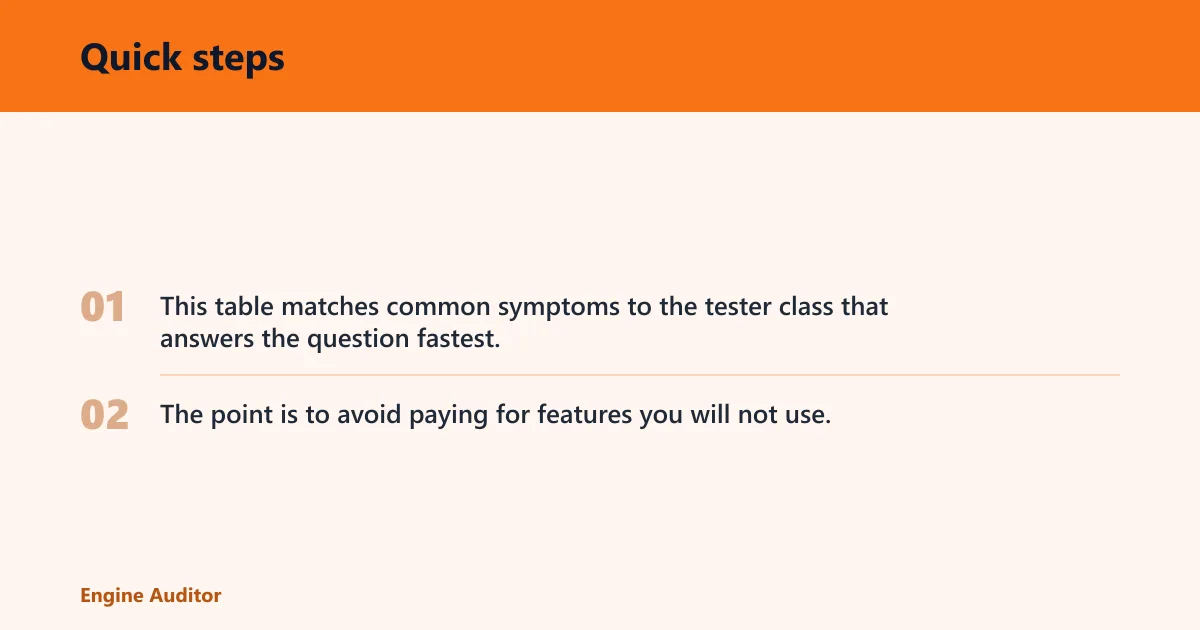
This table matches common symptoms to the tester class that answers the question fastest. The point is to avoid paying for features you will not use, or using the wrong tool and misreading a battery that only looks bad because the charging system or test setup is wrong.
| Symptom | Likely cause | Best tester type | Required voltage range | Minimum CCA support | When to skip a load test |
|---|---|---|---|---|---|
| Slow crank on a passenger car after sitting overnight | Weak battery, surface charge loss, or parasitic drain | 12V digital analyzer with cranking test | 12V | Match the battery label, commonly 100-2000 CCA | Skip only if the battery is obviously damaged or the tester cannot match the battery type or CCA rating |
| No-start with lights on but engine will not turn | Starter draw issue, loose cables, or poor battery condition | 12V load tester or analyzer with cranking test | 12V | Match the battery label, often up to 1000 CCA on simple load testers | Skip if you only need a quick battery-health verdict and do not need starter draw data |
| Battery keeps dying after short trips | Undercharging, short-trip use, or parasitic drain | 12V analyzer with charging system test | 12V | Match the battery label, commonly 100-2000 CCA | Do not skip if you need to separate charge loss from battery wear |
| Battery test says good, but the car still cranks slowly | Bad starter, bad cables, or charging fault that mimics battery failure | Analyzer with cranking and charging checks | 12V | Match the battery label | Skip only if the symptom already points clearly to a cable or starter fault and you are moving to voltage-drop checks |
| Truck or mixed-fleet electrical diagnosis | 12V or 24V system fault | 12V/24V diagnostic analyzer | 12V/24V | Follow the tester’s supported CCA range | Never skip if the vehicle is 24V; a 12V-only tester is the wrong class |
| Motorcycle or small battery storage check | Low-capacity battery, storage discharge, or sulfation | 12V tester with low-end CCA coverage | 12V | As low as the tester allows, but it must still match the battery label | Skip if the battery is too small for the tester’s minimum CCA range |
What is the best car battery tester for home use?
The best choice for most home use is a 12V digital analyzer that includes battery, cranking, and charging tests. It can sort out weak batteries from alternator faults without a separate tool. If you only need a simple pass/fail check, a load tester is cheaper and easier to understand, but it gives less detail.
For most passenger cars, 12V coverage is enough. That is also where support for flooded lead-acid, AGM, gel, and EFB batteries matters most, since the tester must match the battery chemistry before the result means anything useful.
Autel MaxiBAS BT506: best for clearer pass/fail results
This is the better fit if you want a digital-style answer that is easier to read than an analog needle tester. Based on the manufacturer’s specs and published product details, the attraction is clear: a 12V analyzer workflow that helps you sort battery condition from charging-system behavior without leaning on guesswork.
It suits a home mechanic who wants clearer results on a passenger car, especially when the question is whether the battery is weak, the charging system is off, or the starter draw looks wrong. The drawback is that a smarter interface can still be wasted if you only need a quick pass/fail check and do not want app-guided steps.
Because this class of tester depends on correct setup, you still need the battery type and CCA to match the battery label. Wrong inputs can distort the result, especially on AGM and EFB batteries or when surface charge is still present.
Do I need a load tester or a digital battery tester?
Choose a load tester if you want a direct battery-and-starter check with a simple yes-or-no result. Choose a digital analyzer if you want quicker separation of battery health, state of charge, and charging-system issues, especially when the no-start symptom is vague or intermittent.
A load tester is useful when you trust the battery label and just want to see whether the battery holds up under demand. A digital tester is better when you need more context, because it can show battery condition and charging data that a plain load test cannot.
Say your sedan starts fine after a jump, then acts weak again the next morning. A digital analyzer can help sort low state of charge from true battery wear, while a load tester mainly tells you whether the battery survives stress at that moment.
Schumacher BT-100: best for simple load testing
This is the simpler choice for home mechanics who want a plain analog workflow. The Schumacher BT-100 supports 6V and 12V batteries up to 1000 CCA, so it fits basic garage testing on older vehicles and many common passenger-car batteries.
Its strength is directness. It checks battery behavior under load and helps spot starter draw problems in a way that feels familiar to anyone who wants a needle-and-scale style diagnostic. The tradeoff is that it does not give the same SOH and SOC detail as a digital analyzer.
That means you get less help separating sulfation, partial charge, and alternator trouble. If you want fast, plain results and do not need app-based guidance, though, this style still has a place.
Can a car battery tester check the alternator too?
Yes, if the tester includes a charging system test. That matters because alternator faults can look like bad batteries, especially when the car starts after a jump but then dies again, or when voltage looks normal at rest and wrong with the engine running.
Charging tests matter because a weak alternator can leave the battery undercharged, which creates a false battery-failure story. Cranking data helps too, since starter draw problems can mimic a flat battery even when the battery itself is serviceable.
A common first-timer mistake is assuming a dead headlight means the battery has failed instead of checking the battery tester and the charging system. If charging voltage is low and the battery keeps coming back discharged, the alternator or the wiring may be the real problem.
What CCA range should a home mechanic look for?
Look for a tester whose supported CCA range matches the battery label, not just the vehicle type. For home use, a commonly supported CCA range is about 100 to 2000 CCA, and the tester’s setting should match the battery rating for the result to be meaningful.
CCA matters because the test is built around battery size. If the input is wrong, the result can drift toward false weak or false good, especially on batteries that are older, partially charged, or used in cold weather.
That is why a tester that lists 100-2000 CCA is useful on many cars, SUVs, motorcycles with appropriate batteries, and light trucks. If the battery is outside that range, the tool may not be the right match.
Are 12V-only testers enough for most cars?
For most passenger cars, a 12V battery tester is usually enough, because the vehicle system, battery, and charging checks are generally centered on 12V hardware. That is why 12V analyzers are the default choice for home mechanics.
They usually cover the battery, cranking, and charging system, and many support flooded lead-acid, AGM, gel, and EFB batteries. The limit is simple: they are not the right tool for a full 24V system.
Use a 12V/24V analyzer only when the vehicles you service need both voltages. Otherwise, 12V-only coverage is usually the better value.
What battery tester works for AGM and gel batteries?
Use a tester that explicitly lists AGM and gel support, because battery chemistry affects how the tool interprets condition. If the tester only assumes standard flooded lead-acid, the result can be misleading on newer or sealed batteries.
For home use, that usually means a 12V digital analyzer with chemistry selection. The TOPDON BT100 supports flooded, AGM, spiral, and gel battery types, which is the kind of detail you want when the battery in the car is not a plain flooded unit.
Wrong chemistry input is one of the easiest ways to get an unhelpful result. The tester may still work, but the reading is less trustworthy when the battery type does not match.
Which battery tester is easiest for beginners to read?
A digital analyzer is usually easiest for beginners because it can present a guided result such as GOOD, RECHARGE, or REPLACE. That is simpler than interpreting a needle, especially when the issue is not just battery wear but charging or cranking behavior too.
The simplest choice depends on comfort level. If you want the fewest decisions, a digital 12V tester with clear prompts wins. If you prefer a mechanical reading and do not mind slower interpretation, a load tester stays viable.
State of Health and State of Charge help here. SOH tells you the battery’s condition, while SOC helps you separate low charge from actual battery wear, which is useful when a vehicle has sat for weeks or has short-trip use.
Do I need a printer on a home battery tester?
Usually no. A printer is more useful for shop records, fleet work, or warranty documentation than for a one-car garage. Home mechanics normally care about the diagnosis itself, not a paper trail.
Printouts can still help if you are tracking a recurring fault, comparing before-and-after results after charging, or documenting a battery that keeps failing under warranty. But that is occasional value, not a must-have feature.
The SOLAR BA327 provides a printout straight from the machine, and the TOPDON BT600 has a built-in printer. Those are useful features, but they add cost and bulk that many home users do not need.
OBDMONSTER BM550: best for 6V, 12V, and 24V coverage
This is the broader-coverage option in the supplied lineup. The OBDMONSTER BM550 works on 6V, 12V, and 24V batteries, and it checks the battery, charging system, and starting system, which makes it a fit for mixed vehicle needs rather than only passenger cars.
It is most useful if you work on different voltage platforms and want one tester to move between them. The drawback is that this class can be more tool than a simple home garage needs, especially if you only own a 12V car and want basic diagnosis.
Buy this style only if the 24V capability is truly relevant. A 12V-only tester cannot be assumed to cover a 24V system, and that distinction matters more than extra menu items.
Can I use a battery tester on a motorcycle battery?
Yes, if the tester’s supported CCA range can handle the motorcycle battery and the battery is still a 12V unit. The important part is not vehicle type, but whether the tester can read the battery size accurately and whether the clamps or leads fit safely.
Many motorcycle batteries are smaller than car batteries, so the tester’s minimum CCA matters. If the tester starts too high, the result may be unreliable or the tool may simply not be appropriate.
Storage batteries also fail from sitting. In that case, low state of charge or sulfation can look like battery death, which is why a proper charge and retest is often more useful than one fast reading.
How accurate are cheap car battery testers?
Cheap testers can be good enough for a basic decision, but accuracy drops if you choose the wrong battery type, enter the wrong CCA, or test immediately after charging when surface charge is still present. The tool is only as good as the setup.
Cheap does not automatically mean useless. It does mean you should expect narrower guidance and more dependence on correct inputs. If the battery is sulfated, the alternator is weak, or the vehicle has parasitic drain, a low-cost tester can still point in the right direction, but it should not be treated like a lab instrument.
Suppose a compact car battery is rated at 550 CCA and you enter 750 CCA by mistake. The result can shift enough to suggest a problem that is not really there, which is why matching the label matters more than chasing a bigger feature list.
Which one should you buy?
Buy the 12V analyzer if you want the best all-around home tool. It is the strongest fit for most passenger cars because it can handle battery, cranking, and charging checks in one workflow, and it gives more context than a plain load test.
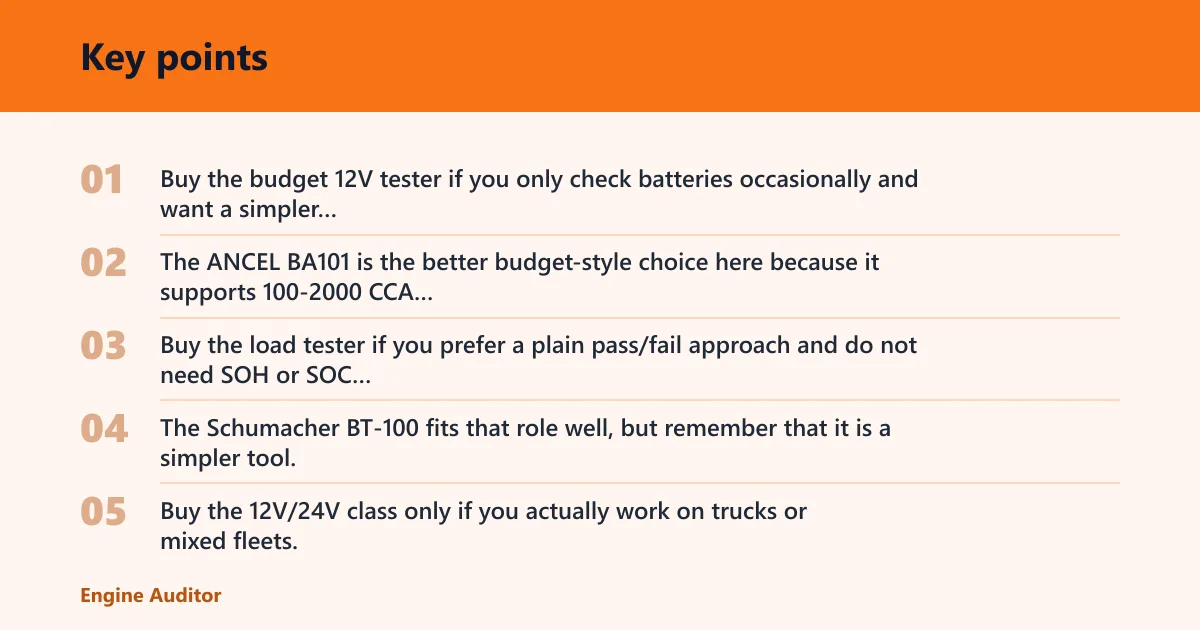
Buy the budget 12V tester if you only check batteries occasionally and want a simpler tool. The ANCEL BA101 is the better budget-style choice here because it supports 100-2000 CCA batteries and includes cranking and charging tests, which covers the most common home-diagnosis jobs without stepping into truck territory.
Buy the load tester if you prefer a plain pass/fail approach and do not need SOH or SOC readouts. The Schumacher BT-100 fits that role well, but remember that it is a simpler tool, not a broader diagnostic analyzer.
Buy the 12V/24V class only if you actually work on trucks or mixed fleets. The FOXWELL BT705 supports 12V/24V vehicles with 100-2000 CCA, and the TOPDON BT600 and TOPDON BT200 both cover 12V and 24V batteries, but that broader range is unnecessary for a single 12V car.
ANCEL BA101: best budget 12V pick
This is the right budget pick for one-car owners who want routine battery checks without paying for fleet features.
Its main value is that it covers the core checks a home mechanic actually needs. The drawback is that it stays in the 12V lane, so you should not buy it thinking it will handle a 24V system or replace a broader mixed-vehicle analyzer.
Before buying, verify that your battery falls within the supported CCA range and that you are working with a 12V passenger car battery. That keeps the result tied to the battery you actually have.
How to choose
- Start with the vehicle voltage. If you only own 12V cars, a 12V tester is usually enough. If you service trucks or mixed fleets, step up to a 12V/24V analyzer.
- Match the CCA setting to the battery label. Common support runs from 100-2000 CCA, but the tester must agree with the battery for the reading to matter.
- Check the battery chemistry list. Flooded lead-acid, AGM, gel, and EFB are not interchangeable in every tester.
- Pick the test style that answers your question. Use load testing for plain pass/fail checks. Use digital analysis when you need SOH, SOC, cranking, and charging data.
- Ignore the printer unless you truly need records. For most home mechanics, it is extra cost, extra bulk, and extra upkeep.
Picture a 2014 sedan that cranks slowly after sitting all week. A 12V analyzer can help separate low charge from battery wear, then move to charging checks if the result points away from the battery itself.
Suppose a pickup with a 24V starting system needs diagnosis. A 12V-only tester is the wrong class, even if it looks feature-rich. The voltage range matters more than the menu.
Products related to this article
Sponsored / affiliate links. As an Amazon Associate I earn from qualifying purchases. I may earn additional commission from eligible campaigns.