How Cold Is Too Cold for Your Engine Oil to Flow Properly?
For many modern cars with the correct winter-viscosity oil, temperatures around 0°F (-18°C) are usually normal. Below about -20°F (-29°C), oil may become thick enough to move more slowly, especially with 10W or thicker grades. Too-thick oil can mean slow cranking, delayed oil pressure, and extra wear during startup. This guide explains the temperature limits, warning signs, and the oil grades that cope best in deep cold.
Why pour point matters for winter cold start performance
There is no single cutoff where every engine oil fails. The practical line depends on the oil’s winter grade, the engine’s design, where it was parked, and how cold the sump actually is, not just the outside air. For many drivers, the problem starts when cranking slows, the oil light stays on too long, or top-end noise hangs around.
What “too cold” means in practice
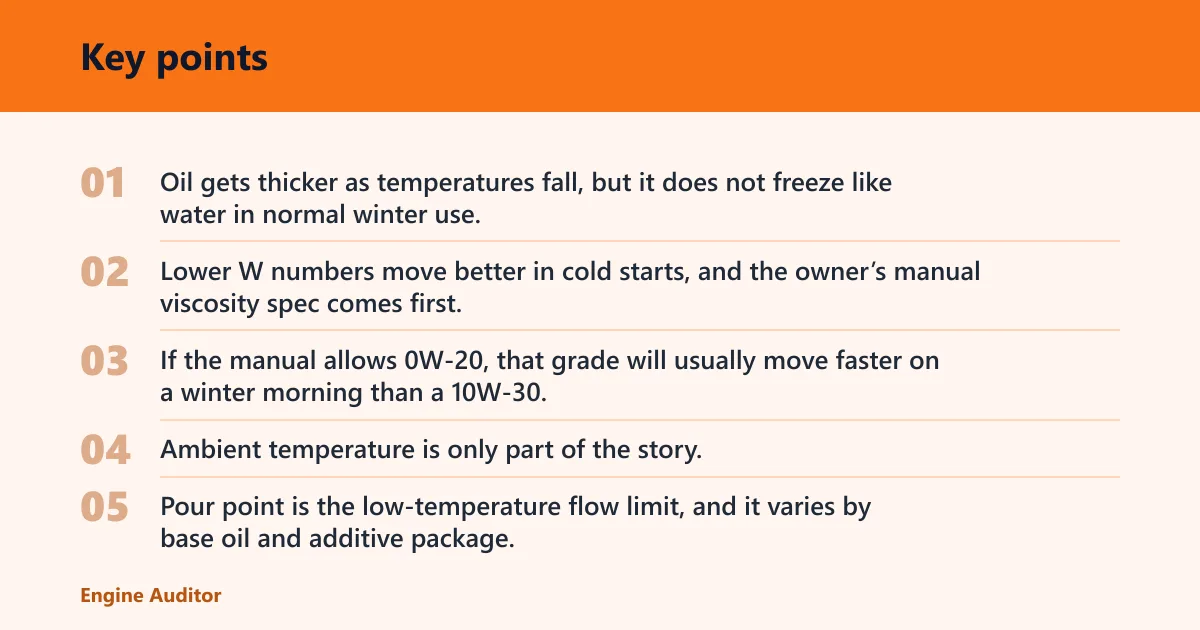
Oil gets thicker as temperatures fall, but it does not freeze like water in normal winter use. Lower W numbers move better in cold starts, and the owner’s manual viscosity spec comes first. If the manual allows 0W-20, that grade will usually move faster on a winter morning than a 10W-30.
Ambient temperature is only part of the story. A car parked outside overnight can have cold oil throughout the sump, while a garage-kept engine may still start with oil that is much easier to move. That is why the same oil can feel fine at one start and sluggish at another.
What happens to oil as temperatures drop
As oil cools, its viscosity rises. Pour point is the low-temperature flow limit, and it varies by base oil and additive package. It is a flow limit, not a true freezing point. Long before oil stops moving, it can become thick enough to slow circulation and delay pressure at startup.
Most engines aim for oil temperatures around 180 to 210 degrees Fahrenheit. Cold oil increases startup wear because it moves more slowly through galleries, lifters, and the upper valve train. Hot oil has the opposite problem: it can thin too much, which is why proper operating temperature matters too.
What is normal on a cold start?
A healthy engine can build main-bearing oil pressure in 1-3 seconds after startup. The upper valve train may take longer than the main bearings to receive oil, so a brief tick or light clatter can be normal. A healthy start should not produce a long warning-light delay, heavy knocking, or noise that grows worse.
Oil-pressure light timing
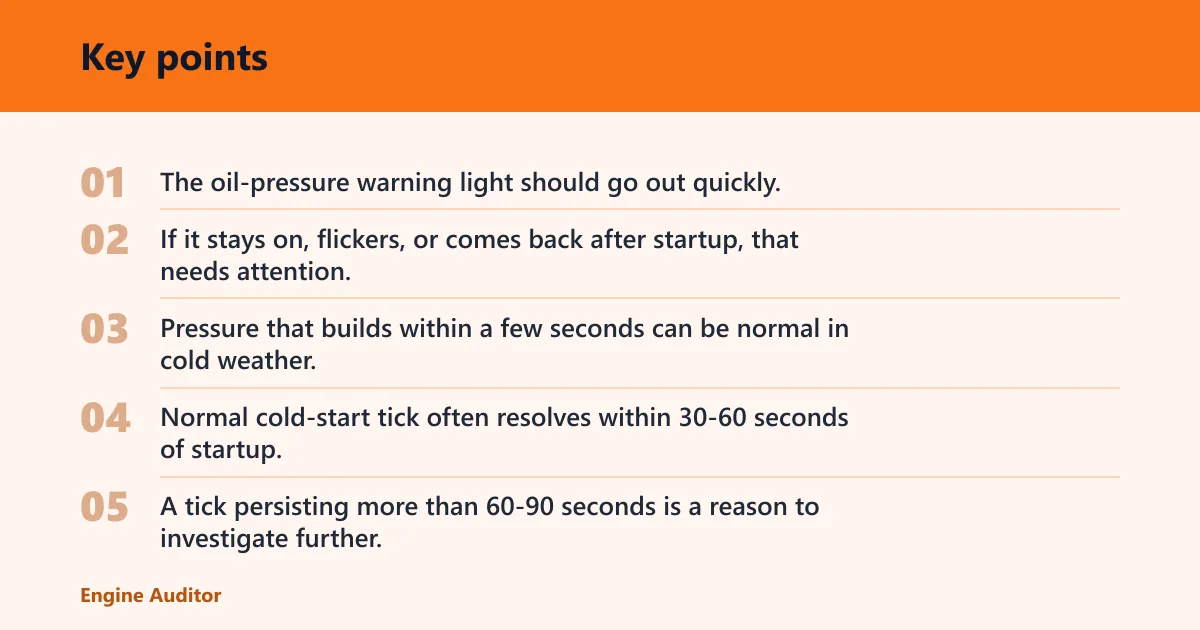
The oil-pressure warning light should go out quickly. If it stays on, flickers, or comes back after startup, that needs attention. A brief delay can happen in cold weather, but a light that lingers beyond the normal startup window is a sign to stop guessing and check the cause.
Think in time windows. Pressure that builds within a few seconds can be normal in cold weather. Pressure that takes much longer, or never fully stabilizes, moves the situation from “cold morning behavior” to “possible lubrication problem.”
Brief lifter and valvetrain tick
Hydraulic lifters and the valve train can tick during the first seconds after startup because they depend on oil pressure. Normal cold-start tick often resolves within 30-60 seconds of startup. A tick persisting more than 60-90 seconds is a reason to investigate further.
That pattern matters because brief noise and persistent noise do not mean the same thing. A short-lived tick can be oil filling the top end. A steady or worsening tick can point to low oil level, very thick oil, a dirty pickup, a sticking lifter, or a problem that needs inspection.
Say your sedan has 5W-30, sat outside at 0°F, and starts with a light tick that fades after 20 seconds. That fits normal cold-start behavior. Suppose the same car keeps ticking for two minutes and the oil light stays on for several extra seconds; that is a different case and needs attention.
Cold oil decision table
Use this table as a practical winter guide. It does not replace the owner’s manual, but it helps separate normal cold-start behavior from oil that is flowing too slowly for safe startup.
| Temperature range | Likely flow risk | Common symptoms | What to do next |
|---|---|---|---|
| Above 0°F (-18°C) | Low for the correct winter grade | Short tick, brief delay in oil light extinguish | Start normally. Follow the manual spec and watch for noise that lasts longer than 60-90 seconds. |
| 0°F to -20°F (-18°C to -29°C) | Moderate, especially with 10W or thicker oil | Slower cranking, longer pressure build, upper-valvetrain tick | Prefer the lowest W grade the manual allows. If symptoms are mild and brief, monitor; if they linger, inspect oil level and condition. |
| Below -20°F (-29°C) | High for many conventional oils | Very slow cranking, delayed oil light, stronger top-end noise | Use the winter grade specified by the manual, often 0W or 5W. If the engine sounds rough or the light stays on, avoid repeated starts until the cause is checked. |
| Near the oil’s pour-point limit | Very high | Cranking strain, little visible oil-pressure response, persistent ticking | Do not keep cycling the starter. Warm the vehicle or environment if possible, then reassess with the correct oil grade. |
What oil viscosity should you run in winter?
The best winter viscosity is the one in the owner’s manual that fits your minimum temperature. Lower W numbers move better in cold starts, and that matters because cold-start wear happens before the oil reaches the top end. A 5W-30 flows significantly faster at 20°F than a 10W-30, and a 0W-20 flows faster still in cold conditions.
How to read 0W, 5W, and 10W
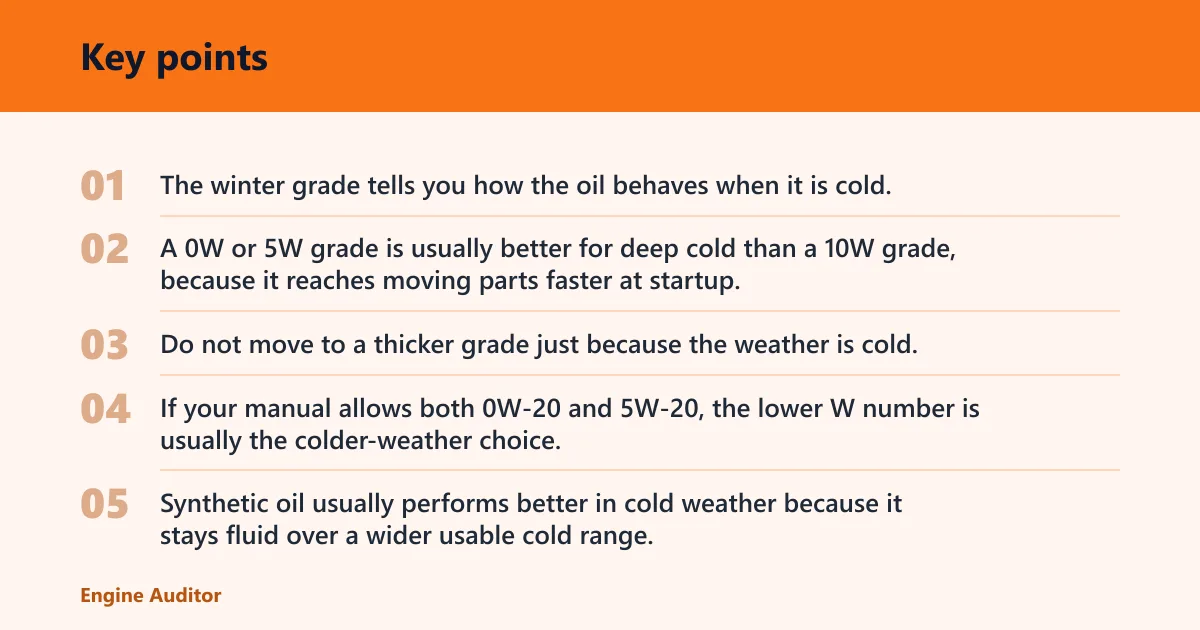
The winter grade tells you how the oil behaves when it is cold. A 0W or 5W grade is usually better for deep cold than a 10W grade, because it reaches moving parts faster at startup. That does not mean thinner is always better; it means you should stay within the approved range first.
Do not move to a thicker grade just because the weather is cold. Thicker oil can slow circulation and can make startup harder, especially when ambient temperature is already below the oil’s intended winter rating. If your manual allows both 0W-20 and 5W-20, the lower W number is usually the colder-weather choice.
Is synthetic oil better for cold starts?
Synthetic oil usually performs better in cold weather because it stays fluid over a wider usable cold range. Synthetic oils usually remain fluid down to about -40°F (-40°C) or lower. That makes them a strong choice for winter use, especially where overnight temperatures sit well below freezing.
Conventional oil thickens sooner in cold weather and may flow poorly below roughly -20°F to -30°F. That does not mean it is wrong for every climate, but it can be a poor match for deep winter. Synthetic is not a cure for every startup issue, yet it often gives the engine a better chance of building pressure quickly.
When a thicker grade is the wrong fix
Using 10W-40 instead of 5W-30 in winter is usually the wrong move unless the manual explicitly allows it. A thicker grade can slow cold-start flow, delay pressure, and make top-end noise worse. If the engine is noisy in winter, the answer is often a colder-weather grade, not a heavier one.
A common first-timer mistake is to quiet a tick by moving to thicker oil before checking the manual. That can hide the symptom while making cold flow worse. The safer order is manual first, local minimum temperatures second, then the approved winter grade.
Why some engines feel cold oil first
Some engine types show cold-start symptoms sooner than others. Turbocharged engines can punish delayed oil flow because the turbo bearings depend on oil quickly. Direct-injection engines may also make startup noise more noticeable. High-mileage engines can show more tick if clearances have opened up or seals have aged.
Turbochargers and direct injection
Turbochargers spin fast and need prompt lubrication. If oil is very thick, the turbo may receive oil later than the main bearings, which can make startup feel rougher. Direct-injection engines can also be sensitive to cold oil because their operating patterns often make short noise events easier to hear.
That does not mean these engines are defective. It means a slow-flowing oil grade, low oil level, or delayed pressure can show up earlier in the sound profile. Brief noise may still be normal; persistent noise is the divider.
High-mileage engines and seal wear
Older engines with more wear may have larger internal clearances, and that can increase cold-start noise. Low oil level makes the problem worse. If the dipstick is low, cold oil has less reserve, and pressure at the top end may take longer to stabilize.
Oil cooler thermostats or bypass valves also matter. These parts keep cold oil circulating inside the engine by routing around the cooler until oil temperature rises. That helps warm oil faster and balances startup wear protection with heat rejection once the engine is hot.
Picture a pickup with 10W-30 parked overnight at -25°F. It cranks slowly, the oil light stays on longer than usual, and a lifter tick lasts nearly two minutes. That combination points to oil that is too thick for the morning, not to a normal short-lived startup sound.
When should you worry about cold-start oil flow?
Worry when the symptom window stretches past normal cold-start behavior. A healthy engine can build main-bearing oil pressure in 1-3 seconds, and a short tick can clear in 30-60 seconds. If the pressure light stays on, the noise lasts more than 60-90 seconds, or cranking becomes unusually slow, you should investigate.
Red-flag symptoms
- Oil-pressure light stays on after startup instead of going out quickly.
- Tick, knock, or clatter continues more than 60-90 seconds.
- Cranking is slow enough that the starter sounds strained.
- Noise gets louder with rpm instead of fading as oil circulates.
- The engine is low on oil or the dipstick reading is uncertain.
If any of those happen together, do not treat it as ordinary winter noise. The issue may be viscosity, low oil level, degraded oil, a clogged pickup, or another lubrication fault. A warning light or persistent noise deserves a real inspection, not another cold start.
What to check before the next start
-
Check the oil level.
Make sure the dipstick is within the safe range before another start. Low oil can delay pressure and increase top-end noise. -
Confirm the viscosity grade.
Compare the bottle and the manual. If the current oil is outside the approved winter range, plan a change rather than a guess. -
Look for warning lights.
A lingering oil-pressure light is a stop sign, not a normal winter quirk. Start only after the cause is understood. -
Listen for persistence.
Brief ticking can be normal. Noise that stays beyond 60-90 seconds, or returns on every cold start, needs diagnosis.
Frequently asked questions
How cold is too cold for engine oil to flow properly?
For many vehicles, the practical trouble zone begins below about -20°F (-29°C), especially with 10W or thicker oil. That is not a universal failure point, but it is where conventional oils may thicken enough to slow cranking, delay pressure, and extend startup noise beyond the normal window.
At what temperature does engine oil get too thick to circulate?
Oil can start to become noticeably thick below -20°F (-29°C), and conventional oils may start thickening around -20°F to -30°F. Synthetic oils usually stay usable longer in the cold. The exact point depends on the oil’s base stock, additives, and the engine’s actual sump temperature.
What oil viscosity is best for cold weather driving?
The best winter viscosity is the one in the owner’s manual that matches your coldest expected conditions. In general, 0W and 5W grades move better in winter than 10W grades. If the manual allows a lower winter grade, that is usually the better cold-start choice.
Can I use 10W-40 instead of 5W-30 in winter?
Usually no, unless your owner’s manual explicitly allows it. A 10W-40 grade is generally thicker at startup than 5W-30, so it may slow cold flow and delay pressure. In winter, the safer choice is normally the lowest W number the manual approves for your temperatures.
Why does my engine tick only when it’s cold?
Cold-start tick often comes from delayed oil circulation to the upper valve train or hydraulic lifters. That noise commonly fades within 30-60 seconds. If it lasts more than 60-90 seconds, keeps returning, or is paired with a warning light, the engine needs closer inspection.
When should I worry about oil pressure on a cold start?
Worry if the oil-pressure light stays on, returns after startup, or if the engine takes much longer than 1-3 seconds to build pressure in a healthy state. A brief delay can be normal in cold weather. A persistent light or repeated delay is not something to ignore.
Does engine oil freeze in cold weather?
Engine oil does not freeze like water under normal winter conditions. It thickens as temperatures drop, and that thickening is what slows flow. Pour point is the low-temperature flow limit, and it varies by oil type and additive package, so the oil can become hard to move long before it solidifies.
How long should oil take to reach the top end after startup?
There is no exact stopwatch for every engine, but a healthy engine can build main-bearing oil pressure in 1-3 seconds after startup. The upper valve train may take longer. A brief tick for 30-60 seconds can be normal; a tick beyond 60-90 seconds deserves attention.
How do engine oils behave differently in extreme cold versus extreme heat?
In extreme cold, oil thickens, cranking slows, and circulation can lag. In extreme heat, oil can thin too much and lose some film strength. Most engines are designed to run with oil around 180 to 210 degrees Fahrenheit, which is why both cold-start flow and hot running viscosity matter.
Texaco Lubricants (uk)
For any brand, including Texaco Lubricants in the UK, the same winter rules apply: follow the owner’s manual, choose the correct SAE winter grade, and match the oil to local minimum temperatures. Brand name matters less than the approved viscosity and the oil’s low-temperature behavior.
How temperature affects engine oil performance
Temperature changes oil viscosity, pressure build time, and how fast the top end receives lubrication. Cold oil flows more slowly and can produce brief startup noise; hot oil can thin and protect less well if the grade is wrong. The right winter viscosity keeps the engine within its intended operating range.
Products related to this article
Sponsored / affiliate links. As an Amazon Associate I earn from qualifying purchases. I may earn additional commission from eligible campaigns.
 DongJinK Engine Oil Level Gage Dipstick Compatible with Toyota 4Runner 1984-1995 for Toyota Celica 1984-1985 for Toyota Pickup 1984-1995 Replace# 15301-35020 1530135020
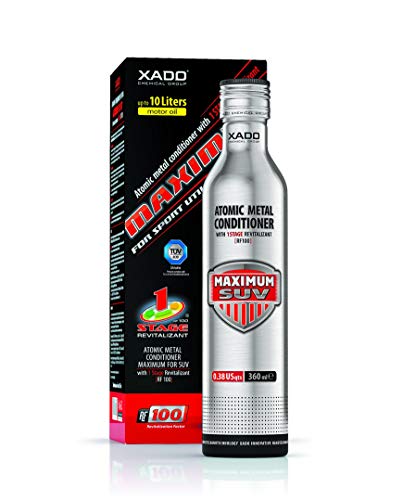 XADO Engine Oil additive - Protection for Engines - additive for wear Protection & rebuilding of Worn Metal Surfaces - Metal Conditioner w. Revitalizant 1Stage Maximum SUV (up to 10qt of Oil Capacity)